A: Around
Sandwiched between the ocean and the military base.

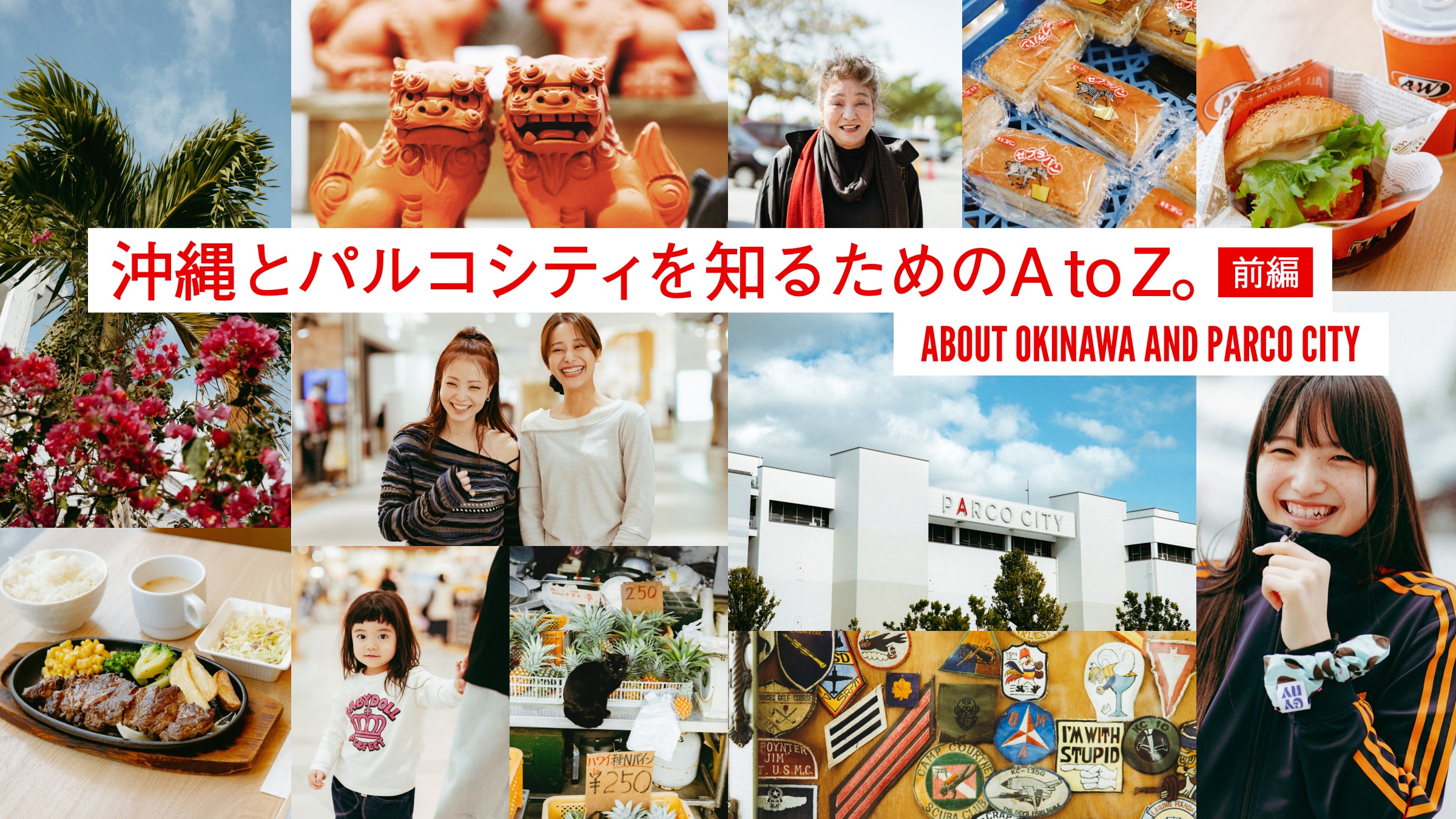
First, you’ll want to know where “Parco City” is located. It’s about a 20-minute drive north from the airport and downtown Naha, situated in the Urasoe West Coast redevelopment area. One of its distinctive features is the view of the blue East China Sea stretching out before you, with Camp Kinzer, a U.S. military facility, situated behind it. Additionally, its location along National Route 58—a major thoroughfare—makes it easy to naturally incorporate into your itinerary, whether at the start or end of your trip. The white buildings stand out beautifully against the blue sky.
B: Base
Is California right behind the building!?
If you look behind the “Parco City” parking lot, you’ll see Camp Kinzer, a U.S. Marine Corps base, stretching out before you. Administratively, its address is not Okinawa, Japan, but California, USA. Looking around the camp, you can see U.S. Marines playing basketball or going for runs, and on their days off, they enjoy barbecues. In 2026, the facility will be open to the public on Saturday, June 13, and Sunday, June 14, allowing anyone to shop or eat there. You don’t have to go through the trouble of flying for over 10 hours—you can experience a taste of America right here.
c: Churakaagi
“There are a lot of ”Churakagi.”
Phrases like “Nankuru nai sa” and “Menso-re” have a certain ring to them that puts even “Ichaa” (people from the mainland) at ease. The title, “Churakaagi,” means “beautiful woman.” It doesn’t simply refer to physical beauty; the term encompasses various nuances, such as a bright expression, a friendly demeanor, and an effortless charm. From the staff working inside the facility to the local ladies and grandmothers out on the streets, the place is full of “churakagi,” and I can’t help but find myself drawn to them.
D: Dollar
A foreign land is right next door.
In areas near U.S. military bases, it’s common to see prices listed in both dollars and yen. The history of businesses that started by catering to U.S. servicemen still leaves a strong imprint on the area. Tailors and restaurants in the Koza district of central Okinawa, in particular, frequently displayed prices in dollars. Currency exchange shops can also be found standing alone on ordinary streets. Of course, you can pay in yen when shopping at “Parco City.”
E: Embroidery
Locals, tourists, and U.S. soldiers alike. A beloved embroidery shop that’s been around since 1935.
“Authentic American culture” in Okinawa is found not in theme parks or tourist spots, but in independent shops. “Crazy Store,” a long-established embroidery shop near Kadena Air Base, has served as a hub for a tradition dating back to before the war, where U.S. servicemen would bring in jackets and bags to have them custom embroidered. That tradition continues to this day, and it’s said that there are still a few U.S. servicemen among the customers.
Embroidery costs 350 yen for 1 centimeter (1–5 characters) and 320 yen per character for 3 centimeters. If it’s not peak season, it can sometimes be done in about 30 minutes, so be sure to stop by while you’re sightseeing. There are also many U.S. military personnel at "San-A Parco City," so feel free to take a quick peek at their embroidery for inspiration—just be sure to do so respectfully.
Shop Info
Address: 4-1-2 Chuo, Okinawa City, Okinawa Prefecture
Hours: 10:00 AM–6:00 PM (Last admission at 5:15 PM)
Phone number: 098-937-6916
Instagram:@crazy_store37
Official Site
f: Food Hall
Enjoy Okinawan specialties while taking in the ocean view!
The most popular spot at "Parco City" is the food hall on the second floor, which is always bustling with locals, tourists, and military personnel. There are two main reasons people gather there. First is the view. Through the large windows, you can gaze out at the blue ocean stretching into the distance and enjoy everything from the sparkling sea during the day to the sunset over the water.
Combo Set (The A&W Burger + Superfly + Root Beer) ¥1,350
Another highlight is the lineup of shops in the food hall. It features “A&W,” a local Okinawan fast-food chain, and “Steakhouse 88 Jr.,” a favorite among locals. You absolutely must try A&W’s root beer—known for its slightly medicinal taste—and their curly fries, and you can’t miss the lean cuts of meat at Steakhouse 88 Jr.
There’s no other place in the prefecture where Okinawa’s two culinary giants are located right next to each other. Plus, since this is a food hall, if you go with a few friends and share your meals, you can enjoy both at once.
Junior Tenderloin Steak (200g) ¥2,800
By the way, “Steak House 88 Jr.” is part of the same chain as “Steak House 88,” and you’ll find both types of restaurants side by side on Kokusai Street. The main differences lie in the quality of the meat and the prices. The Jr. version is designed with the local crowd in mind and is more budget-friendly. "When ordering, we recommend you try it as rare as possible," says Mr. Kishimoto, manager of the San-A Parco City branch.
Shop Info
Address: Sanei Urasoe Nishikigai Parco City, 2nd Floor, Green Zone
Hours: 10:00 AM–10:00 PM (Last order at 9:30 PM)
Phone number: 098-975-5502
Store Page
Shop Info
Address: Sanei Urasoe Nishikigai Parco City, 2nd Floor, Green Zone
Hours: 10:00 AM–10:00 PM (Last order at 9:30 PM)
Phone number: 098-894-8801
Store Page
g: Gift
You might be able to find all your souvenirs right here.
Classic Shisa figurines are a great choice, as are Yachimun pottery and Ryukyu glass. When it comes to food, Chinsuko cookies are a hit, and brown sugar and salt are also popular gifts.
Okinawa offers a wider variety of souvenirs than any other prefecture, and there are plenty of them right on the island. However, hopping from store to store in search of them can be quite a hassle and time-consuming. That’s where “Parco City” comes in. You can find everything you need in one place!
First, I’d like to explain the “San-A” part of “San-A Parco City.” For residents of Okinawa, it’s the name of an indispensable supermarket chain with locations all over the city. Simply put, “San-A Parco City” is a facility that combines that supermarket with “Parco.”
Located on the first floor, "San-A Food Hall" is a popular spot among locals, offering a wide variety of items ranging from vegetables to meat and fish. It also stocks local snacks and foods that you won't find even in the airport souvenir shops.
The editorial team selected six items, starting from the left in the photo: “Nakayoshi Pan,” a bread that every resident of the prefecture has tasted; “Pochigi,” a breakfast staple; dried Okinawa soba noodles; unique local sweets such as “Ume-Kogame” and “Kokuto”; and a shopping bag with a pulley.
Looking at the list, I get the impression there are a lot of green and red packages—whether by chance or not. Is this a characteristic of tropical regions, or simply the editorial team’s personal preference?
Adjacent to the Food Hall, “Okinawa Takarajima” offers a wide selection of souvenirs and folk crafts made with local ingredients. While there are unique Okinawan food-themed keychains available, our editorial staff chose Okiham’s Taco Rice Nuts and “Jimmy’s” cookies—a classic among Okinawan Western-style sweets. A great feature of both is that they come in individual small bags, making them easy to share at work or school.
While bustling, famous streets are nice, you can’t go wrong buying souvenirs at a well-curated shop that locals actually use in their daily lives.
Shop Info
Address: 1st Floor, Orange Zone, San-A Urasoe Nishikigai Parco City
Hours: 9:00 AM–11:00 PM
Phone number: 098-871-1120
Store Page
Shop Info
Address: 1st Floor, Orange Zone, San-A Urasoe Nishikigai Parco City
Business hours: 10:00-22:00
Phone number: 098-988-4513
Store Page
indecent: Hip-hop
A city where hip-hop has taken root.
From Awitch to Spit-Ki, the list of hip-hop stars hailing from Okinawa is endless. *RASEN* was amazing, and OZworld and CHICO CARLITO’s *Yae LIT* was a brilliant fusion of Okinawan identity and hip-hop.
So, why does this culture exist? It’s widely believed that the influence of U.S. military personnel plays a major role. Black music and related subcultures have been imported directly from the U.S. for a long time, and they’ve taken root here more deeply than on the Japanese mainland. Even just walking around town, you’ll see graphics everywhere, along with plenty of stickers plastered all over the place. Walking around with an eye out for these is one of the joys of sightseeing in Okinawa.
I: Ichariba Chode
Even if it’s our first meeting, we feel like family right away.
“Ichariba Chode” is an Okinawan phrase that means something like “Once we meet, we’re all family.” Whether it’s the Okinawan spirit or a tradition dating back to the Ryukyu Kingdom era, everyone here is kind and warm-hearted.
Whether it’s the people having a drink in the shopping district or the ladies I met at the community center, they all welcome me as if we’ve met countless times before. Even in large-scale facilities like “Parco City,” you can still feel that warmth. It’s amazing that even in commercial spaces, which tend to become homogenized, the unique warmth of the local people remains. That regional character is surely one of the reasons Okinawa is so beloved.
J: Juicy
A personal taste test of various juices.
Whether at supermarkets, convenience stores, bento shops, or Okinawa soba restaurants, you’ll find “Jūshī” everywhere in the prefecture. It’s not “Juicy,” but rather "Jūshii" . This Okinawan-style seasoned rice is truly a staple of daily life here, and you can’t say you’ve truly visited Okinawa without trying it. Our reporting team fell in love with it during our stay, and at the airport on our way home, we even tried comparing different kinds of "Jūshii"!
Starting from the top left of the photo: The rice ball from “Chuo Mart” has a high moisture content and a rich flavor, while the “jushi” in the bento from “Ryubo” supermarket has a strong burdock root flavor and a light, refreshing taste. "Uema Tempura Shop" has a lower water content and pairs perfectly with soups. Skipping one, "FamilyMart" offered a punchy, well-defined rice ball with a distinct flavor profile—just like you’d expect from a convenience store.
I’ve tried a variety of options at different stores, but the “Juushi” at the “San-A Food Hall” in Parco City is a well-balanced choice that lets the rich broth flavor unfold with every bite—it works just as well as the star of the show or a supporting player. Honestly, you can’t go wrong with any of them!
k: Kitatani?
It’s not pronounced “Kitatan” even though it’s written as “北谷.”
Okinawa Prefecture is a treasure trove of hard-to-read place names. Even Chatan—a place tourists often mistakenly read as “Kitatan”—is indecipherable at first glance, despite being written with simple kanji characters. The correct pronunciation is “Chatan.” “Cha” for “north” and “tan” for “valley.” Other examples include Nakijin, Onna, Kunigami, and Kin, while Kyan and Zukeran are considered advanced-level challenges.
"Parco City" is located in Urasoe City, but it is pronounced "Urasoe," not "Urazoe."
l: Local Market
Experience the authentic Okinawa vibe at Ishijaya Yuntaku Market.
This isn’t unique to Okinawa; in any city, the further you venture away from the urban center, the more vividly you’ll experience the local way of life. Experiencing this firsthand is one of the true joys of travel, so while you’re sure to spend time at the big shopping malls, I hope you’ll also make a point of visiting a local market at least once.
Located in Kin Town, a 30-minute drive from "Parco City," the "Ishija Yuntaku Market" is the perfect place to get a glimpse of local life. Housed in rustic huts that look like they could be found in Southeast Asia, the market features locally grown vegetables, recycled goods, and American imports that are hard to find on the main island.
Not only was the selection impressive, but when I visited for a story, the elderly woman at the booth offered me a seasonal tankan orange, saying, “Here, have a bite,” and shared some croquettes with me—it was a truly warm and welcoming atmosphere.
Experience the sophisticated side of Okinawa at "Parco City," then get a taste of authentic Okinawa at the market. This back-and-forth will surely add more depth to your trip.
Mega: Mega Shop
So many huge stores!
With approximately 250 stores, it is one of the largest retail complexes in Okinawa Prefecture. In addition, the Uniqlo store here is one of the largest in the prefecture, and the GU store is also massive. Even if you find yourself short on something while traveling, you can find everything you need right here.
Shop Info
Address: 3F, Orange Zone, San-A Urasoe Nishikigai Parco City
Business hours: 10:00-22:00
Phone number: 050-3093-1687
Store Page
Shop Info
Address: Sanei Urasoe Nishikigai Parco City, 2nd Floor, Green Zone
Business hours: 10:00-22:00
Phone number: 050-3096-6839
Store Page