PROFILE

His distinctive works, which capture the essence of their subjects through simple, monochromatic lines, have earned him high acclaim both in Japan and abroad. He is active in a wide range of fields, including advertising, book design, and brand collaborations.
RICOH GR IV ¥194,800
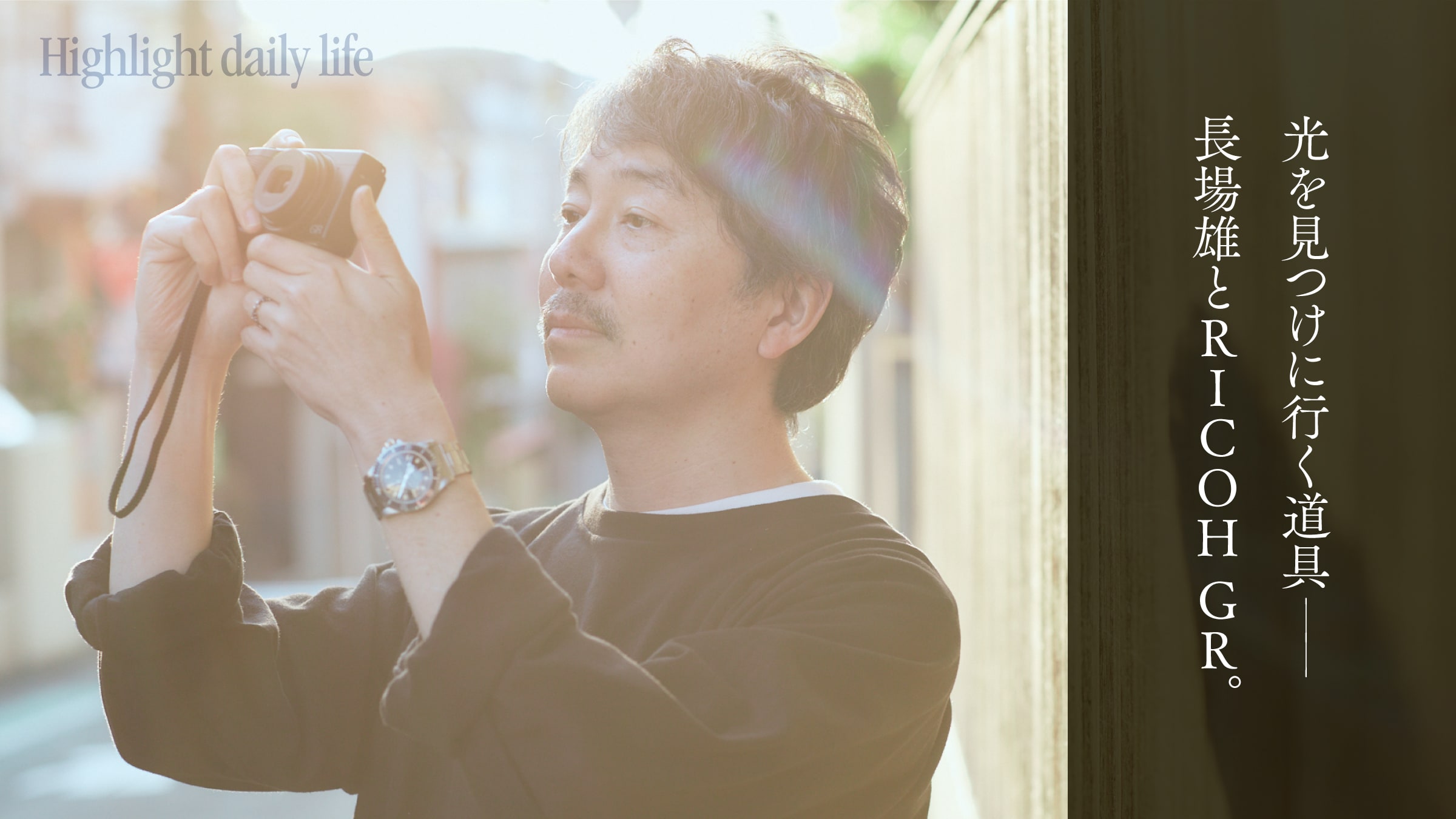
The GR series, which began with the film-based GR1 in 1996, celebrates its 30th anniversary this year. While inheriting the philosophy of being the “ultimate snapshot camera”—a legacy refined through generations of the GR series—this model features a completely redesigned image sensor and image processing engine. With its pocket-sized portability, agility born of its compactness, speed from startup to shutter release, and the ability to transform everyday scenes into dramatic moments, the GR offers a unique appeal found in no other camera.
I first encountered the GR 20 years ago.
── (Looking at the photos Mr. Nagaba took) So you went to the Donald Judd exhibition, too. Do you like contemporary art?
I’m actually quite fond of art and go to exhibitions often. I think it’s pretty interesting to start by focusing on the cuteness of a piece or that gut-level reaction it gives you, and then delve deeper to uncover the context behind it. It’s kind of like there’s a connection with objects. Maybe it’s about starting with “cute” and then digging deeper from there.
── It’s kind of like fashion, isn’t it? While the quality of the item itself matters, you also decide whether to wear it based on the brand’s history and context.
Shoes and watches might be the most obvious examples. Even though it feels like a hassle, maybe it’s just one of those games where you enjoy the little details like that.
── Are there any items you own, Mr. Nagaba, that offer the pleasure of learning about their background through the object itself?
I think the same goes for glasses. Since they sit right in the center of your face, they really change your whole look. I have all kinds of different pairs and switch them up depending on my mood, but right now I’m really into a style called “Frame France”—French-made glasses from the 1940s and ’50s. This was before the era of brands from production centers like Sabae in Japan. They’re made from acetate that can’t be produced today, and the designs from that time were often quite eccentric. But it’s interesting that some of them still have designs that work today, so I’ve been collecting them a bit lately.
── When you go shopping, do you usually do your research first?
It’s not that I don’t do any research, but I don’t go that far. For example, if I’m looking for vintage glasses, I might hear that “that shop has them,” get curious, and just buy a pair to try. I get information by talking to the staff, and then I start looking into things from there. I guess I just end up thinking about it after I’ve already bought them.
── Do you ever buy things that are recommended by the store or the people around you?
That happens all the time. I get curious, give it a try, and if I like it, I stick with it; if not, oh well. In the end, I’ve found that asking other people is the best approach. If someone whose tastes align with mine recommends something, I feel confident that it’s a safe bet.
── What about the "RICOH GR"?
It’s been about 20 years since I first got my hands on one. I remember buying either the GR DIGITAL II or the GR DIGITAL III right before a trip to Europe, after a friend who was a graphic designer recommended it to me, saying, “It’s portable and easy to use.” Back then, smartphones didn’t exist yet, so it was standard practice to carry both a digital camera and a cell phone. It was a time when film photography was gradually fading away and people were starting to buy digital cameras.
── Did you keep using it after that?
I used it a lot during that trip and for a while afterward, but I gradually stopped using it. Then I bought a digital SLR, but it was so heavy that I ended up not taking any pictures with it. I felt like I had to “get it just right,” so I’d get all worked up about it, and it actually took some courage to just snap a photo.
── And there’s the reaction from those around us, too.
Oh, right. After that, I bought a compact film camera. It was great, but the film was so expensive that I couldn’t just snap away casually, so I ended up using it less and less. I also bought an instant camera. I’m a fan of the photographer William Eggleston, and since he had published a photo book featuring shots taken with an instant camera, that’s what inspired me.