PROFILE
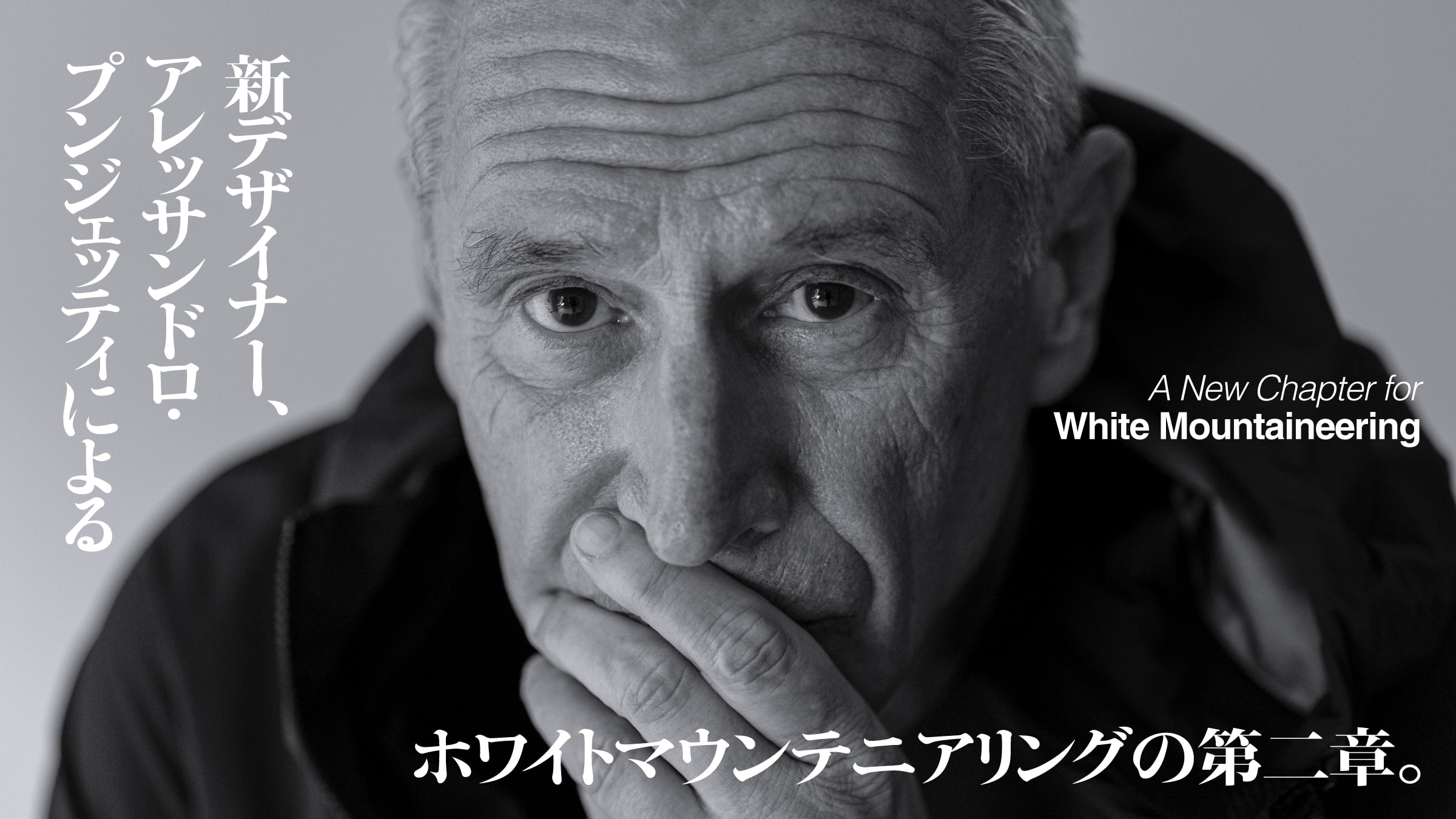
Born in Bologna in 1956. After studying at an art school, he moved to Paris and, upon returning to Italy, began his career in the fashion industry. He has been involved in the creative direction of various brands, including and , and in 2009, he co-founded with Paul Harvey, with whom he had previously worked at . He currently serves as Art Director and Head Designer at and as Head Fashion Designer at . Starting with the 27AW season, he assumed the role of Head Designer and Creative Director at .
—How often do you visit Japan?
I think I've been here at least 10 times. My first visit was about 40 years ago. I've only ever been to Tokyo, though.
—Please tell us your impressions of Japanese fashion brands.
I’ve always been interested in Japanese brands. Forty years ago, when I was living in Paris, I saw the first presentation by *COMME des GARÇONS* and felt that there was something truly new there. Then there’s Junya Watanabe. It’s well known that he’s extraordinary, so there’s nothing in particular I need to add. More recently, Tenshi and sacai collaborated. The designer, Chitose Abe, is a former member of COMME des GARÇONS, isn’t she? She brings a completely different perspective and has successfully fused military and workwear styles with fashion. I think it’s truly wonderful.
—Are there any designers who have influenced you?
That’s a tough question. However, Massimo Osti’s contributions to sportswear have undoubtedly had a major influence on my career. The same goes for Junya Watanabe. His determination to bring the perspective of sportswear into the world of fashion was incredibly significant. And then there’s Martin Margiela. That’s because his rigor has always been exceptionally strong. His approach to products is more artistic. I think it’s safe to say that these three individuals have served as my guiding lights.
Paul Harvey, who is also a friend of mine, is in a league of his own. We worked together at *Stone Island* 30 years ago and then again at *Tensy*, so that goes without saying, right?

—I imagine you’re always working on multiple projects at once. How do you switch gears?
Since I’ve created numerous collections for many brands over the years, it’s not difficult for me to align myself with each one. Also, naturally, each brand is following a completely different path. 〈CP Company〉 has a contemporary vision aimed at a younger generation. On the other hand, conducts research on materials and silhouettes and targets people who appreciate that aesthetic—in other words, a more professional demographic. The color palettes are also different. Because each brand’s direction is so clearly defined, it’s very easy to get down to business. I can decide without hesitation on the materials, colors, silhouettes, and overall image for each collection.
—Please share your honest first impression when you heard about the *White Mountaineering* project.
At first, I was very surprised, and then I gave it some serious thought. It was a very strange situation—one I’d never experienced before—because it meant stepping out of my comfort zone, out of my own world. However, I had been keeping an eye on *White Mountaineering* for quite some time. That’s because they have a unique perspective, which I found extremely intriguing. For me, this is a once-in-a-lifetime opportunity, and I find the fusion of Italian and Japanese cultures incredibly appealing. I want to pour my skills and experience into this project and challenge myself to see just how close I can get to a new world that’s unfamiliar to me.
Of course, I fully understand that this is a very difficult challenge. However, I’m not undertaking this as a reckless venture. I’m doing it precisely because I’m confident that it will lead to positive results. But to make this opportunity a reality, we need to fuse the Italian perspective on sportswear with the complexity of Japanese research and work as one with the *White Mountainering* team.
I first saw the collection seven years ago. What particularly impressed me were the videos created five or six years ago. One was filmed in the mountains (21AW) and the other on a hill (22SS). They had a unique atmosphere, and I thought they were wonderful creations. The products themselves are wonderful, too, but I was impressed by something else entirely.
Fall/Winter 2021
2022 SPRING/SUMMER
What I found particularly fascinating was how the project fused the functional aspects of the outdoor world with urban elements. I’m not a big fan of the term “fashion,” but unlike most outdoor products, this wasn’t static—it was driven by thorough research, fresh ideas, and a determination to create something innovative. For example, the specific color palette and provocative approach were very intriguing, and I felt it was a truly unique and original project. It definitely set itself apart from others working in the same field. As everyone knows, people in the outdoor industry tend to specialize in technical aspects. However, this project was truly original.
—What’s something you’d like to try that’s different from what *White Mountaineering* has done so far?
There are various possibilities. For example, it could involve dyeing, or completely different techniques—such as an approach reminiscent of the world of photography—or the use of colors never seen before. And of course, there’s also influence from the world of military wear, which is where I started. However, rather than simply recreating it as-is, I’ll update it by incorporating functionality. I intend to build on what already exists and infuse it with my vision. That said, it should remain within the realm of the outdoors. It’s not sports. These two are completely different.
—Given your diverse background, I imagine you have many areas of expertise. I think knitwear is one of them—what kind of knitwear do you plan to create at *White Mountaineering*?
That’s right. I have a long history with knitwear. I spent 12 years creating knitwear at *Stone Island*, where I developed new types of sports knitwear that hadn’t existed before. What I want to create isn’t just what you’d call “classic” knitwear. For example, I print the exact knit pattern used in mountaineering sweaters directly onto polyester knit fabric. At the same time, I’d also like to start creating hand-knitted pieces—which require some of the world’s most skilled craftsmanship—in the future. This creates two completely different images: one is traditional and authentic knitwear, while the other is modern and innovative.
We have a vast archive of knitwear in the office. Some of it consists of knitwear I designed, while other pieces are for research purposes. The same goes for our other categories: military clothing I’ve collected from around the world, garments that have personally caught my interest, and technical apparel, among others.
—Please tell us more about fabric processing and dyeing, which is another area of expertise for you.
I think we’ll continue to draw on the traditions of *White Mountaineering*—such as using functional materials like “GORE-TEX”—while also applying techniques like low-temperature dyeing. Low-temperature dyeing is a technique in which the dye does not penetrate completely into the fibers but remains only on the surface. By applying multiple layers of dye to materials that have been used in the past, we aim to transform them, give them a unique character, and breathe new life into them.
—What kind of proportions and silhouettes do you plan to create at *White Mountaineering*?
Naturally, this will mark a departure from the silhouettes I’ve worked on so far. I think the silhouettes will feature a more relaxed outline with a sense of volume that’s deliberately not too structured. They might even be closer to what people think of as streetwear. I like wider-leg bottoms, but I might also mix things up. What I’m envisioning right now is a collection built on contrasts. For example, hand-knitted sweaters paired with printed knits, or wide-leg pants paired with sportier, slim-fit pants. I think these contrasts will create an interesting interplay.
—What is the thought process involved in designing?
In many cases, our inspiration comes from the world of military wear and technical details, but rather than using them solely for the functionality they were originally intended for, we apply them with a completely different interpretation. We transform items originally made purely for military use into clothing you’ll want to wear every day. It’s crucial to draw inspiration from the military and incorporate it into a new, different context. Simply using “GORE-TEX” to create a field jacket with an outdoor twist is too predictable. Instead, we incorporate only a few elements into the outdoor concept—for example, using just one pocket and eliminating stitching. Even this alone transforms the garment into something entirely different. We then adjust the sizing and fit to introduce a new interpretation. Above all, it’s crucial to contribute to the brand’s vision without compromising what it has built so far.
—Please tell us about the concepts and philosophy you value most when creating things.
It means that the products and collections I create are designed to be worn for a long time. While it’s important for them to be modern and suited to the current era, they must also stand the test of time. If a jacket has technical features, it should be made according to the rules of those features—it shouldn’t be created solely for the sake of visual appeal. Even if a pair of pants has an unconventional shape, they need to be durable. In other words, they should be functional while also being personal to the wearer. I like people who wear the things they love for a very long time. In that sense, decorative designs run the risk of becoming tiresome. Even if they look beautiful at first glance, there’s a chance they’ll grow tiresome over time.
—Original textiles and black. How do you view these two elements that have defined *White Mountaineering*?
I believe our original fabrics should continue to be a core part of our identity. We’re currently working on bringing that vision to life. Also, since black is my favorite color, it will continue to feature prominently. I think the collection’s color palette will lean toward warm tones. In addition to colors inspired by nature, military-inspired hues would be nice, too.
—Many Japanese brands are beautiful and have a solid foundation. There are also many talented designers. Given that, what will be *White Mountaineering*’s key strength as it competes in this market?
It’s all about pursuing originality to the fullest. It’s about maintaining the brand’s strengths and building projects that are distinctive and unlike anything else out there. That was exactly the strength I felt when I watched the *White Mountainering* video. That impact and that worldview were everything. I want to preserve that. So, even while operating within the realm defined as “outdoor,” I want to maintain a perspective that’s completely different from others and create something that truly resonates with the needs of urban dwellers.
For the time being, this will be a transitional collection—marking the shift from the previous designer’s *White Mountaineering* to the *White Mountaineering* I’m now involved with.
I incorporate my own perspective—specifically, elements drawn from the worlds of workwear and military fashion—into the brand’s inherent, traditional, and distinct characteristics. However, all of these are expressed through the unique lens of *White Mountaineering*. It is a collection that has been filtered and reinterpreted.
—Finally, please tell us about your enthusiasm for taking on this new project.
I am very fortunate because life gives me opportunities to take on challenges. The various projects I work on—each and every one of them—serve as fuel for me, and building them gives me tremendous energy. It’s important to keep a vision in mind as I think about these projects—what will happen next, and what tomorrow will bring. The work we’re currently undertaking will take shape a year from now. You, the readers of this article, may not usually think about such things, but we’re always looking a year ahead. We’re constantly looking toward tomorrow. Please look forward to the future of *White Mountainering*.