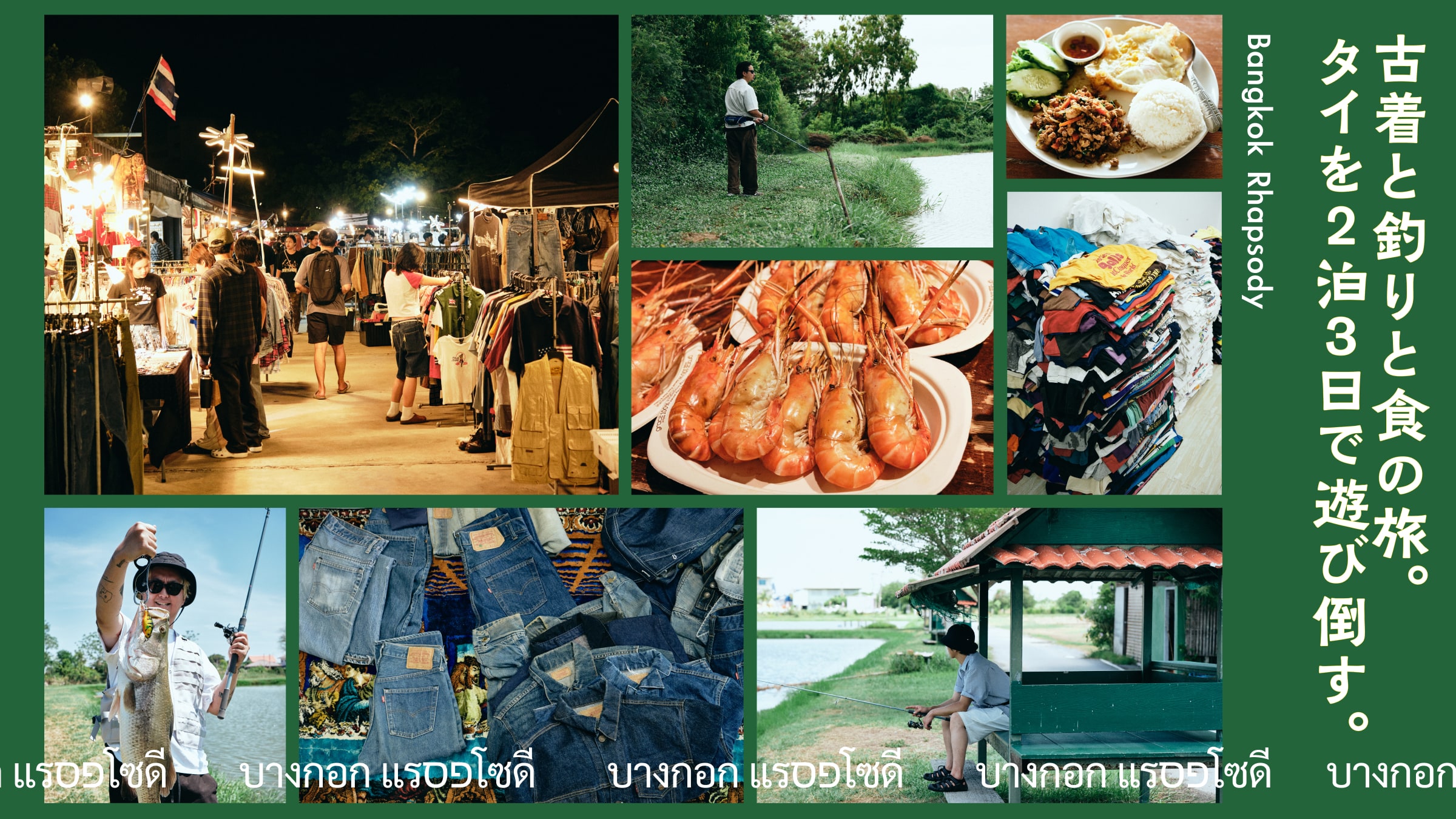
A Thai Journey to Enjoy with All Five Senses.

In recent years, due to the weak yen and rising prices, it seems that more and more vintage clothing stores are sourcing their merchandise from Thailand rather than the United States. Just how many great vintage finds can you actually come across in Bangkok these days? We went on a fact-finding mission with two vintage store owners who have a keen eye for style.
Another goal of this trip is to experience activities unique to the region. Escaping the hustle and bustle of Bangkok, we’ll head to a managed fishing pond in the peaceful suburbs to target the elusive fish that anglers dream of catching. It offers a peaceful yet exciting experience—a refreshing change from city life. This contrast is sure to make your travel memories even more vivid.
While both the city and nature have their own unique charms, one thing that was indispensable during both parts of my trip was the local cuisine. From classic national dishes to foods that are less familiar in Japan, I feasted on a variety of exquisite delicacies. Experiencing the local food culture is one of the true joys of travel.
After a flight of about seven hours, I landed at Suvarnabhumi International Airport, the gateway to Bangkok. The temperature was 35°C. It was just the start of the rainy season, so the humidity was high, and the thick, hot, and humid air made me realize I had truly arrived in Thailand. Filled with anticipation, I set out into the streets of Bangkok.
Yosuke Ishii (right)
Senior Editor, Huynh Nam
Fuinam Fishing
Club President. “I covered Bangkok’s vintage clothing scene eight years ago. Back then, I was able to find great items at affordable prices, but I’m curious to see how things are now. Since I only know Bangkok, it feels refreshing to go fishing at a leisurely pace in an area a little further out. I’m going to make the most of this three-day, two-night trip.”
Yasutaka Saizu (left)
Owner, ARMS Clothing Store
He runs “Arms Clothing Store,” a popular vintage clothing shop with locations in Yutenji and Aoyama. “I’ve been sourcing merchandise in the U.S. up until now, but I came to Thailand in May to do some research and see what the scene is like here. I wasn’t able to see everything back then, so I’m looking forward to visiting various markets this time. I’m also hoping to catch some rare fish that you can’t find in Japan.”
Ryu Ito (center right)
GOOD THING / INCVN Vintage Owner
He operates the hair salon “Good Thing” in Gobongi, Kitasando, and Daikanyama. In January of this year, we opened the vintage clothing store “INCVN” in Gohonmaki. “I’m curious to see how many of the ‘Good Regulars’—the kind of items we carry in our own store—will be available. It’s been about eight years since I last went fishing, so I don’t have much experience, but this is a rare opportunity to catch a huge fish. I’ve been really looking forward to it.”
Shogo Komatsu (center left)
writer
I mainly write for fashion magazines and online publications. “I’ve heard that Bangkok has a well-established vintage clothing culture, but how does it differ from Japan’s? Are there any hidden gems to be found, and are the prices reasonable? I have so many questions. I’m also looking forward to visiting that rumored managed fishing pond I’ve heard about from a friend. Since I eat Thai food often, I’m eager to savor the authentic flavors.”
Fumihiko Ikemoto
photographer
He’s active in magazines, on the web, and in advertising, and also handles outdoor photography. “I’ve often heard that Thailand’s vintage clothing scene has been booming in recent years, but I didn’t really have a clear picture of what it was like. I also didn’t know that managed fishing spots were popular, so it looks like I’ll get to experience a new side of Thailand’s charm. It seems you can catch some big ones there, so I’m determined to catch one no matter what.”
Contents
Diggin’ Vintage
Researching Bangkok's vintage clothing scene.
If you’re looking to buy vintage clothing in Bangkok, rather than finding shops scattered around the city as you would in Japan, most are located within shopping centers or markets. Since you can check out a variety of vintage shops all at once, this means less travel—a definite plus for travelers. Given that Thailand is hot year-round, T-shirts and shirts are the main items sold everywhere. There are huge piles of T-shirts priced at around 100 THB each (as of July 2026, 1 THB = 4.9 yen), but is there a valuable piece hidden among them?
This time, we visited the “Red Building,” which houses shops selling vintage clothing and antiques across five floors, and the “Green Vintage Night Market,” where vintage clothing stores line the streets. We were also given special access to a vintage clothing dealer’s warehouse, which is normally off-limits to anyone but buyers.
Numerous stores that reflect the growing popularity of vintage clothing.
The “Red Building” is one of Bangkok’s largest shopping centers specializing in vintage goods. In addition to vintage clothing, it’s home to a variety of shops selling furniture, home goods, and other items. The top floor features a food court, and the building is so well-equipped that you can easily spend an entire day there. Across the street is Bangkok’s largest market, the “Chatuchak Weekend Market.” Since it’s also lined with a huge number of vintage clothing stores, if you’re visiting the “Red Building” on the weekend, you’ll want to check it out as well.
Vintage clothing from a wide variety of genres is crammed into every available space—so much so that it’s impossible to thoroughly check everything in a single day. And above all, you need to be on the lookout for bootlegs sold at prices indistinguishable from genuine items. You must carefully inspect the texture of the prints, the stitching, and the tags.
"Game.VTG" specializes in T-shirts from the '90s, including those by Nike. In true Y2K style, many of the designs had a tech-inspired look. A Nike T-shirt featuring the oval logo is priced at 850 THB. The store carries a selection of items that are likely to see their prices rise even further in the future.
Next to it was a long row of *Stussy* items from the ’80s and ’90s. There were many young people wearing *Stussy* around town, which showed just how popular the brand is. Aside from the items displayed on the wall, prices ranged from 3,000 to 6,000 THB, giving the impression that they’re slightly cheaper here than in Japan.
Just like T-shirts, denim pants are sold in large quantities at a wide variety of stores. For example, a pair of Levi’s 501s from around the ’90s cost around 2,500 to 3,000 THB, which wasn’t much different from the price of vintage clothing in Japan.
Harley-Davidson T-shirts, which are very popular in Japan, seem to be a hit in Thailand as well. I even found them for sale at a store that mainly carries anime and band T-shirts. The one pictured here costs 1,200 THB—just a little cheaper than in Japan.
Soccer is a hugely popular national sport in Thailand. Old jerseys have recently gained value as vintage clothing, and there were several specialty stores selling them inside the “Red Building.” A West Ham United FC jersey—sponsored by Dr. Martens—was priced at 5,990 THB.
Although they are few and far between, stores specializing in true vintage items seem to be popping up here and there in recent years. At “OldFriend,” tracker jackets and coveralls—items you’d rarely have a chance to wear in Thailand’s tropical climate—are lined up in rows, highlighting the presence of people who simply enjoy vintage fashion. As for pricing, it’s pretty much on par with Japanese standards. For example, a 1960s Levi’s BIG E Third Type in suede is priced at 14,500 THB.
Just like the specialty stores for true vintage items, I discovered a store specializing in outdoor brands—something that wasn’t very common in Bangkok in the past. In particular, it carries an extensive selection of Patagonia products, with a wide range of fleece items such as the “Synchilla Fleece Jacket” and “Synchilla Snap-T.” A 1993 *Patagonia* “Nuevo Range Coat” is priced at 20,000 THB.
A night market lined with a wide variety of vintage clothing stores.
As the sun sets and the temperature cools, the night markets come alive. For Thais, night markets are not just places to shop, but also places to eat at food stalls and spend time with friends and family.
The “Green Vintage Night Market” is one of Bangkok’s largest vintage clothing markets. Located in a residential area about 10 km north of downtown Bangkok, it stands out for its strong local vibe, attracting many young locals. In addition to vintage clothing, there are many booths selling collector’s items such as figurines, used books, and cameras. If you get a little hungry, be sure to try some street food at the food stalls.
There are two types of vendors: permanent tenants and outdoor booths. Since outdoor booths can operate as one-day pop-up stands, you might just stumble upon a vendor that’s only there for that day. One thing to watch out for here is bootleg merchandise. They’re often displayed right out in the open, so be careful not to loosen the purse strings too easily.
The outdoor booths feature a wide and eclectic selection, so you might have a hard time finding just the right item. Since the shops are spread out across a vast area equivalent to four soccer fields, we recommend moving briskly from one to the next.
The ever-popular “Detroit Jacket” from Carhartt is priced at 7,500 THB.
There was also a booth featuring a wide selection of Japanese anime T-shirts. While the selection focused mainly on recent titles like *Dragon Ball Super* and *Jujutsu Kaisen 0: The Movie*, I spotted a retro *Pokémon* T-shirt among them. It was reasonably priced at 1,800 THB.
Specialty eyewear stores also carry brands such as and . The pair shown in the photo costs 3,000 THB, but it’s not in very good condition.
A vintage bandana with a small maple leaf emblem costs 1,000 THB. From the stack of bandanas piled flat, a Bob Marley bandana is 150 THB. A Tokyo Disneyland bandana is 180 THB. They’d make great souvenirs.
A T-shirt featuring the 12 zodiac signs from the skateboarding magazine *Thrasher*, designed with a quirky sense of fun, costs 1,000 THB. Komatsu bought it as a gift for a friend.
By the way, there are also booths selling cards, and it seems they cater not only to vintage items but also to modern collectibles. Prices tend to be higher than in Japan.
A lineup only a dealer can offer.
Not content with just browsing shops and markets, we ventured further to the sourcing locations behind the scenes. We went behind the scenes at two vintage clothing dealers that are normally off-limits to anyone but buyers. Both locations cater to customers from overseas, including Japanese visitors. We were given a peek at the kinds of items they carry.
The first stop is “Lever Bull Up.” The owner, Mr. Hige, has about eight years of experience running a vintage clothing store in Tokyo, so his eye for quality is unquestionable. He had been traveling to Thailand regularly for about four years to source merchandise, but reportedly moved to Thailand last year and established a vintage clothing business there.
Unlike shops and markets where thin fabrics like T-shirts were the main draw, “Lever Bull Up” offers a wide range of other items as well, thanks to the Japanese buyers who visit the store. The store is lined with a wide selection of items that enjoy solid popularity, such as military-style clothing and denim.
The lineup includes many brands from Europe and Australia. The reason for this is that Thailand serves as a distribution hub. Apparently, vintage clothing exported from Europe and Australia to Southeast Asia all converges in Thailand. If you’re looking for that kind of vintage clothing, Thailand might be a quicker option than the United States.
From a dealer’s perspective, I decided to ask Mr. Hige about Thailand’s vintage clothing scene.
"Picking out only the best items in Thailand might feel a little pricey. If you focus mainly on buying cheap T-shirts in bulk, I think there’s still a lot of potential. Prices for used clothing have gone up about 25% since the first time I came to Thailand. In terms of purchase price alone, it can sometimes be cheaper in the U.S. But since the cost of living is higher in the U.S., your overall expenses end up being higher. In that regard, Thailand lets you keep airfare, shipping costs, and lodging expenses lower.”
"If you're buying vintage clothes for yourself rather than for resale, I think the night market is a great place to find some real gems. You might even be able to get vintage items for a little less than in Japan. However, since the pricing is a bit unique, there are actually quite a few vintage items that are more expensive than in Japan."
At the second store we visited, “EXIT VINTAGE,” they mainly carry T-shirts. I’m told they’re visited by buyers from various countries, ranging from Japan, South Korea, and China in Asia all the way to Australia. The shop is run by Mr. Tae. He told me he started the wholesale business about three years ago after a friend in Japan asked him to source vintage clothing to help open a vintage clothing store.
"We mainly carry single-stitch T-shirts that were popular until the early '90s. We generally source them from Pakistan and receive about 10,000 pieces every month. However, there are times when we can't get them, so in those cases, we buy them domestically in Thailand."
The CDs are stacked flat by price and arranged on shelves by genre. I decided to see what gems might be buried among that overwhelming volume of CDs.
Apparently, T-shirts featuring musicians and movies are still very popular. Ishii hesitated until the very end over which of the popular animal T-shirts—featuring large illustrations of animals—to buy as souvenirs, but ultimately purchased two from Car Graphic.
"Band T-shirts and Harley-Davidson items are consistently popular. The trends in the designs we source vary slightly from country to country. Japan is where these changes show up the fastest, followed by South Korea and China. The Australian buyers who come to our store are a different story. It’s almost like they’re selling at a flea market—they buy up massive quantities of cheap T-shirts, prioritizing low price over brand or design. With the increasing number of inquiries from overseas, I’m realizing every day just how much attention Thailand’s vintage clothing scene is attracting.”
Depending on what you're looking for, you can get great deals.
After checking out various shops and markets, I found that vintage clothing prices have skyrocketed compared to when I covered the scene for Fuinam eight years ago. There’s little difference from market prices in Japan, and I got the impression that Thailand’s vintage scene has fully matured. It might be difficult to head to Thailand in hopes of striking it rich.
However, since there’s a huge selection of inexpensive regular items, it’s definitely worth picking some up as souvenirs at the night market while you’re traveling. Also, if you happen to come across that vintage piece you’ve been dreaming of, you might be able to get it for a little less than in Japan, so you’ll want to keep your eyes peeled so you don’t miss the opportunity. I’ve found that rather than visiting solely for vintage clothing, it’s best to combine it with other activities.
Play Fishin’
An Encounter with Exotic Fish.
Foreign cities are full of excitement, but if you want to enjoy your trip in a more laid-back way, why not leave the city behind and spend some time fishing in a peaceful area? Just a short trip from Bangkok, you’ll find experiences you can’t have in Japan. It feels great to relax and cast your line, get excited by a sudden bite, and be amazed by an encounter with an unknown, mysterious fish. Even though it’s called “mysterious fish fishing,” it’s at a managed fishing pond, so anyone can give it a try.
It was 4:00 a.m. With the lingering atmosphere of the night still hanging over the city behind us, we drove for about an hour. We arrived at “Pilot 111.” Surrounded by farmland and industrial zones, the open sky stretches out in a way that’s unique to flat terrain. This is Thailand’s premier managed fishing spot for catching exotic fish. Located about a 40-minute drive from Suvarnabhumi International Airport, it attracts anglers from overseas who come to chase their dreams.
The exotic fish you can catch here include barramundi, Asian redtail catfish, Mekong giant catfish, chado, and tilapia. Just hearing their names, it’s hard to imagine what they look like—they’re all fish that are unfamiliar in Japan.
I assembled the “Swagger” pack rod I’d stashed in my bag and got ready to cast. The first cast of the morning is the crucial moment.
Then, Mr. Saizu got a bite on his very first cast.
I caught a barramundi right away. But it was still a juvenile. The barramundi caught here are much, much bigger. Still, the fact that I caught one so quickly has me feeling hopeful.
After a while, Komatsu caught a barramundi, too.
It’s grown a bit, but it’s still on the small side. Still, its distinctive small face and ruggedly handsome features—with its eyes and mouth close together—are really cool. Its large mouth, typical of a predatory fish, is also a major attraction. I wonder just how impressive it will look once it grows even bigger.
The barramundi bears a striking resemblance to the red-eyed snapper, a large endemic species known as one of Japan’s “Three Great Mysterious Fish.” The barramundi belongs to the family Serranidae within the order Perciformes, and until not too long ago, it was apparently considered the same species. Akame can only be caught in Kochi and Miyazaki, but catching them is incredibly difficult—so much so that some people go year after year without ever landing one. Taking on the challenge of catching Akame requires both skill and determination, but here you can catch barramundi and casually enjoy the thrill of battling this “mysterious fish.”
And since it’s a managed fishing area, you can take on the mysterious fish in your everyday clothes—that’s another big plus. Without any special preparation, you can experience the thrill of an escape from the ordinary right in the middle of your trip. Everyone is wearing the new apparel series from DAIWA, which debuted this year: “DAIWA 247 (DAIWA 247)〉, which debuted this year. Even amid today’s dramatic climate changes, the line offers all-weather apparel designed for comfort whether you’re in the city or out in the great outdoors.
The shirt Mr. Saizu is wearing is the “DOT AIR SS SHIRT.” It features Toray’s functional fabric “DOT AIR®️,” which has microscopic ventilation holes throughout the fabric, making it a garment that offers excellent breathability and stretch. With ventilation panels on the back, it stays comfortable even in Thailand’s hot and humid climate. It also has a water-repellent finish, providing peace of mind when out in the field.
Underneath, he was wearing a T-shirt created in collaboration with “Gallery Tsukigime” in Gakugei-daigaku, Tokyo. It features artwork by illustrator Koji Yaobita, who continues to create illustrations centered on fishing, particularly bass fishing. The design depicts a Bandwagon heading out to fish before dawn, accompanied by the message “SHOW MUST GO ON TO BE NEXT STAGE”—a design that stirs the romantic spirit of anglers.
Komatsu is wearing the “DOT AIR SS SUCKER SHIRT” and “BASIC SHORTS.” The “DOT AIR SS SUCKER SHIRT” is made from “DOT AIR®️” woven into a textured seersucker fabric. Like the “DOT AIR SS SHIRT,” it features a convenient functional detail: a cleaning cloth for wiping sunglasses on the inside of the hem. The “BASIC SHORTS” stay dry to the touch even when you sweat, preventing stickiness and ensuring a comfortable fit.
The shoulder bag that Ishii loves is a collaboration between and . It’s made of cotton-like nylon canvas fabric with a water-repellent finish. Its size is perfect for holding a standard lure case, making it ideal for everyday use.
The “COMBI-UP VEST” that Ishii and Ikemoto are layering is sure to come in handy whether you’re fishing or out on the town. It features the “Combi-Up System”—a technology found in fishing apparel—that allows it to integrate seamlessly with a compatible jacket. At , it can be docked with the “PERTEX COMBI UP SHELL JACKET,” allowing you to wear the jacket and vest together without them shifting out of place. You can also attach a separately sold pouch to expand your storage capacity.
Mr. Ito is wearing the “PERTEX PCS JACKET.” The high-performance “PERTEX® EQUILIBRIUM” fabric features a unique double-weave structure with an eco-friendly water-repellent finish. Crafted with a two-layer structure using fabrics of different densities on the outer and inner surfaces, it is designed to block wind while allowing moisture to escape easily. It is also lightweight yet durable. Its packable design makes it a versatile piece for both urban and outdoor settings.
The "GORE-TEX WINDSTOPPER HAT," designed to block strong sunlight, features a durable 75-denier recycled polyester outer fabric and incorporates eco-friendly water-repellent materials and processing technologies.
Fish that look like sea bream are being caught one after another.
Even though we all have part-time jobs, we keep putting off eating, and before we know it, it’s almost noon. It’s a muggy day with a temperature of 37°C and 70% humidity, but the air feels crisp and there’s a breeze, so it actually feels more bearable than Japan’s rainy season. Without paying any mind to the oppressive heat clinging to my body, I focused single-mindedly on battling these strange fish. I’d like to catch species other than barramundi, too.
By the way, while “Pilot 111” operates on a catch-and-release basis, the norm in Thailand is catch-and-eat. There are spots where you can fish at fish farms rather than managed fishing areas, and you’ll even see people fishing in town just to eat what they catch. I’ve heard that the fish you can catch at “Pilot 111”—such as barramundi, tilapia, catfish, and snakehead—are sold as local dishes at street stalls. And apparently, they’re delicious.
I rotated through my lures, gauging the fish’s reaction, but they just weren’t biting. Well, since this is a managed fishing pond, I knew the fish would be wary and that getting them to bite wouldn’t be easy. Just then, a staff member from “Pilot 111” brought over a large number of small tilapia. I wondered what they were up to, but they tossed them right into the spot where we were fishing. That’s right—here, they regularly scatter live bait and pellet feed to stimulate the fish’s activity. However, just because they’ve scattered bait doesn’t mean you’re guaranteed to catch anything. It’s a prime opportunity, but it’s still a battle where you can’t let your guard down.
Amid all this, Ishii and Komatsu caught Chado.
Chado is the Japanese name for a species of snakehead fish, also known as the giant snakehead or toman. Its powerful fight, breaking the water’s surface, is a rare experience. Shimmering shades of purple and green stand out against its black body, giving it an almost mystical appearance.
And Mr. Saizu set a new record for the size of a barramundi. With its beautiful gold and silver coloring, it has a truly majestic presence.
That’s when Mr. Saizu’s winning streak began; he caught barramundi one after another, and even a chado. The powerful fight really drains your energy, but even that exhaustion feels good.
Next, Ishii and Ikemoto both caught impressive-sized barramundi at the same time.
The sensation of being connected by a line to a fish of such impressive size and the thrill of the fight are truly irreplaceable. And for Mr. Ito, who hadn’t been fishing in eight years, he gradually got back into the swing of things and landed the fish he’d been longing to catch.
What on earth is this?! It has a rather unusual shape. This fish is called a pacu, a relative of the piranha. It has a hard mouth, so I hear it’s difficult to catch.
Mr. Ito said that when he went mountain stream fishing eight years ago, he didn’t catch a single fish. His very first catch became his prized catch. After that, Mr. Ito hooked another fish.
Next up is the barramundi. It’s a size that’s more than satisfying.
In this way, everyone managed to land a fish, and some even caught ones of a size they were satisfied with. The tension the moment a fish took the bait and the exhilaration the moment it was reeled in were truly irreplaceable experiences. Encountering these mysterious fish, so typical of Thailand, left a lasting impression on this trip and stirred up emotions that you simply can’t experience in the city. I went fishing in Thailand. That special time remains an unforgettable, vivid memory.
Yummy Food
My Top 11 Dishes I Ate in Thailand.
Even when you’ve been browsing thrift stores, fishing, and enjoying yourself to the fullest—leaving your heart content—you still get hungry. Food is one of the greatest joys of travel. Here’s a carefully curated selection of the dishes I savored during my three-day, two-night trip. While Thai cuisine has become quite familiar in Japan these days, the authentic flavors were in a league of their own. I savored it to my heart’s content at various spots, including the cafeteria at “Pilot 111” and “Jod Fair,” a market lined with restaurants. Every dish was so delicious that it left me craving more—so much so that I found myself searching for authentic Thai restaurants as soon as I returned home.
① Pad Ga Pao
Ga Pao Rice, an absolute staple of Thai cuisine, is one of the country’s national dishes that many people enjoy even at night markets. This dish is from the cafeteria attached to “Pilot 111.” While sweet basil is often used in Japan, the authentic version uses holy basil, and its spicy aroma really whets the appetite.
Ikemoto:Although it wasn’t as spicy as Japanese food, the aroma of the spices really stood out. The fried eggs were made with eggs laid by chickens raised on the premises, and I could really taste the bounty of the local area in the dishes.
② Rensep
Recommended by Mr. Saizu. Pork backbone is slowly simmered and seasoned with the heat of green chili peppers and the tartness of lime. It’s served in a hearty, generous portion—put on some plastic gloves and gnaw the meat right off the bone!
It pairs perfectly with beer. This is one of the most popular dishes on the “Jod Fair” menu.
Saisu:This is a dish I tried the last time I was in Thailand—it was so delicious that I’ve been wanting to have it again. It’s still relatively unknown in Japan, and it seems there aren’t many restaurants that serve it.
③ Pakbun Faydin
This is what’s known as stir-fried water spinach. It’s a staple of Thai home cooking, and the aroma of fish sauce, garlic, and Thai fermented soybean paste (tao chiow) really whets the appetite. It was such a favorite among our group on this trip that we always ordered it whenever it was on the menu. It’s a dish that originated in Chinese cuisine and was adapted to local tastes in Thailand.
Ishii:Unlike the stir-fried water spinach you find in Chinese restaurants, the combination of spiciness and tartness was truly delicious. It was perfect as a side dish for lunch and as a snack with drinks in the evening.
④ Nua Date Diao
This Thai beef jerky is made by marinating beef in a sauce containing fish sauce, garlic, and other ingredients, sun-drying it, and then deep-frying it. The concentrated umami flavor spreads throughout with every bite. It’s the perfect snack to pair with beer. There’s also a pork version called “Moo Daet Diao.”
Saisu:I tried it without really knowing what it was, and it was so delicious I could have kept chewing on it forever. I’d love to see it on the menu at Japanese izakayas.
⑤ Pad Thai
It’s just as well-known in Japan as Ga Pao Rice, but the flavor in Thailand is milder and has a sweet-and-sour taste. The noodles are chewy and substantial. It’s also fun to customize the flavor to your liking with the fish sauce and chili peppers provided on the table.
Ito:When it comes to Thai food, Pad Thai is a must. The chewy noodles really filled me up. I felt the flavor was a bit milder than what I’m used to in Japan, but it was still delicious.
⑥ Som Tam
This is Thailand's signature salad. The crisp texture of green papaya is complemented by the tartness of lime, the heat of chili peppers, and the savory umami of garlic and fish sauce. While it offers a variety of flavors, it has a refreshing, light taste.
Ikemoto:I really enjoyed this dish—it’s the kind of Thai food I love, with its perfect balance of sour, spicy, and savory flavors, paired with the refreshing texture of green papaya. It’s perfect for Thailand’s hot climate.
⑦ Tom Yum Goong Scrambled Eggs
This creative dish combines Tom Yum Goong—a classic Thai dish—with fluffy scrambled eggs. The eggs give the sour and spicy Tom Yum Goong a mellow, smooth texture. The umami of the shrimp and the richness of the eggs pair perfectly with rice.
Komatsu:Tom Yum Goong is one of my absolute favorites—I’d been dying to try it. The addition of scrambled eggs gave it a whole new twist.
⑧ Pla Mook Nun Manao
One of Thailand’s most iconic seafood dishes. Steamed squid is topped with a sauce made from chili peppers, fish sauce, garlic, and other ingredients, and finished with a zesty lime kick. It has a complex flavor, and the sweetness of the squid unfolds with each bite. The refreshing aftertaste makes it a perfect pairing for rich, flavorful dishes.
Ito:It had a light, refreshing flavor that went really well with the pad thai. The sauce was exquisite, with a great balance between a subtle spiciness and the refreshing zest of lime.
⑨ Khao Niao Mamuang
A traditional Thai dessert featuring mango served with glutinous rice cooked in coconut milk. A pinch of salt is added to the glutinous rice, giving it a sweet-and-salty flavor that pairs perfectly with fresh mango.
Komatsu:The glutinous rice, which retains a slightly grainy texture like ohagi, was both sweet and savory, harmonizing perfectly with the rich sweetness and aroma of the mango. It’s a flavor you’ll find yourself craving.
⑩ Roti
Ishii's Recommendation: A popular street food treat. Originally from India and the Middle East, it became widespread in Thailand, but since there aren't many street stalls selling it, I finally managed to find one. The wheat-based dough is grilled on a griddle until the outside is crispy and the inside is chewy. You can choose your own toppings; this one is chocolate banana.
Ishii:I was blown away the last time I came here, and I absolutely had to try it again. The sweetness and texture are totally addictive. I’m also curious about the coconut and cheese toppings.
⑪ S-Cola
Thai cola that Mr. Hige brought as a gift. As expected, Coca-Cola is still the standard choice in Thailand, but S-Cola—launched in 2012 as a “new wave” product—also seems to have a strong and loyal following.
Komatsu:Maybe it was the weather, but for some reason I suddenly felt like drinking cola. It was sweeter than Coca-Cola and had a unique, lingering spiciness. Including this one, I feel like I drank a year’s worth of cola during my three-day stay.
Thailand's “Clothing, Food, and Entertainment”—Full of Charm.
A three-day, two-night trip where I got a feel for the vintage clothing scene, interacted with the mysterious fish I’d always admired, and feasted on local cuisine. Though my stay was brief, I was able to spend a time that was far more fulfilling than I’d imagined. But that’s just the tip of the iceberg. There are still markets I haven’t visited, fish I haven’t caught, and plenty of dishes I’d love to try. There must be even more charm waiting to be discovered. That said, I’m completely satisfied with this trip. I’m looking forward to the day I can visit again.
Ishii:When I came to cover Bangkok’s vintage clothing scene eight years ago, I was able to buy great items at low prices, but things have changed a lot since then. Still, it was interesting to see that while they used to sell mostly T-shirts back then, now the shelves were lined with true vintage pieces and heavy outerwear. Above all, this was my first fishing trip abroad. I learned that if you stick to managed fishing areas, you can enjoy yourself even with minimal gear. I’m really happy I was able to catch barramundi and chado. Thanks to fishing, I feel like my horizons for enjoying travel abroad have broadened.
Saisu:I’m glad I was able to get a sense of the current state of the vintage clothing scene, which I hadn’t fully grasped the last time I visited. Good vintage pieces are out there where they’re sold, and it was fun just looking at the huge selection of T-shirts. It was a really refreshing change to not just browse vintage shops but also go fishing. I was happy to catch two fish even when it wasn’t the right time to be casting bait. Catching a species of fish that isn’t found in Japan made for a great memory. If I had to be picky, I wish I could have stayed longer.
Ito:I’d heard rumors about Bangkok’s vintage clothing scene, but seeing it with my own eyes was a great learning experience. It was also a valuable experience to visit various shops with Yasu-san (Saizu), a true veteran of the vintage scene. It was my first time fishing in eight years, and the fact that the very first fish I caught was a pacu made it an unforgettable memory. I was reminded once again of the appeal of fishing—it really is a great hobby. Also, the colors of Bangkok’s cityscape were charming, and the view from “Pilot 111” was truly refreshing.
Ikemoto:Going fishing allowed me to discover the charm of Thailand beyond the city of Bangkok, and it was a truly wonderful experience. The laid-back atmosphere at “Pilot 111” was so relaxing—it was completely different from the managed fishing spots in Japan. And I never imagined I’d actually catch one of those “monster fish” I’d only seen on TV. Fishing for such massive fish was absolutely amazing. As for the food, I found it easier to eat than Thai cuisine back in Japan. There were some dishes I was trying for the first time, and I’ve come to love Thai food even more.
Komatsu:It was a mysterious fish I’d read about in books and always dreamed of catching. It was much smaller than I’d imagined, but I’m overwhelmed with emotion that I managed to land it safely. This experience made me realize once again that fishing is a hobby that broadens your horizons and stirs the imagination. It made me want to go fishing in places I’ve never been to, both here in Japan and abroad. I’ve also found myself wanting a “Swagger” pack rod. It’s not just great for black bass—it performed well for saltwater fishing too—and the fact that I could even catch a “mysterious fish” with it makes it incredibly versatile. Whether it’s vintage clothing, food, or fishing, I’d love to come back and enjoy it all to the fullest again.