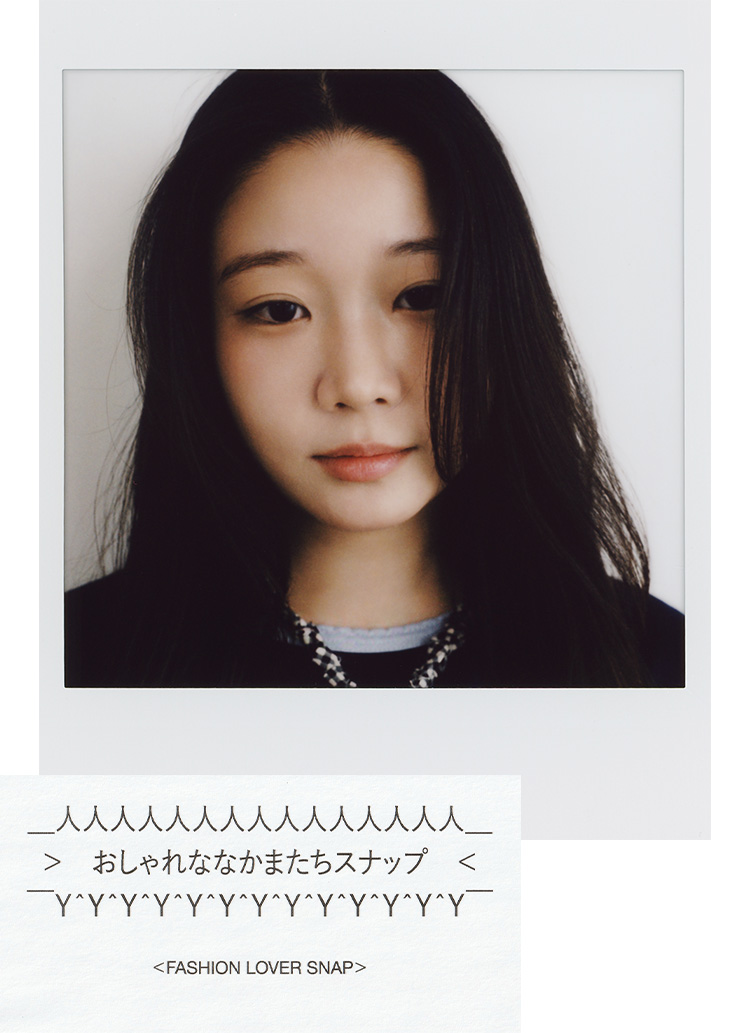
PROFILE
As the representative of “Instant Bootleg Store”—known for its content that delves not only into vintage clothing itself but also into the fashion, music, and culture behind it, under the theme of “Great Ways to Spend Your Pocket Money”—he currently works as a video creator while also handling product planning and design for various brands and companies.
Instagram: @hajime0722
PROFILE
After serving as the manager of the apparel division at “Under the Sun”—a combined hair salon and vintage clothing store in Sangenjaya, Tokyo—he is currently in charge of sales and PR at *Cabaret Povar*. Drawing on her experience working with a wide range of styles—from vintage to contemporary fashion—she is involved in various brand-related activities. Alongside this, she is also working on her own projects.
Instagram: @yuki_arai_ayako
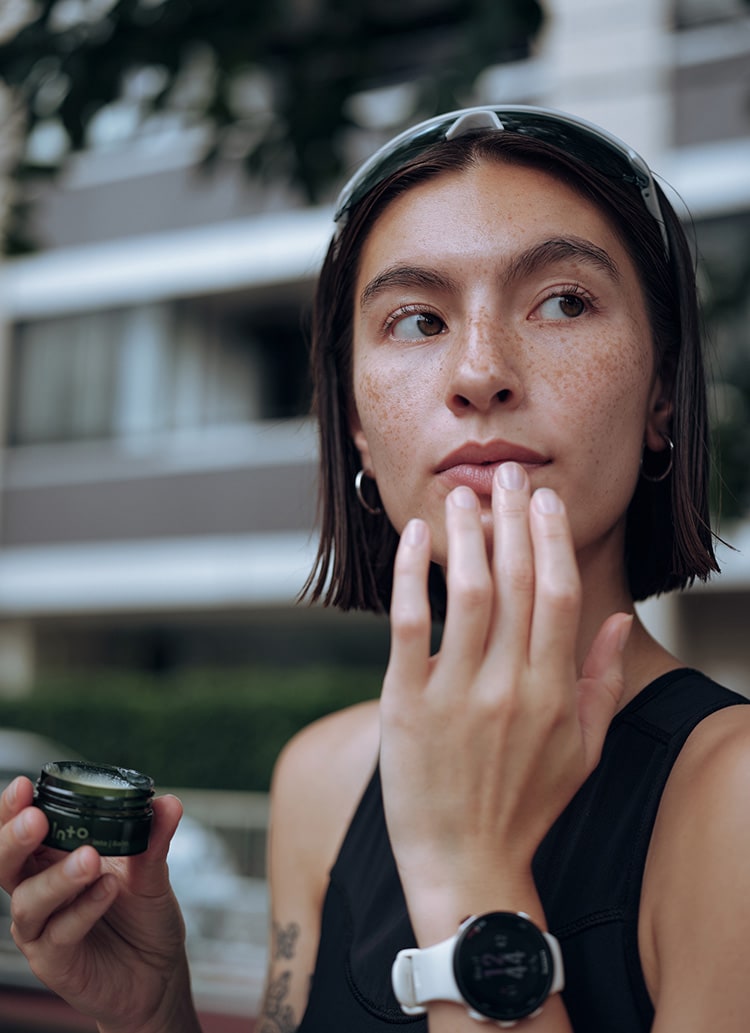
PROFILE
He is the owner of “Blue Room,” a vintage clothing store in Shibuya, Tokyo, that curates a selection of streetwear and sneakers from the 1990s and 2000s through a unique lens. In 2026, he participated as Tokyo’s representative in “Air Works,” a Nike design program featuring creators from eight cities around the world. Moving beyond the confines of a vintage clothing store, he is expanding the scope of his activities to include collaborations with brands and product design.
Instagram: @htk2626
It's interesting because there are still new discoveries to be made.

—First, please tell us about how each of you first encountered *Cyrus*. Although you’re from different generations, what initially drew you to it?
Hazuki: When I was a teenager, my older brother—who’s four years older than me—used to wear a pair of tapered pants from *Cyrus*, and I’d occasionally borrow them from him; that’s how I first discovered the brand. Then, around the time I was 21 or 22, as I was poring over old magazines and becoming interested in 2000s culture, I started seeing them frequently and grew interested in them.
Arai: It was kind of the same for me—when I was in high school, I was flipping through a magazine that a friend’s older brother had, and before I knew it, I’d come across the name and logo of *Cyrus*. However, my real introduction to the brand was *Aliz*. In my mid-20s, an Italian shoe brand I wore often, *College Shoes*, collaborated with *Aries*, so I looked into it, wondering, “Who’s behind this?” That’s when I came across the name Sofia Plantera (one of the co-founders), and from there, I traced it back to *Cyrus*. The early *Cyrus* graphics really do resemble today’s *Alize*—you can sense Sofia’s interests and background in both. I think it’s skillful how they maintain a core that never changes while still capturing the spirit of the times with a unique blend.
Sakamoto: Even though we’re from different generations, I got into it the same way as those two (lol). Back in 2000–2001, when I was 16 or 17, our generation thought *Supreme* was the cutting edge, but the older brother of a skater friend who lived in Ebisu told me, “*Park Walk* is the coolest right now.” That got me hooked on UK club culture and punk culture; I discovered the record labels *Mo Wax* and *Slam City Skates*, and started going to the flagship store “Cyrus & Maria” on Namikibashi.
Arai: I didn't grow up skateboarding, but did skaters really wear *Cyrus* back then?
Sakamoto: Speaking from my own experience, the brand was really popular with skaters. Especially the skaters who rode in places like Shimokitazawa and Ikebukuro—I think they had this eclectic style where they’d pair a *Cyrus* polo shirt with *A.P.C.* jeans. Not only were skaters at the forefront of fashion, but I think *Cyrus*’s style just really fit that “Tokyo vibe.”
Hazuki: Come to think of it, I don’t recall seeing British people wearing those extremely baggy pants that were so characteristic of U.S. skatewear back then, and I don’t associate them with *Cyrus* either. This is just my interpretation, but I think the fact that James Jebbia (the founder of *Supreme*) grew up in the UK may have had some influence on the clean aesthetic of early *Supreme*.
Sakamoto: That’s exactly how it was with the early *Supreme*, wasn’t it?
Hazuki: What made *Supreme* groundbreaking was that it retained a distinctly British feel, and I feel like *Cyrus* embodies that aspect. Also, Hiroshi Fujiwara has openly spoken about his influences from punk culture, so I think the UK has had a huge impact on Japan throughout the ages.
Sakamoto: I think fashion periodically needs that sense of edginess, but when it comes to shifting the trend, it’s the UK’s essence that really makes the difference—more so than the US’s. I think that’s because the UK has had a strong counterculture that’s been passed down continuously ever since the Sex Pistols emerged. In terms of our first exposure to UK culture, just as *Seditionaries* was for Hiroshi, *Cyrus* might have been that for us. That said, back then, I don’t think we were at all conscious of distinguishing between the UK and the US.
Arai: It’s true—when I first encountered *Cyrus*, I didn’t really have any particular image of it as a UK brand, for better or worse. But looking back now, *Cyrus* was my gateway to UK culture; it’s as if it had been ingrained in my mind without me even realizing it (laughs).
Hazuki: I get it! As I dug deeper, I discovered that the brand has its roots in the UK. And it was actually Yosuke Kubozuka who first made me really take notice of *Cyrus*. When I picked up an issue of *Huge* featuring Kubozuka on the cover, there was a special feature on how to style *Cyrus*. Around the same time, in the movie *GO*, he wore a wine-red *Cyrus* polo shirt paired with dark-colored denim and *Nike* “Air Force 1” sneakers. Seeing a street style icon who epitomized the early 2000s rock *Cyrus*’s style just clicked for me.
Arai: The image of is all about this understated logo, but it's amazing that you noticed I was wearing it with "GO" (lol).
Hazuki: I didn't realize it when I watched the movie over and over again, but it was clearly visible in a photo book I bought recently, and it was quite a shock when I finally noticed it.
Sakamoto: When I think back to brands from the UK and Europe back then, *Nike* doesn't really stand out that much in my mind, but *Cyrus* used to have models wear their clothes in their lookshoots.
Hazuki: I also have memories of high-tech styles like the “Air Presto.” And yet, it’s precisely this versatility—the ability to offer shoes other than sneakers, such as and —and that open-mindedness that truly define .
Sakamoto: Their sense of style is pretty laid-back, isn't it? I feel like they were the ones who pioneered layering collared shirts in streetwear back in the day, and it was also revolutionary that they had a solid women's line in a streetwear world that was still overwhelmingly male-dominated at the time.
Arai: Although the brand emerged from the “Slum City Skates” movement, one of its defining characteristics is that it’s hard to categorize it definitively as either a skate brand or a streetwear brand. Sofia herself has an Italian father and a British mother; she grew up in Rome before moving to London, where she studied fashion at Central Saint Martins. That background may be one of the reasons why *Cyrus* exudes a unique sensibility and a mysterious atmosphere.
Hazuki: Even in magazines from that time, it was described as a “brand whose full scope is hard to grasp,” wasn’t it?
Sakamoto: It felt like something within reach, but it wasn’t something you could just buy—and I think that’s exactly why everyone was so into it. Basically, *Cyrus* is a bit out of our league. It’s probably part of their branding—they’re good at keeping things mysterious, or maybe it’s just that cool vibe of not revealing everything. There’s something about things you don’t quite understand that’s kind of appealing, right? (laughs)
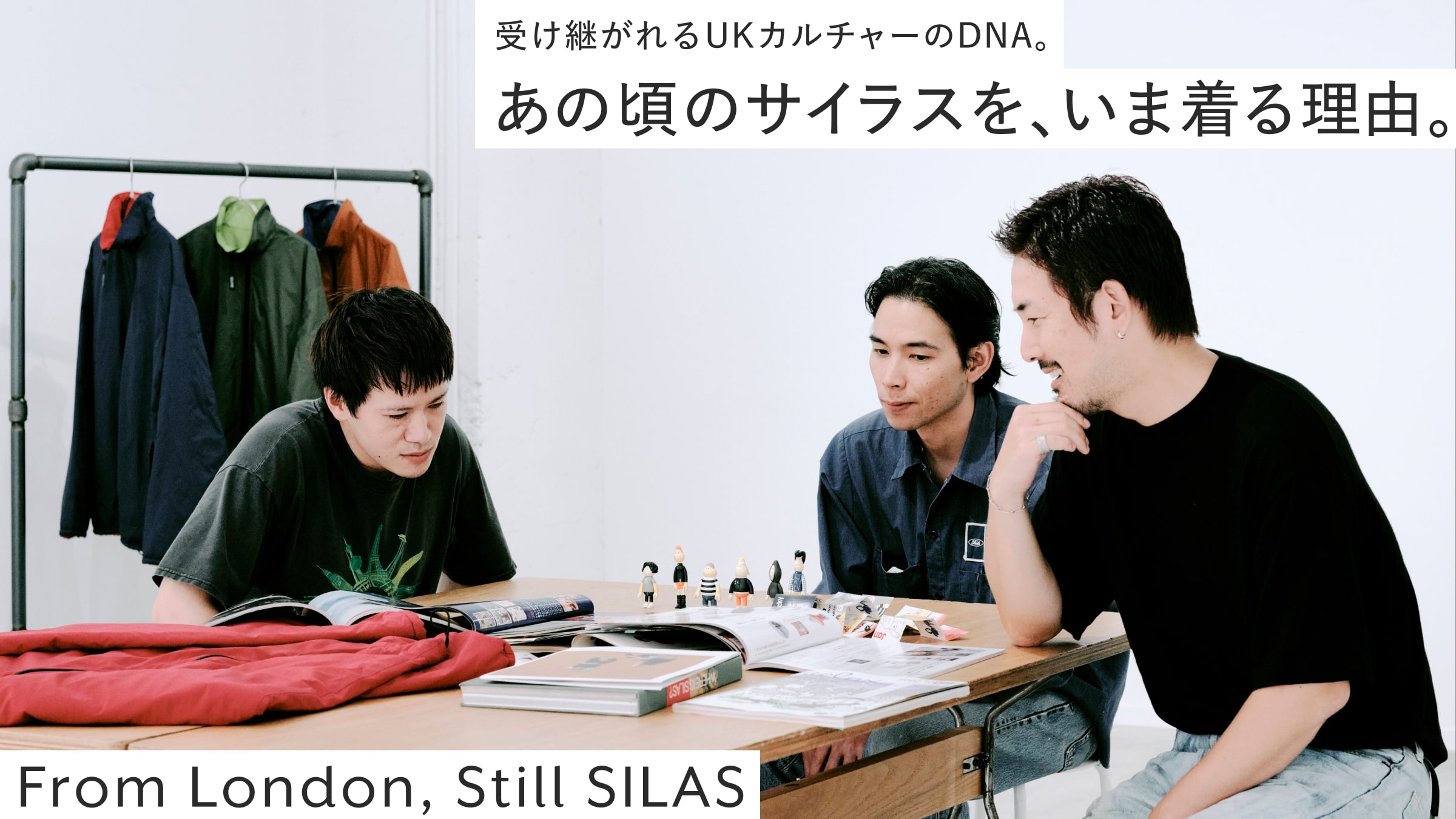
—This time, we’ve prepared a few items from the original *Cyrus* archive. When you hold the actual pieces in your hands, what aspects of the design and details make you feel the essence of *Cyrus*?
Arai: Even when I look at it now, it’s just plain cool—partly because I know the background, but I suppose it’s also because the design has stood the test of time.
Hazuki: Even looking at them now, the quality really does surpass that of streetwear brands, doesn’t it? In particular, the items from the early 2000s used zippers from “Lili” (a long-established Swiss luxury zipper manufacturer)—and back then, only “Cyrus” and “A Bathing Ape®” were using them.
All: Wow!
Hazuki: I really like how *Cyrus* at this time of year even has cashmere beanies—you can tell they’re trying to set themselves apart from the rest (lol).
Sakamoto: The care labels always have some kind of unique phrase on them, don’t they? There are some U.S. brands that do something similar, but while they go for straightforward sarcasm, *Cyrus* has a somewhat cynical edge. That’s very British of them (laughs).
Arai: This shirt features a double-breasted construction, and the attention to detail is impressive—for example, the inner color scheme is visible when the shirt is slightly unbuttoned. With shell jackets, for instance, the reinforcement stitching is often incorporated into the design itself.
Hazuki: The cool color palette of this shell jacket really has that *Cyrus* vibe, doesn't it? For me, when I think of *Cyrus*, the colors are a big part of the image.
Sakamoto: Come to think of it, *Cyrus* doesn't really have a "black" image. I get the feeling they treat navy as the standard for what's usually considered "black," which is a pretty stylish touch.
Arai: I guess it's a different sense of timing than in the U.S.
Sakamoto: Also, although they’re not here, there were a lot of psychedelic graphic T-shirts back then, weren’t there? I wonder if that’s just my impression from the era when Fergus Purcell (the graphic designer who also created the Tri-Fer logo for *Palace Skateboards*) was involved?
Hazuki: That’s one way to look at it. Come to think of it, I ran into Fergus by chance in Australia the other day. He was wearing a pair of well-worn “Air Max 90s” when he stopped by a event.
Sakamoto: Good catch! I remember feeling like there was something about *Pam* that reminded me of *Cyrus* when it first started.
Arai: According to mixi at the time, it seems that 〈Cyrus〉 carried 〈Pam〉.
All: Haha.
Those days, seen through today's eyes.
—And this time, the “New Liner”—a reversible, quilted jacket with a stand-up collar—is being reissued from that archive. What do you think of this design from about 30 years ago, now that you’re seeing it again?
NEW LINER ¥27,500
Sizes: M, L
Sakamoto: I’ve been carrying Harrington jackets at my store, “Instant Bootleg Store,” since around last year—mainly because, among jackets with collars, I was in the mood for a stand-up collar. And it’s specifically the Harrington jacket—not the American-style Drizzler jacket—because I wanted to incorporate a British influence.
Arai: Wearing it buttoned all the way up is the classic British way to wear it, isn't it?
Sakamoto: Plus, I was in the mood for something plain rather than a jacket with a graphic print, so this comes in handy.
Arai: It’s surprisingly hard to find plain, lightweight outerwear when you look for it, and this unassuming look is so typical of *Cyrus*. Personally, I like reversible pieces, but I’ve never had the chance to own one, so I’m really happy to have this.
NEW LINER HOUYHNHNM Direction Color ¥ 27,500
Sakamoto: While they’ve stayed true to the original style and context of the era—and even retained some of the classic patterns—they’ve also embraced what’s possible now, 30 years later, and updated the materials and details to suit the modern era. The fact that it’s not a complete reissue is so typical of *Cyrus*—and that’s what makes it great!
Hazuki: The drawstrings on the sleeves are a thoughtful detail you don’t see very often, so I’m grateful they kept them. Just looking at the width of the tape, you can tell it’s designed so the zipper doesn’t get caught.
Sakamoto: If I'm going to wear this, I'd like to pair it with slacks and something other than a hoodie underneath. To put it a bit pretentiously, I feel like pairing everything with a hoodie is kind of American.
Hazuki: I know this might sound a little weird coming from me, but I just can't help wanting to pair a hoodie with a stand-up collar jacket… (lol).
All: Haha.
Hazuki: Especially during this time of year, I love turning up my collar and pulling up my hood, so I can't wait to try it out around town.
—Now, I’d like to ask the three of you to style the navy-and-red outfit—one of the three colorways for which “Fuinam” provided the color direction—in two different ways that make the most of its reversible design.
Sakamoto: For me, the most beautiful way to wear *Cyrus* is to leave the stand-up collar open and layer it over another collared piece—so I’ve adapted that look to suit my current mood. Not just today, but whenever I wear UK or EU brands, I always pair them with *Adidas* on my feet—these “Superstars” are my go-to pair that I wear at least once every two weeks. And since going all-UK from head to toe would be “overdoing it,” I’ve paired it with a pair of vintage Levi’s® “501®” jeans I recently picked up.
Sakamoto: For this look, I imagined stepping out of an Audi station wagon (lol). I’ve always liked the red-and-black color combination, and I think it has a certain British vibe to it, so I paired it with black denim bottoms and a black top. What both the navy and red outfits have in common is that the hems aren’t tapered, but the sleeves are. This is my own Japanese take on how to wear *Cyrus*.
Arai: I only own two pairs of pants in total (lol). That said, this “New Liner” has plenty of room, so I figured it would blend seamlessly into my everyday style without feeling forced—which is why I paired it with the jeans I wear all the time. Zipping up the stand-up collar all the way and pairing it with a shirt feels fresh to me, but it’s actually one of the classic styles in the UK, isn’t it? Since the jeans have a faded, slightly frumpy silhouette, I’ve rounded out the look with leather shoes.
Arai: A red outerwear piece can sometimes be too eye-catching on its own, but by wearing a cap with ear flaps—which adds a slightly playful vibe—I’m balancing out two strong elements. As for the bottoms, while I did use a process of elimination—pairing them with denim would have made the look too retro—I ultimately chose a pair of brown pants. Since the top half makes such a strong statement, I wanted to balance it out with muted tones on the bottom, so I went with Birkenstocks, which are physically flat. Of course, I’ll keep the collar turned up here as well.
Hazuki: Since zip-up hoodies are my favorite type of clothing, I paired this one—a must-have item for me—with a navy “New Liner.” The collar works really well with the hood, whether I zip it all the way up or leave it slightly open. The hoodie is a Supreme piece that a friend hand-dyed for me just the other day when I was in London. I paired it with bottoms from “Always Do What You Should Do”—a New Zealand brand that’s popular among UK skaters—to add my own touch of UK flair to the top and bottom. For my feet, I felt my usual sneakers would be too streetwear-y, so I sampled an old look and went with instead.
Hazuki: I wear a cap 360 days out of 365, but I once saw a comment by Russell Waterman (one of the co-founders) in a magazine saying, “We don’t make baseball caps at *Cyrus*,” so I stopped wearing one (laughs). Also, I’m not confident about my current hairstyle, but since the look back then often featured natural-looking hairstyles, I’m going for a casual, effortless vibe—in a good way. By wearing an early 2000s Supreme shirt underneath, I’m picking up on the mood of that era and the jacket’s color, and pairing it with light-colored denim and a pair of worn-in “Air Max 97s” is my personal take on a “Cyrus”-style outfit.
—Finally, could you tell us what you think is the appeal of *Cyrus*?
Hazuki: Although it’s originally rooted in the skateboarding scene, the beauty of *Cyrus* is that it resonates with people outside that community as well. Above all, even a little digging reveals that “the graphic designer from back then also worked on *Palace Skateboards*”—it shows you that a single T-shirt can open up a whole new world. For the generation below mine, it might have been hard to discover this brand back then, but precisely because we live in an era where it’s easy to dig deeper, I hope people will take a moment to look back at who designed it, what brand it was, and where it was worn. If they do, I’m sure their perspective on other UK brands will change as well.
Sakamoto: It’s always been the gateway to UK culture—both now and in the past. But that’s just the beginning; there’s so much more to it. Over the past decade, I think it’s been a good thing that the younger generation, in particular, has refined an aesthetic sensibility centered on “if it’s cool, it’s good”—though I suspect quite a few people have stopped at just the surface level. “Cyrus” shows you—whether through its current collection or vintage pieces—the interesting nuances that emerge when you delve a little deeper and draw the line between UK and US styles. Plus, I think it’s a brand that people who grew up in the street culture scene can wear effortlessly and naturally. When I was younger, I used to try to stretch beyond my means to get their clothes, but now I don’t have to (laughs).
Arai: When you take a closer look, you see references to skate culture, music, graphics, and toys—and you get a glimpse of that counter-snob attitude. It really makes me think, “That’s a UK brand for you.” It might look simple at first glance, but if you look at the details and background, you’ll find hidden charm. Plus, while archives are increasingly being highlighted these days, this brand has a resilience that prevents it from being easily consumed or discarded as a fleeting trend—it doesn’t feel dated, yet it’s not just “hip” for the sake of it. Just as Sofia and Russell said in a past interview—“Cyrus is ‘No age, No concept.’ Our ideal is clothing that anyone can wear”—it blends easily with any person’s style. But it’s a brand that, the more you dig into it, the more you get hooked on it.
SILAS NEW LINER HOUYHNHNM Directional Color (NAVY × RED)
Release Date: Friday, October 9, starting at 12:00 p.m.
Deployment Location:SILAS Online Store *Not available for purchase on Fuinam.
contact information (for inquiries) (e.g. corporate phone number)
SILAS
Official Site
Special page
INSTAGRAM:@silasandmariajp