Fabric selection, printing, and super-water-repellent treatment: The journey to creating a water-repellent furoshiki.
Here, we’ll walk you through the process of how a furoshiki is actually made. “Asakura Senpu” currently employs about 70 to 80 artisans, each of whom carefully performs their assigned tasks with expert skill.
The first step is selecting the most suitable fabric from a wide variety of options. The fabric delivered to the factory is sorted into processing batches to ensure that subsequent processes run smoothly, and any fabric requiring dyeing is sent directly to the dyeing machines.
Since they also focus on contract manufacturing, the factory houses fabric samples from some of Japan’s leading underwear brands that support people’s daily lives.

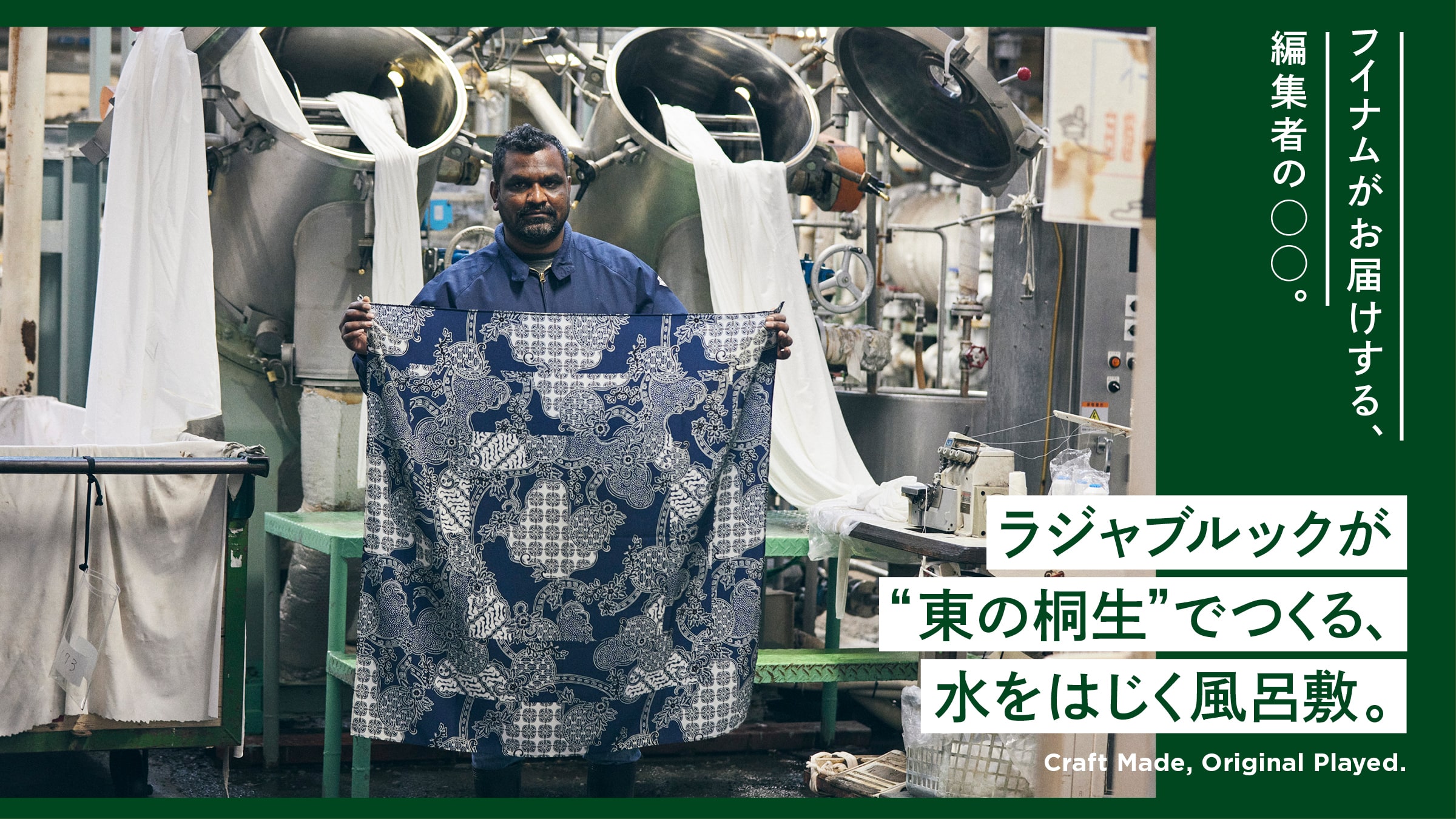
Next comes the printing of the graphics, which are the heart of the design. At Asakura Senpu, they reportedly use two different methods: sublimation transfer, in which transfer paper created by a printer is heat-pressed onto the fabric, and direct inkjet printing, in which ink is sprayed directly onto the fabric. Incidentally, Rajabrook items utilize direct inkjet printing, which allows for a wide range of colors and finer details. Even complex batik patterns composed of numerous curves are reproduced on the fabric with absolute precision.
Another characteristic of direct inkjet printing is that a steaming process is necessary to bring out the colors clearly. The fabric is fed into a sturdy-looking machine capable of steaming up to 10 rolls at once; by applying heat to the entire fabric, the color reproduction is said to improve. By comparing the vividly rendered fabric print with the color swatch and carefully checking for any discrepancies with the naked eye, I could sense the craftsmen’s uncompromising commitment to quality.
Once the steaming is complete, the final step is the water-repellent treatment. This is a particularly crucial process for the “Super Water-Repellent FUROSHIKI.” A special liquid is infused into the entire fabric—and even into every single thread—and then rolled to ensure even distribution. Huge machines lined up densely right before your eyes are constantly in operation, and their sheer power and speed are so captivating that you can’t help but stare for a while. Finally, after heat-pressing and passing an inspection based on quality standards, the “water-repellent furoshiki”—filled with our passion—is complete.
This is how our “Super Water-Repellent FUROSHIKI” is created. While each step of the process is often carried out at a different location, Asakura Senpu handles every stage in-house, ensuring high-quality, Made in Japan products that retain their water-repellent properties even after 100 washes.
Rajabrock blends Japanese traditions—passed down and refined by master artisans—with a touch of Southeast Asian flair, bringing this fusion to a wide audience through fashion. Ms. Ushida’s creative process begins with traveling to various places and meeting people.