Technology and trust—the fruits of our continued efforts.
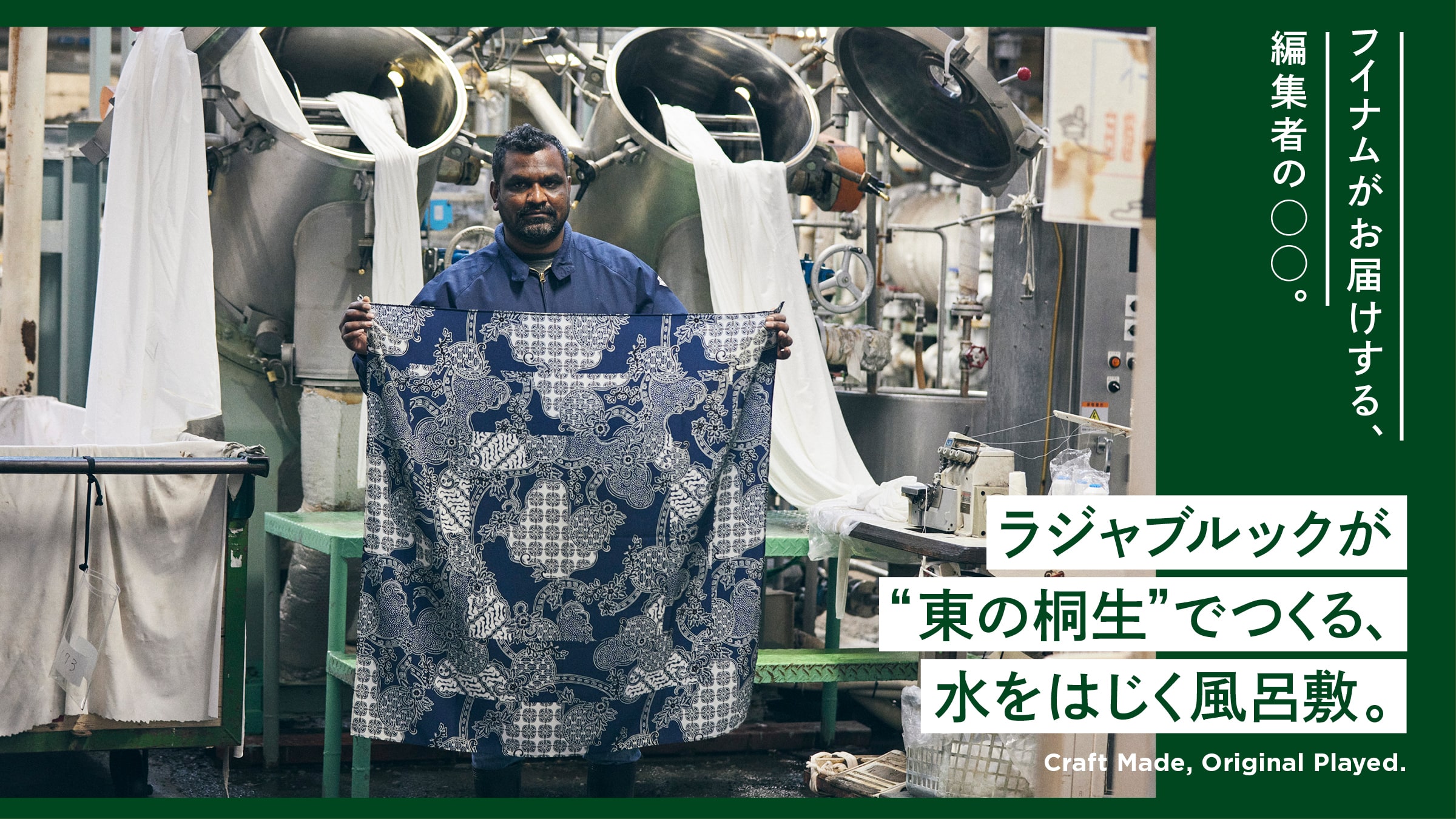
The Fuinam editorial team traveled to Kiryu in Gunma Prefecture to visit the factory where the products are made to cover the entire process of creating the “Super Water-Repellent FUROSHIKI.” Next, we spoke with designer Mr. Ushida about the brand’s origins, his passion for craftsmanship, and his dedication to the “Super Water-Repellent FUROSHIKI.”
PROFILE
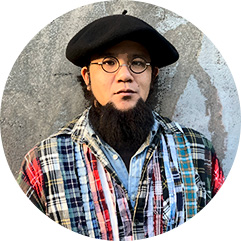
Born in 1989 in Tokyo. Spent his childhood in Malaysia and Singapore in Southeast Asia. He launched his own brand, *rajabrooke*, in 2018, and in 2022, he opened his flagship store, “Mansion Butik HALIA” in Kita-Horie.
—First, could you tell us about *Rajabook*?
Ushita: Rajabrook is a brand that draws inspiration from the flavors of Southeast Asia (the Orient) to create a wide range of products, from apparel to accessories.
—What inspired you to start the brand?
Ushita: I’d always thought about starting my own brand someday, but I hadn’t really made any plans. When I finally decided to take the plunge, I printed Southeast Asian-inspired patterns on tenugui—which were a must-have for me since I sweat a lot—and basically just sold them to my friends by hand. At the time, it was just an extension of my hobby.

—What is Southeast Asia like?
Ushita: It’s hard to sum up in a word, but it’s just been hot the whole time. Sometimes I think that’s actually a good thing, and other times I don’t.
—Specifically, what aspects of Southeast Asia inspire you?
Ushita: The city, people, food, clothing, and shelter; colors, patterns, sounds, temperature, and the wind, among other things.
—So, batik patterns are one of the symbols of Southeast Asian culture, aren't they?
Ushita: "Batik" is the name of a dyeing technique known as wax-resist dyeing, so it doesn't refer to any specific pattern, though there are some classic designs. Given the region's predominantly Muslim population, the patterns tend to feature plants and natural motifs rather than people or objects. Incidentally, when designing patterns for , we incorporate not only patterns commonly found in local dyeing but also those seen in local textiles.
—What do you prioritize when creating items?
Ushita: It depends on what we’re creating, but I always believe that, as a “brand,” it’s important to strive for a level of originality that you won’t find anywhere else.
—What does originality mean to ?
Ushita: To put it simply, maybe it’s that exotic atmosphere created by blending Western styles and Japanese culture with a touch of Eastern flair? Or perhaps a mix of genres and eras? I feel like I understand it, but I’m not really sure (lol).
—How did the “Super Water-Repellent FUROSHIKI” come about?
Ushita: It all started when a senior colleague told me about "Asakura Senpu." I think that was about five or six years ago. Just like with tenugui, I thought the blend of traditional Japanese elements and Southeast Asian influences was fascinating, so I made one right away.
—Plus, the fact that every step of the process is handled by "Asakura Senpu," making it a genuine Japanese product, is another appealing feature.
Ushita: It really embodies the Japanese spirit, craftsmanship, and the trust built up over history, doesn't it?
—So, what did you think of the craftsmanship of this long-established company with over 130 years of history?
Ushita: In this day and age, when everything is changing so rapidly, I was truly struck by the sheer power of simply “sticking with it.” While I’m nowhere near their level, it was a valuable experience to realize firsthand that perseverance leads to skill and trust.