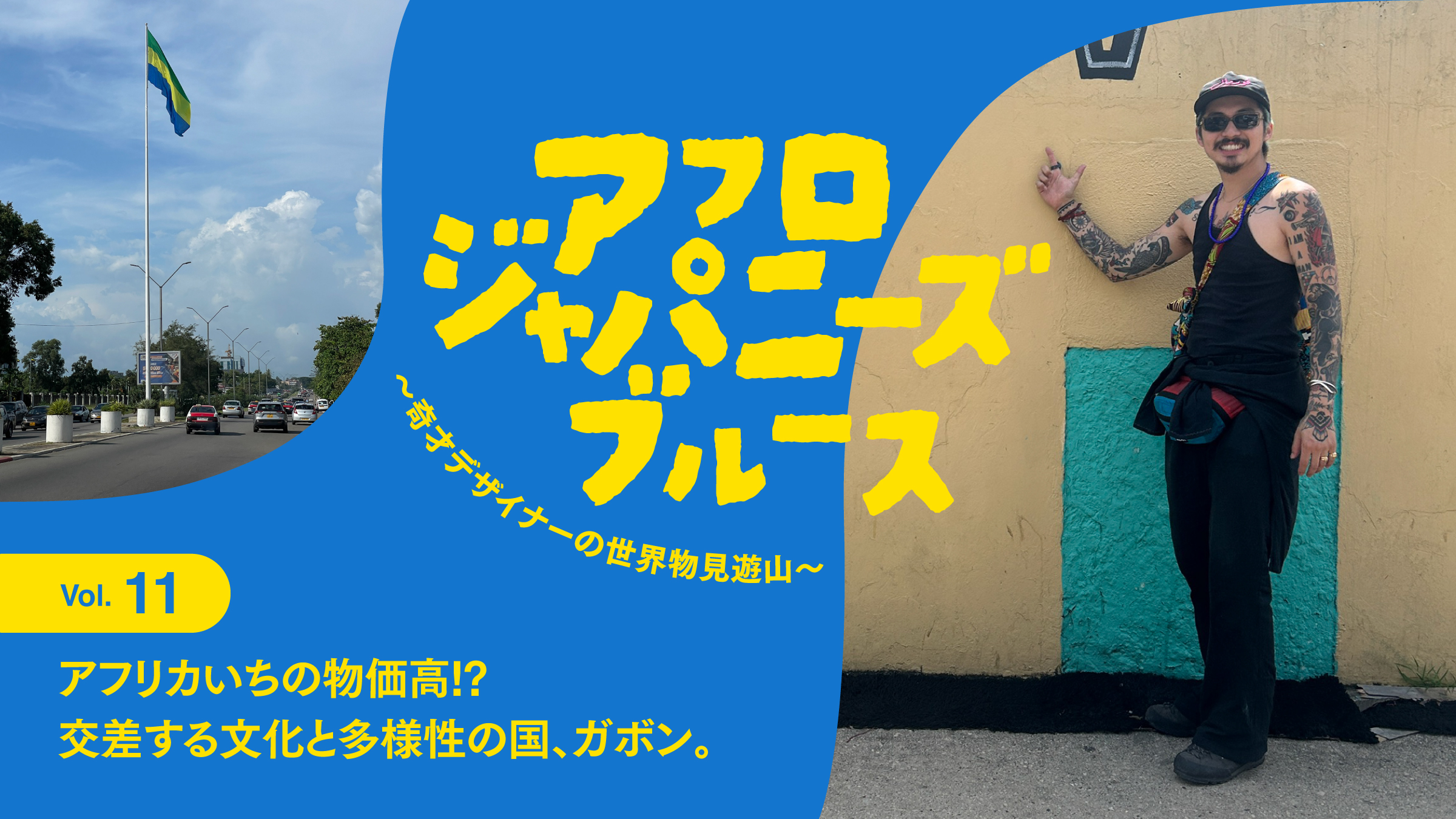
Fascinated by black culture and passion forLamrofand an African jewelry label calledAFLOGICAL JEWELRYSDaisuke Sakamoto, aka Shirley, is a fashion designer who pours generously into the "Shirley" brand.
In addition, in recent years, the company has been developing a new label, "Miscellaneous Goods," which focuses on items from the American mid-century period, which it had been operating for some time.Aflogical AntiquesHe has also changed the direction of his business to mainly African goods, expressing the black culture he loves from various angles.
The term "Afro-zero" means "of African origin. In this sense, Sakamoto is an "Afro-Japanese" with roots in Africa, even though he is Japanese.
In this series, we introduce the people, things, and things that Mr. Sakamoto has seen while wandering around the world, especially in Africa, through his own filter. We present the realities of black culture as he sees it, how he incorporates it into his products, and the realities of the black culture that has fascinated him, through actual photos and Sakamoto's own voice.
Photo_Sha-Le (Daisuke Sakamoto)
Edit_Naoya Tsuneshige
PROFILE
In 2022, he launched the fashion brand "Ramroff". In 2024, he started an African jewelry label "AFLOGICAL JEWELRYS" and an antique goods label "Aflogical Antiques". Aflogical Antiques" label will also be launched. He is deeply devoted to black culture and struggles daily to bring it to as many people as possible. He is also a soccer fan from the bottom of his heart.
Sha-Le Instagram:@8_shale_8
Lamrof Instagram:@lamrof_official
Aflogical Jewelrys Instagram:@aflogical_jewelrys
Aflogical Antiques Instagram:@aflogical_antiques
Troublesome checkpoints and immigration.
After a fulfilling buying trip to Cameroon, Mr. Sakamoto next headed to Gabon, a country on the Atlantic coast of Central Africa, without much rest. From Yaounde, the capital of Cameroon, he took a shared cab. It took him five hours to reach Kiyosi, an area where the borders of three countries (Cameroon, Guinea, and Gabon) intersect, via a town called Ambam.
I had somewhat expected this to be an overland border crossing, but as expected, there were many checkpoints before we reached Kiyosi, and we were dropped off the bus at least five times for passport checks. And each time, a bribe in the form of a commission tip was taken. Of course it is a hassle and I don't like it, but it is about 300 to 1,200 Japanese yen, so I would rather pay it quickly than take a lot of time for something I did not want to do. This is also common in Africa.

I visited the border between Senegal and the Gambia a few years ago and experienced this terrible thing. We were detained by corrupt police officers (laughs). They were really rude and accusing us, and they kept on accusing us for 8 hours. The whole time, they kept asking me to give them money. I asked for help from the Japanese embassy in Senegal, but the answer was, 'Please bribe them to release me.
A scene from a boat crossing the border between Senegal and Gambia.
I finally settled the matter by paying 20,000 Japanese yen at that time. I think it's unreasonable and I don't understand it, but since I chose this trip and this job, I can't avoid it and I have to get used to it. If you get angry or tense, things will go from bad to worse, so the best thing to do is to stay calm, smile, and be in the police's good graces.
Nevertheless, there are likely to be cases of incidents, so please be careful when you go to Africa. Mr. Sakamoto headed for Bitam, a town in Gabon, just across the border from Kiyosi. He chose a private cab as his mode of transportation.
He told me that he would take care of all the immigration negotiation for me, so I decided to trust his word and take a private cab.
From Kiyoshi to Bitam, we were dropped off approximately 10 times. Each time, we had to pay a commission tip as we went along. I wondered if it was really necessary... (laughs). Finally, we arrived at the border, where two immigration checkpoints were located about 50 meters apart across the border bar. The police here saw the tattoo on my arm and said, "Oh! I was able to finish in a calm mood from start to finish thanks to the police who made fun of my arm tattoo and said, "You're a gangster!
A Gabonese man resembling Mbape near the border.
"The problem was next. On the Gabonese side, they said, 'Why did a Japanese person come to this place? Don't you speak French? This is Gabon! We were being harassed in a high-handed manner for a long time. Finally, it was the turn of the individual taxi man. He worked very hard to mediate between us, and somehow we were able to enter the country safely.
Sakamoto says he went to bed early because the border crossing took longer than he had imagined. He said the hotel was like a prison. After a good night's rest at the hotel, he decided to take a 6:00 a.m. bus to Libreville, the capital city, the next morning.
Gabon is urban!
Finally, this was the day to explore Gabon...but there was still a great migration waiting for us.
I didn't get much sleep, and by 5:30 a.m. I went to the bus station. Then there was already a large group of people waiting there. I had a bad feeling, but it was right on target."
The bus departed with a very flat stomach, and I was seated in an auxiliary seat, sandwiched between two strong men. And the road was terrible. The roads were not well-maintained mountain roads...and we were on them for 15 hours. It was like an ascetic training.
On the way, they also encountered an accident.
In the end, it was around 10:00 p.m. by the time he arrived in the capital, Libreville, and Mr. Sakamoto ended the day just moving around. He is looking forward to the next day.
I was almost crushed by the bus, but thanks to the fact that I had asked the man next to me about Libreville, I knew exactly where I needed to go that day. First, antique masks, and then to an area where jewelry dealers are supposed to congregate."
The antique masks in Gabon were basically unique to Gabon. When I asked him about the details, he told me that there are several different tribes in Gabon depending on the area, and each tribe has its own style. It was interesting to see how this was reflected in the masks."
Gabon is said to be the most expensive country in Africa. Blessed with mineral resources such as oil, manganese, and iron, as well as high-quality forest resources, the oil industry accounted for 46.4% of the country's GDP in 2010, making it one of the highest income countries in Africa. Mr. Sakamoto talked about the cityscape of Gabon.
The high cost of living is evidence of the country's stability. This is also reflected in the cityscape. The public transportation system is very well maintained, and the traffic lights have large, high-tech electric panels that display the number of seconds, which I have never seen before in Japan, and are easy for everyone to see. I was even more surprised at how well-designed the streets were since I had just recently seen the poverty problems in Cameroon."
By the way, this is what a museum in Gabon looks like.
Compared to Cameroon, where he was just a few days ago, Sakamoto said there was one more difference. He said there was one more difference compared to Cameroon, where he had been just a few days before.
Gabon was home to a wide variety of people of all races. This is a sight that was not at all present in Cameroon, and is quite rare throughout Africa. Including this point, I was keenly aware of the unique development of Gabon's culture and its security during the three days I was there. It is really interesting to feel and know firsthand the differences between countries within Africa like this. It is the best part of traveling to different countries."
"We flew to London, our next stop, via Istanbul and Paris. Due to airline problems, the flight time was suddenly changed to midnight, but, well, I'm used to this sort of thing."
I was disappointed that my stay in Gabon was shorter than planned because I had to enter the country by land, but I think I was still able to spend a dense time there. It was a very wonderful country, one of the easiest to spend time in Africa, with a developed yet unique traditional culture. Next time I want to come here by plane (laughs)."
Sha-Le:@8_shale_8
Lamrof:@lamrof_official
Aflogical Jewelrys:@aflogical_jewelrys
EARTHY ANTIQUES:@earthy_antiques