Although it has been a long time since people started to hear that young people are drinking less, craft beers and natural wines have certainly become a part of the culture. Not only are there many variations in taste, but there is also the pleasure of choosing a bottle based on its design and comparing drinks with friends. Sake, on the other hand, is the most familiar alcohol brewed in Japan, but it still gives the impression of being for experts and is considered too expensive. We are now working to create an experimental sake that overturns this image.Gekkeikan Studiois the new "no.6was released, a young editorial staff member in his 20s attended the tasting.
- Photo_Shingo Goya
- Text & Edit_Kazuki Sakaguchi
Our goal was to create a sake that no one had ever experienced before.

Gekkeikan Studio is an experimental project by Gekkeikan, a long-established sake manufacturer in Kyoto, to explore new possibilities for sake. The company is constantly researching and experimenting with the keyword "sake science" in order to discover flavors that no one has yet experienced. The project is truly a scientific experiment, using specialized analyzers to measure the taste and aroma components of fruits and other objects to be reproduced, and developing original yeast to brew sake in small quantities.
In fact, Gekkeikan was one of the first companies to take a scientific approach to sake. The company established the Gekkeikan Research Institute in 1909 during the Meiji era (1868-1912), and in 1911, at a time when sake in barrels was at its peak, it was the first company in Japan to develop sake in bottles without preservatives. Since then, Gekkeikan has continued to lead the industry with a variety of firsts, including the release of unpasteurized sake that can be distributed at room temperature and the brewing of sake with zero sugar content.
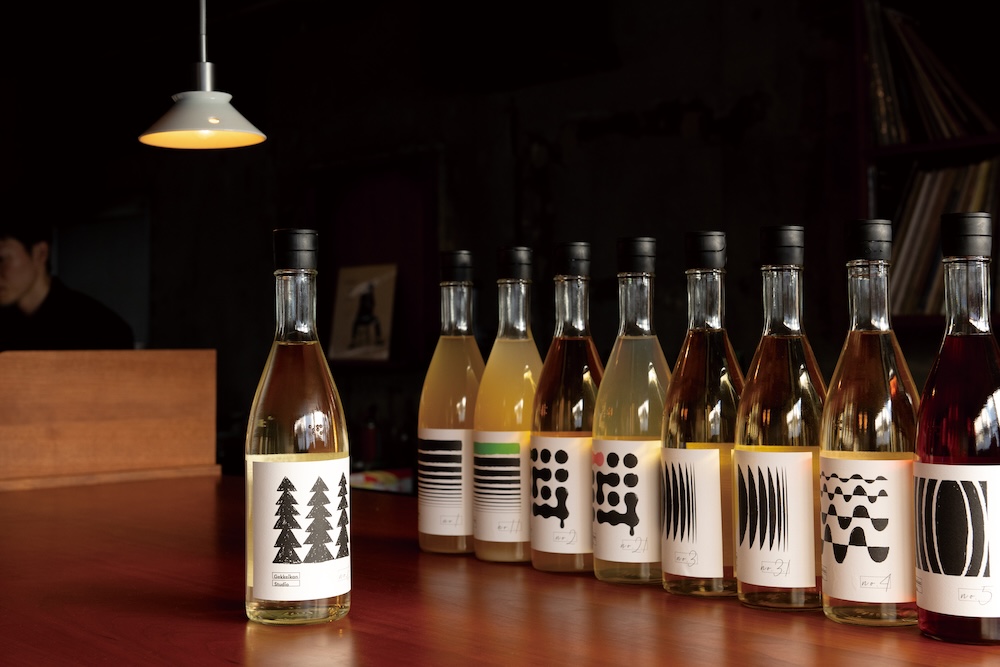
Gekkeikan Studio was established in 2021 to return to this history of innovation and create sake that no one has yet experienced. Once a new sake is created, it is sold in the prototype stage and the feedback gathered is used for the next product development. So far, they have released a variety of unique sake from "no.1" to "no.5. The prototype-like names tickle my fancy.
From left to right: no.1 with a smooth mouthfeel and melon-like flavor with aromas of fresh fruit.
An evolved no.1.1 with more fruity aroma and juicy fruitiness.
The no. 2 has an aroma and taste like pickled peaches and plums, and a dense texture that drips thickly on the tongue.
The no. 2.1 has evolved to be fresher and denser, pursuing a realistic fruitiness.
It tastes like pineapple, and you can enjoy the change in flavor as the temperature changes no.3.
The pineapple-like aroma of no. 3.1 has been enhanced and evolved.
No. 4 of 5% alcohol with a gorgeous, clean taste created from a balance of sweetness and acidity.
No.5, which uses ancient rice as part of its raw material, has a mellow, spice-like aroma and astringent taste.
Sake like whiskey!
Gekkeikan Studio no.6 ¥3,300 (720ml)
The newest release from Gekkeikan Studio is "no.6". It is a super-dry sake with a mellow oaky aroma. The label features a wooden graphic, expressing the harmony of wood and sake. While some labels with large kanji characters on the label may seem unapproachable, this one is stylish and easy to pick up.
The concept is "health" as in "no.4" and "no.5". The "no.4" series has achieved a healthy sake by keeping the alcohol content at 51 TP10T, and the "no.5" series has achieved a healthy sake by using ancient rice, which is rich in polyphenols and minerals, as its raw material. And this time, the healthy finish is achieved by using a sugar-free sake as the base. Gekkeikan's ability to make sake with no sugar content while using rice as the raw material is the result of tireless research and development. Gekkeikan has obtained a patent for this technology.
The participants of the tasting were given a tree chart showing the process of "no.6" birth. The story of "no.6" begins with the growing interest in barrel sake within the company. The aroma of a barrel varies depending on the type of wood used. Therefore, the company tried soaking five kinds of wood chips (mizunara, yamazakura, white oak, chestnut, and cedar) in sake. As a result, the most popular were the mountain cherry and white oak. While the combination of cherry blossoms and sake is not very unexpected, the latter has an interesting whiskey-like aroma but tastes like sake, so we decided to use white oak for the barrels.
Next, we decided on the base sake. Four types of sake were prepared: a low-alcohol sake, a sake with a melon-like aroma, a very dry sake, and a sake with a peach-like aroma. After tasting the sake, the group narrowed the selection down to two, the ultra-hot sake and the peach-scented sake. After a final vote, the base was decided on the super-harsh sake, which combines the sharpness of a distilled spirit with a sake-like flavor.
It doesn't end here at the research-oriented Gekkeikan Studio. So far, decisions have been made based on taste, but here we throw in an aroma analyzer. It turns out that the aroma component of cedar, once eliminated as an option, has a large molecular size and tends to remain in the mouth. We hypothesized that this feature could be used to create a depth of aroma that changes with time, and decided to use cedar for the lid of the barrel.
And what is interesting is that the aroma changes depending on the way the barrel is charred, even if the same wood is used. There are two types of charring: charring, in which the inner surface is carbonized over high heat, and toasting, in which the inner surface is charred by heating it slowly over low heat. In this case, the wine is aged in casks with charring, which gives it an aroma reminiscent of vanilla and caramel.
The story of the trial-and-error process to complete a single sake was like a free research project. The researcher who explained the process to us conveyed a sense of enthusiasm and exuberance, and we felt that the secret to creating new sake is for the sake makers themselves to enjoy themselves and be flexible in their ideas.
Chilled for its sharpness, warmed for its umami flavor, or at room temperature for its balance.
After hearing about the development story directly from the researcher, it was time for the tasting. First, we were served it cold. When I put my face close to the glass, the aroma reminded me of smoky and somewhat sweet whiskey. When you put it in your mouth, it tastes like a dry sake. The taste itself is a dry sake, but because it is chilled and based on a dry sake, it has a crispness that goes right through you. The finish allows you to enjoy the gap between the information from the sense of smell and the information from the sense of taste.
Of course, "no.6" can be enjoyed on its own, but it is a dry wine, and I am sure it would go well with a meal. So, we had the opportunity to experience the pairing as well. The food suggestion was made by a Japanese restaurant with fans all over the world.fieldChef Yuki Noda of "Gekkeik. He himself has been experimenting with ingredients, trying out different cooking methods to pursue new possibilities of ingredients, and gathering and cooking seasonal ingredients without setting a goal. He said that he was very pleased to be able to work with us.
The first item is smoked yellowtail. It is smoked in white oak, which is also used for the "no.6" barrels. A dash of green lemon salt and herb oil is added to finish. The sake is then paired with a top-heated sake bottle (kamikan) at 40-45 degrees Celsius. The higher temperature mellows out the flavor and allows the sake's deliciousness to be felt. This creates a synergistic effect with the strong smoked flavor. In addition, a cedar-derived botanical aroma appears, which could not be detected when the sake is cold. The reason why green lemon and herbs were used to finish the amberjack is to match this aroma. As one would expect from a food professional. While adding color with greenery, even the compatibility of the aromas has been calculated.
There is no doubt that sake and fish go well together, but I realized that by linking the aromas, they harmonize more smoothly and enhance both the flavors of the food and the sake. I had always had a somewhat limited understanding of food and alcohol pairings, with beer for fried food and red wine for meat, so this was an eye-opening experience for me! I was so impressed by the pairing!
Next, to accompany the room temperature "no.6" were gyokuro chahan, mibuna with mustard, and scallion and gyokuro soup. Incidentally, Mibuna with mustard is a local dish of Kyoto, the birthplace of Gekkeikan. At room temperature, it has a taste that balances the crispness of cold sake and the mild umami of the top-grade heated sake, making it a perfect match for any dish. It has the capacity to accept the rich sweetness and umami of gyokuro and the tangy spiciness of mibuna.
By comparing sake at cold, warmed, and room temperature, I realized the appeal of sake's ability to change expression depending on the temperature range. It is a nice point to be able to choose how to enjoy sake according to one's mood and food.
Now that we had heard about pairings from a chef's perspective, we asked Gekkeikan to recommend foods for pairing.
The best feature of "no.6" is its smoky aroma, so I think it should be matched with that. Eel kabayaki should go well with it. The taste of the sake itself is quite dry, so if you pair it with something fatty or strong in flavor, it will wash it away and make you want to have another bite. Yakitori (grilled chicken) might be a good choice. For a different taste, chocolate is also recommended. It has a mellow aroma of oak, so it would be nice to have people enjoy it like whiskey.
Chef Noda, who was listening to this, suggested that it would be a good match with smoked salmon and dishes using dried bonito flakes. This would make it possible to enjoy the "no.6" pairing at home with ingredients available at supermarkets.
A tasting event will be held where you can compare drinks.
Many of you must have wished to try the unknown sake produced by "Gekkeikan Studio" after reading the previous explanations. Here is some good news for those people. A tasting event will be held on Wednesday, December 17, where you can sample several brands, including the "no.6" introduced here. The event will be held at the "Ikejiri-Ohashi" restaurant, a 1-minute walk from Ikejiri-Ohashi Station.Hi (Hi) Tavern."Sake is a Japanese liquor that is made from the finest sake. Take this opportunity to compare and explore the world of unique and innovative sake.
I used to feel that sake was somewhat difficult to drink because I only had the opportunity to drink it around New Year's, but when I learned that there are not only classic sake products but also experimental ones such as those produced by "Gekkeikan Studio," I felt like I was able to shorten my distance from sake at once. The bottle design is stylish, and you can enjoy a taste you have never had before, so I think it would be a great gift to bring as a souvenir to a year-end or New Year's gathering with friends and relatives.
Gekkeikan Studio no.6
Gekkeikan Studio no.6
Dates: Wednesday, December 17, 18:00-21:00
Location:Sun (Hi) Bar
Address: 2F Higashiyama Kyodo Building, 3-14-1 Higashiyama, Meguro-ku, Tokyo