I want to listen to music at high volume through a high-quality sound system. But clubs are a bit too intense. I’d rather lose myself in the music in a more casual, relaxed setting—and still enjoy conversation and drinks. A record bar is the perfect fit for that kind of mood right now. We live in an era where we can listen to as much music as we want via streaming services, but vinyl still sounds better—and it’s packed with charms unique to analog media, from the album cover art to the ritual of dropping the needle onto the record. In this series, we’ll visit the record bars that catch our eye and explore each one’s unique character and appeal. In Part 3, we’ll look at “溝".
- Photo_Mikito Hyakuno
- Text_JAY
- Edit_Kazuki Sakaguchi

PROFILE
Born in 2001. The record bar in Ebisu, “A10"After honing his skills as a bartender at bars and clubs in Tokyo, including "," he worked at a record store in Shinjuku called "Dub Store Records" I work at . One of Japan's leading art galleries, "Taka Ishii Gallery"His father is Takayuki Ishii, the founder of [the gallery], and he serves as manager of the music bar "Mizo," which opened in July 2026 at the same gallery."
A fusion of bar and art, curated by Taka Ishii Gallery.
—First of all, could you tell us what kind of gallery “Taka Ishii Gallery,” which is handling “Mizo,” is?
This contemporary art gallery was founded in 1994 by my father, Takayuki Ishii, and currently operates at six locations nationwide, including Tokyo, Kyoto, and Maebashi. While the exhibitions originally focused mainly on photography, we’ve recently been actively hosting painting exhibitions as well. The gallery curates a wide range of exhibitions, featuring not only established artists but also up-and-coming young talents.
—Is Yutaka also involved in running the gallery?
No, I’ve only had a few part-time jobs in the past, so I haven’t really been involved in that world much. Personally, I’ve worked as a bartender at bars and clubs, including “A10” in Ebisu. But art has always been a part of my life. I’ve been able to connect with artists around my age through galleries, and we hang out together sometimes.
—Could you tell us how “Taka Ishii Gallery” came to open a music bar?
It seems my father had long been interested in opening a café or bar; he used to mention it quite often. While the “Taka Ishii Gallery” mainly features works that appeal to the sense of sight, a restaurant allows people to experience the five senses—taste, smell, hearing, and more. I think that’s the kind of space he was trying to create.
Right around that time, I happened to be talking with a friend about opening a bar together. “Why don’t you do it at our place?” my father suggested. I wasn’t sure if he was serious, but once we actually started looking for a location, I realized, “Oh, he really means it.” So I got serious and started making preparations.
—Why did you choose Gaienmae?
Originally, I was limiting my search to the area around “Taka Ishii Gallery Roppongi,” where the gallery is located. However, due to redevelopment in Roppongi, many properties required tenants to move out within a few years of moving in. So, I chose Gaienmae, which is relatively close to Roppongi and where I’m familiar with a few shops run by people I know. Another key factor was its easy-to-find location near “Ski Shop Jiro.”
—The interior design reflects an aesthetic sensibility that is made possible precisely because the gallery serves as its backdrop.
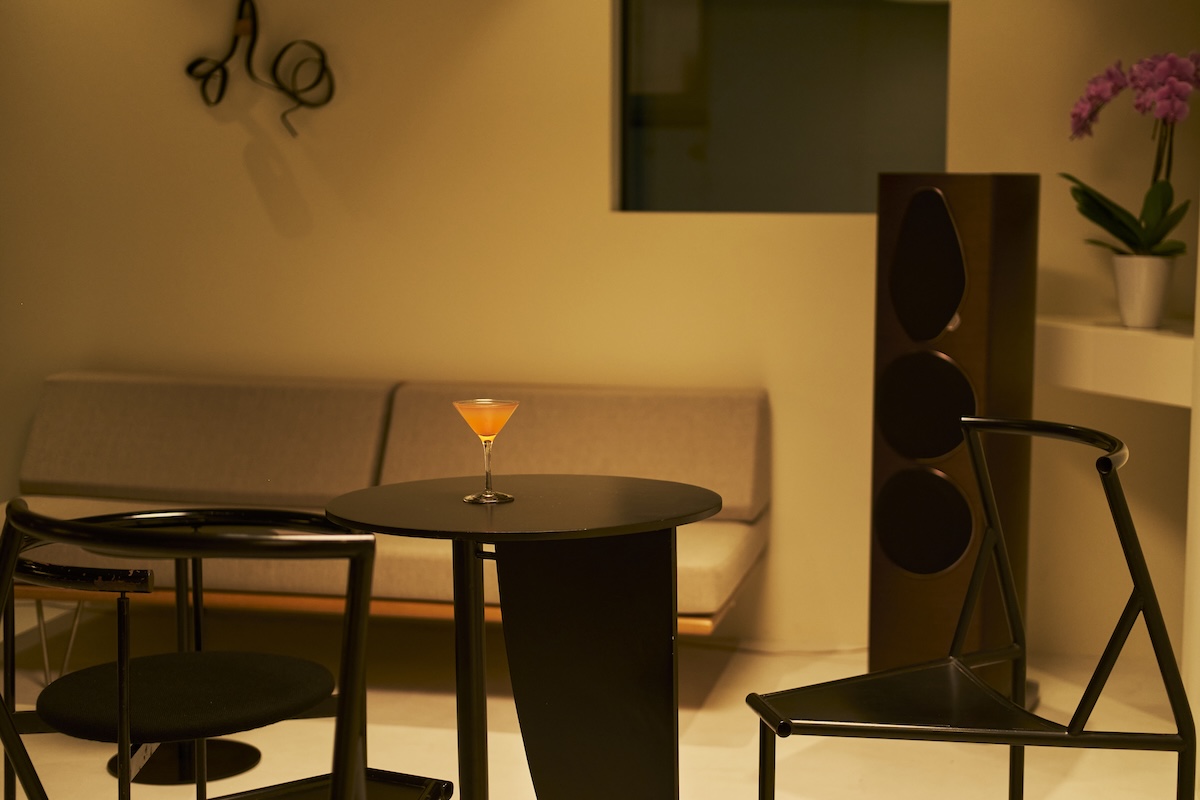
Most of the interior furnishings—such as the tables and sofas—were collected by my father. They’re mainly postmodern furniture from the 1980s designed by Shigeru Uchida and Martin Zekeli. The photographs hanging on the walls are by Robert Mapplethorpe, and the vases are by Shiro Kuramata.
The interior is “Broad Bean"We commissioned a company that also designed the interior of the 'Taka Ishii Gallery' to handle this project. What we really focused on was deliberately displaying the records. Personally, when I'm drinking alone at a bar, I sometimes feel a bit nervous in sophisticated places and find myself wondering where to look."
But I thought that if I lined up the record covers right in front of me, it might be just the right place for them. Hiding them all would certainly make the space look cleaner, but then it would be too orderly, and I wouldn’t know where to look. By deliberately leaving them on display, I aimed to create a more inviting atmosphere.
—Will you be organizing any projects in collaboration with the gallery?
I don’t have any specific plans, but I’d be happy if this place inspired more people to take an interest not only in drinks and music, but also in the world of galleries and art. I think quite a few people feel that galleries can be intimidating, but I believe using a music bar as a gateway could help broaden the audience.
We want you to relax and enjoy our carefully curated music and drinks.
—Could you tell us the origin of the store's name?
I got it from the grooves of a record. I love music myself—I’ve worked at record bars and record shops, and I’ve also been a vinyl DJ focusing on hip-hop, soul, and funk—so I have a special connection to records.
Also, when I visited a French winemaker to learn about wine, the rows of vineyards stretching out in layer upon layer reminded me of the grooves on a record, and that sight really left a lasting impression on me.
—What kind of records do you carry at your store?
We carry a wide selection of music across all genres, with a focus on jazz and world music.Tomoo Gokitaand an artist based in New York,Sanya KantarovskyFor albums where someone I know—such as [Name]—has created the artwork, I arrange them so the cover art is visible. In addition,Daido MoriyamaThree,Yoshitomo NaraThree,KYNEI've lined up albums whose covers were designed by my favorite artists—regardless of generation or genre—including [Name].
—Please tell us about your favorite photo.
It’s “Take Five” by the Dave Brubeck Quartet. I love the pleasant sense of dissonance created by the unusual 5/4 time signature, as well as the cool, laid-back vibe unique to West Coast jazz. It’s a rhythm that would normally feel a bit unnatural, but when Paul Desmond’s cool saxophone rides over that steady piano loop, you find yourself drawn into the groove before you even realize it. That exquisite sense of balance is just irresistible.
—How did you decide on the sound design?
The speaker is from the Italian company 〈Sonus faber〉So, the amplifier is a Japanese 〈Accuphase〉That’s right. When choosing equipment, my top priority was finding something that could convey a sense of three-dimensionality and depth in the sound—as if the musicians were performing right in front of me. The first time I listened to an 〈Accuphase〉 amplifier, I was really impressed by its meticulous craftsmanship, which faithfully captures even the subtlest nuances. When the idea of opening this store came up, I decided right away that I absolutely had to use this brand.
I wondered what kind of speakers would go well with this amp, so I tried listening to a variety of them. In the end, the Sonus Faber speakers—with their warm, rounded sound that still comes through clearly—felt like the perfect match. They make it easy to carry on a conversation, and they fit my vision perfectly.
—Please tell us about your philosophy regarding drinks.
In addition to standard drinks like beer and tea-based cocktails, we also offer cocktails that incorporate mixology (*1) techniques. Rather than masking the flavors with sweetness, we focus on using techniques such as “distillation” and “fermentation” to bring out the pure aromas and umami of the ingredients.
*1: A portmanteau combining “mix” (meaning to blend) and “ology” (meaning a branch of knowledge), referring to the art of creating cocktails by combining fresh fruits, vegetables, herbs, and other ingredients with distilled spirits, using scientific techniques and creative thinking.
A scene of aromatherapy water being distilled / Homemade kombucha
For example, I highly recommend trying our experimental original cocktails, such as a Manhattan with a touch of tartness from homemade kombucha, an espresso martini accented with homemade shio-koji, and a frozen martini made with shio-koji and butter-washed gin.
At this time of year, I recommend a summery mezcal Negroni flavored with botanical water made by distilling cucumber and Sichuan pepper. When you smash cucumbers, they can release a grassy or bitter taste, but distillation allows you to extract only their refreshing aroma.
Right: Kombucha Manhattan; Left: Cucumber and Sichuan Pepper Mezcal Negroni
—Could you tell us what sparked your interest in mixology?
When I was working at “A10,” I learned that making cocktails isn’t just about mixing drinks—it’s a science. I found it fascinating how flavor is created by logically combining various elements, such as temperature, ingredient combinations, and mixing techniques.
By incorporating fermentation and distillation into the process, I can experiment with an infinite number of combinations through trial and error. It’s fascinating when something I thought was a failure turns out to be surprisingly delicious, and then I find myself wondering, “Why did that turn out so well?” and exploring the reasons behind it. I’m learning by talking to people at various restaurants and bars and striving to develop my own unique flavors through repeated trial and error.
—I hear you’re also focusing on natural wine.
Influenced by my wine-loving parents, I got hooked on it too. I even went on winery tours in Champagne and Burgundy with my mom, who’s a sommelier. Wine has all sorts of rules—like production methods and laws, right? Even with those constraints, winemakers pursue the flavors they envision and go head-to-head using nothing but grapes. That’s what I found so appealing.
I also love the unique culture of wine, where you put your thoughts and impressions into words while you drink. There’s something cool about really engaging with the liquid, don’t you think? Because the range of aromas and flavors is so broad and the ways to describe them are so nuanced, it’s interesting to hear such a variety of opinions.
—Finally, could you tell us about your future plans?
As for the music, I’d like to organize days on the weekends where we book DJs so people can enjoy the space in a different way than usual. That said, I’m not talking about anything flashy like a party or a club event—I just hope they can add some color to the time people spend at “Mizo” as music curators.
When it comes to alcohol, I’d love to try making cocktails and gin using vegetables and spices that I’ve grown myself on my own farm.
We don’t have a sign out front, and the atmosphere is minimalist, but I hope you’ll come by casually without feeling like you have to be on your best behavior. Neither this place nor the gallery is a stuffy environment, so I’d be happiest if you could just relax and enjoy the drinks, music, art, and furniture.
溝
Address: 4F Black Aoyama, 3-2-7 Minami-Aoyama, Minato-ku, Tokyo
Hours: 7:00 PM–12:00 AM (Closed Sun, Mon, and Tue)

![[Series: 【Vinyl Bar Diaries] Vol. 4 LISTEN](https://www.houyhnhnm.jp/wp-content/uploads/2026/09/DSF6257-700x467.jpg)
![[Series: 【V Vinyl Bar Diaries] Vol. 2: STUDIO MULE](https://www.houyhnhnm.jp/wp-content/uploads/2026/06/DSF3564-700x467.jpg)
![Serialized 【Vinyl Bar Diaries] Vol. 1 Kompakt Record Bar TOKYO](https://www.houyhnhnm.jp/wp-content/uploads/2026/05/DSF4016-700x560.jpg)