"POST" has been introducing international art books through its unique approach of featuring one publisher at a time. Counting from the launch of its predecessor, "limArt," the publication has been active for approximately 24 years. In recent years, it has been featured at "Dover Street Market Ginza" on the 7th floor of “Dover Street Market Ginza,” “Gallery 5”—the shop at the Tokyo Opera City Art Gallery—and “Shinkenchiku Shoten/POST architecture books,” operated jointly with Shinkenchiku-sha.
The owner, Yusuke Nakajima, has also served as the director of the TOKYO ART BOOK FAIR since 2015 and has been a leading figure in Japan’s art book scene.
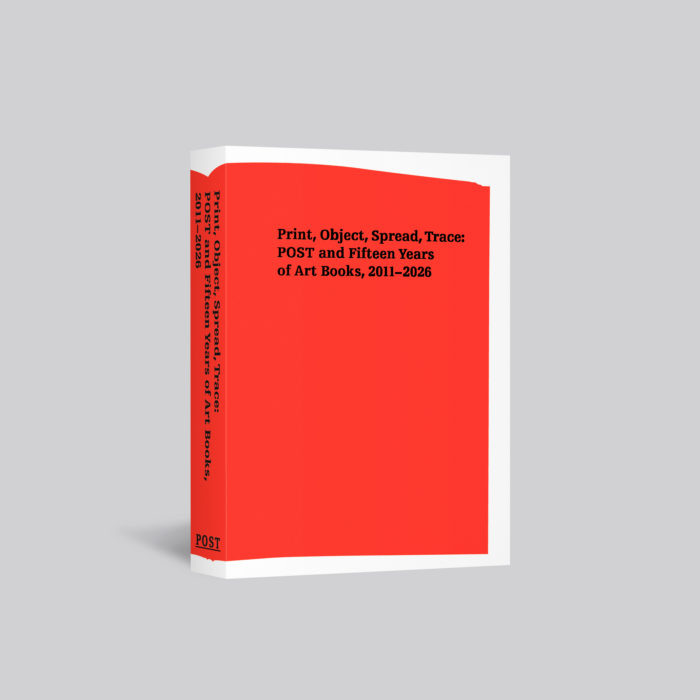
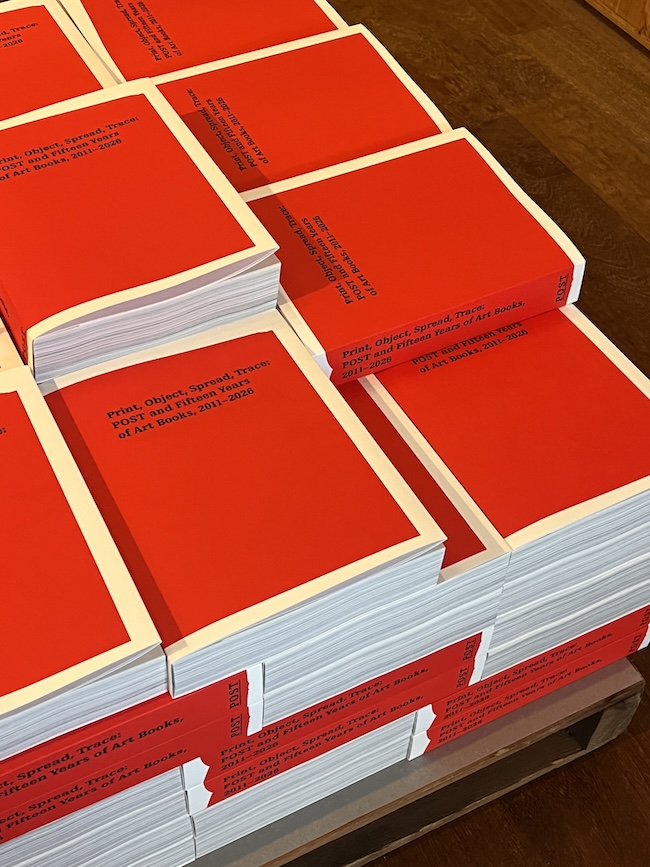
POST has published *Print, Object, Spread, Trace: POST and Fifteen Years of Art Books, 2011–2026*, a volume summarizing its 15 years of activity. Structured to trace “POST’s” journey to date while also highlighting the evolution of art books, it is a book that can be enjoyed from any page, much like a dictionary or an illustrated guide.
We spoke with Mr. Nakajima to find out how this book came to be and what makes art books so appealing in the first place.
PROFILE
He has served as the director of the “TOKYO ART BOOK FAIR” since 2015. He is a leading figure in the domestic art book scene.
Staff who help me rediscover my初心.
—Congratulations on POST’s 15th anniversary! First, could you share your thoughts now that you’ve reached this milestone?
Thank you very much. It really feels like 15 years have flown by before I knew it. While the work itself hasn’t changed much since we started, over the past four years or so, as our store and staff have grown, the range of what we can do has expanded. This book, too, could not have been published at any other time. I consider it a book created together with our 16 staff members.
—So that’s why you included the staff members’ names in the colophon. And the fact that you even included former staff members really showed how strongly Mr. Nakajima felt about it.
Since this book is the result of all of us working together to run “POST,” I wanted to include the names of everyone who has been involved so far. When we opened “POST” in Yoyogi VILLAGE in 2011, we decided we wanted to start with the German publisher Verlag der Buchhandlung Walther König as our first partner. It all began when Kanako Murakami, a staff member who had studied abroad and was fluent in English, arranged a meeting for us. Seeing all these names listed like this really makes me realize just how many people have been involved—it’s truly moving.

—You mentioned that the expansion of your staff has broadened the range of what you can do. Could you share a specific example?
Most of our staff are in their 20s, and each has their own interests and strengths; they’ve been introducing me to new things and sharing their knowledge with me. As for this book, the staff shared all the practical tasks—including rewriting the text and restructuring the content—among themselves. That’s why I truly believe I could never have done this on my own.
—What kinds of things do the younger staff members teach Ms. Nakajima?
It also helps me reconnect with my roots. This past May, I took my staff on our first buying trip to Europe since the start of the COVID-19 pandemic. When I first started “Rim Art,” I couldn’t tell what a book was about just by looking at the spine, so I’d pick up every single book from the beginning and look through them, buying the ones that caught my eye. But as I got used to it, I began to know just by looking at the spine whether it was something I’d like or not. As a result, I found myself only picking up books that piqued my curiosity. But my younger staff members approach books exactly the same way I did when I first started “Rim Art.” Watching them discover interesting books that way made me realize I mustn’t forget that sense of wonder—and it also made me realize I shouldn’t assume I already know everything.
With the help of generative AI, too.
—When did you start planning this book?
Yoshihisa Tanaka, who handles the art direction for “POST,” was set to hold a solo exhibition at the Ginza Graphic Gallery, and he approached me with the idea: “Why don’t we create a book to coincide with the exhibition?” That was around May of last year. Actually, ever since we started “POST,” Mr. Tanaka and I had been talking about how nice it would be to create a book summarizing the shop’s journey in the future.
—Did you have any specific ideas in mind at the time?
The foundation of this book is *Die Bücher der Künstler*, a compilation of German artist books from the 1960s to the 1990s. It was a book I used to look through constantly before I opened my bookstore, and it served as my gateway to learning about both artists and books at a time when I knew next to nothing about either.
While discussing with Mr. Tanaka how to design the graphics for the bookstore “POST,” we agreed, “Let’s create visuals that follow this style,” and that’s how we began photographing the books from a true bird’s-eye view.
—What challenges did you face during the production process?
Although the printed materials we produced for each publisher included basic specifications and a minimum amount of explanatory text, since they were created on a case-by-case basis, there were no standardized formatting rules. Our staff had been working together to standardize this, but when I reviewed the materials around July—just before they were submitted to the printer—I noticed some issues that bothered me. For example, we had initially standardized the book titles so that the first letter of each word was capitalized, with the rest in lowercase. However, I got the impression that authors might intentionally use all uppercase or all lowercase letters, so I wasn’t sure if it was okay for us to override their intent with our own rules. As a result, we decided to standardize the title format to match the cover—and made that change just three days before the scheduled submission deadline.
—That must have been tough.
We had to recheck the covers for 1,800 copies, and since there was absolutely no way we could meet the submission deadline, I consulted with Mr. Tanaka. Since the Obon holiday was also coming up, it seemed there was a possibility that if we went past the scheduled date, we wouldn’t make it in time for the special exhibition. However, we decided to prioritize this project since it would be preserved as a book, so Mr. Tanaka reached out to the printing company and other relevant parties on our behalf. As a result, we were granted about a week’s extension, but this meant that Hachiko Art—the company we commissioned for printing—and their partner companies had to forgo their Obon holidays. It got to the point where they told us, “If we miss this deadline, we’ll never work with you again.”
—It really hits home that this book was made possible only through the cooperation of so many people.
That’s why Mr. Tanaka strongly urged us, “Under no circumstances should you go beyond that point,” and we worked frantically to verify everything. I think one thing we were able to do precisely because we’re in this era was to utilize generative AI. Using Claude was key to ensuring that the standardized notation rules were correctly reflected. If generative AI hadn’t existed, I think it would have taken us about two years just to compile everything. The same goes for the index at the end of the book. When I instructed Claude to “create an index based on these rules,” it was completed in about an hour.
—Did you gain any new insights during the production process?
When I first started working with art books, there was so much I didn’t know that I would pore over the prefaces and texts to learn more, relying on the written words to understand them. But as I handled more and more books and my knowledge grew, I found myself thinking I understood them just by picking them up and looking at them. This time, as I reread the texts to rewrite them, I learned so much that it felt like I was returning to my roots in a way.
—For example, what kinds of discoveries did you make?
While compiling this series of 50 publisher spotlights, I also noticed that Ed Ruscha is mentioned quite frequently. A glance at the index reveals 14 entries—an overwhelming number. It has become clear that Ed Ruscha is, indeed, a significant artist in the world of art books.
Creating new values through art books.
—To start with, how do you define an art book?
I do think the physical experience plays a major role. This book, for example, has a texture unique to thin paper that you can feel when you turn the pages. The illustrations and text themselves convey the same information regardless of the type of paper used. However, the physical experience changes the way that information is conveyed, and I believe that an art book is a proposal that incorporates that very experience. Especially since around 2010, there has been an increase in books designed with elements that influence the experience—including even the book’s size and weight—and I feel they are created with a conscious effort to convey things that can only be expressed through a book.
—For those who haven’t looked at an art book before, where should they start?
I, too, was initially drawn to art books because of their visual appeal. So, for example, if you’re into music—take this book by the artist Raymond Pettibon—the cover was actually used for a Sonic Youth album. There’s also a natural affinity between fashion and art. When I was in high school, there were some candies wrapped in silver foil displayed in the window of *COMME des GARÇONS* in Aoyama. I remember thinking, “What is this?” and it really stuck with me; later, I found out it was an installation by Félix González-Torres. I think it’s best to start by finding a connection to whatever interests you most right now.
—By the way, I hear you’ve always been interested in fashion, Mr. Nakajima, and that you even attended the Bunka Fashion College while you were in college. Could you tell us which fashion designers have influenced you over the years?
I was blown away by *Comme des Garçons* when I saw it on *Fashion Tsushin* back in middle school—it had such an overwhelming presence—and in high school, I was into *Martin Margiela*. I had the impression that 1990s fashion, in particular, was at the intersection of music and art. That’s what sparked my interest in fashion. It wasn’t so much the clothes themselves as the cultural expressions associated with fashion in general that interested me.
—So that’s how it ties into the art book, isn’t it?
That’s right. Rather than having a preference for a specific genre, I’m just constantly interested in cultural things like that. So I don’t consider myself an expert at all—maybe I’m a “generalist specialist.” When it comes to specialized fields, I know I can’t possibly compete with actual experts. Franz König, whom we interviewed this time, also said in another interview, “I’m really not an expert,” and I’ve always felt the same way.
—What brings you joy when delivering art books, Mr. Nakajima?
When I was in elementary school, my older sister invited me to set up a booth at a flea market for the first time. That’s when I discovered the joy of interacting with customers, and ever since, I’ve wanted to be someone who sells things. When I talk with customers, I find it fascinating to witness the moments when their values shift. I find great joy in being able to inspire even a small shift in someone’s values through art books.
—Finally, could you tell us about the future prospects for “POST”?
For now, this has taken shape as a book, but one of my goals is to keep this project going. Also, since art books are still somewhat of a niche market, I’d like to make them a bit more accessible to the public—or rather, I want to do things that will reach a wider audience. At “Gallery 5” in Tokyo Opera City, the audience is completely different from that of our previous “POST” events. Even if it’s just a single postcard instead of a book, I hope people can take something home with them—and I’d like to increase the number of places where even such small things can serve as a catalyst for something. It also makes me very happy to see that the younger generation is taking an interest in bookstores as places where cultural events can happen.
"Print, Object, Spread, Trace: POST and Fifteen Years of Art Books, 2011–2026"
Edited and Written by POST
Release Date: Friday, September 4, 2026
Specifications: 912 pages / Bilingual (Japanese and English)
Dimensions: 240 × 180 × 42 (mm)
List Price: ¥8,250
Art Direction: Yoshihisa Tanaka
Design: centre Inc.
Interview Editing and Writing: Sawako Fukai, Toshiaki Koga
Annotation by: Toshiaki Koga
Printing and binding: Yahkoh Bijutsu Co.
Published by: POST (limArt)
Special Website for This Book: https://post-books-book.com
POST Official Website
POST Official Instagram
*An exhibition showcasing the production process of this book is currently on display at the location listed below.
Yoshihisa Tanaka ARCHIVE / ACHIEVE
Dates: September 4 (Fri) – October 21 (Wed)
Venue: Ginza Graphic Gallery (ggg)
Address: 1F/B1F, DNP Ginza Building, 7-7-2 Ginza, Chuo-ku, Tokyo
Phone: 03-3571-5206
Hours: 11:00 a.m. to 7:00 p.m. Closed on Sundays and holidays
Free Admission