There are moments when noise is allowed—and moments when it isn’t. Just before a serve, thousands hold their breath; the moment the ball lands near the line, a collective murmur erupts. Watching tennis in person offers a strange yet pleasant sense of tension and release that simply can’t be fully conveyed through a screen. To experience this at its peak, I headed to the “Kinoshita Group Japan Open Tennis Championships” (hereinafter referred to as the Japan Open) held at Ariake Coliseum.
- Photo_Hideaki Nagata
- Text_Jun Nakada
- Edited by Jun Nakada and Kazuki Sakaguchi
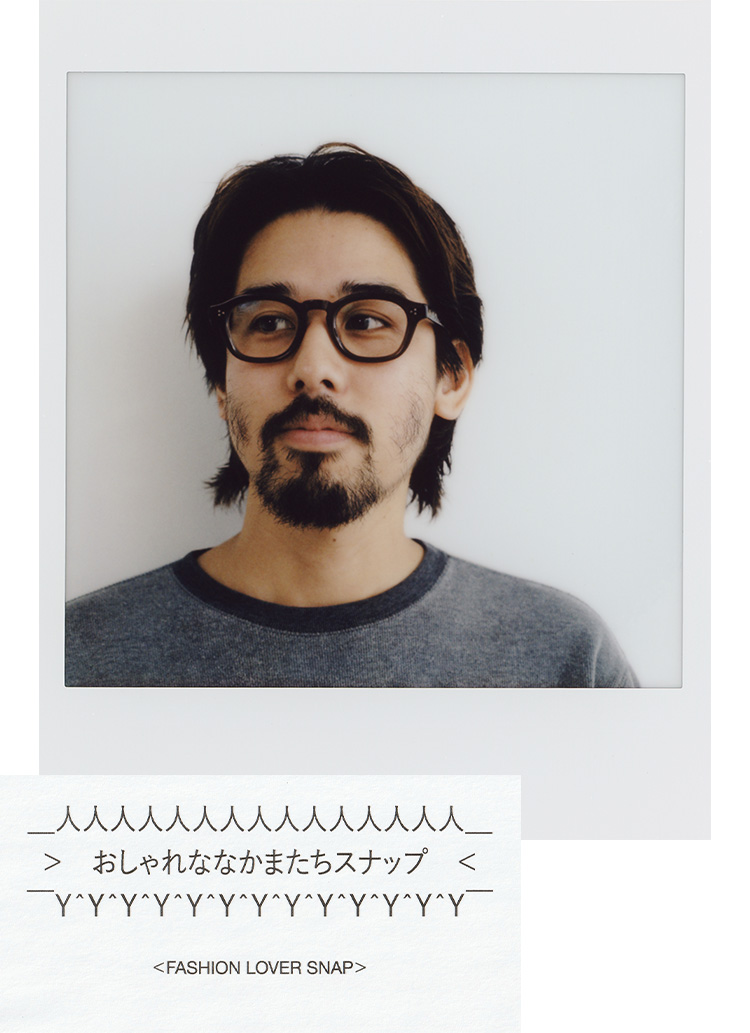
PROFILE
Representative of the architectural firm “DAIKEI MILLS.” Through projects involving commercial spaces and public facilities, he has consistently explored the relationship between people and space. In 2020, he launched “SKWAT,” a movement that temporarily occupies underutilized urban facilities and opens them to the public. He also serves as a part-time lecturer in the Department of Environmental Design at Tama Art University. He has been playing tennis for 13 to 14 years and currently uses a Wilson “Pro Staff” racquet.
Instagram:@daikei_mills
PROFILE
He works as a barber at “BARBER BOYS,” a barbershop located in Daikanyama. He is widely recognized as a man of many interests, with a particular passion for vintage items and a deep appreciation for photography and art. Although he’s only been playing tennis for about a year and a half, he’s completely hooked on the sport. Coincidentally, the first racket he ever bought was a Wilson “Pro Staff”—simply because it was an American brand.
Instagram:@yu_shimada
Shop, watch, play. The Wilson booth has it all.
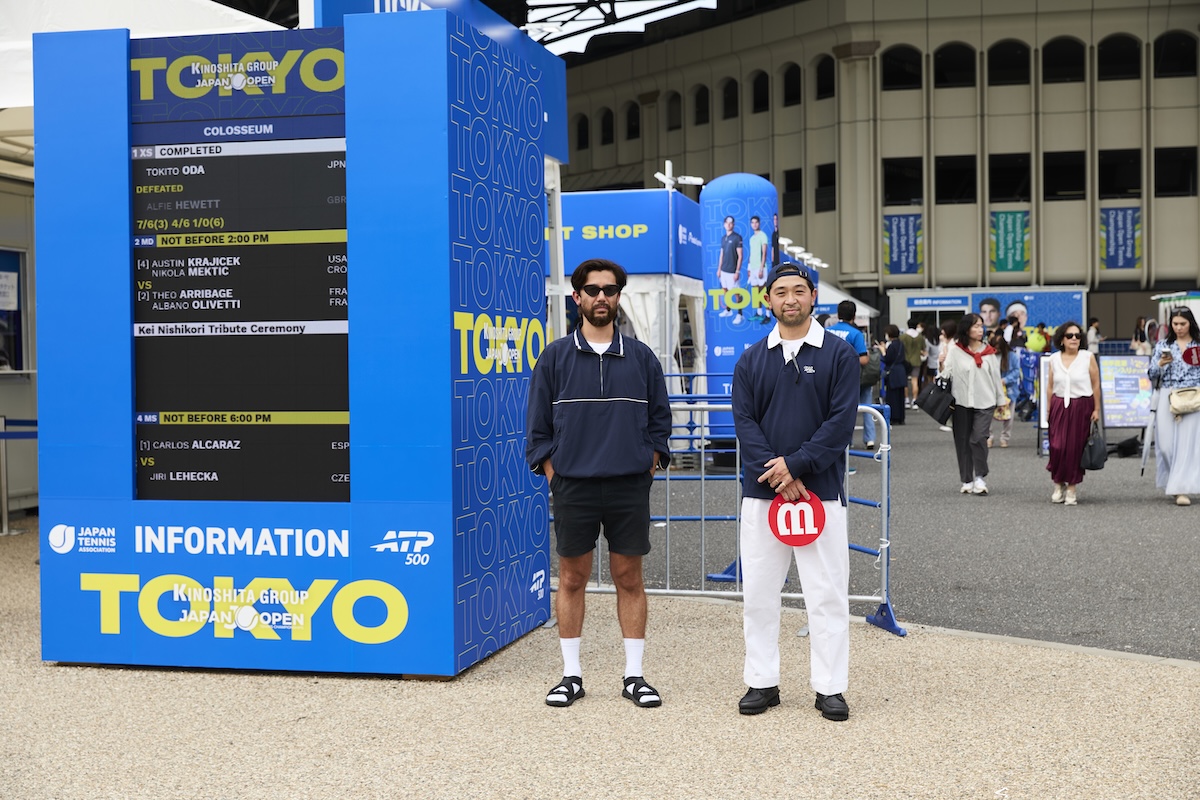
The “Japan Open” is Japan’s largest tournament, attracting top players from around the world. On the final day, the two met at the Ariake Coliseum, the venue for the event; though both were tennis fans, their experiences as spectators were in stark contrast.
Mr. Nakamura has been playing tennis for 13 to 14 years. He still practices once or twice a week, and in fact, he had come to watch the semifinals as a spectator the day before our interview. The fact that he attended the same tournament two days in a row isn’t so much because he’s passionate about reporting as it is because he simply loves tennis. On the other hand, Hiroo Shimada has only been playing for about a year and a half. Even so, he’s incredibly enthusiastic, and since this was his first time ever watching a match live, he seemed excited even before the match began.
The schedule for the day included the doubles final, a tribute ceremony for Kei Nishikori, and the singles final. Before that, we planned to stop by the Wilson booth. At this point, it felt less like a work assignment and more like the editorial staff was tagging along on a day off with two tennis enthusiasts. One of us has been playing for a long time, while the other has just started getting hooked on the sport. It’s precisely because we have these two different perspectives that even the same single point looks a little different to each of us.

Before the doubles final, we stopped by the Wilson booth. Since both of them play tennis regularly, they were very serious as they looked over the apparel. Wilson’s apparel features classic designs, so it really looks sharp on the court. Incidentally, the tops they’re wearing today are also from Wilson. Another appealing feature is how easy they are to wear in everyday life.
At the adjacent “KEI NISHIKORI MUSEUM,” visitors can view photographs chronicling Nishikori’s career and a display of autographed rackets from throughout his career. As we look back on his memorable moments, we get excited for the tribute ceremony honoring him, which will take place in a few hours.
During the event, a raffle was held at the booth for people who purchased sports apparel, offering a chance to win a racket autographed by Nishikori. Regarding professional rackets, Mr. Nakamura explained, “Even if it’s the same model as those sold to the general public, the player’s version differs in weight and fine-tuning.” Even rackets with the same name become unique tools, as distinct as the number of players using them. For tennis enthusiasts, conversations can branch out from even a few millimeters of frame difference.
Once you've finished viewing the exhibits, it's time to get moving. At the "DEFYER SNIPER" attraction booth, you'll find the new racket, "DEFYER"A target-shooting game where players aim at targets. You get five shots. Two players will wield the racquets trusted by top players such as Holga Rune and Karen Khachanov."
Those five pitches flew by in the blink of an eye. Just as they were getting into their stride, it was already over. Both Mr. Shimada and Mr. Nakamura looked like they were giving it their all, judging by their form, but unfortunately, they didn’t quite make it to the prize round…
The Reason Behind the Rally Car's Speed and Quietness.
Before long, the doubles final began. It was a highly anticipated matchup between the No. 4-seeded pair of Austin Krychek and Nikola Mektic and the No. 2-seeded pair of Theo Alibage and Albano Olivetti. The match was a back-and-forth battle, and the outcome came down to a match tiebreak played to 10 points. In the end, Klaycheck and Mektić prevailed to claim the championship.
In doubles, the reaction time is incredibly short; no sooner have you returned a fast serve than the next shot is already being smashed back as a volley. Mr. Nakamura seemed surprised, remarking, “The level of play these days is extraordinary. Until a few years ago, rallies didn’t seem to continue at this kind of speed.” Mr. Shimada, who was watching a match for the first time, reportedly learned right then that the final set in doubles isn’t played as a regular game but as a match tiebreak, where the first player to reach 10 points wins. Discovering new things like this is one of the joys of actually going to see a professional match in person.
With the excitement of the doubles final still in the air, the tribute ceremony for Kei Nishikori began at 4:30 p.m. A video looking back on his career, remarks from Michael Chang—his longtime mentor—and video messages from legends such as Roger Federer and Novak Djokovic were displayed on the Coliseum’s giant screen.
“It really drove home just how much Nishikori has been loved,” Shimada reflected. “Both Michael Chang’s words and the video were truly wonderful.” Many people in the audience had tears in their eyes, and Shimada candidly admitted, “I almost started crying too.”
Finally, it’s the long-awaited singles final. This match pits last year’s champion, Carlos Alcaraz, against Izzy Lehečka, a rising star of the next generation who is steadily making his mark thanks to his consistent play. Rehechika plays with the “PRO STAFF” racket by Wilson—the same model favored by Nakamura and Shimada. He’s decked out head-to-toe in Wilson gear, from his racket to his apparel and shoes.
As for the match itself, the first set was a back-and-forth battle that went to a tiebreak. Alcaraz trailed 2-4 but won five consecutive points to take the set. In the second set, Alcaraz broke serve at 3-3. Although Lehečka fought back with powerful shots, Alcaraz prevailed 7-6 (4), 6-4 to win the tournament for the second consecutive year.
Based on the score alone, it was a straight-set victory. However, the two players were very evenly matched. What caught Mr. Nakamura’s attention was Alcaraz’s variation in pace. In the middle of a high-speed rally, he would drop a drop shot, then deliberately play the next shot softly across the court before suddenly accelerating it.
"They can pull off plays that captivate the crowd when it really counts. That’s true of both Alcaraz and Lehečka, but I felt it was particularly evident with Alcaraz this time. The atmosphere in the arena gradually shifted in Alcaraz’s favor. I suppose that’s part of what makes him such a strong player."
“In other sports, it feels like the crowd is constantly cheering, but in tennis, you watch quietly after every shot, don’t you? I think that sense of tension is one of the charms of watching tennis,” Mr. Nakamura reflects.
Though it was his first time attending a match, Mr. Shimada had a truly memorable day. “The doubles matches were exciting to watch, but the singles matches had a completely different energy and atmosphere,” he said, clearly unable to hide his excitement. “It was my first time watching, and it was incredibly fun.” His simple comment—“It was fun”—and his satisfied expression said it all.
Just because you watched a pro match doesn’t mean your shots will suddenly get faster the very next day. But you’re bound to have gained some insights that you can incorporate into your own game. The next time you step onto the court, you’ll surely want to try out something you saw today. Their tennis journeys are far from over.