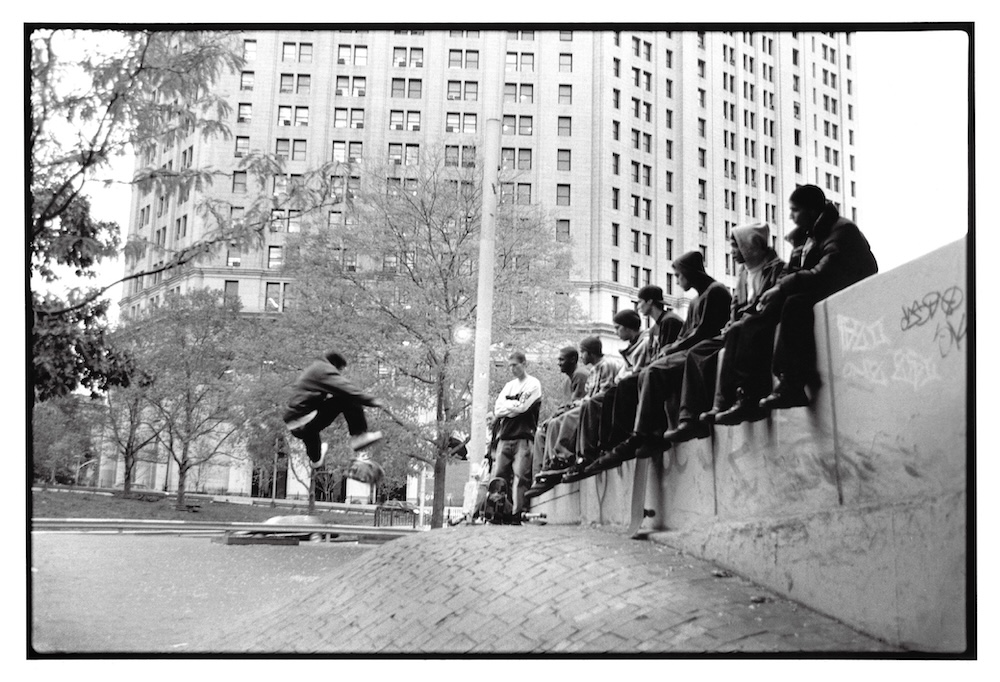
"Newyorkcity 1996-2010," a photo exhibition featuring images of the New York skateboarding scene taken between 1996 and 2010 by photographer Yuri Shibuya, will be held at "GALLERY TARGET" in Harajuku. To coincide with the exhibition, a photo book of the same name will also be published. Although Shibuya currently lives in Berkeley, California, and photographs the natural landscape and climbers captivated by Yosemite National Park, it was the New York skateboarding scene of the 1990s—which she encountered and found profoundly impactful shortly after she began taking photographs—that left a lasting impression on her.
Drawn to the local skateboarders, whose unique presence was so striking it kept others at a distance, he has continued to take photographs while traveling back and forth between Tokyo and New York for 14 years. By immersing himself in the scene, he captured numerous photographs of the everyday lives and scenes of these dedicated skaters—images that, 30 years later, have become a valuable record of New York’s culture.
Photo by Yuri Shibuya
Text & Edit_Kana Yoshioka
PROFILE
Born in Tokyo. Graduated from the Department of Spatial Design, Faculty of Fine Arts, Musashino Art University. While still in college, he began teaching himself photography while traveling around the world. In 1996, he discovered skateboarding in New York and spent 14 years photographing that community from the inside. In 2010, he began photographing climbers gathering at Yosemite National Park, and in 2014, he published the photo book *Camp 4, Yosemite*. Currently based in California, he continues to create works centered on the relationship between humans and nature.@kimurikimur
My encounter with the skaters who had gathered at Aster Place.

—What got you started in photography in the first place?
Shibuya:I was studying spatial design at Musashino Art University, and there were classes on photography and video—I tried photography then and found it really interesting. Even while I was a student, I started traveling during summer and winter breaks, and since I was into punk, I went to London. After touring all the major punk culture spots, I decided to stop by New York as well—airfare was cheap back then. But when I arrived in New York and checked into a cheap hotel in Midtown, I was so scared on the first day that I couldn’t bring myself to step outside at all. It was a kind of fear I’d never felt before, not even in Japan or London, but when I got to New York, I was so terrified it felt like my pores were opening up.
—At that time, what kind of fear did you sense in the city?
Shibuya:You get this feeling that people might attack you, and the energy of the city just feels different, doesn’t it? But that atmosphere was really fascinating. Back then, I was always carrying my camera around because I wanted to take pictures, and on my last day, while I was waiting to meet a friend at Aster Place, there were some skateboarders there. When I saw them, I wanted to take a picture, but I was kind of scared and couldn’t bring myself to look through the viewfinder. As I stood there, Quim (Caldona) (*1)—who appears right at the beginning of the photo book—came up to me and spoke to me.
—So that’s what led Mr. Shibuya to start photographing the New York skateboarding scene, isn’t it?
Shibuya:Up until then, I hadn’t been interested in skateboarding at all, and I’d never even taken a photo of a skateboard before. But when I saw skaters gathering at Astor Place (*2) in the evening—it looked like they were taking over the city—I thought it was really interesting. After that, I went back to Japan and showed the photos to a friend at college who skated, and he told me, “Those are pros.” From then on, I started going to New York every year to take photos.
I was accepted by the local skaters.
Shibuya:At first, I attended a language school, and after class, I’d go to Astor Place and watch everyone from a little ways off. Gradually, I started taking photos there in the evenings and at night. Around that time, when I asked everyone where else they skated, they told me it was Brooklyn Banks (*3). Back then, going to the foot of the Brooklyn Bridge seemed far away and a bit scary, so I wasn’t really keen on going, but when I went to check it out on the weekend, there were tons of skaters there.
Shibuya:Everyone was really friendly, and Steve Rodriguez (*5)—who had just started Five Boro (*4) at the time—came up and talked to me. After that, Steve introduced me to all sorts of people and even built me a skateboard. I started out just pushing myself along, and I was doing my best to follow him around on my skateboard like a little puppy (laughs). Since the neighborhood where I lived wasn’t exactly safe, there were times when I’d use my skateboard to get out of dangerous situations.
—So I got a skateboard, we started skating around town together, and I started taking even more photos.
Shibuya:In 1997, I started making more friends, so I began going to New York every year. In my case, I’d ride my skateboard around with them while photographing their lifestyles, but the skaters would say, “We want you to film our tricks, too.” And I’d be like, “What do you mean, ‘tricks’?” (laughs). Back then, whenever an exclusive photographer from a West Coast skateboarding magazine came to town, everyone would get excited, thinking, “If we get photographed, we’ll be in the magazine,” but unless you were a pro, it was pretty hard to get your picture taken. Around that time, I was introduced to Ted Newサム, who was the staff photographer for Transworld (*6), and he taught me how to take skateboard photos. He even created a page in Transworld to showcase my photos. That was the turning point—it led me to start going out to take photos with the skaters in New York.
—How has the skateboarding scene changed over the 14 years you’ve been filming?
Shibuya:The New York skateboarding scene was originally a local one, but as Brooklyn Banks gained fame, it felt like the local momentum started to wane around 2005. A generational shift began around that time, and it was also then that New York-based skate brands started sponsoring riders who weren’t locals. The skaters up until then were very particular about having grown up in New York City—and that was what made it so great. Personally, I was filming skateboarding not as a sport, but as a culture deeply rooted in the local community.
With respect for New York's skateboard culture.
—How did you curate the content for the photo exhibition and photo book?
Shibuya: I’ve published seven issues of the zine *Newyorkcity*, which has focused on the New York skateboarding scene, so I thought I’d compile them all into one volume to mark the 30th anniversary since 1996. However, rather than simply reproducing the original content, I’ve re-edited it to include photos that haven’t been published before. After all, I wanted to properly feature the people I’d met, and I also wanted to show my respect for those who were actually part of the New York skateboarding scene.
—Is there a message you’d like to convey through your photo book and photo exhibition?
Shibuya:I’ve been taking photos for 14 years without ever thinking, “I’ll take this because it’ll make me money.” In my own way, I’ve witnessed and experienced that era in real time, and looking back now, I truly feel I had a wonderful time. So, what I want to convey is this: you should enjoy those moments—and the time that exists only in that moment—to the fullest.
(*1) A native of New Jersey. A leading professional skateboarder on the East Coast who has been active on the streets of New York since the 1990s. He runs the wheel brand “Sushi Wheels.” His late brother, Mike Cardona, was also a professional skateboarder.
(*2) This refers to the downtown area of Manhattan, centered around 8th Street, where Broadway, 4th Avenue, and 3rd Avenue intersect. There is a subway station of the same name, and the large black Alamo Cube stands as a symbolic landmark.
(*3) A legendary skateboarding spot at the foot of the Brooklyn Bridge that has been around since the late 1980s and has given rise to countless legends. After overcoming more than a decade of closures and threats to its existence, it was fully restored in 2026 thanks to the efforts of Steve Rodriguez.
(*4) A skateboard brand founded in New York in 1996 by professional skateboarder Steve Rodriguez.
(*5) A professional skateboarder from New York and an icon of street culture. For 14 years, from 1996 to 2010, he ran the skateboard brand *Five Boro* and played a key role in reviving the legendary skate spot, Brooklyn Banks, through negotiations with the city.
(*6) A long-established media company specializing in board culture and action sports, founded in the 1980s and based in Carlsbad, California. It formerly published the magazine *TransWorld SKATEboarding* and has operated as an online media outlet since 2019.
Yuri Shibuya, *New York City 1996–2010*
Dates: Thursday, November 26 – Saturday, December 19
Hours: 12:00 p.m.–7:00 p.m. Closed Mondays
Venue: GALLERY TARGET
Address: 5-9-25 Jingumae, Shibuya-ku, Tokyo
Opening Reception: Thursday, November 26, 6:00 p.m.–8:00 p.m.
Purchase isthis way (direction close to the speaker or towards the speaker)from (e.g. time, place, numerical quantity)