PROFILE
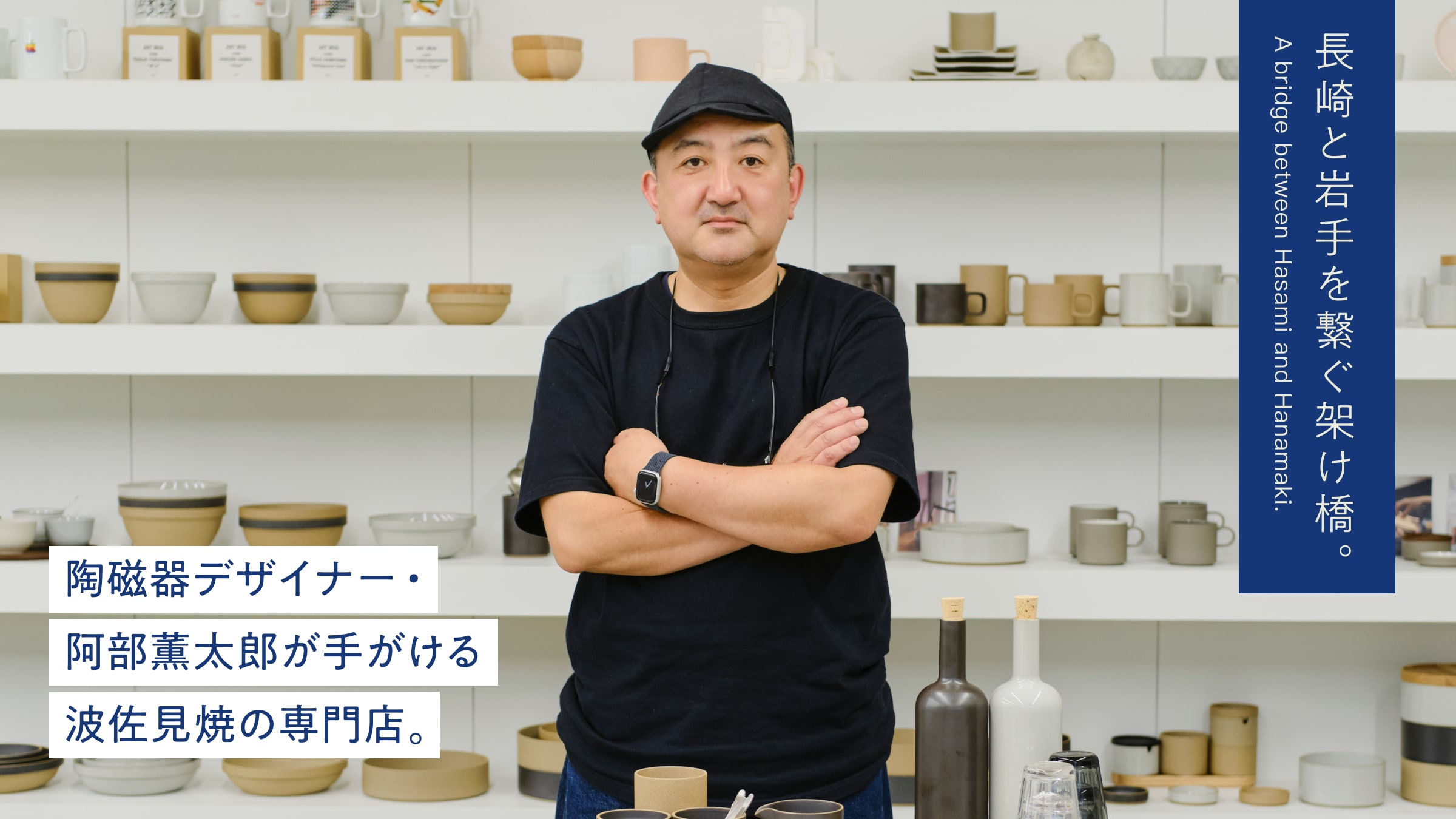
"", a general trading company specializing in ceramics based in Hasami Town, Nagasaki Prefecture,Saikai Pottery" where he serves as a designer and engineer for the company's own brand. He continues to create tableware that bridges the history and philosophy of Hasami-yaki with modern lifestyles. In September 2025, he will open a Hasami-yaki shop in his hometown of Hanamaki, Iwate Prefecture, called "C.P.D." has opened. He currently divides his time between Hasami Town and Hanamaki.
Instagram:@kuntaroabe
Ease of use over appearance.
—First of all, could you tell us what Hasami-yaki is?
Hasami-yaki is a type of pottery that developed as everyday porcelain primarily in Hasami Town, Nagasaki Prefecture. It all began during the Edo period, when potters were commissioned to create tableware for meals served on ferries operating on the Yodo River. For this reason, durability and the ability to be used without hesitation every day have always been prioritized over elaborate decorations.
—There are famous pottery-producing regions like Imari and Arita around Hasami Town, aren’t there? What are the differences between these types of pottery?
They are all made of porcelain, and the materials are almost identical. The only difference is who the pieces were intended for. Arita ware and Imari ware developed under the Nabeshima clan as high-quality items for lords to present as gifts to other domains, so many pieces are ornate, featuring gold accents and intricate designs. Hasami ware, on the other hand, was intended for everyday use, so practicality takes precedence over appearance.

—Why did porcelain production flourish in this area?
A major reason for this was the discovery of porcelain stone—the raw material for porcelain—in Arita in 1616. At that time, pottery production was already thriving in nearby Karatsu. Because it faced the sea, it was easily influenced by the continent, and the soil was well-suited for pottery production. As a result of the convergence of the pottery techniques already established in the region and this new material, the entire area developed into one of Japan’s leading pottery-producing regions.
—By the way, what’s the difference between porcelain and earthenware?
The main difference is the raw material. While earthenware is made from clay, porcelain is made from glass-like stone. Earthenware has a thick, warm texture, while porcelain is thin and smooth. Since porcelain doesn’t absorb water, I think it’s better suited for everyday use than earthenware.
—Hasami-yaki now boasts a large market share as everyday tableware, but how did it become so popular?
Actually, Hasami ware was sold as Arita ware for a long time. Since Arita ware has such strong brand recognition, it sells better when marketed as Arita ware. That’s why department stores and other retailers instructed us to affix Arita ware labels to the pieces.
However, following a series of scandals involving the mislabeling of beef origins in the early 2000s, there was a movement to reevaluate origin labeling for pottery as well, and Arita Town banned the use of labels. In response, the entire town came together and decided to shift its focus toward developing Hasami-yaki as a brand.
At that time, Hasami-yaki was positioned as a product for the general public and sold at affordable prices, which led to its spread throughout the country.