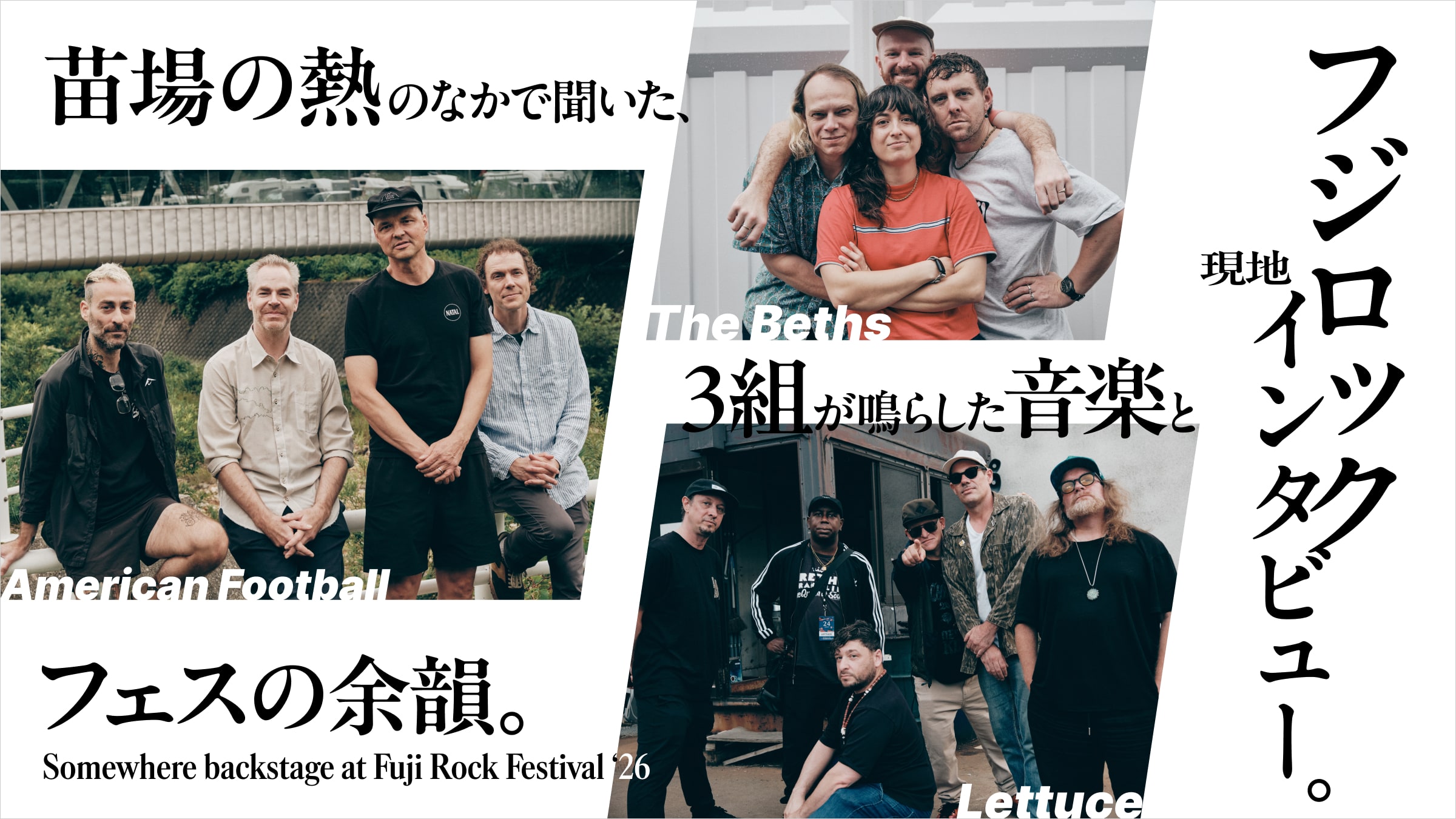
American Football
The headliner filled the RED MARQUEE with a quiet energy.
Right at the very end of the show, when they played “Never Meant,” the long-time fans went wild at the very first note, and everyone sang along! A serene, deeply resonant, and refreshing atmosphere spread throughout the venue. Mike Kinsella and Steve Holmes sat down for the interview.

—Looking back on that time when you turned the world around you into stories through your music, how do you feel when you see that, even now, long after all that time has passed, your music is still loved in countries far away?
—Looking back, how did you feel to know that the music you wrote back then—the stories inspired by your everyday lives—are still loved today, even decades later and in countries far from home?
Mike Kinsella (hereinafter referred to as Mike): I’m constantly surprised. The further away I get from my hometown, the more surprised I get. I can understand why people in a small town would take a liking to us, but…
Mike Kinsella: I mean, it’s surprising every day. And the farther we get from home, the more surprising it is. You know, it makes sense—like, maybe in that little college town, we were a band that people would like.
Steve Holmes (hereinafter referred to as Steve): Actually, in a way, I feel like we’ve kind of been inducted into a hall of fame. Just like the stars I loved when I was a kid, or those classic albums that haven’t been discovered yet, people are now talking about our records too. I still can’t believe it, and it’s really amazing. After the pandemic ended, we started playing live again in 2023, and the audience feels—how should I put it?—kind of renewed. There are more and more young people who’ve never seen us before, and I get the sense that people are still discovering this work even now.
Steve Holmes: It’s actually been canonized in a way that’s similar to the records I loved when I was a kid—like Big Star and other, like, undiscovered classics—and now our record is considered to be in the same category as those records, which is still mind-boggling and amazing. Since the pandemic, we’ve started playing shows again in 2023, and the audience seems to have, like, been revitalized—it’s younger people who hadn’t seen us before, and it seems like the audience continues to, like, discover this album.
—Has the core idea that’s important to you when creating music remained the same from LP1 through LP4?
—So between LP1 and LP4, have the core ideas or values that are most important to you when making music remained the same? It’s probably better to ask it this way. What part of it has remained the same, and what part of it has changed over time in terms of your core values or even your approach?
Mike: Our core value boils down to being honest with ourselves. In a sense, you could say we make music for ourselves, and we actually believe that’s the case. To put it bluntly, it’s a selfish approach. We can’t just try to trick people into liking our music. It feels like we’re simply turning what interests us in this very moment of our lives into sound. I can say with certainty that hasn’t changed at all.
It’s been that way since our LP1 days. From there, we ended up getting lumped into the “Midwest emo” scene, but back then, we were really just doing what we wanted to do.
Mike: I’d say the core value is that we’re kind of honest with ourselves. Like, we’re just making music—I’d say— and I truly believe that, in a selfish way. We’re not really trying to trick anyone into liking our music or anything. It’s sort of about what interests us right now, at this point in our lives. So that’s basically stayed the same. It was the same back with LP1. We weren’t really part of a scene. I mean, I know we got, like, this Midwest emo scene retroactively, like, pinned on us, but we were just kind of doing our own thing back then.
Steve: What’s more, we were actually trying to go against the grain of the scene we were part of, if anything. The only thing I can tell young people is: just do whatever you think is cool.
Steve: And in our minds, we were intentionally going against the grain of the scene we were part of. It’s like I always tell young people, “Just do what you think is cool.”
—American Football has gone through a breakup, a reunion, and two hiatuses. Frankly speaking, how do you feel about being able to make music as a band again? Is it really the power of music that brought you back together after you’d drifted apart emotionally…?
—American Football has gone through both a breakup and a reunion, as well as two hiatuses. How do you honestly feel about the fact that you’re able to make music together as a band again today? Was it ultimately the power of music that brought back together something that had perhaps drifted apart?
Mike: I’m sure all of us feel much more grateful than ever before for the fact that we can still make music. When the pandemic took that away from us, I really missed having work, having an outlet for creativity, the bonds of friendship and camaraderie, and traveling… Each and every one of those things is truly awesome, and I feel lucky to be able to do this—I appreciate it so much more than I used to.
Mike: The music is definitely something I think we all appreciate being able to do more than ever. When it was sort of taken away during COVID, I know I personally really missed having a job and a creative outlet, and I also missed the friendships, camaraderie, and the travel…. Every part of it is so cool, and I feel so lucky to be able to do it—I know I appreciate it more than ever.
—What do you think is the best part of a festival?
—What do you think is the best part of playing at a music festival?
Mike: I like it, but to be honest, I’m not really sure… It’s just so different from our usual live shows. Mentally, I’m actually having a bit of a hard time with it. At festivals, I can’t help but feel like nobody really cares that we’re playing. Do you get what I mean?
Mike: I like it, but I don't know... It's very different. It's really—mentally, I actually kind of struggle with it— at a festival, I kind of don't believe anyone cares whether we play or not. You know what I mean?
Steve: Playing at a festival is kind of a weird experience. Part of it is that there’s more to organize on-site than usual, but it’s also that you arrive at the venue, take care of everything else, and still might be able to catch one or two other bands. But I actually think that’s part of what makes it fun. There are dozens of bands there that I’d never have had a chance to see otherwise, and it’s a situation where, if I wanted to, I could probably catch them all.
Steve: It’s a weirder experience playing because there’s often a lot of logistics involved. But, you know, getting there and doing other things, and then maybe you’ll get to catch one or two other bands. I think it’s exciting to be able to say, ‘Okay, I’ll be…“ There might be a dozen bands I wouldn’t have seen otherwise, and I can see all of them now.
—Finally, please share one piece of news you’d like to share with your fans in Japan.
—Final question: Could you share a piece of news or a message for your fans in Japan?
Mike: Yeah, I figured, “I have to write ‘LP5’ so I can come back to Japan in a few years.”
Mike: Yeah, we’re like, “We’ve got to write LP5 so we can go back to Japan in a couple of years.”
PROFILE
Formed in 1997 in Illinois, USA. The band has consistently adhered to an unusual style, releasing every album—from their debut to their latest—under a self-titled name. They have been elevated to cult status as a landmark of the Midwest emo scene and continue to exert a profound influence on the scene to this day.
Instagram:@americfootball