PROFILE

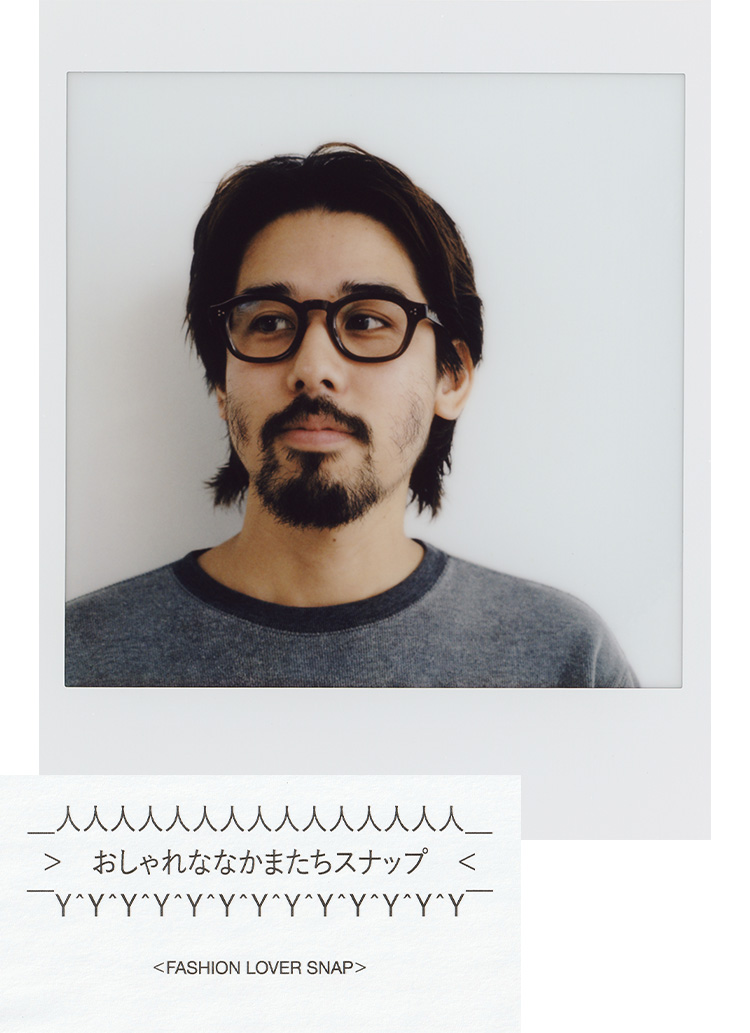
While working as an editor, she opened her long-awaited bookstore, “Stacks Bookstore,” in 2021. The store has since relocated to Jimbocho, where she continues to showcase culture—including not only books but also music, fashion, and art—from her own unique perspective.
Live the life of your hobbies in a BESS home.
BESS homes, which focus primarily on log houses built from stacked logs, have garnered enthusiastic support from hobbyists across the country. With a design that leaves room for residents to customize their living spaces as they see fit, and a versatility that flexibly accommodates a wide range of lifestyles, BESS homes are redefining the conventional concept of housing. Their freedom of design and the philosophy of “aging with charm”—where the joy of living in them deepens over time—are attracting attention as a new lifestyle choice.
This time, we visited a model home in Fujisawa City, Kanagawa Prefecture. Located near the ocean, this site features four model homes, each with its own distinct character. Maruo Yamashita, director of “stacks bookstore,” brought his personal belongings here and arranged them throughout the various spaces to reflect his four hobbies: art, home goods, books, and music. What kind of scene emerges when the character of the house blends with the items Mr. Yamashita has collected over many years? Our first stop is “WONDER DEVICE,” one of the most popular series in his collection.
Contents
BESS Homes and Hobbies.
CASE 1. WONDER DEVICE × Art In a playful room, display your favorite artworks however you like.
The “WONDER DEVICE” series is based on the concept of “devices for enjoying daily life.” While the exterior walls are made entirely of Galvalume, the interior is filled with real wood. With features like metal grating shelves and a ladder, it’s one of the models that best embodies a sense of playfulness. The building’s shape is a clean, boxy design.
“The impression I got from the outside was completely different from the one I had the moment I stepped inside—I was simply amazed. The scent of wood wafted gently through the air in a way you’d never expect from the cool, sleek look of the Galvalume. The shelves even look like playground equipment—it’s a room that really gets you excited,” said Ms. Yamashita.
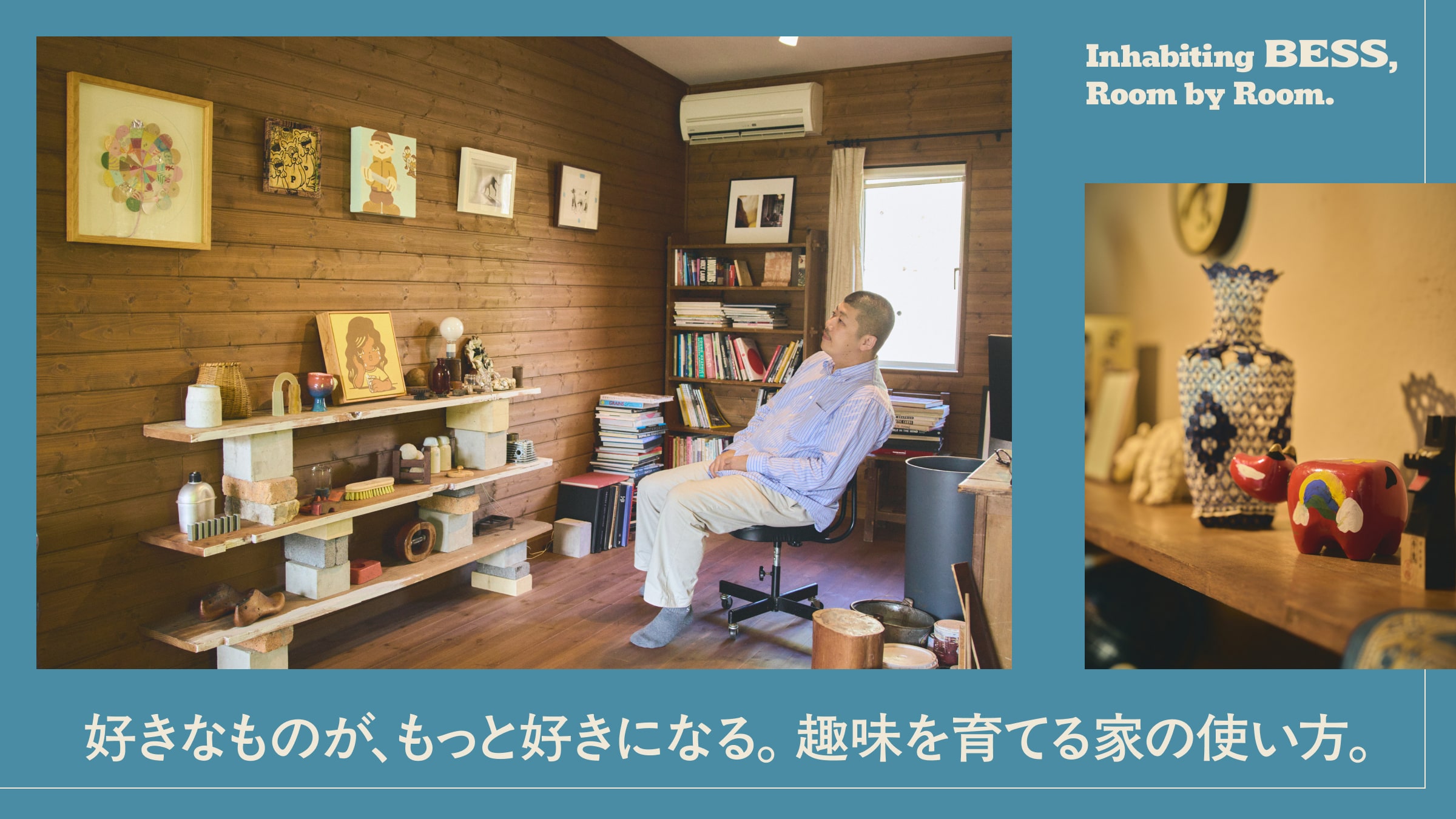
It was works of art that Mr. Yamashita began to slowly arrange in this space.
"Since there are no unnecessary decorations, there’s still plenty of blank space left on both the walls and floors—it’s perfect for displaying art. Plus, since the walls are made of wood, I can hammer nails into them without hesitation, and I think this color scheme will complement artwork of any style."
Just as he said, Mr. Yamashita decorated the wall with a wide variety of pieces—ranging from graffiti art to photographs, and from colorful works to black-and-white ones. They all fit together perfectly.
On display along the walls are works by sculptor Thomas Campbell—known for *Beautiful Losers*—as well as pieces by Fukuoka-based graffiti artist LURK and artist PUTS, who has previously held a pop-up exhibition at “stacks bookstore.”
On the shelves are sculptures by glass artist Baku Takahashi—whose work is collected by enthusiasts around the world—as well as tableware by ceramic artist Satoshi Miyashita, who exhibits in various countries, and graphics by graffiti artist ZECS, who just recently held a solo exhibition at “stacks bookstore.” A massive photograph by photographer Shinichiro Shiraishi is casually displayed by the window. Although we often use the term “art” in a general sense, Mr. Yamashita’s collection is truly diverse.
It’s said that the ways people discover these artists and their works vary. Apparently, it’s actually quite rare to learn about them through word of mouth; instead, people often discover them by regularly checking out galleries and shops that catch their interest and going to see the exhibits in person.
So, how do I interact with art in my current home?
"Basically, I have art pieces displayed in every room—it’s like every available space is filled with art. Even so, I still don’t have enough space, so there are times when pieces are stacked in multiple layers all over the place… I swap them out every now and then to freshen things up. But “If I lived in ‘WONDER DEVICE,’ I could display as much art as I want, and I think I’d even be able to display large pieces that I wouldn’t consider buying right now.”
This isn’t simply a matter of “more storage” or “more space to display things.” Whether or not you have enough display space is directly linked to “what you’ll want next.” In my current home, there were pieces of a certain size that I’d unconsciously ruled out because I couldn’t find a place for them—but the moment I saw the expanse of this wall, they immediately became viable options. When your home changes, the very criteria for what you collect change as well.
This truly embodies the idea that “your home nurtures your hobbies.” This applies not only to art, but to all kinds of hobbies.
Galvalume on the outside, real wood on the inside. Metal shelves with rugged details reminiscent of playground equipment. Different materials and elements coexist seamlessly. The structure of “WONDER DEVICE” is surprisingly well-suited to Mr. Yamashita’s approach to decorating—he doesn’t stick to a single style but simply keeps adding items to the walls as they catch his eye.
CASE 2. A Home in Moderation × Home Goods Bring the warmth of handcrafted work to a room with a sense of grandeur.
Next, we visited “The Moderate House.” It is the most solid and stately series in the lineup.
The spacious earthen-floored area serves as both an entryway and a place to light the wood-burning stove. By seamlessly connecting it to the adjacent deck, the design intentionally blurs the boundary between inside and outside.
Bamboo is used for the partition doors, and the ceiling has a texture reminiscent of the traditional Japanese “nijiro” bamboo weaving. The rough-hewn wood also exudes a sense of traditional Japanese design.
With a look that’s somewhat reminiscent of a traditional Japanese house, it perfectly embodies a passage from the *BESS* catalog that reads, “Neither over-engineered nor over-decorated.”
“I really liked the spaciousness and sense of openness of the earthen-floored entryway the moment I walked in, and it’s a home that feels warm and inviting,” said Yamashita. “Also, it somehow reminds me of the vacation home my great-aunt used to have in Karuizawa, so it feels very comforting. Personally, it was my favorite house.”
This space features a selection of miscellaneous goods, primarily folk art and traditional regional toys.
"It’s a space with a solid, substantial feel, yet it also has a traditional Japanese atmosphere. So, I naturally found myself wanting to display a variety of items—from folk art and crafts to other artisanal goods. Basically, I want to keep things casual when it comes to decorating my home. While I have a foundation, I still feel free to display whatever I personally like. This applies to everything—I love a mixed-and-matched look, so I don’t want everything to be perfectly uniform.”
Here, you’ll find “Aka-beko,” a traditional folk toy from Aizuwakamatsu in Fukushima Prefecture—where my mother’s family is from—as well as a wooden carved bear from “Spacy,” a thrift store in Shizuoka, an American-made flower vase woven from buttons, “Pekori Glass” by glass artist Kohei Komaki, and vintage wooden toys from the USPS (U.S. Postal Service)—items from all genres, regardless of age or country of origin, are displayed here.
“I’m a big fan of stencil-dyeing artist Keisuke Serizawa, and I make a point of visiting the art museum whenever he has an exhibition. I think Serizawa is particularly skilled at seamlessly blending elements of different natures, and I believe I’ve been influenced by that to no small extent. I like the way it encompasses both Japan and America—and how the old and the new coexist.”
He says he’s recently picked up a new hobby: pottery.
"As I’ve been visiting various galleries and shops again, I’ve come to realize just how fascinating pottery is. Even though it’s something we use every day, it often reflects the artist’s unique style so strongly. And even among mass-produced items, there are some truly unique pieces. Lately, I’ve been gathering information by visiting exhibitions that catch my eye and stopping by roadside stations in rural areas."
I also came across the pottery of Fukuoka-based artist Ryuta Fukumura and the works of Yasuhiro Sasaki from Mashiko as a result of that fieldwork.
"I said earlier that I 'don't want to unify things,' but looking at it this way, I think this is something that could only have been achieved in this space. It's as if the house has a certain depth of character—or perhaps, strangely enough, things that should be disparate somehow come together without clashing."
Don’t overdo it. Don’t make everything too uniform. And leave some breathing room so it can adapt to any resident. It’s perhaps because of this BESS philosophy that Mr. Yamashita’s diverse collection fits in so naturally.
CASE 3. G-LOG Summer × Books I satisfy my desire to read on my open-air balcony and in my cozy hideaway.
The third home is “G-LOG Natsu.” With white-painted ceilings and walls, this model exudes a bright, modern atmosphere. It’s said that quite a few people fall in love with the triangular roof at first sight and decide to buy.
Its most distinctive feature is the spacious balcony on the second floor. Named “NIDO” (meaning “nest” in Italian), it’s a space where you can use it however you like—whether that’s displaying plants or enjoying a family meal in a picnic-like atmosphere. The small room built into the tip of the triangular roof is also a popular spot.
"An open balcony and a small room at the top of the ladder. Under the same roof, there are two spaces that are complete opposites. When I saw this place, I thought it would be a great spot to get some reading done. I figured I could switch between them depending on my mood or the book I’m reading."
Speaking of Mr. Yamashita, he’s an avid reader—so much so that he’s often featured in magazines. He curates the selection at his own store, “stacks bookstore,” in Jimbocho, and apparently still buys a lot of books every month. He’s such a book lover that he finds time to read from morning till night and even takes the train just to read. He always carries two books in his bag.
Now, on the sofa on the balcony were a guidebook to horror movies—a genre he himself loves—titled *A Super-Contemporary History of Horror Movies* (DU BOOKS); a food-themed novel, *Omelet of the Sea and Mountains* (Shincho Crest Books); *Goodbye, Money Worship* by Yamazaki OK Computer (Rokusho), which explores the value of money from a fresh perspective; and a collection of works by Margaret Kilgallen. She says that whether it’s humanities, fiction, art books, or photo collections, if something catches her interest, she makes a point of reading it.
"I carry books with me not just in my daily life, but even when I'm traveling. I love reading in a room with a nice view. Of course, it probably depends on where the building is located, but this place also has a spacious balcony with a panoramic view of the outdoors, so it gives me a similar feeling. It seems like I'll be able to fully immerse myself in my own world and read a book at my leisure. And when I want to be by myself, I can retreat quietly to the room upstairs.”
Reading is actually a hobby that depends on your surroundings. By creating the right environment, you can immerse yourself in it even more. On a sunny day, feel the gentle breeze; on a rainy day, let the sound of the rain serve as your background music—you’ll probably find yourself turning the pages faster.
CASE 4. COUNTRY LOG × Music Enjoy music even more by taking advantage of the properties of wood.
The last place we visited was “COUNTRY LOG.” It’s a genuine log house built by stacking hand-hewn solid wood logs.
Beneath a large, gently sloping roof, the earthen-floored entryway and open-concept space extend seamlessly up to the upper floor. With minimal partitions, the high degree of flexibility—which allows for unrestricted use of the space—is one of the home’s key attractions. The catchphrase that 〈BESS〉 has adopted for this series is “1/f fluctuation.” This refers to that pleasant, gentle fluctuation found in natural sounds and light—neither too regular nor too irregular.
Although this concept is often associated with the flickering flames of a wood-burning stove or the irregular grain of wood, this time it unexpectedly overlapped with the theme of “music.” As it happened, what Mr. Yamashita wanted to enjoy in this house was, coincidentally, “music.”
"It's really just a coincidence, but I thought it would feel great to listen to music while soaking up the sun in this space up the stairs."
Mr. Yamashita originally loved records and collected them. At the height of his collecting, he had so many records that they filled an entire room, but eventually he lost control of his collecting and decided to get rid of them all at once. Even so, his passion for music never waned, and he now spends his days listening to CDs both at home and at the store.
The audio equipment he brought in was the final-generation model of the “Soundwave,” known as a classic BOSE product. He said he bought it about 10 years ago.
"Not only does it have a soothing sound that isn't too high-pitched, but I also like the way it looks. I use this both at the store and at home, and even at about 20 percent volume—which is saved as a preset—it's already plenty loud enough."
And now, the CDs Yamashita collects aren’t just any CDs—they’re mix CDs. He also plans and produces mix CDs at his own store about once a year. He says one of the charms of mix CDs is that friends who haven’t seen each other in a while can exchange them as a way of catching up. On this day, he brought about 20 mix CDs, including some from “EPOCH,” a shop in Kobe that was also sold at “stacks bookstore,” and others he received from DJ HOLIDAY.
"I've always loved compilations and mixtapes. Unlike streaming services, with MIXCDs you can enjoy the album art, and the sense of satisfaction you get from owning a physical copy is completely different. Come to think of it, I actually first learned about Tatsuro Yamashita through one of MURO's mixtapes (laughs)."
By the way, log cabins are made entirely of wood, so sound reverberates very softly inside them. Wood has the unique property of absorbing sound to just the right degree while also allowing it to echo. As proof of this, concert halls are almost entirely constructed of wood. “It’s true—the sound does seem a bit softer,” said Mr. Yamashita.
Mr. Yamashita says it was intuition that made him want to listen to music in this space. However, it’s actually tied to physical factors—such as the acoustics of the log cabin—as well as the home’s overall concept. Perhaps even behind a “hunch” lies a valid reason.
"Another thing I really liked about the 'COUNTRY LOG' is that it has fewer partitions, so compared to other models, you can sense someone’s presence no matter where you are. The music I play here will probably carry into the other rooms, too. It’s really easy to imagine what life with my family would be like here."
When you move to a new home, your hobbies will expand even further.
After we had finished touring the rooms, I asked Mr. Yamashita once again about the appeal of *BESS*, and he replied as follows.
"What struck me most was the texture and the warmth. You can feel the wood no matter where you are, and with so many windows, you feel close to the outdoors. I think my hobbies go well with a log house, and the atmosphere was exactly what I was looking for."
Although Ms. Yamashita grew up right in the heart of the city, she says she still harbors the same longing for the vacation home in Karuizawa where she once lived. She goes on to say:
"Since my work and hobbies are pretty closely connected, my personal space is very important to me, and I want to be able to quietly focus on the things I love. That’s exactly why my home is so important to me."
Rather than going out with others to share experiences, he would stay home alone and immerse himself in his hobbies. By nurturing his hobbies in this way, Mr. Yamashita developed his own unique aesthetic sensibility.
In a home by 〈BESS〉, your hobbies will expand and deepen… The connection between your home and your hobbies may be stronger than you realize.