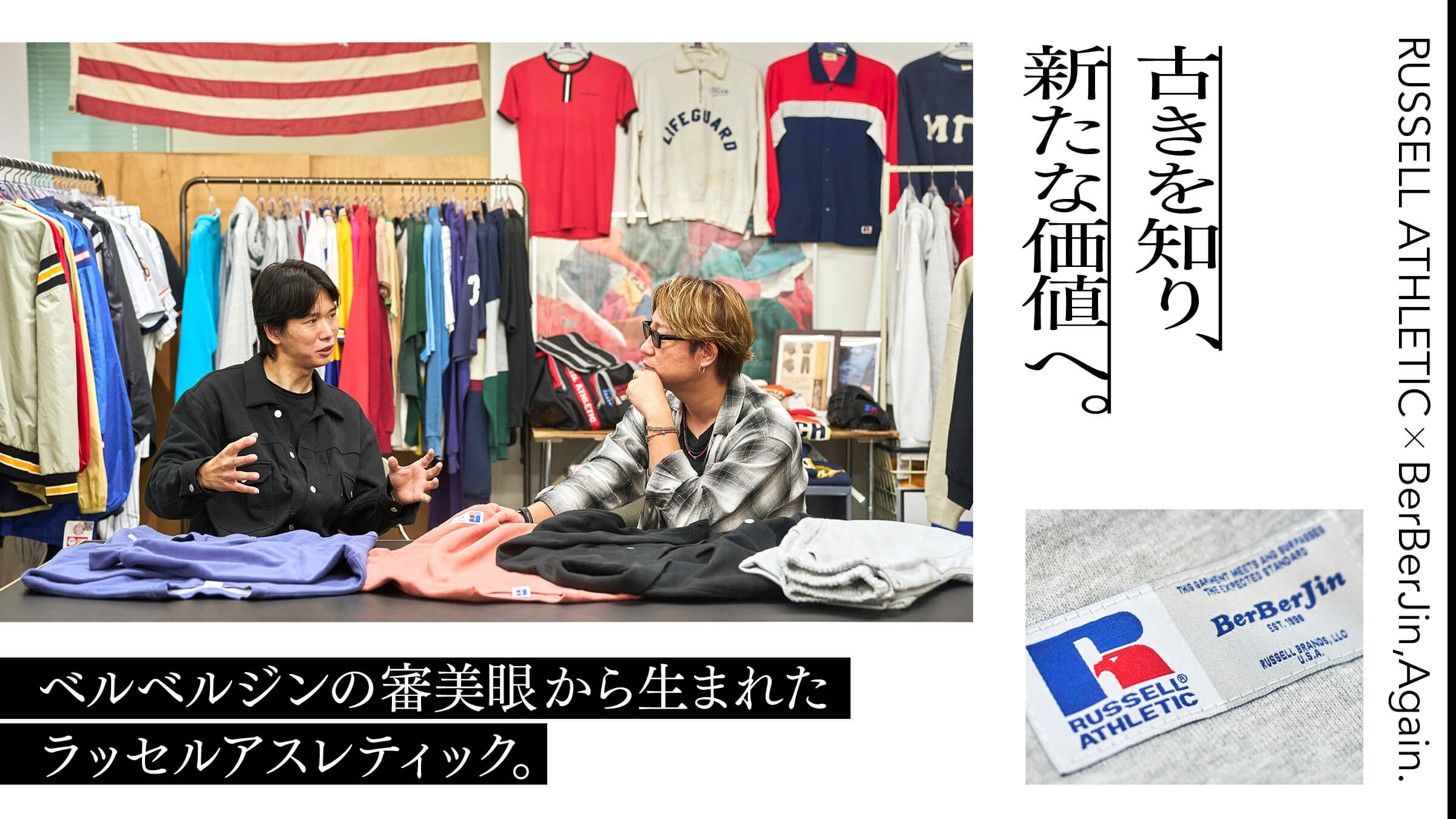
Drawing on our expertise in vintage clothing, we’ve reimagined these pieces to suit today’s trends.
—The collaboration announced this time is a collection with a very different feel from the last one. Why didn’t you base it on the *Russell* archives this time?
Ando:Since I was able to convey some of the depth of the “Russell” brand in the first collection, this time—as a step forward—I really wanted to create clothes that capture the current vibe.
Makita:On top of that, I felt I needed to bring out the unique “Berberjin” style. So I thought it might be interesting to make the trucker jackets and workwear—which have become synonymous with the shop’s image—out of sweatshirt fabric.

RUSSELL ATHLETIC × BerBerJin
Pro Cotton Loopback Terry Sweat Trucker Jacket ¥26,400
A denim jacket commonly known as the “Second Type”—long beloved in the vintage market and a staple at “Berberjin.” We’ve reimagined its iconic details using Pro Cotton, a 12.5-ounce heavyweight sweat fabric. Available in three colors: ash gray, navy, and black.
—While many brands have released “Second Type” tracker jackets, it’s rare to see one made from sweatshirt fabric.
Makita:That’s right. I was thinking, “When it comes to trucker jackets, the Second model with two pockets is better than the First,” when Yutaka (Fujiwara, director of BerBerJin) said, “Well then, bring me an authentic one,” and lent me a size 50 jacket from the ’50s.
The 507XX, provided as a sample by Mr. Fujiwara of “Berberjin.” We have the extremely rare size 50 in stock.
Ando:While the overall construction specifications follow those of the original Second model, adjustments have been made to the pattern and silhouette.
I think the sloping shoulders are particularly easy to spot, and vintage secondhand pieces are, of course, stylish. But when you look at them as actual clothing, they’re not exactly functional. So, by lengthening the body and adjusting the armhole design, we’re updating them for the modern wardrobe while preserving their vintage aesthetic.
Makita:We create our own original patches and pay close attention to the details, while designing patterns that are easy to wear casually in everyday life.
Ando:The other pair of double-knee pants was one of the items I really wanted to include this time, since we didn’t release any bottoms during our first collaboration.
RUSSELL × BerBerJin
Pro Cotton Loopback Terry Sweatshirt with Double Knee Pads PT ¥22,000
Among the painter pants that epitomize American workwear, this double-knee style enjoys immense popularity on the vintage market. By reimagining the design using heavyweight sweatshirt fabric, we’ve created a piece perfectly suited for urban wear. Available in three colors: ash gray, navy, and black.
Makita:Even if I had just made sweatpants based on a 5-pocket jeans pattern, I didn't think I'd really want to wear them myself (lol). So I figured, since I was going to make them anyway, I might as well create a pair of work pants with a medium-wide silhouette—the kind I actually want to wear right now. That's what got me started.
The inspiration for this design comes from a 1970s Carhartt, and back then, the cut at the double-knee area was set much further in—which looks really cool.
Following the style of 1970s Carhartt, the double-knee patches extend all the way to the belt line.
Ando:Since the double-knee design naturally gives the pants a substantial look, I added a drawstring and belt loops at the waist. I think the finished product looks more like a proper pair of pants than your typical sweatpants.
Makita:I used to hate how sweatpants always looked too loose—and in some cases, even looked like pajamas. These are substantial and rugged, but since they’re sweatpants, they look and feel great. I think I’ve managed to strike just the right balance.
—It’s true; both look so well-made that you wouldn’t think they’re made of sweatshirt fabric.
Ando:The material I used this time is called “ProCotton.” It’s a newly developed fabric based on samples of a material that has been produced for athletes since 1989, and it’s a fairly thick and sturdy fabric weighing 12.5 ounces.
Since this fabric was originally designed in the U.S. with the idea that “you should wear it for a long time and let it mold to your body,” when I heard about this project—which is based on denim and workwear—I immediately thought, “ProCotton is the only choice.”
—In terms of “breaking it in,” this fabric feels similar to denim, doesn’t it?
Makita:That's right. I hope you'll enjoy watching the sweatshirts age over time.
RUSSELL × BerBerJin
Nu Blend™ Double Face CN Sweatshirt ¥15,180
This double-faced design features the ”Nu Blend™ Sweat”—a medium-weight cotton-polyester brushed fabric developed in 1991—lined with a tightly-woven jersey. It’s versatile enough to wear year-round and offers a light, comfortable feel. Available in three colors: charcoal, navy, and black.
—What about the sweatshirts being released at the same time?
Ando:As for the two styles of crew-neck sweatshirts, the concept might be similar to updating the vintage archive.
This crew-neck sweater is double-faced, but the reverse side is made of tightly woven T-shirt fabric rather than sweatshirt fabric.
Makita:〈Russell〉 released double-faced sweatshirts in the ’70s and ’80s, and they’re popular on the vintage market. But to be honest, there’s the question of, “When on earth should you wear a double-faced sweatshirt?” (laughs). So I consulted with Mr. Ando, and he advised me, “Why not use a tightly-woven jersey fabric for the lining?”
Ando:The knit fabric is a 50% cotton/50% polyester fabric called “New Blend,” which has been available under Russell’s red tag since around 1991.
Personally, whenever I think of “Russell,” this fabric comes to mind, so I thought it might create an interesting contrast if I combined it with a sweatshirt.
Makita:As for the color scheme, I wanted to capture a faded look that evokes the scent of the ocean. That’s why, instead of using a deep navy, I deliberately chose a faded, vintage-like shade. The two of us sat together with a faded vintage piece in front of us, holding up a color chart and discussing various options until we finally settled on it.
—The fabric color is custom-made, too, isn't it?
Ando:That's right. Also, the combination of a crew neck and a kangaroo pocket is quite rare in the archives. However, both in terms of design and practicality, a crew neck with a kangaroo pocket is really cute. I think it's a style that can be worn by anyone, regardless of gender.
Makita:Personally, I also really like the curve of this kangaroo pocket and the piping details. It’s a design so frequently used in their archives that even if you don’t look at the tag on a vintage piece, just seeing this part is enough to make you think, “Oh, that’s Russell.”
RUSSELL × BerBerJin
Pro Cotton Slub Loopback Terry Brushed Elbow Patch Sweatshirt ¥18,480
By using slub yarn for the weft in the Pro-Cotton fabric, we’ve added a heathered effect and natural irregularities, creating a heavyweight yet textured look with depth. The design features vintage-inspired faded colors and elbow patches. Available in two colors: pink and beige.
—I hear the other sweatshirt also uses Pro Cotton, but the texture of the fabric is quite different from that of the track jacket and sweatpants.
Ando:This fabric is also made to be 12.5 ounces and the same thickness, but we’ve given it a slightly slubby texture.
—Do you have any slub sweatshirts in the 〈Russell〉 vintage collection?
Ando:I guess I was just wondering if there was anything that looked a bit like slub fabric. This is a fabric we developed when I joined the design team, with the intention of trying something new—we even made the ribs slub-like to match the texture of the fabric.
Makita:I liked it the moment I saw it, too, and it made me want to go with a color that wasn't the usual choice. Plus, since the fabric itself has such a distinct texture, I thought adding pockets might be a bit too much.
So, we've added elbow patches, like those found on work chambray shirts, to give it a slightly football-shirt-like look.
Ando:We’ve also designed the pile on the reverse side of the fabric to have a slightly worn-in look, reminiscent of vintage pieces. Some of our staff asked, “Why not apply a vintage finish?” But since we’re making this as a brand-new item, we’d rather have it age naturally through wear and tear—rather than making it look old artificially. That’s why we’ve limited the treatment to just a wash.