From Haneda to JFK. Back to this place again.

One sunny day in October. Takaho Ohashi was in the East Village, where autumn had arrived a little earlier than in Tokyo.
He’s lost count of how many times he’s been to Manhattan. It’s been four months since he was last here.
This year, Ohashi had more opportunities than ever to experience the energy of New York. Ohashi flew to New York the month after seeing the Wu-Tang Clan’s live performance in Yokohama—their first visit to Japan since 1997 and their final one—deliberately timing his trip to coincide with the NBA Finals. As a result, the Knicks won their first championship in 53 years, and the city was buzzing with excitement.
Feeling that it was a strange coincidence, I suggested to Ohashi that we do a photo shoot in New York, and he adjusted his schedule—which already had several prior commitments—and readily agreed.
"It was truly an honor for me to be able to shoot with her."
Sue Kwon. A photographer based in New York since the ’80s and deeply connected to the city’s culture, she has captured the rise of hip-hop by photographing a stellar lineup of artists—including her work for *The Source*—while also chronicling the daily lives of ordinary people whose names she doesn’t even know. Ohashi, who discovered hip-hop in middle school and became obsessed with it, was also one of those who grew up looking at her photographs without even realizing it.
“I’d heard Sue’s name mentioned before—by the close-knit Supreme crew and at the gold jewelry store I frequent—so to me, she’s always felt like one of New York’s icons. When I actually met her, she was a bundle of energy. I think New York City itself is that kind of place, but what everyone who survives here has in common is that they’re incredibly energetic, just like her. And they’re loved by the city and its people. I felt that Sue was a person with a deep capacity for love, and I realized that this is exactly what it means to be someone who’s lived in New York for so long.”
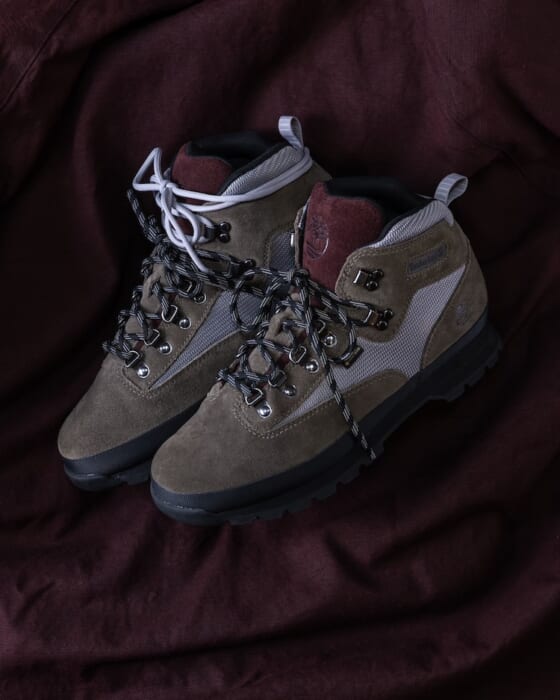
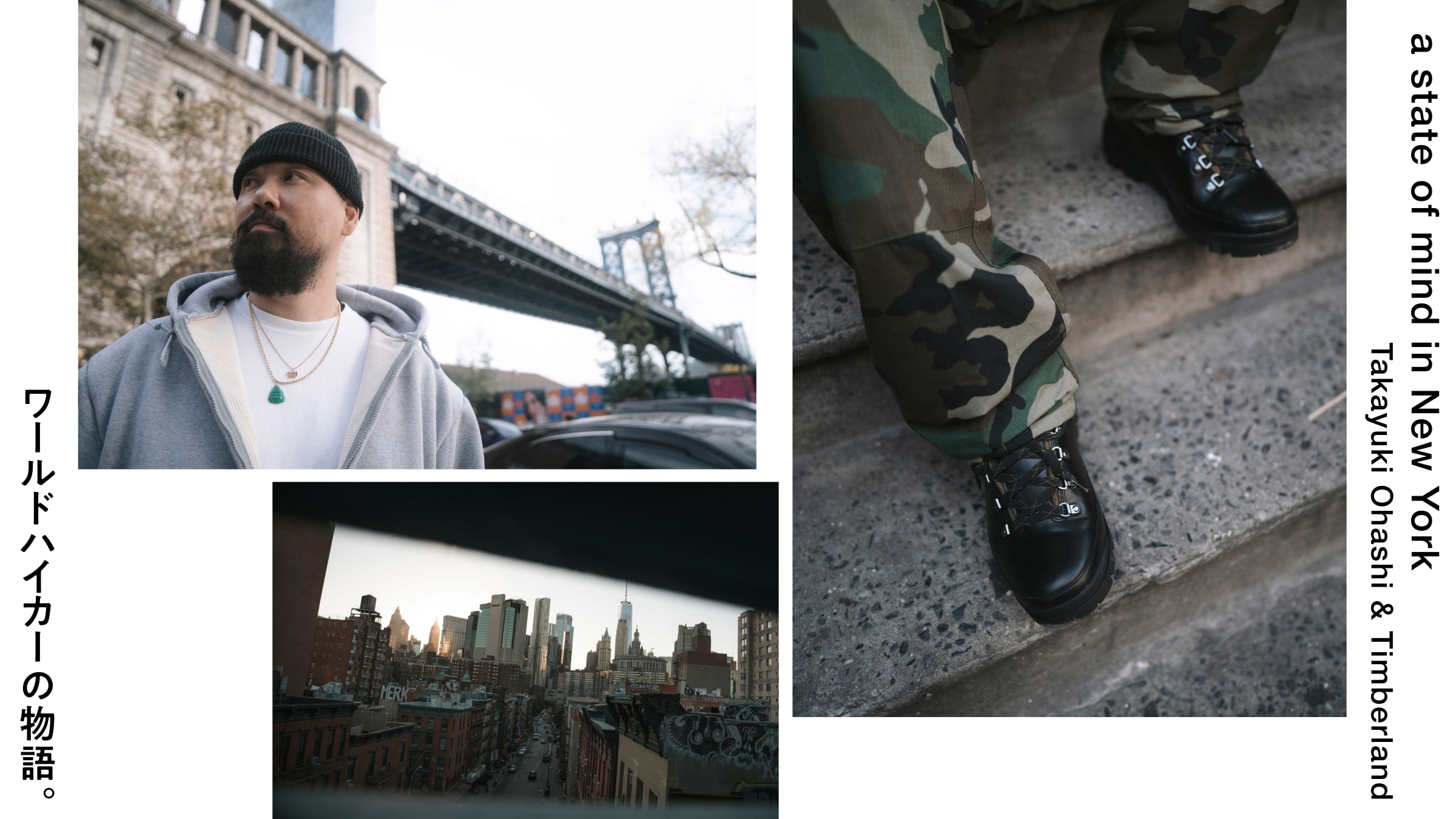
Ohashi, who joined us on the day of the shoot, was dressed in a Camber hoodie, Woodland Camo cargo pants, and Timberland World Hiker boots. With his vast archive of vintage clothing—and given that he often wears such rare pieces even when traveling—his classic choice may have been a nod to his roots.
“I first came to New York when I was 30. My first trip was for buying trips. I seem to remember wearing a pair of Beebro (field boots) back then, too. As I came here more and more, I got used to it and started wearing sneakers, but at first, I figured that since I was going there to shop for things I liked, I should wear the clothes and shoes I liked.”
From the Lower East Side toward the Manhattan Bridge. The shoot took place over the course of a long day as we wandered through downtown. As Su walked alongside me, the yellow Vibram sole stamp was occasionally visible on the back of his boots. While Timberland boots are a familiar choice for him, he says the World Hiker model feels a little different from his other pairs.
’I absolutely loved Bootcamp Click, and I used to watch a VHS called *Duck Down Visuals* over and over again. I’m pretty sure the World Hiker came out in “94, but in the music video for *Buck Em Down* (by Black Moon) that was included on that VHS, the person in the background was wearing a pair of World Hikers. I saw other artists wearing them after that, too, but whether it was the yellow nubuck or the Beebro, those World Hiker boots with the ”ALL WEATHER’ label seemed more special and functional than any other Timberland boots.”
He first wore Timberland boots when he was in high school. He said he bought a pair of Field Boots at a shoe store in Suidobashi, which was close to his school. The store is long gone, and he can’t even remember its name, but its racks were lined with World Hiker boots in original colors like brown and taupe. Back in the days when only parallel imports were available, it was only natural that he would have formed such an impression of the World Hiker, which cost far more than today’s list price.
Now that he carries those shoes at the store he runs with his friends, he has visited New York—a city he once knew only from magazines and TV—many times, and acquaintances who happen to spot him on the street have started to say hello. When I asked him if he felt accepted by the city he had once longed for, he gave me an unexpected answer.
"I still don't feel at all like I've been accepted here (wry smile). Or rather, I don't think there's any way I could ever be accepted. When I put together a New York-themed playlist, I’ll include songs like ‘Englishman in New York,’ but I’m still an outsider—I’ve always felt that way, and I think the people who live there probably feel it too. After all, I’m not a New Yorker—I’m from Tokyo.”
A cityscape that always feels somewhat aloof, no matter how much time passes—a place where you still sense a certain distance even when you get deeply involved. That is precisely why anyone can be there—it’s a place that belongs to no one. Ohashi, who grew up in Tokyo, had sensed this relationship between the city and its people since his boyhood. No matter how much he longed for it, or how many acquaintances he made, his demeanor in New York remained unchanged.
“I think everyone feels this way, but when I was a teenager, I got a little too cocky and learned the hard way—and through those experiences, I gradually became more low-key, or rather, I think I matured. If I’d first come to New York when I was 19, things might have been completely different, but I came here after I’d already matured quite a bit. I’m really happy about it, but for example, when I’m negotiating prices in cash while buying merchandise, I never smile and make sure not to show my teeth. From the very beginning, I was very conscious of interacting with people without getting too excited, but always with sincerity.”
An awareness of being an outsider—how one should conduct oneself in someone else’s town. That strong sense is always present within Ohashi. “When someone comes from another town, they’re essentially representing that place, aren’t they?” he says, and continues:
"Of course, I'm here in New York as a Japanese person and a Tokyoite, but I think it's a little strange that I feel like a different person when I'm in New York compared to when I'm in Tokyo. That's why I try to be as friendly as possible to people, just like I would back home."
In Japan, when you meet someone with foreign roots, you can usually tell right away whether they live there or are just visiting. While it’s heartwarming to see tourists getting excited and a bit giddy, they will surely never become a part of the daily lives of the people who call that place home. What strongly captivated Ohashi during his visit to New York—a city he once actually visited—wasn’t the picturesque landmarks or trendy hotspots, but rather the places and shops where he could truly sense the lives of the locals.
“Take Macy’s in *Miracle on 34th Street* or Fifth Avenue, for example—isn’t that the kind of New York you see in movies and guidebooks? Even if you aren’t blatantly turned away because you’re recognized as a tourist, I think there are still doors that remain closed to you there. For example, if someone visiting Japan from overseas says, ‘When I’m busy and short on time, I eat at Fuji Soba,’ you’d think, ‘This person really gets it,’ right? (laughs) I think people are judged very much by the city in that way. That goes for what you wear, the music you listen to—and even the restaurants you choose to eat at.”
After the photo shoot with Sue was set, Ohashi hardly made any specific requests of her beforehand. He simply told her, “I’d be really happy if you could take the photos at a place that captures the feel of Old New York.” I’m sure that was his own way of showing respect for what he admired—and that there was a certain etiquette involved.
- 1
- 2