Sara Finchley's accessories are based on her memories of old things she encountered at churches and antique markets in England, and her craftsmanship, which she shapes through repeated trial and error. We traced the roots of the brand's silver accessories with buyer Ms. Nakamura in anticipation of the order-taking event to be held at "Reshop Aoyama" from April 28 (Tue.).
- Photo_Kae Minami
- Edit&Text_Shun Koda
PROFILE
This brand was launched in 2023 by a designer who previously worked as an accessory designer for Yohji Yamamoto. The brand's activities range from jewelry, bags, and hats to collaborations with textile sculptors.
PROFILE
He joined BAYCREW'S in 2008 and started his career at "JOURNAL STANDARD". Currently, he is a buyer for "Reshop". He knows the depth of universal clothes, biased clothes, clothes with roots, and clothes without attributes, and continues to search for clothes that allow him to share the joy of choosing.
“Trial-and-error manufacturing cultivated through ”fun wins the race.
long vowel mark (usually only used in katakana)I understand that you originally worked at Yohji Yamamoto. What is your background?
Sara:Actually, before joining Yohji Yamamoto, I worked for another apparel company. I quit after about a year there, but when I knocked on the door after that, I was told, "Well, come here tomorrow. From there, it was a hectic 17 years until I quit.
long vowel mark (usually only used in katakana)Were you involved in design work all the time at that time?
Sara:That's right. I originally wanted to work in clothing because I had a textile background, but I was told, "You are in charge of accessories. Since then, I have always been in charge of accessories. However, up until then, I had only been making clothes, so I had absolutely no experience with accessories. The day after I joined the company, my bosses told me that it sounded interesting and that I should give it a try, and I was given the chance.
Nakamura:It's a good time. Nowadays, you can't help but worry about your background and accomplishments.
long vowel mark (usually only used in katakana)At first glance, it seems like a close field, but clothing and accessories are completely different. Were there any areas you struggled with at first?
Sara:Hmmm ...... but it was a lot of fun. I had never done anything like this before, so of course there were many failures. But it was fun, including the failures. It was a department where I could really experience many different things, so I was able to work with a fresh mind each time.
It's not that I struggled, but rather that the 17 years really flew by. I sometimes wonder if I have mastered one thing, but I think I have acquired a lot of knowledge and experience, albeit in a broad and shallow sense. Even though I had very little experience, there was an atmosphere of "as long as it's fun, it's a win-win. So I would create things on my own and show them to people, saying, "Here is what I created.

long vowel mark (usually only used in katakana)So you were like an independent designer, even though you belonged to a company. How did you acquire such knowledge?
Sara:It was all trial and error. I went to the factory myself, asked the craftsmen to teach me, and repeated the process. When I made my first bag, I didn't even know there was such a thing as a “mold. Of course, I didn't know that there was a mold fee. Later, I received a very expensive bill from the company, and I was extremely angry (laughs).
Nakamura:I break out in a cold sweat just imagining it (laughs).
Sara:At first, it was really a series of such failures. But I gradually learned from them one by one.
long vowel mark (usually only used in katakana)What you created in the first year was immediately released as a product. Did you feel any pressure to do so?
Sara:The joy was greater than the pressure.
Nakamura:What was the first item you created?
Sara:You can't imagine it from me now, but it was a ...... skull brooch (laughs).
Nakamura:It is indeed surprising, given your current image of Sara.
Sara:That's right (laughs). But it was surprisingly well received, and everyone picked it up. I was very happy. From there, I started making not only accessories but also shoes and hats.
long vowel mark (usually only used in katakana)How did you come to know about Sarafin-Chile?
Nakamura:I have a mutual acquaintance with Sara, and one day she was wearing a really cool misanga bracelet. I asked him, "Where is that from? He told me it was made by Sara. That was the first time I was introduced to her.
At the time, I had no idea that he had been at Yohji Yamamoto or that he had been designing for a long time. I just genuinely thought, "I really like what this person makes.
long vowel mark (usually only used in katakana)Silver jewelry is now a signature of your brand, but did you often make silver jewelry before?
Sara:I had only made a few of them. That is why I still feel fresh every time I work on it.
Nakamura:When we first started selling our products at "reshop," there were only about three models of misanga. From there, I asked for narrower narrow types, rings with stones, and so on.
Sara:Yes, thanks to that recklessness, the lineup gradually expanded (laughs).
Silver Misanga, the brand's signature item. They are made using silver beads from the hill tribes living in northern Thailand and near the border with Myanmar.
A fountain of inspiration, travel, memories, and beloved junk.
A group of items that are both a record of and inspiration for the journey. From silver shoehorns to ceramic matchboxes and acrylic key chains, each item is interesting not only in design but also in its materiality.
long vowel mark (usually only used in katakana)I have the impression that you often work with flowers and other such motifs. What kind of things inspire you and are reflected in your creations?
Sara:I travel once or twice a year, often to England and Paris. I am often inspired by churches and old buildings.
Nakamura:Is it a baroque interior or something like that?
Sara:Yes, I do. I am attracted to things that I am not sure where they are from or what they were used for. I often go to antique markets when I travel. It could be a key chain or an old matchbox. ...... I have a habit of collecting (laughs).
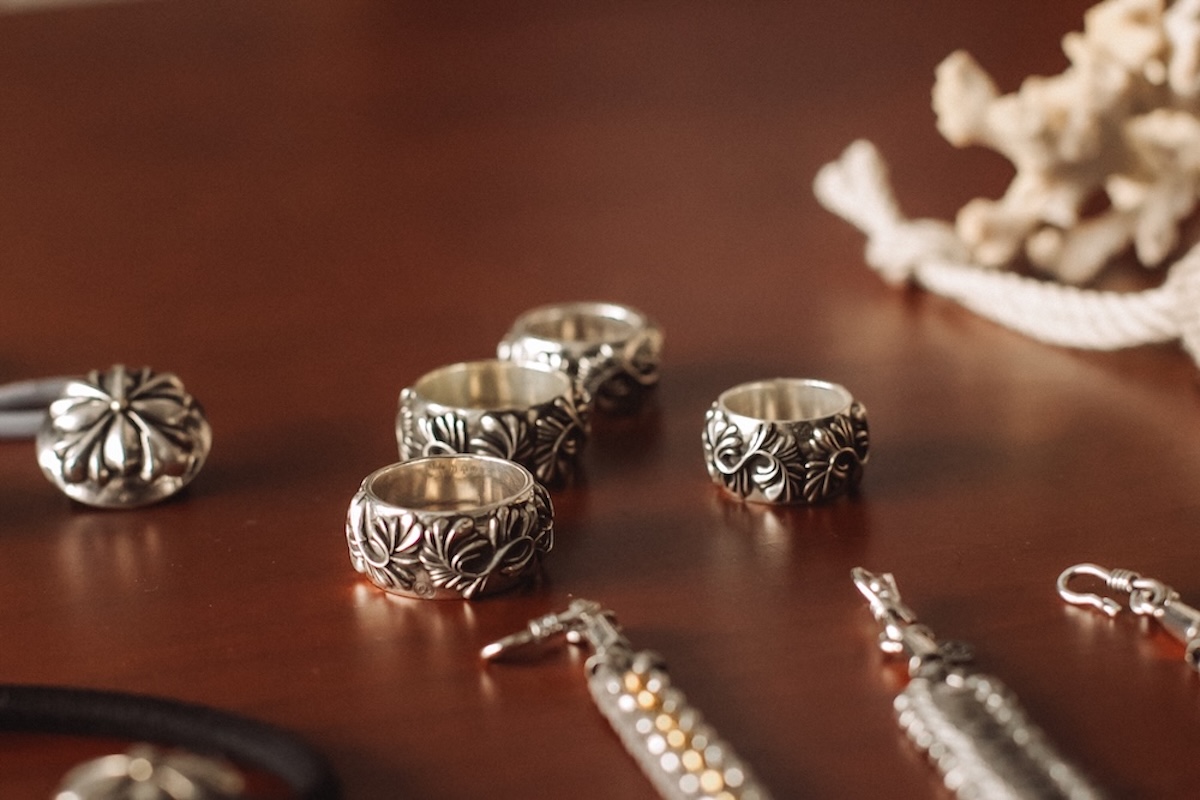
Sarah's grandmother made these rings as a hobby. Some of the rings were made by Sarah herself, but they are all designed with a sense of their roots.
Nakamura:I see that the things you encountered in your travels and the memories you have at that time give you a clue. Is this ring also something old?
Sara:This belonged to my grandmother. My grandmother was an engraver as a hobby.
Nakamura:I didn't realize that. I had no idea it had its roots in such a place.
Sara:Also, I lived in London for about four years when I was a child. There is a town called Rye that I visited during that time, and it is very close to the brand image of "Sarafinchley.
Nakamura:It's a very nice place, with the old townscape still intact.
Sara:It is a really beautiful city. There are many antiques, and every time I go there, I discover something new. It's a town that gives you a sense of good old England, like something you might see in "The Witch's Delivery Service.
long vowel mark (usually only used in katakana)As for the process of making things, do you draw sketches while taking hints from such things?
Sara:Yes, I am. But at first, they are surprisingly bad at it. It really starts out like a doodle, and as I gradually develop the image, it takes on a shape closer to the actual product.
Rough sketches of ideas. This is where all items are created.
Nakamura:I've always wondered how it would take shape, so this is very interesting.
Sara:However, when I actually made it three-dimensional, it was often different from what I had imagined. From there, we fine-tune the image again. Because it is a small three-dimensional object, it is not always possible to reproduce details that are too fine.
Nakamura:Is this notebook like a conceptual notebook?
Sara:Yes, I do. I write down ideas. For example, I would like to make a shoehorn someday.
Nakamura:That is interesting. Do you accumulate ideas on a daily basis?
Sara:When I think of something, I draw it or take a picture of it. I often forget about it, but I try to think that if I have forgotten about it, that was the end of it.
I also wrote the idea for the website in this notebook. I wanted to handwrite all the text, and I had to rewrite it many times.
Nakamura:It's digital, but it has a proper warmth to it.
Sara:I would like to keep that in mind.
Nakamura:Are you the type of person who creates ideas all at once?
Sara:I often draw it first, and if it looks good, I revisit it a few days later and expand it further.
The design drawing is the result of trial and error.
Nakamura:Does it ever simmer down even for you, Sarah?
Sara:Of course, we have a lot. There are also a lot of things that have been kept in storage. I once wanted to make a scarf ring. But I wondered what it would be like to put expensive silver on a scarf that could easily fall off. I thought that the weight of the ring might make it easy to come off, or cause stress to the user. So I changed the design I had in mind as a scarf ring to a ring.
Nakamura:First of all, do you want to make it anyway?
Sara:Of course, I will sift through them in my mind. But if I think something is good, I will try to make it. I even made a prototype of a scarf ring, but in the end it was put on hold.
Nakamura:Perhaps it is similar to the feeling of a potter breaking a vessel that he is not satisfied with.
long vowel mark (usually only used in katakana)What is the actual production process?
Sara:We often create wax prototypes and 3D printers in two ways. In the wax prototype method, the wax is scraped off with a rheuter or soldering iron to make a prototype. The wax is then made into a plaster mold, into which silver is poured. From there, we continue to make fine adjustments while looking at the finished sample.
The gray concho and hook above are prototype samples output from a 3D printer. From here, they were actually replaced with silver and fine-tuned over and over again to bring them closer to the finished form. The silver conchos lined up below are samples that follow the process from left to right until commercialization. If you look closely, you can see that the three-dimensionality, depth of the edges, and details of the engraving differ little by little.
Nakamura:How long does it take to make one?
Sara:It depends on what it is, but it can take 4 months or more. For longer ones, it may take more than a year.
Nakamura:I knew it would take that long.
Sara:The other is to first draw an illustration, from which we create a three-dimensional drawing and turn it into 3D data. We output it many times to resin using a 3D printer, adjust the shape, and finally replace it with metal.
long vowel mark (usually only used in katakana)It looks very classic, but the way it is made is very modern.
Sara:Yes, I did. I redid it over and over again, making mistakes. In the end, I thought it would be better to make it a little more rounded, and so on. I keep repeating that kind of thing.
Whistles and rings that could eventually become antiques.
long vowel mark (usually only used in katakana)What new items will be on display at this order-taking event?
Sara:The new items are rings and whistles. The ring is a derivative of a motif I originally created as a concho. There is a decoration in St. Paul's Cathedral by a sculptor named Grinling Gibbons. When I saw it, I thought, "I want to make something three-dimensional like that, too. That is how the concho was born.
The “Gibbons” series of rings, inspired by sculpture, will be on display at the order event. The finely carved shapes show the high degree of perfection that was achieved after many prototypes and revisions.
Sara:I myself really like this series. I wanted to make a ring with this motif someday, and at first it was a completely different shape, but after some twists and turns, it finally took this form.
Nakamura:It's quite elaborate. It has a three-dimensional feel to it, which is really cool.
long vowel mark (usually only used in katakana)Where did the whistle come from?
Sara:I've always been drawn to old tastes, and I've always wanted to make whistles someday. In the extreme, silver is something you don't have to have. Clothes are necessary for life, but accessories are not. That is why I feel a weight of responsibility in making silver. It is something that will last for many years.
Therefore, I think that I should not make something until I am truly satisfied with it. In a sense, I had to make a clean break. I took on the challenge of making items that I thought were good, even if I wasn't sure who would like them.
The new “Pendere” series at this order event is an excellent work based on the motif of whistles. The quality is superb, and the one on the right actually makes a sound.
Nakamura:It is hard to find a brand that makes whistles today.
Sara:It cost a lot of money to make, and it was inevitably expensive, but I am glad that I was able to make it.
Nakamura:It is surely a piece that will eventually become an antique.
long vowel mark (usually only used in katakana)From your point of view, what is the appeal of "Sarafin Chilies"?
Nakamura:Each design is imbued with meaning and significance. I think this is in line with the concept of "Reshop.
As with the scarf ring I mentioned earlier, the company does not stop at the artist's point of view, but also considers the people who will be using it. I think that is the reason why our products are supported by our customers.
long vowel mark (usually only used in katakana)It is truly “the beauty of use.
Nakamura:Yes, I am. Personally, I am also attracted to the fact that the design is fresh, yet somehow nostalgic. After hearing about your inspiration earlier, I understand why you feel a somewhat British essence.
Sara:I am glad to hear you say so. I think it is important to have both an earthy and modern feel. I am also conscious of the fact that I want my designs to look good no matter who wears them.
Nakamura:It's subtle, yet cool. I think that is the reason why all of our staff wear them. If you wear it with simple clothes, it will accentuate them, and if you wear it with decorative clothes, it will blend in. Because you have experience at top maisons, you can show us perspectives that we have never seen before. I would like to encourage those who have not yet had the opportunity to experience "Sarafinchli" to pick up a piece at this event and see it for themselves.
Sara Finchley Order Event
Period: April 25 (Saturday) - May 6 (Wednesday)
Location: Reshop Aoyama
Address: 3 Minami-Aoyama, Minato-ku, Tokyo
Phone: 03-5413-4714
Hours: 11:00 - 20:00
Instagram@sarafinchley_official
Instagram@lechoppe.com