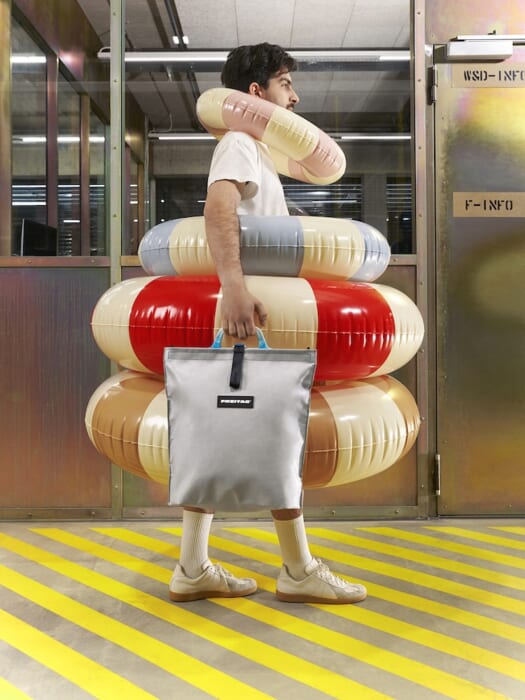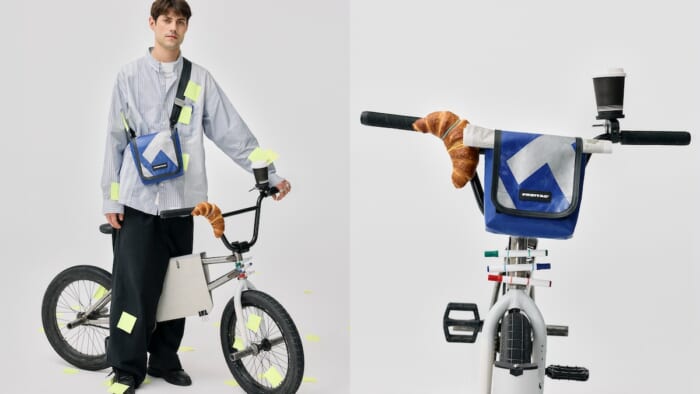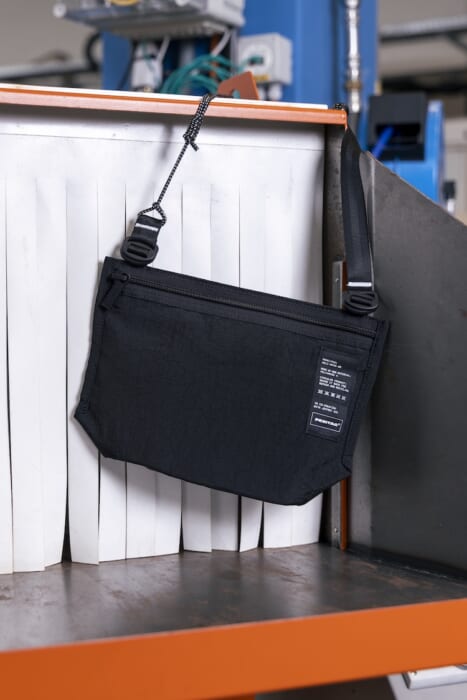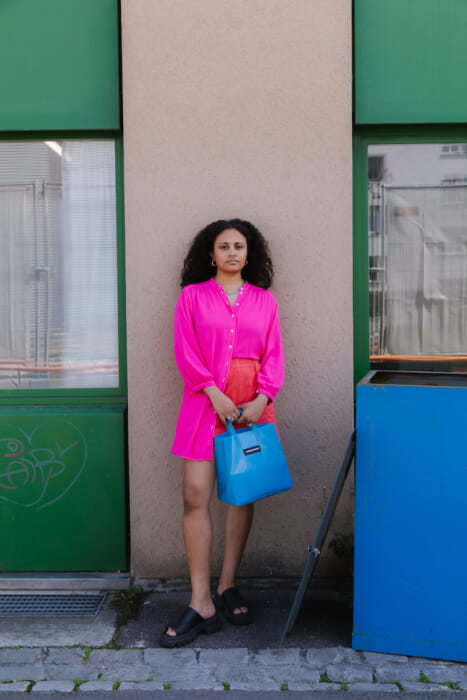
A rugged bag made from truck tarps. That’s probably the extent of most people’s image of *Freitag*. However, it took many years and the involvement of a wide range of people for these bags to gain popularity in Japan. Just one month ago, a member of our editorial staff visited the brand’s headquarters, factory, and store in Zurich, Switzerland. There, astonished by its magnificent history, my journalistic instincts urged me to write an article—and so I am now putting pen to paper. Here, I will record what I saw with my own eyes and experienced firsthand.
- Photo_Ryosuke Hoshina
- Text & Edit_Yuri Sudo
Something that can only come from a person's own experience.
One day in August, a member of our editorial staff traveled to Switzerland, a major tourist destination. The direct flight took 14 hours. After arriving at Zurich Airport—where an Omega watch greeted us—it was about a 10-minute train ride to Zurich, Switzerland’s largest city.
With a low of 15°C and a high of 28°C, the weather is pleasant, and the ever-changing conditions—with light rain one moment and sudden breaks of sunshine the next—remind us that we’re near the mountains.

The purpose of the trip was a press tour for the Swiss-born bag brand *Freitag*. Four Japanese media outlets, including Fuinam, and three groups of influencers gathered and headed to the company’s headquarters.
By the way, about ten years ago, I actually took part in the same press tour with Fuinam. The details areThis articleI’d like you to take a look at these photos. As you’ll see, the manufacturing process at *Freitag* has remained virtually unchanged—which is a very good thing. However, some aspects have been updated to keep pace with the times. I hope you’ll enjoy reading both articles while comparing these changes.
First, we were shown to the area where the tarps are stored. What caught my eye was a giant version of the familiar bag. Apparently, it was made to cover the Needluf store in Zurich’s Old Town while it was under construction, and it’s about 15 meters long. It looks big enough to easily fit an elephant.
The stacked tarps were collected from throughout Switzerland and neighboring European countries. It’s surprising to learn that back in the 1990s, when the company was first founded, they used to collect tarps by jotting down the company names printed on them while out and about in town, looking up those companies in the phone book, and contacting them directly. These days, the company sources tarps through the internet and at trade shows related to truck tarps, logistics, and transportation.
Incidentally, the original idea came about because the founders—the Marcus brothers—were having a hard time carrying their design blueprints around in rainy Zurich. Living along a highway, they watched trucks zooming by outside their window and came up with the idea of turning a sturdy tarp into a bag.
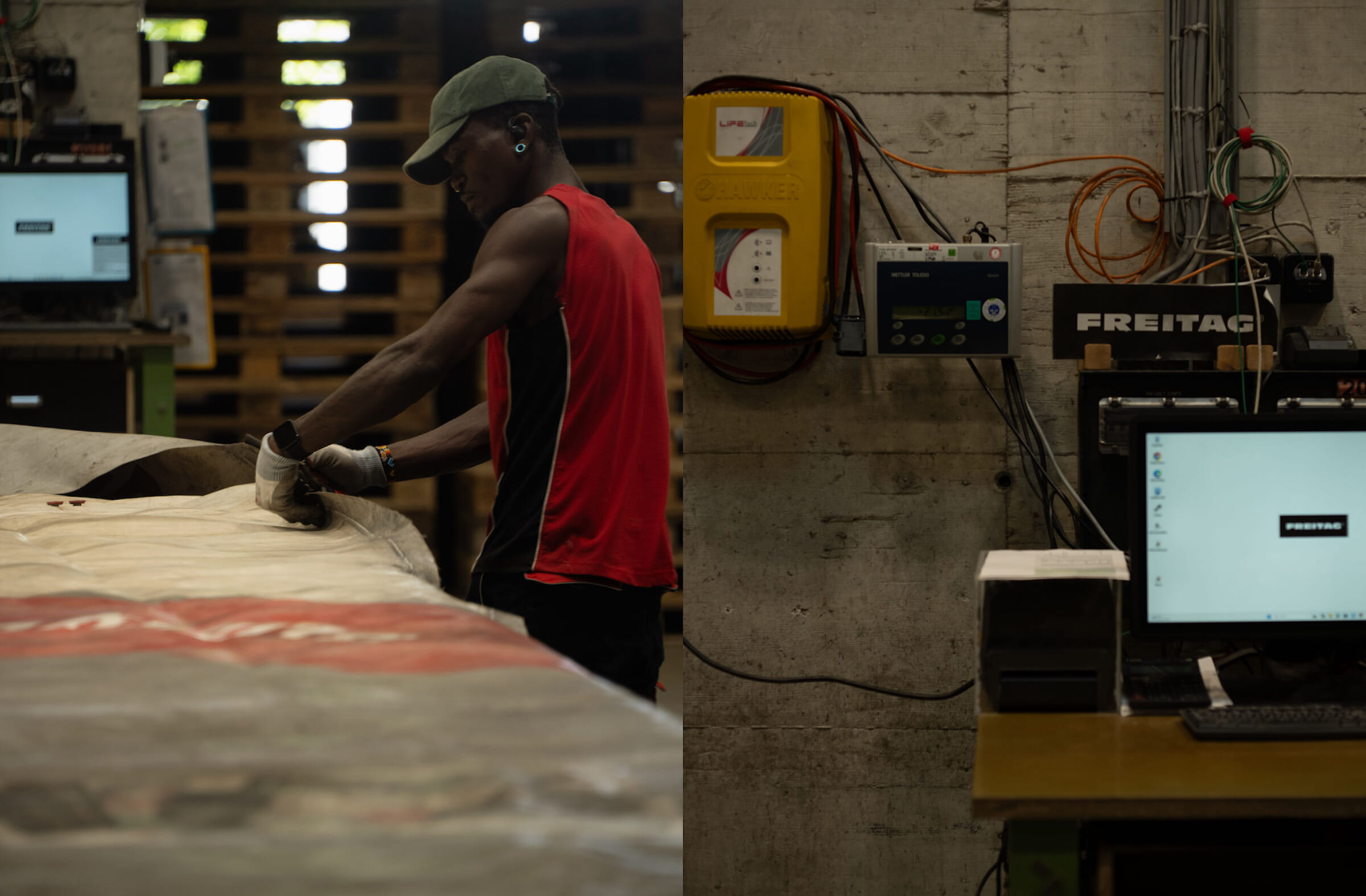
This step involves removing the metal parts from the collected tarps and cutting off any unusable sections. The metal parts can be recycled as is.
The sorted tarps are washed for about an hour in warm water at approximately 60°C. I’m told that 50% of the water used is rainwater stored in an underground reservoir on the headquarters’ grounds. Incidentally, this cleaning method was the same 10 years ago.
Among the various production steps, the part where we cut out the bag patterns deserves special mention. The photo above shows the process of cutting by hand using a transparent template. Since each tarp varies in its degree of aging and condition, we determine which sections to cut out while carefully avoiding any areas with mold.
The area shown in the photo below was newly established in 2015; here, cutting instructions are overlaid onto digital images using a computer. However, it’s not just a matter of placing the instructions—human judgment is ultimately required to ensure, for example, that the zipper does not overlap with the logo.
Whether analog or digital, the design of each one-of-a-kind bag is determined by the artisan’s subtle touch, drawn from years of experience. The brand’s philosophy likely drives its decision to give artisans complete creative freedom in their work.
This section covers product repairs. Services range from minor repairs, such as replacing parts, to more extensive services that involve completely disassembling and reassembling the item. The appeal of *Freitag* lies in the fact that instead of throwing things away when they break, we repair them so you can continue using them for a long time.
The department that handles online shipping. I hear there have been a lot of orders from Asia lately, especially from South Korea, so it’ll be fun to see which designs they choose.
In the neatly organized office, you can see the employees' sense of playfulness.
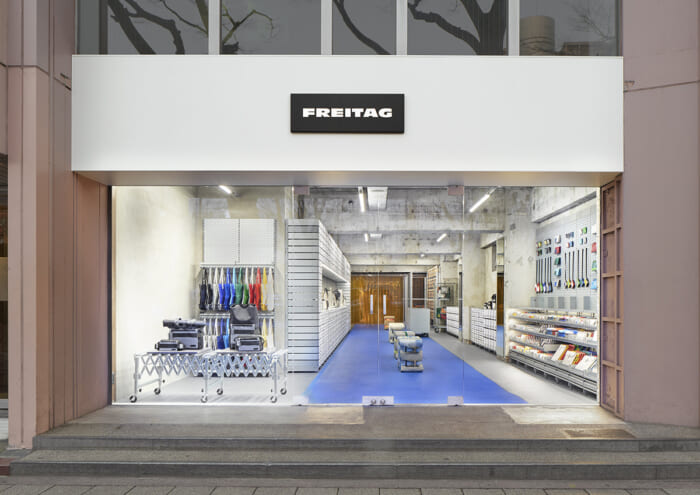
Now that we’ve gotten a full picture of the manufacturing process, let’s head to the bag store. The flagship store is located at Geroldstrasse 17, about a 3-minute train ride from Zurich Main Station.
This store, reportedly built by stacking 19 used shipping containers on top of each other, is just as impressive as the rumors suggest! It’s rare to find a store design that so succinctly captures the brand’s essence.
The interior was designed so that customers could see the product color variations and lineup at a glance. Faced with such an impressive array of merchandise, it’s no wonder shoppers’ desire to buy is piqued. Incidentally, there’s also a repair station right next to the store.
Reflecting on the tour of the headquarters, I realized that *Freitag* doesn’t believe that everything should simply be streamlined for efficiency; rather, it maintains that people are ultimately in the driver’s seat. The company places its trust in the history forged by human connections and in the things that can only be created by human minds, hands, and experience. With AI on the rise, this made me feel truly encouraged.
Compared to the article from 10 years ago mentioned at the beginning, while the brand’s form has changed, its core remains the same. This may be the reason why bags have become so popular in Japan and have gained global recognition.
Break the rules and challenge the status quo.
Friday is a brand that’s not only dedicated to its products but also to how they’re presented. While maintaining its signature style, the brand’s diverse range of expressions—which transcend the boundaries of a typical bag brand—is truly remarkable. Behind this creativity is a mastermind. We conducted a brief interview with Creative Director Thomas Wakeford.
Thomas Wakeford
Born in 1983 in Geneva (French-speaking Switzerland). Holds a Master’s degree in Fashion Design from Central Saint Martins. Since then, he has had a diverse career, including serving as a senior designer at Victoria Beckham, where he was responsible for multiple lines; working as design director at Jason Wu; handling styling, branding, and art direction at Zalando; and running his own brand, 3000. She has served as Creative Director at since 2025.
—Before we talk about the brand, since information about Swiss fashion and trends doesn’t really make its way to Japan, could you start by telling us a bit about that?
“Trend” is a broad term that refers to the tendency to follow or imitate what those around you are doing, but Switzerland is often seen as slow to adopt such trends. I think this is because the country has a somewhat sensible approach to consumption, one based on practicality, functionality, and durability.
That said, I went to the “Blood Orange” concert in town last night, and the young audience was brimming with diversity and style. I sensed a mix of Y2K elements, techwear, and romanticism, along with a fluidity of expression—and there was that wonderful energy you see in major cities around the world. It was truly a beautiful experience to witness.
—What about the creative side of things?
As for the creative sector, to be honest, since I’ve only been back in Switzerland for about a year and a half, it’s difficult for me to comment on it directly. However, while the creative industry has traditionally tended to be concentrated in major European cities, I feel that more and more people are seeking out quieter places and a slower lifestyle—as a way to counter the tide of overconsumption and algorithms that seek to capture our attention and money. I often see friends who have worked for many years in cities like Paris, London, and Berlin returning to Switzerland to apply their international experience within smaller communities.
In addition, younger generations are choosing not to move to big cities and are instead working to nurture their local cultures. I hope this trend will naturally alleviate the concentration of population in major urban centers and enrich the creative scenes not only in Switzerland but also in small cities, countries, and communities around the world.
—Let’s get to the main topic. From your perspective, what do you find appealing about ?
First is “practical and functional problem-solving,” which is the foundation of all bag designs. Second is the traditional graphic design and typography that emerged naturally from the materials used in the bags.
Furthermore, this brand sometimes takes an “alternative”—that is, rebellious—approach, even by Swiss standards. In contrast to Switzerland’s typical public image—with its beautiful mountains, conservative national character, and the luxury industry—this brand embraces an urban, unconventional, and anti-establishment stance, approaching design and functionality with a sharp, distinctive perspective. At the same time, it firmly maintains the manufacturing quality unique to Switzerland. I was drawn to all of these elements.
—After touring the headquarters, I got the impression that the company has a very positive atmosphere. What are your thoughts on that?
I believe there is tremendous potential here. It’s truly a rough diamond waiting to be polished—a company with genuine corporate values and a one-of-a-kind story: “From Truck Till Bag.” Although we’re still a relatively small company, I believe we have immense potential to make a significant impact.
What’s more, while the brand as a whole embodies an open, humble, and unpretentious approach to creativity, it continues to break the rules and challenge the status quo. It is truly an honor to work alongside people who possess such ideas, knowledge, and passion.
Visuals created by Thomas.
—The recent brand visuals you’ve been involved with also make a very stimulating and unique impression. Could you tell us about your creative starting point?
We always begin our creative process with the product, its features, or its concept. From there, we imagine “what kind of users are using it,” build a story, and add elements that evoke the processes, insights, and origins of materials characteristic of . Ultimately, we tie all of this together with irony and unexpected perspectives.
Furthermore, in recent years, we’ve started to think not only about the visual presentation and storytelling of content, but also about how it will be deployed across various media, how it will be consumed, and how it will interact with the community.
—So you’re focusing on the essence while also considering the surface-level aspects and how the work will resonate after its release. Where do you usually draw your inspiration from?
I draw inspiration from the ordinary people going about their lives on the streets. I’m deeply fascinated by the subtle nuances that define their individuality and the ways they express themselves in unique ways. Everyone designs their own life, refines their way of living, and forges their own identity. That is what fascinates me endlessly. For example, from a single pair of shoes someone chooses, you can sometimes glimpse their musical tastes, the culture they belong to, their childhood interests, the sports they play, or even their political views.
—Yours,Instagram PostYou can see that reflected there, too.
That’s right—it’s full of personal tastes and interests. I’m also captivated by products created through craftsmanship and the way they age over time. I often collect wooden objects, pottery, and paintings at flea markets, and each of them carries a “story from the past”—one in which someone intentionally displayed, used, or created it. I feel that humans are beings who simply cannot help but create, and that is precisely what makes us human.
These days, everything has become a bit too “cool,” and while fashion and mass consumption dominate the mainstream and are at the center of pop culture, I find that unpretentious, ordinary moments are far more stimulating.
—Finally, Fuinam is a media outlet that features trendsetting people, things, and culture. Please tell us about the hippest spot in the city where you currently live.
There are two of them; one is called “KIOSK.” It’s located just a few minutes’ walk from the flagship store and was opened by a former employee of the brand. They carry vintage furniture from Europe and Switzerland, and it seems they host events there regularly.
KIOSK
They renovated a large warehouse themselves. They often host events on the weekends, which has helped foster a sense of community.
Furniture isn't just purchased from wholesalers; it can also be bought from private individuals.
Inside the building, there are not only “KIOSK” stores but also architecture firms and record shops.
Leiv, the owner of “KIOSK,” who used to work at *Freitag*.
—What's the other one?
"Souvenir Sport," located in the Old Town, carries traditional Swiss vintage items and military goods. They also carry "Appenzeller Gut," a traditional Swiss brand of handcrafted leather belts, which is popular among younger customers.
Souvenir Sport
Upon entering the store, European vintage items and military gear are lined up on both sides, while the central display case showcases the Swatch archive.
The man in the photo is the owner, Caspar. Despite being only 30 years old, he has a keen eye for vintage clothing that isn’t swayed by passing trends. When I got really excited and started talking to him, he brought out some of his most prized, rare finds from the back room.
SHOP 1. KIOSK
Address: Geroldstrasse 11, Zurich, Switzerland
Hours: 11:00 a.m.–7:00 p.m. (Wed–Fri), 10:00 a.m.–6:00 p.m. (Sat)
Instagram:@kiosk.io
SHOP 2. Souvenir Sport
Address: CH–8001 Zurich, Switzerland
Hours: 3:00 PM–6:00 PM (Wed), 11:00 AM–6:00 PM (Thu–Fri), 11:00 AM–5:00 PM (Sat)
Instagram:@souvenirsport
It’s been quite some time since the rise of social media began, and now we’re feeling the threat of AI. Through my conversation with Thomas, I realized that the challenges facing creatives are the same regardless of country, and that every brand is taking steps to overcome them.
Rather than simply creating something catchy that catches the eye, he approaches creativity by drawing on the brand’s context and the product’s background. His output is supported by the breadth of the brand’s appeal and the accumulation of Thomas’s own personal perspectives. This simple, wholesome approach to design is not something that can be achieved easily. Let’s continue to keep a close eye on every move Freitag makes.