We know everything ourselves and are responsible for making it.
Paraboot takes pride in its "Made in France" brand, doesn't it?
Eric: Paraboot is a family-owned business. I myself joined in 2019 and will soon celebrate my 7th year with the company. One of the values we hold dear as a family is to keep production in France. But even more important is to preserve and pass on the savoir-faire of our craftsmanship. There are nearly 150 steps involved in making a pair of shoes. It is very difficult to maintain these skills and pass them on to the next generation. This is because the work is not automated and is done by hand. This is the essence of "Made in France.
And the term "Made in France" has a certain guarantee. That is why we believe it is of utmost importance to maintain it. It is the same with "Made in Japan," isn't it? To be successful in Japan means to be accepted anywhere in the world. This is because Japanese people have a very delicate and rich sensitivity to materials and details. That is why success in Japan has a special meaning for us.

Japanese craftsmanship is also recognized around the world as "Made in Japan" for its quality. However, there are many concerns about the transmission of such skills as well. Not only in shoes, but in many other fields, there is a shortage of skilled workers.
Eric: As for the passing on of skills, this is a concern in Europe as well. Even in Spain, the craftsman shoe industry is declining. In France, the situation is almost the same, with very few brands and workshops maintaining artisanal production. Most have moved to industrial mass production. There is a movement to supplement handwork with a system of mass production, but there are very few places that continue to make shoes in the true artisanal sense, that is, by hand, anymore.
One could argue that this is why they are so rare, but that is not the intention.
Eric: What we value is the "maintenance and succession" of craftsmanship. When I joined the company, there were many skilled craftsmen working exclusively for "Paraboot" in the workshop. Today, however, the situation is completely different. People's senses have changed with the advent of smartphones and the Internet, and now everything is quick and easy to obtain. I fear a significant loss of patience. In shoemaking, it takes a long time to learn a single movement. So it has become very difficult to pass on skills to young people.
How do you deal with such situations?
Eric: What I am working on is a reorganization of our work structure. We are trying to listen to the requests of the younger generation by, for example, allowing them to work four days a week with the same working hours and to take three days off on weekends, instead of the usual five-day work week. Recently, I even received a request from someone who wanted to take a year off, travel around the world, and then come back here again. I have responded to this and promised to make sure that the staff positions are also properly secured.
It is never easy to accept, but nevertheless, it is essential to be flexible in this day and age. One of the most important things in management today is to respect employees' ability to balance life and work while maintaining a long-lasting relationship. It is necessary not only to teach skills, but also to create an environment in which they can continue working for a long time.
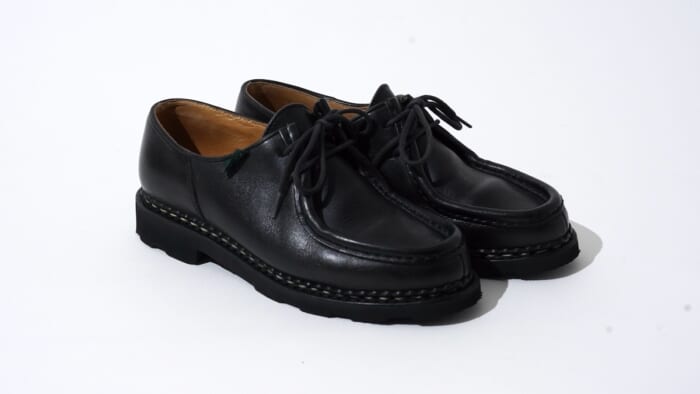
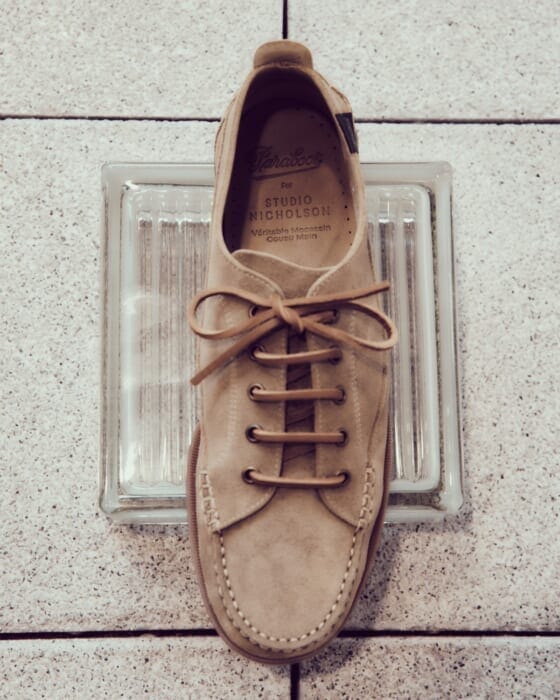
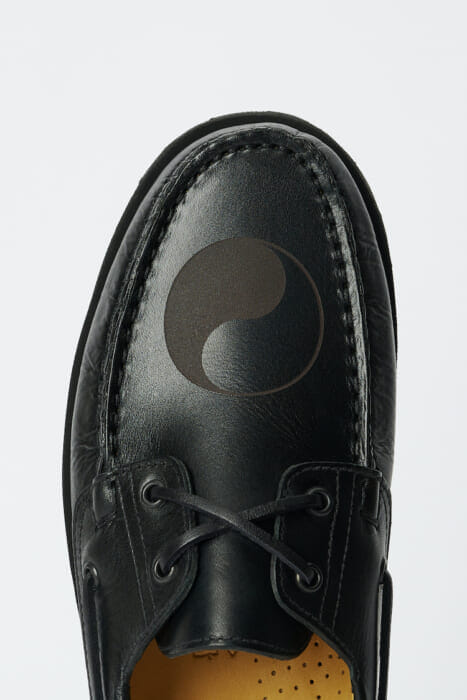
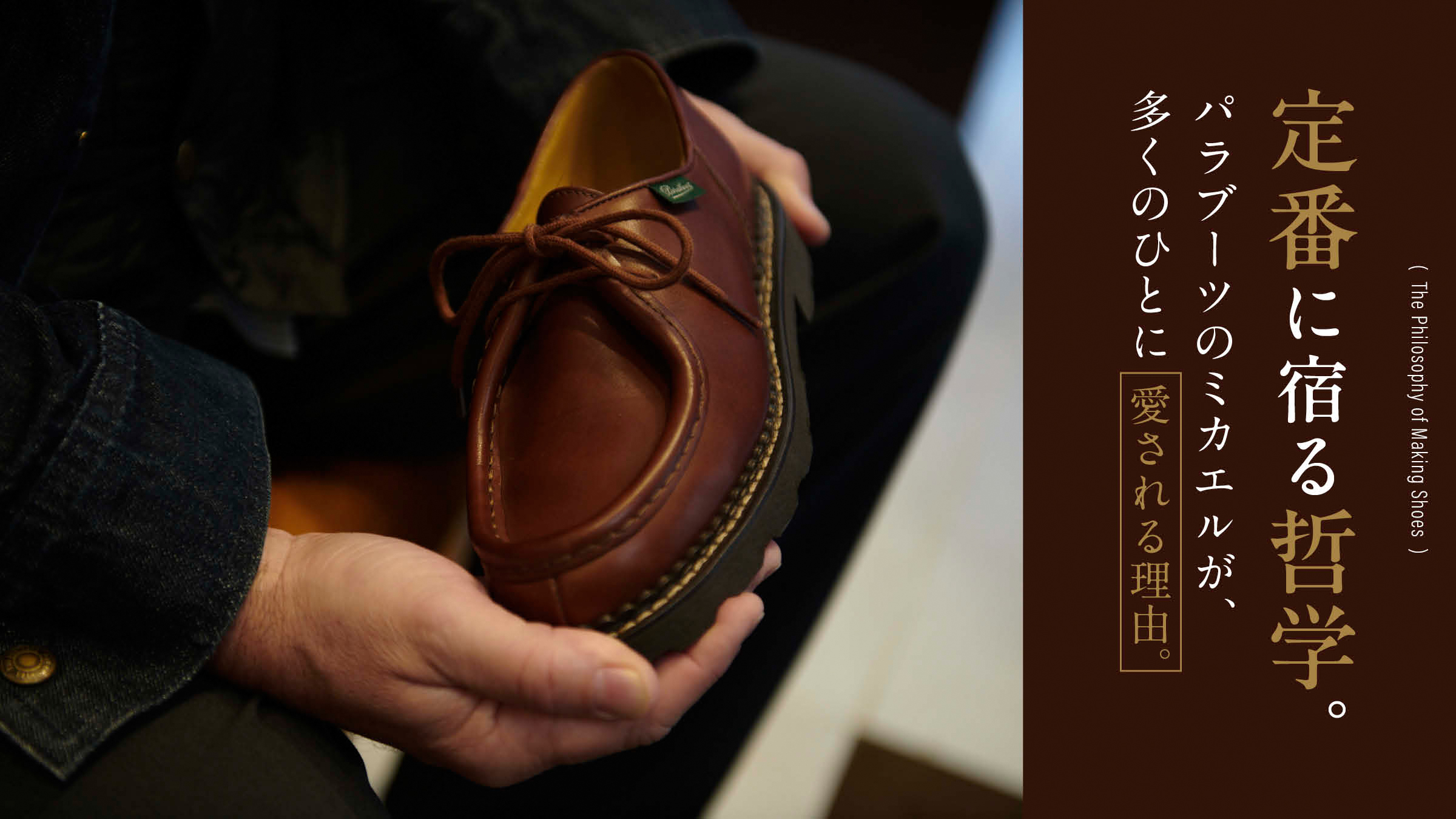
While based on a simple two-eyelet design, there are now many variations.
I think it is important to be flexible and adapt to the times, isn't it? We've gotten a little too deep into the subject, so let's return to "MICHAEL," but Paraboot consistently produces its own soles. What kind of commitment do you have to this?
Eric: That's a good question (laughs). I think for us, one of our strengths is that we control the entire manufacturing process from A to Z. Even if the material of the sole is something as simple as natural rubber, we manufacture it in the classical way, which requires a very precise process.
The simpler and higher quality the product is, the more advanced technology is often required, isn't it?
Eric: That's right. Some of our shoes are also produced in Spain, but we have been working with that workshop for over 50 years. It is almost like our family. We make our shoes in Spain because of a specific "stitching method" (sewing technique). The technique died out in France at one point, so we simply do it in Spain, where there are still craftsmen who have the know-how to do so. Even so, the process is completely supervised by "Paraboot. We know everything ourselves, and we take full responsibility for our work. That is the philosophy of "Paraboot. And such a brand has become very rare in Europe.