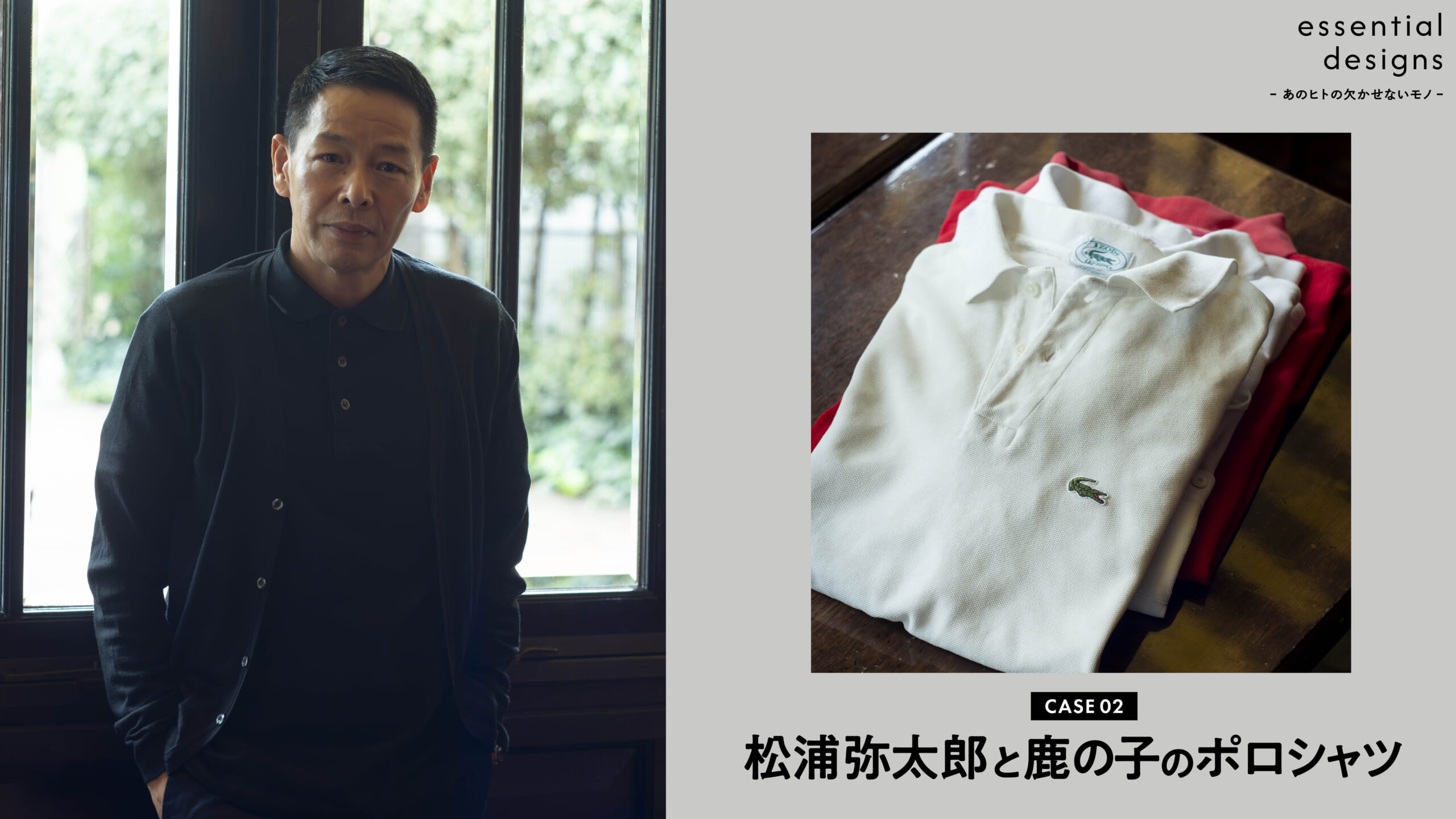
PROFILE
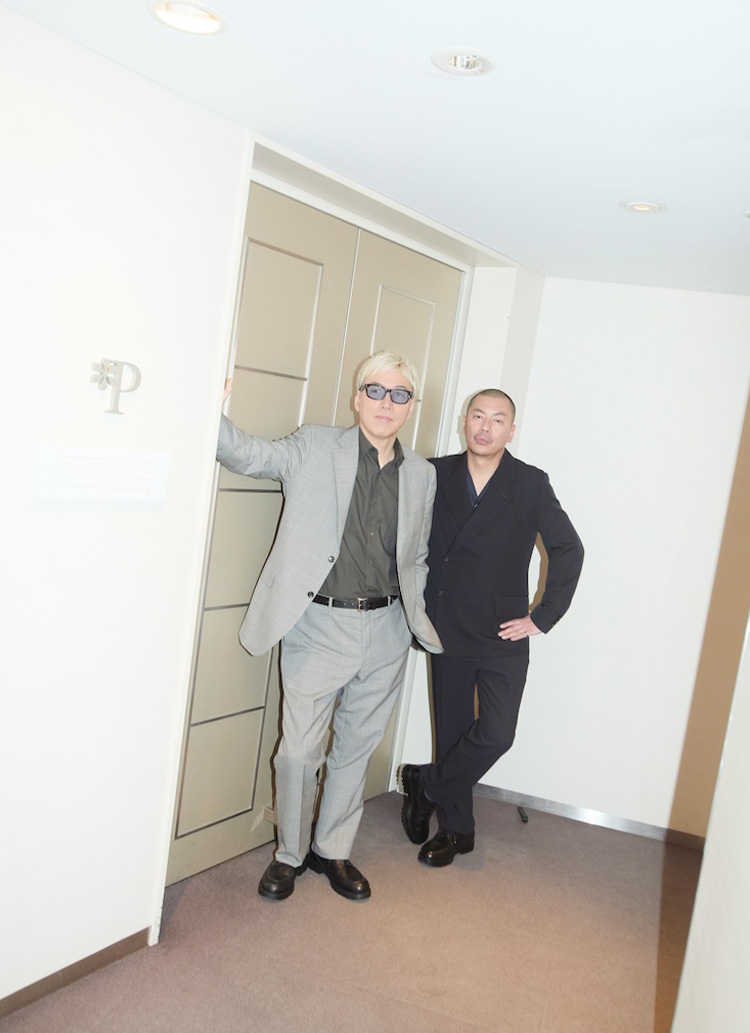
Born in Tokyo in 1965, he opened the select bookstore "COW BOOKS" in Nakameguro in 2002, and served as editor-in-chief of "Kurashi no Techo" for 9 years from 2006 before joining "Cookpad" in the spring of 2015. In the same year, he launched the web media "Kurashi no Kihon" (The Essentials of Life); in 2017, he became co-CEO of "Oishii Kenko" (Delicious Health). In addition, he is also the editor-in-chief of "DEAN & DELUCA MAGAZINE". He has published many books, and his representative works include "Today too Teinei" (PHP Bunko) and "Shigoto no Kihon Kurashi no Kihon 100" (Magazine House). He is also the creative officer of the fashion brand "PAPAS" from November 2025.
Instagram:@yatarom
As a boy, I longed for Made in USA.
I saw on Instagram that you have been using LACOSTE's polo shirts as your favorite item for a long time. You seem to be very attached to it.
Matsuura: I think I got my first one when I was in the third grade of junior high school. I know this may sound a bit clichéd, but through "Popeye," I became fascinated with America, and my desire to wear and want American things began to grow.

The first polo shirt I acquired was made in the U.S. by Izod Lacoste (top photo). The size notation is special, and 1/2 Patron is equivalent to size M. Patron is equivalent to size M, size L is Patron, and size XL is Grand Patron. Yataro says, "The unfamiliar size notation really struck a chord with me as a child.
And the first American clothing you acquired was a polo shirt.
Matsuura: No, my first encounter with American clothing was with a pack T-shirt from "Hanes. As a boy who had only ever worn flimsy, underwear-like T-shirts, it was a huge shock to me. As I wore and washed them over and over again, I became more comfortable in them, and every time I put my sleeves on, I felt like I was wearing something really fashionable. The next step was Lacoste polo shirts.
When you had an interview with Keiji Kaneko, you mentioned that you "have clothes to wear depending on the season. What about polo shirts?
Matsuura: I use it as an inner layer in the fall and winter, as I do today, but it is more of an everyday summer garment. It is always at the center of my wardrobe, and I wear it every day.
Polo shirts are also used as school uniforms, and I feel that polo shirts are becoming more and more popular among today's young generation. How was it for you at that time, Yataro?
Matsuura: I really like the American-made "Izod Lacoste. I really like the American brand "Izod Lacoste," but the back hem is unusually long. This is unexpectedly not suitable for young people. However, if you tuck it in, you look like an old man, and if you tuck it out, you look sloppy. So it is very difficult to wear them well. I thought it was somehow different from the stylishly dressed foreign models with well-trained bodies and sunburned skin in "Popeye" magazine, but I was happy to "wear something made in the USA," so I forced myself to wear it. I forced myself to wear it.
Have you changed the items you wear and your styling since then?
Matsuura: At that time, I don't think there were many people who had the concept of styling, except for the staff working in clothing stores and a few others. Of course, the staff at the clothing stores were all very nice, but ordinary people like us had no fashionable skills, so we just wore what was available. Since we didn't have any clothing options to begin with, just the fact that we were wearing polo shirts was enough to make us very happy. I was also proud to say, "How do you like it? I was proud of myself (laughs).
This French Lacoste may have the highest degree of perfection. The front and back hems are uniform in length, and the chest opening is slightly deep. Yataro's style is to close the buttons all the way to the top and wear chinos as bottoms.
As I said, being a junior high school student in Tokyo, you seem to be quite precocious.
Matsuura: I guess so. Some of my friends were well-informed people who read "Popeye," and under the influence of my older brother, they would say, "You have to wear T-shirts from 'Haynes,' jeans from 'Levi's,' and polo shirts from 'Lacoste. Then, when I was about 20 years old, I realized that European-style clothes made in France, such as Lacoste and PAPAS, were also nice, and I began to wear them.
What was it that made you become interested in European things?
Matsuura: It was also due to the changing times. Magazines increasingly featured European themes, and when I read an article that said, "There's a Lacoste made in France! I would read an article that said, "There's a French-made Lacoste! The length is a little shorter than I had been struggling with, and it's cool.
Yataro has been wearing a white polo shirt by Pappas since he got it in his early 20s. The founder and designer, Taro Aramaki, was an admirer of Yataro's. He likes the silhouette and design of the shirt, which is wide in body and short in length, as if Izod and French were added and divided by two.
Yataro-san, you went to the U.S. during that period. Did you see the U.S. differently from what you had seen in magazines?
Matsuura: By that time, everyone had already started to dress fashionably based on information obtained from magazines, but when I went to the U.S. dressed like that, I felt awkward. American casual is carefree and unrefined, or to put it better, it is natural. In fact, the American-style clothes we had imagined were nowhere to be found, and we couldn't find the Levi's and Haynes we had expected to find all over the place.
- 1
- 2