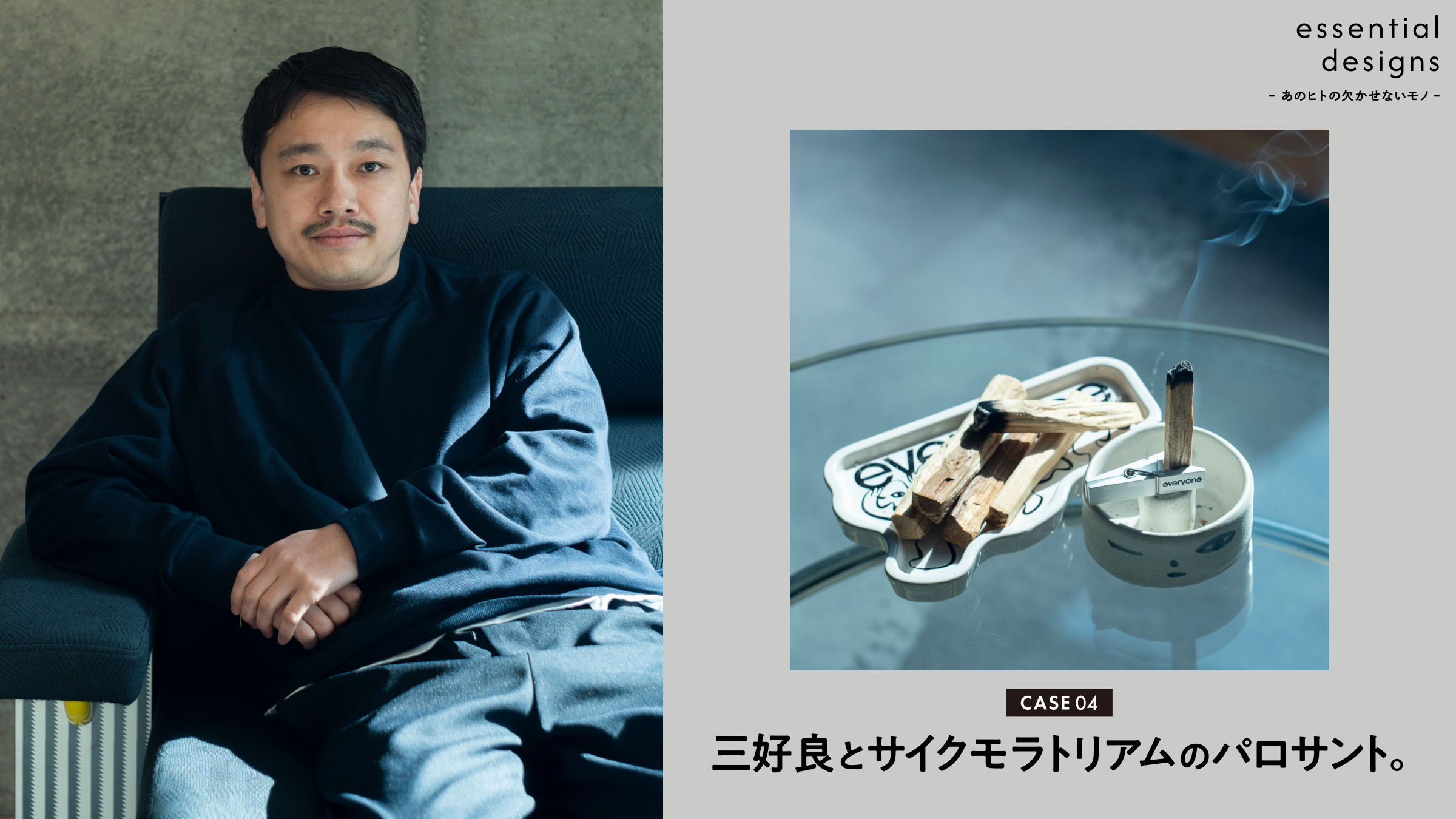
PROFILE
In 2009, he joined “1LDK.” From 2016 until November 2021, he served as the store’s creative director, and in 2018, he launched “SOU Shop & Hostel
Nakameguro," a hybrid shop and hostel. In 2022, he left "1LDK" to launch his own brand, , and opened an appointment-only shop in Yutenji that November.
Instagram:@ryomiyoshi
The sacred tree—essential for creating your own personal space.
—I was totally sure Ms. Miyoshi was going to be introducing fashion items, so the palo santo was a bit of a surprise.
Miyoshi: “When I was given the theme ”Essentials,” I thought about all sorts of things I wear every day, like watches and knitwear. But when I took a step back and asked myself, “What exactly is an essential?” what came to mind was something I use every day and take with me when I travel—something that’s simply indispensable to my daily life.

—You talked about palo santo on your podcast in 2021, didn’t you? At the time, you mentioned that “your first encounter with it was in France.”
Miyoshi: Yes. As for when we first met, it was actually a few years before the radio recording. I first saw it at an exhibition for a friend’s brand held in Paris when I was still at my previous job. I was told it was called palo santo, but at the time, I just thought, “Oh, really?”
—You said it hadn’t really sunk in yet at that point.
Miyoshi: I think I started paying attention to it after a friend who knows a lot about New York and international culture pointed it out to me again, and it clicked in my head: “Oh, that’s the thing I saw before!”
—What part really resonated with you?
Miyoshi: A friend told me, “You’ll find them right by the register in trendy New York shops.” It’s that same vibe as the chewing sticks the HIP , and it’s got that same vibe. So I looked into it and found all sorts of interesting things; when I actually tried it, I liked the scent, and I got hooked right away. My favorite is from a Japanese shop and brand called *Psyc Moratorium*, run by that same friend.
The interview took place at the EveryOne studio, which they had just moved into last December. With its exposed concrete walls, metal columns, streaming natural light, and carefully curated furnishings, it’s an environment where they can focus on their creative work without being distracted by extraneous noise. The mere presence of the smoke and scent of palo santo instantly transforms the space into a deeply relaxing atmosphere.
—Basically, it seems to be used like incense, where you light it and enjoy the scent, but when do you use it, Mr. Miyoshi?
Miyoshi: I usually light it in the morning or whenever I want to freshen up the air. When I travel, I’ll often pack just this one stick and a lighter in a zipper bag. As soon as I get to my hotel room, the first thing I do is light it to freshen up the air.
—There are definitely times when you stay somewhere and think, “I’m not sure I like the smell in this room.”
Miyoshi: I’m actually pretty sensitive to smells, so I guess that’s why it’s something I’m particularly drawn to. Having Palo Santo helps me create my own personal space and lets me feel calm and relaxed. That’s why it’s become part of my routine when I’m traveling.
—It’s said to be a “sacred tree” with the power to ward off evil and purify, and since it smells so good, it probably has a relaxing effect too. By the way, are there any pros and cons to using palo santo?
Miyoshi: It’s primarily sourced from Peru in South America, and since it’s harvested from natural trees, the pieces come in all sorts of shapes—some thick, some thin. While the wood is usually sold as-is, the palo santo from *Cycomoratorium* is carefully shaped by hand through planing and cutting. As a result, it gives off a scent even before it’s lit, and the oils that rise to the surface make it easier to ignite. I really appreciate their commitment to taking that extra step to enhance the quality of the product.
—I hear that "Everybody" also stocks *Sykmoratorium*'s *Palo Santo*.
Miyoshi: Yeah, that’s true. But it’s so popular right now that it’s sold out, and I’m afraid my personal supply is about to run out too… I asked if we could have some, and they said, “It’s okay if it’s just for you guys to enjoy,” so they gave us some old, uncut stock, and we’re cutting it ourselves to use. Or maybe it’s more accurate to say they’re prescribing it to us (laughs). We’d really be in trouble without this now.
- 1
- 2