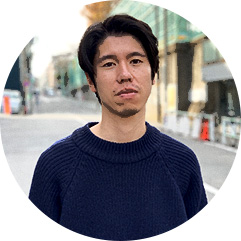
Case 01 : Kenji Sato More than thousands of words of information....

PROFILE
After graduating from Musashino Art University's Department of Imaging Arts and Sciences, he went to the United States to study. He is known for his "Heritage of the Odd World" series, a collection of photographs of strange landscapes and things from all over the world taken from a natural history and aesthetic point of view. He has also appeared on the TV program "Crazy Journey" and held photo exhibitions in Japan and abroad. His favorite camera is a Leica.
Instagram:@x51
-Mr. Sato became widely known after his photo book "Kikai Heritage," didn't he?
Sato: That's right. I studied film and photography as an art student, but there were very few people who could make a living as a photographer after graduation, and the only realistic path was as a studio photographer. I was posting photos from my overseas research on the web when I was approached by a publishing company, and when I had accumulated enough photos, I compiled them into the book "Kikai Kai Heritage.
-What originally led you to pursue the "strange"?
Sato: When I was a child, I was strongly influenced by TV programs and movies that dealt with the wonders of the world. When I studied abroad in the U.S. during art school, I had an assignment to choose a theme for my photographs, and I went to Nevada to photograph the ruins of the gold rush, which is within easy reach of San Francisco. I also visited Area 51, a UFO base that I had been interested in since I was a child.
The photos I took there were well received within the school, and I received inquiries from abroad. It was the first time that my "interesting I began to pursue the Nazca Lines in South America, Inca ruins, and snow men in the Himalayas.
-Until then, what kind of pictures?
Sato: At art school, I was taking pictures for assignments, but what I originally wanted to do was media art and video production. However, the equipment was heavy, the geeky videos were rarely seen, and the reality was that it was financially difficult to make them. I began to question whether I really liked it. It was during this time that I shot "Area 51," and I was able to find a theme that I enjoyed and that people also wanted. Photography is also a way for me to be able to complete my work easily by myself, and before I knew it, I had become a photographer.
-At the time of "The Heritage of the Odd World," how many mysterious things were you able to find on the Internet that could be the subject of coverage?
Sato: It's a 50-50 split in terms of feeling. It was just when the Internet was beginning to spread, and strange news from abroad kept coming in. On the other hand, stories that I have loved since childhood, such as the snowman and the Nazca Lines, are still stuck on Wikipedia, with information still out of date and largely unresolved. I decided that if there was little additional substance, I would try to visit the sites myself. I thought that if the value of information that can be shared by anyone on the Internet is relatively low, then the time will come when one's own experiences will have value as something that cannot be duplicated.
-You yourself have a strong desire to see for yourself, don't you?
Sato: For the world as a whole, thousands of words of information on Wikipedia may be more useful. However, for an individual, a single realization of "I went there and found it interesting" is much more valuable than the number of words. It is not possible to know everything by going there, but it is great to be able to have one's own interpretation, including the realization that "I didn't understand it when I went there.
Even if you look like you understand something just from information on TV or the Internet, it is superficial and quickly disappears. That is why I believe that it is the experience gained by actually visiting a place that is of value.
-It is also amazing that what I started as a student has become my job and has been going on for more than 20 years.
Sato: Actually, I get bored easily, but I find myself continuing. People often say to me, "That's great passion," but it's more the fact that I can stay level-headed that keeps me going. If I get too excited, I get impatient, so I want to stay as calm as I can in an amazing place. It is better to take good pictures in a limited time. The TV director who accompanies me says that I look like I'm in a bad mood when I talk to him (laughs), but I'm just concentrating.
-Consciously, he said, he is keeping his cool.
Sato: That's right. Basically, I cannot continue doing something that I do not enjoy. It is said that there is a big difference in my ability to concentrate when I am interested and when I am not (laughs). If I'm not interested, sometimes I can't do things that anyone else can do. I am not the type of person who can handle everything with ease.