Chapter 3_A T-shirt shop found at the Sihnakarin Railway Market.

The entire market is open only on Thursdays, Fridays, Saturdays, and Sundays from 5:00 p.m. to 1:00 a.m. There are also restaurants where you can drink alcohol, so beware of buying explosives.
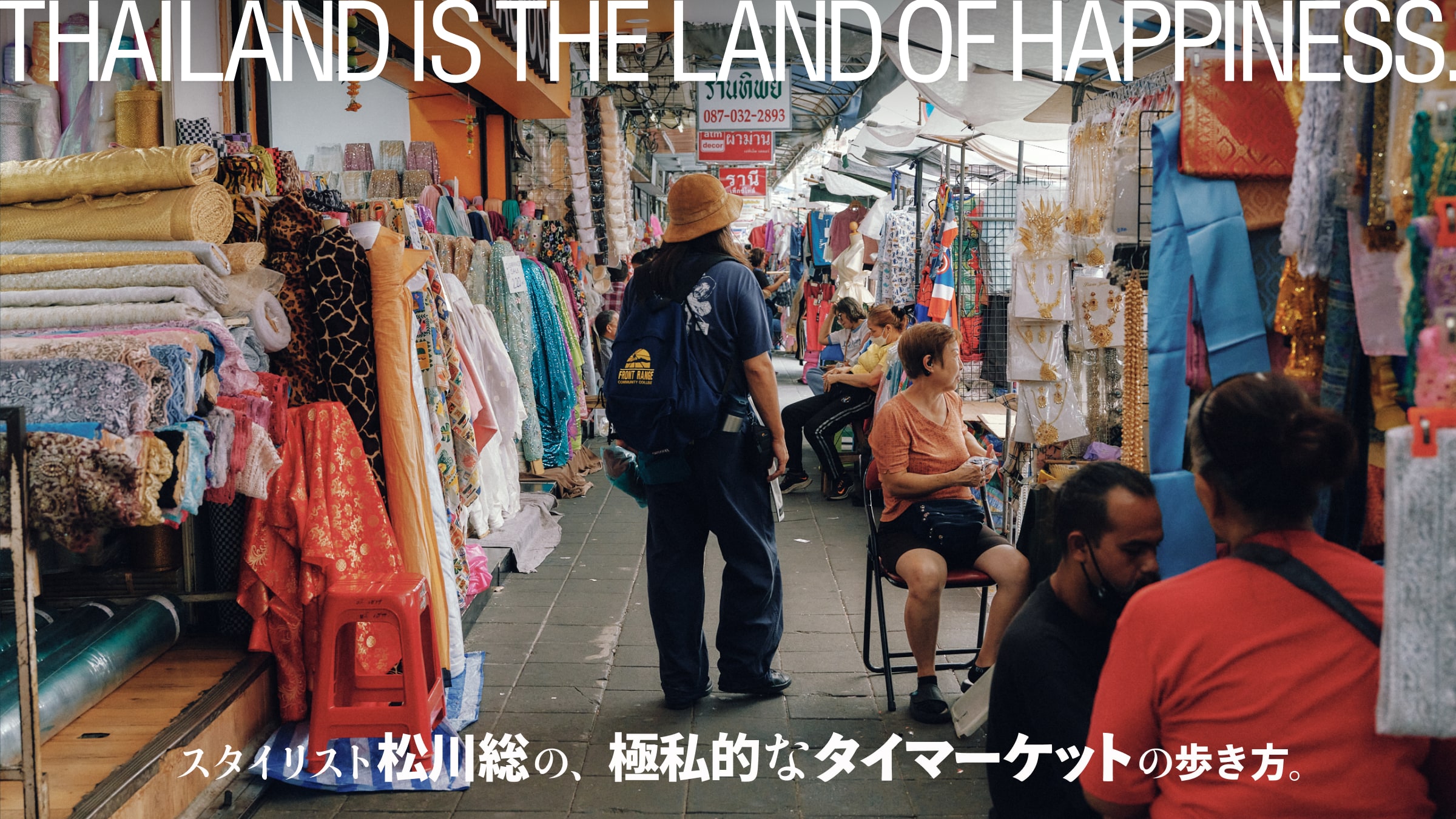
An hour's drive from downtown Bangkok, we arrived at the "Si Nakhaling Railway Market", one of the best markets for second-hand clothes. We are now at the "Sihnakarin Railway Market," one of the most famous markets for second-hand clothing. What are your criteria for selecting T-shirts?
Matsukawa: T-shirts show the color of the store, like band T's, collegiate stuff, and a lot of weird stuff. Personally, I am often attracted to the sense of style of those strange T-shirts. In Thailand, I chose T-shirts based on my intuition, looking at the age of the garment by the stitching and tags, but also being attracted to the prints. As for van T-shirts, I couldn't tell which ones were real and which ones were replicas, and among them, I was always looking for fish, which I was able to buy at a good price in Thailand.
What did you think of each of the two T-shirt shops in the Sinakarin market?
1st house. The name of the store is unknown. On the wall, there are band T-shirts and long T-shirts that are sold at a high price in the market. The owner is spinning a DJ by the cash register, and the atmosphere inside the store is cheerful.
The T-shirts purchased by Mr. Matsukawa cost roughly 600 to 900 baht (about 3,000 to 4,500 yen) each.
Matsukawa: First of all, I thought this place was a choice that Japanese people seem to like. There was a good selection of band T-shirts, priced accordingly, and there were Keith Haring and Patagonia, so it was very close to a Japanese vintage clothing store.
The second restaurant. The name of the restaurant was CHOCO STYLE. There were piles of T-shirts in all directions. The sizing seemed a little big.
Mr. Matsukawa was an old clothes buyer, and his hanger handling was unusually fast. I was a little hesitant to talk to him.
Matsukawa: The store also had what we would call "B" grade items, including old sports and character items, which I chose because they were not very expensive. I thought this would be a good change of pace when preparing costumes for models and actors, rather than for myself.
We found five kinds of Coby's T-shirts. At the time, a 26-episode animated cartoon "Coby's Adventure" was also produced, apparently with the aim of promoting the project widely.
There was also an Olympic T-shirt.
Matsukawa: I don't know what this character is from the 1992 Barcelona Olympics, but not many stores have such a collection. (The character's name is officially Coby-kun.)
I can sense the intention of the store. What is the definition of a good T-shirt shop for you?
Matsukawa: I believe that a store owner's particularity comes out in his T-shirts, so a store that does not have that perspective is more attractive than a store that offers T-shirts that are overpriced on Mercari with the viewpoint that customers will like them.
Other than T-shirts, were there any other stores that caught your attention?
Matsukawa: The fact that there were a lot of student jerseys was also a nod to the fact that there were a lot of student jerseys. I liked the no brand jerseys, not Adidas or Nike. They were student and small.
The store is found outdoors in an eerie atmosphere, lit by outdoor lights. No owner, freestyle.
It is printed with Chinese characters and numbers that appear to be school names, indicating that it is a school-designated jersey that was used in China, Taiwan, Japan, and other countries.
How was the hat shop?
Mr. Matsukawa dug out four from a pile of hats. The one on the far left is a cap with the trade name "stub" for Korean agrochemical manufacturer Dongfang Agro, and the second from the right is a cap with "주차 관리," which means "parking management.
Two-tone yellow and red cap with the Korean flag on the front. The depth is said to be perfect.
Matsukawa: I also liked the cap with Hangul letters. When I prepared one for Takkyu (of Denki Groove) for his costume recently, he checked to make sure it didn't have anything strange written on it (laughs). As for caps, I personally like mesh caps, and there are many signs of rarity, such as a green brim on the back or a two-tone cap with three lines, but I am the type of person who chooses caps based on intuition. I buy them anyway if they are old and comfortable because they are for fun. I also buy things from companies in small towns in America.
Visual for the "adidas Originals" SUPERSTAR 82 GTX ATMOS "G-SNK", a special order for "ATMOS". The cap purchased in Thailand was used for the outfit of Takkyu Ishino of Denki Groove.