Netflix Series "Gas Man"
About 60 years ago, *Gas Man No. 1* (1960) was released as part of the so-called “Transforming Human Series,” which blended groundbreaking science fiction with sharp social commentary. Now, in a first-ever collaboration between Toho and Netflix, the series is being rebooted as an epic drama series featuring eight all-new episodes. Directing all episodes is Shinzo Katayama, who made a striking debut with the film *Siblings at the Cape* (2018) and has sparked a frenzy with each new release, including *Searching* (2022) and *Gannibal* (2022–2025, Disney+). The screenplay is written by written by Yeon Sang-ho, who stunned the world with *Train to Busan* (2016).

story
Detective Kenji Okamoto (Shun Oguri), who had been on administrative leave, is called in to investigate an unprecedented murder case. It is reported that a university professor, who was appearing on a live television program, suddenly swelled up and exploded to death... Upon arriving at the scene, Kenji is reunited with Kyoko Kono (Yu Aoi), a news reporter who witnessed the incident and is the woman he once loved. Before they even have time to react, a man calling himself “Gas Man” (UTA) announces a series of murders, plunging the public into a state of panic. Kenji and Kyoko set out to arrest the culprit and uncover the truth, but the targets are eliminated one after another, as if to mock them. Who exactly is Gas Man? How did he acquire his extraordinary abilities? And what exactly is his true objective? Eventually, the situation escalates into a battle where the motives of the police, the media, video streamers, underworld figures, and those in power all collide. When the thick fog shrouding the case finally clears, a harrowing truth that will shake this nation to its very foundations will be revealed!
PROFILE
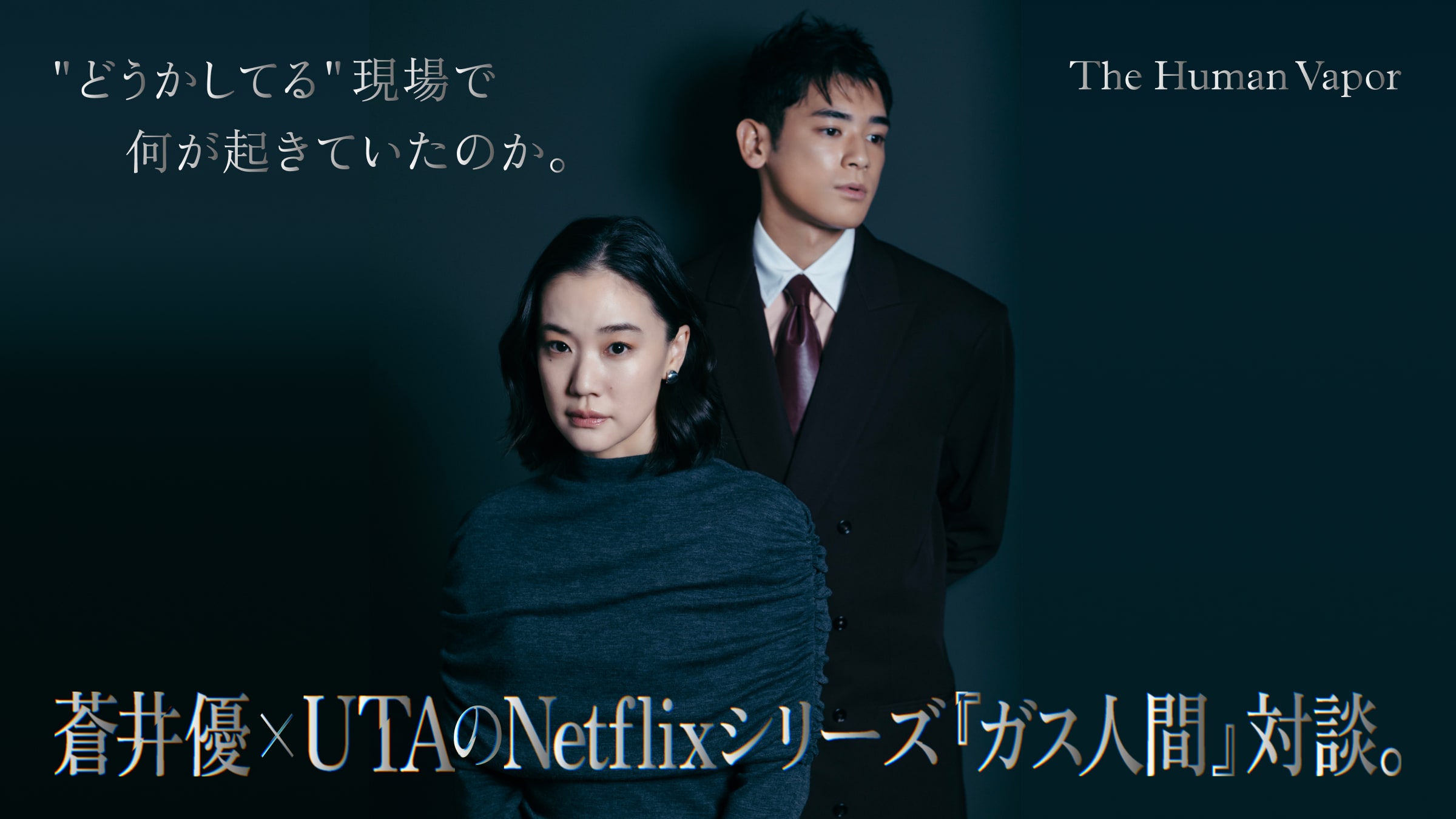
Born in Fukuoka in 1985. Since her debut in the 2001 film *All About Lily Chou-Chou*, she has been active in a wide range of films, TV dramas, and stage productions both in Japan and abroad. She has received numerous awards, including the Japan Academy Prize for Best Actress. In this film, she plays Kyoko Kono, a journalist.
PROFILE
Born in Tokyo in 1997. He attended an international school from a young age and devoted himself to basketball while attending college in the United States. As a model, he has worked with top brands both in Japan and abroad, including at Paris Fashion Week. This film marks his acting debut, in which he threw himself wholeheartedly into the role of the enigmatic “Gas Man.”
This appearance was a challenge for both of them.
—This is a global-scale project involving Netflix, Toho, and a collaboration between screenwriter Yeon Sang-ho and director Shinzo Katayama. Could you tell us what your first impression was when you received this offer?
Aoi: Since Mr. Yon (the executive producer who also wrote the screenplay) had mentioned my name, I thought, “If it weren’t for that…” I don’t recall ever appearing in a film that was so fully committed to this kind of VFX-heavy entertainment, so I was a bit worried about how it would turn out. But since Shun Oguri’s name had already been mentioned at that point, I also felt reassured, thinking it would be fun to work with him. I’d also worked with Director Katayama on Bong Joon-ho’s crew back when he was an assistant director, and I’d been watching his films for a long time, so I’d always hoped to collaborate with him someday.
—This is your first time on set as an actor, isn't it, UTA?
UTA: That’s right. Since this was my first time acting, I approached it with a healthy sense of pressure and nervousness. From Yeon’s and Director Katayama’s previous works, I knew they tackle themes that you don’t often see in the Japanese film industry. Plus, there was the sheer scale of the project—a collaboration between screenwriter Yeon Sang-ho and director Shinzo Katayama, as well as the first-ever partnership between Toho and Netflix— and the unique cast, I’d been thinking a lot even before filming began about how I could leave my own mark and make my presence felt. There was pressure, but it was truly rewarding, and it’s a film I’ll never forget.
—I’ve heard that you, Ms. Aoi, carefully study the script to develop your character. How was it this time?
Aoi:Since I was given a Japanese translation of a script originally written in Korean, the cultural differences made it both challenging and interesting. For example, since Japanese and Korean sensibilities differ slightly, I’d think, “Oh, so that’s the emotional direction they’re going in,” or, since I don’t understand Korean, I’d wonder about the tone in which certain lines were written. While I found these differences to be a uniquely interesting contrast, building my character from that foundation was actually quite a difficult task.
—Since UTA’s role involves a lot of VFX, what specific preparations did you make?
UTA: I did a lot of preparation. Starting about three months before filming, I took lessons with my coach almost every day. Since English comes more naturally to me, I started by doing improvisational acting in English to gradually push past my limits and build a solid foundation as an actor. For the first two months, I didn’t touch the script at all. I’d expressed myself in front of the camera as a model, but acting is something completely different… At first, I was so embarrassed it was almost scary. It felt strange to see myself speaking on screen, and there were times when it was so unpleasant it gave me goosebumps (laughs).
—Even though you're a model, too (laughs).
UTA: I’m used to being watched while walking down the runway, but at first, I was really embarrassed when I had to talk and move around. I gradually gained confidence, and in the final month, I was finally able to go over the script one-on-one. It was precisely because of that preparation—repeating the same scene dozens of times and rehearsing various variations—that I was able to approach the first day of filming in such great shape.
—Did you decide to transform your body on your own?
UTA: As for the physical aspect, it seems Director Katayama had a specific image in mind. Since the Gas Man is often naked in the story, being too big or too muscular wouldn’t fit that image. Whether he’s clothed or not, I aimed for just the right balance to convey an inorganic, eerie atmosphere. You could say I went for a lean, muscular look (laughs). Thanks to that, I discovered the joy of cooking. The trainer who helped me develop the character for this project told me that diet is crucial for transforming your body, and that’s what got me started cooking. I think I was able to maintain a really good level of focus in the days leading up to filming.