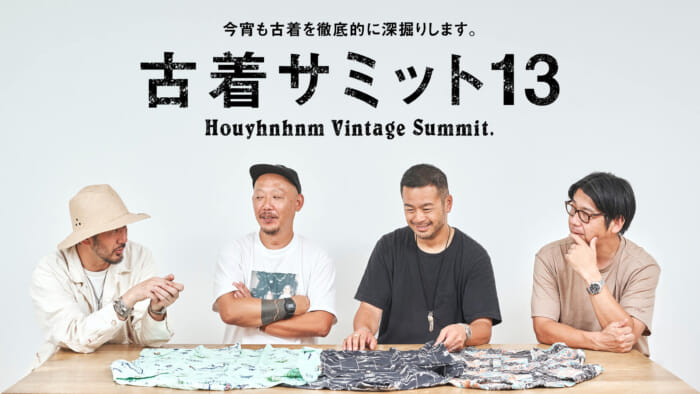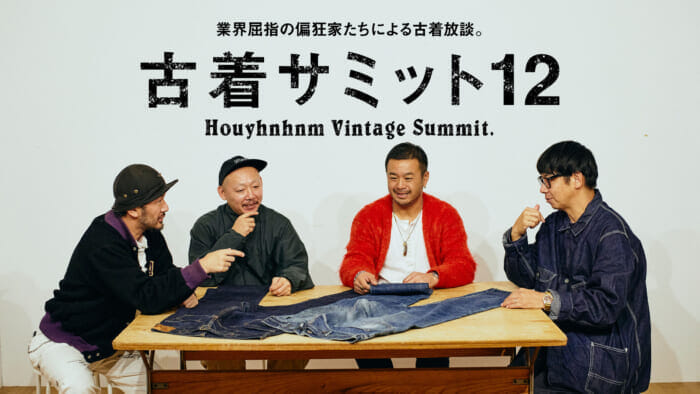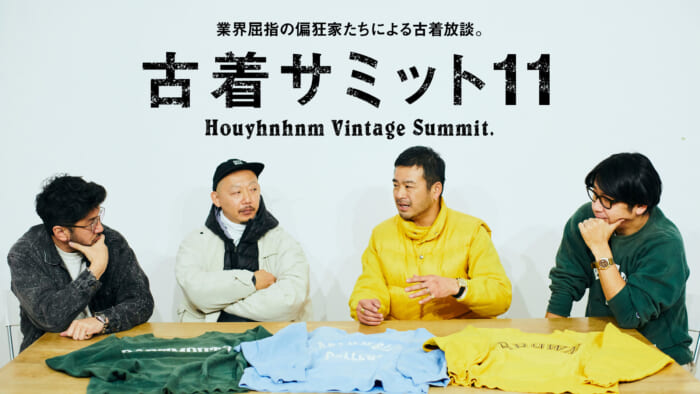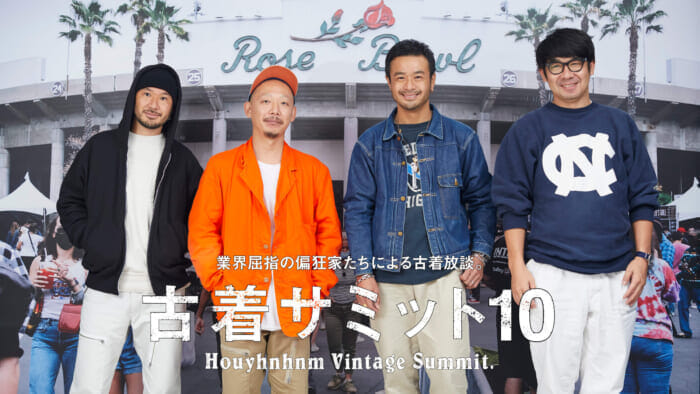

-
Hitoshi Uchida
-
Tomohiro Konno
-
Michihiko Kurihara
-
Takashi Abe
PROFILE
A seasoned veteran who founded “Jantique” and “Uchida Shoten” and laid the groundwork for Japan’s vintage clothing culture. Unbound by trends or conventions, he draws on his unique aesthetic sensibility, shaped by his experiences during his time in Santa Monica. He uncovers value that the times have yet to recognize and offers fresh perspectives.
Instagram:@uchidahitoshi
PROFILE
Founder of . In recent years, he has been engaged in a wide range of activities, including custom designs for various brands and the creation of materials and products that combine unique features with high practicality. He possesses a structural perspective unique to a designer, as well as a deep understanding of vintage clothing cultivated over many years.
Instagram:@nexus7konno
PROFILE
He is the owner of “Mr. Clean,” a shop in Okushibuya, and one of Japan’s leading vintage buyers. He calmly assesses the latest market trends both in Japan and abroad, and meticulously unravels the historical stories and cultural contexts embedded in each item. He adheres to an intellectual hunting style that goes beyond mere “digging,” conveying the true appeal of vintage clothing to the modern world.
Instagram:@michihikokurihara
PROFILE
At the major apparel company “Bay Cruise,” she is in charge of e-commerce content creation and other tasks. She has long served as the guiding compass for this column, expressing her boundless love for vintage clothing in down-to-earth terms. Guided by the philosophy of “what I truly want to wear right now”—uninfluenced by the soaring prices of trendy items—her approach to enjoying everything from handpicked vintage pieces to current collections with boundless enthusiasm resonates deeply with readers.
Instagram:@abeabc1976
Lecture 1: Tomohiro Konno
"Realizing there was a limit to how much I could repair it, I used a pair of sewing shears to cut the sleeve off at the base."
Late ’70s–Early ’80s Varsity Vest (Custom-Made)
Konno:The first item is a custom vest. It was originally a varsity jacket from the ’70s to the early ’80s. You know how you often see those in vintage stores—the wool body is still in good shape, but the leather sleeves have hardened completely and the silver finish has peeled off.
Uchida:Yeah, I know what you mean. The ones where the surface has turned suede-like.
Konno:Yes. This one also had white leather sleeves, but the part below the elbow was so worn out that the lining was showing. I got it around 2018 or 2019, before the pandemic, but I figured there was only so much I could do to repair it, so I used a pair of fabric shears to cut the sleeves off right at the base.
Kurihara:Just judging by the condition of the fabric, I’d guess it was probably washed in a regular washing machine. That’s probably why the damage to the leather got even worse.
Abe:Did you just cut it with regular scissors?
Konno:Yes. With bomber jackets, the sleeves are attached using a unique pattern, so if you just cut them off, the shoulders end up sticking out awkwardly to the sides. It’s exactly like Yakko-san’s pattern, really. So after cutting off the sleeves, I took it to a tailor to have them adjust the shoulder slope just a little bit and clean up the lines.
Uchida:I never would have thought of remaking a varsity jacket into a vest. When we’re picking out jackets, we tend to skip over them as soon as we see the leather on the sleeves is worn out. But for some reason, most varsity jackets we come across are on the small side—this one, though, is a good size.
Konno:That's right. This is probably a size 44, and since it has a loose fit, it works well for all kinds of layering.
Abe:There aren't any tags, so I wonder if this was a promotional campaign for “MacTruck” (an American truck manufacturer whose predecessor was Mac Brothers, founded in 1900; the brand itself continues to operate today as a subsidiary of Volvo)?
Kurihara:That’s certainly a possibility, and it might even have been part of the staff uniform. Still, as Konno-kun and Uchida-san point out, for vintage enthusiasts, the issue of cleaning is always a concern when it comes to varsity jackets. These days, sending a leather-trimmed jacket to the dry cleaner costs about 10,000 yen, and there’s also the risk that the leather might shrink or get damaged. So, cutting off the sleeves so you can wash it yourself might actually be a practical solution. That said, I suppose that would come with its own set of costs, too (laughs).
Uchida:To begin with, the leather used in these bomber jackets is just low-quality. So I think (the previous owner) probably just accepted that it wasn’t worth the trouble of taking it to the cleaners. Of course, during the “button-up” era (when jackets with a front closure featuring regular buttons—rather than snaps—were the norm until around the 1940s), there were some pieces made with good-quality leather.
Konno:It’s true that older bomber jackets often use deerskin, and they’re surprisingly water-resistant and durable, aren’t they? However, starting in the late “60s and into the ”70s, a synthetic leather called “naugahide” (vinyl leather) started appearing, and it tends to get sticky as it ages. Actually, I’ve cut the sleeves off a varsity jacket made of Nauga Hide that had become sticky like that in the past, too (laughs).
Uchida:(If you're playing the bass), you'd be plucking the strings without a moment's hesitation as soon as they're already sticky, right?
Kurihara:Well, I guess so.
HOUYHNHNM:You mean that thing from *Nauga Monster*, right?
Kurihara:That's right. You're referring to vinyl leather, which was developed by a company called (formerly the United States Rubber Company) and became popular in the 1960s.
Konno:You know those “Nauga Monster” stuffed animals you sometimes see at thrift stores? Those were actually promotional items that salespeople were given back then to promote Nauga Hide. It seems they would deliberately splash ketchup or mustard on the stuffed monster and demonstrate how it would “come out this clean with just a quick wipe.”
Kurihara:Aside from clothing, it was widely used for car seats, diner sofas, and the like—I think it was a groundbreaking alternative to leather for its time.
Konno:Maybe there was some kind of animal welfare philosophy behind it. A “monster” created for that purpose, so to speak.
Abe:That's true. I can't say for sure that it doesn't exist.
Konno:By the way, we’re actually working on a collaboration project with *Nexus Seven* featuring this Mac Truck for next season.
Abe:The brand itself still exists, right?
Konno:Yes. While apparel products were already being managed under license by other companies, this project got started because we had originally been collecting vintage clothing from brands like Mack and Bulldog.
"I've been interested in this kind of DIY makeover for quite some time."
’50s–’60s Winchester Remake Vest
Konno:The second one is also a "best" connection. This one-of-a-kind piece is a strong reflection of American DIY culture. It’s based on a canvas bag originally used to collect shotgun shells from the famous ammunition brand *Winchester Ammunition* (a subsidiary of the major Olin Corporation, founded in 1892). I imagine a hunter or shooting enthusiast from that era took apart this sturdy bag—originally designed for tossing used shells into—and remade it into a vest themselves. It has a real ’50s–’60s vibe.
Uchida:I absolutely love pieces like this. You can still see the patches on the back, and it’s got just the right amount of wear and tear. They’ve generously combined the same fabric, and even the piping is beautifully sewn. The shape is interesting, too—you can tell this was made by someone who really loves what they’re doing. In the U.S., there’s a long-standing “feedsack” culture of turning flour and feed sacks into patchwork clothing, but this is like the hunting version—it has that unique appeal you only get from a one-of-a-kind piece. Even overseas, one-of-a-kind pieces like this are incredibly highly regarded, aren’t they? You occasionally come across shirts like this that others are wearing too, but this one really has a unique aura about it.
Konno:That’s exactly right. Even though they’re all “Winchester” bags, the placement of the print and individual variations give each one a completely different look. I’ve been interested in this kind of DIY remake for quite a while now, and there was a time when I was steadily buying up just the “Winchester” bags on eBay and the like, but I just couldn’t seem to collect enough of them. Meanwhile, their popularity overseas kept rising, and recently the prices of the bags themselves have skyrocketed.
Abe:I can't even get my hands on bags anymore. I guess there's a different group of fans and collectors out there, distinct from those interested in vintage clothing.
Kurihara:When it comes to this brand's home goods, I often see calendars from the 1920s and 1930s. They feature illustrations of hunters and hunting dogs and the like.
Abe:I see. So maybe you can tell the era just by looking at the font used in a brand’s logo. But this kind of DIY vibe is part of what makes vintage American clothing so interesting, isn’t it? Take *Frostline*, for example (an outdoor brand founded in Denver, Colorado, in 1966).
Konno:That’s right. It’s not just about selling finished products—there are also kits that include fabric and patterns, so users can make their own down jackets and shell parkas by following the instructions. Every now and then, a Sara kit for a design that hasn’t been made yet pops up.
Uchida:You can really see the creator's personality shining through.
Konno:I once bought a down jacket made from denim patchwork.
Abe:I've also seen a specimen with just the York part in a polka-dot pattern. That one is probably a self-built one, too.
HOUYHNHNM:I think (an outdoor brand founded in Colorado in 1946) also sold kits around the same time, didn't they?
Kurihara:Yeah, there are. That one’s mainly from the '70s, too.
Konno:That's true. It might have been influenced by the DIY spirit—or rather, the desire to rely as little as possible on modern conveniences—that was part of the hippie culture of that era.
"After looking into it, it turned out to be a test sample."
’80s U.S. Army ECWCS Gore-Tex Parka Test Sample (Made by Marmot)
Konno:And this time, the item I was most eager to dig into in depth was this military parka. It’s a GORE-TEX® parka from the “ECWCS (Extended Cold Weather Clothing System),” which every vintage clothing enthusiast knows.
Uchida:But this one is a bit lighter in color, and it’s clearly different from a regular GORE-TEX® parka. Isn’t it just a consumer product?
Konno:Yes. Actually, Kurihara-kun gave it to me about 15 years ago, but after doing some research, I found out it was a test sample. Among military and outdoor enthusiasts, there had long been speculation that “the original prototype was probably the All-Weather Parka,” but the one I got first was this one with the tag on it.
Uchida:Did Kurihara know?
Kurihara:No. Actually, at the time, I had Konno-kun buy one of the two items I’d gotten, and I still have the other one myself, but I didn’t know the details back then.
Konno:Looking back at the history of the brand, one of the first to adopt GORE-TEX® in outerwear—reportedly the first in the world to do so—was the outdoor brand *Marmot* in 1976. Later, in 1978, GORE-TEX® and the U.S. Army’s Natick Research Laboratory made contact, and development of a military parka began, though it did not result in adoption at that time. Later, in 1983, when a full three-year development budget for the ECWCS was finally approved, the military once again commissioned *Marmot* to produce prototypes; however, *Marmot* alone did not have the manufacturing capacity to mass-produce the enormous volume required by the military. Consequently, it was , shown in the center here, that took over production of the mass-production test batch starting in 1985.
Abe:I see. So, does that mean there are some made by too?
Konno:Yes. That's this specimen (the one shown in the product shot at the beginning).
Uchida:So the lining is ripstop, huh?
Konno:That’s right. Actually, I got this piece from a man named Tom, who teaches at an art school in San Francisco. He remembered that I’ve been collecting GORE-TEX® parkas for a while, so he sent me a photo, saying, “I came across something a little unusual”—and that’s how I ended up with this piece from *Marmot*.
Abe:That's quite a story. So, the All-Weather Parka really was the original model, then.
Konno:After I got it, I did some research and found out that it had been issued to a soldier named Nick, who apparently had a close relationship with GORE-TEX® back then.
Kurihara:I also purchased one “Raven” from a dealer in Arizona this year, and since that one also came from a veteran, there’s no doubt that it was actually issued to soldiers back when it was still a prototype.
Konno:This test sample from *Raven* is just fascinating. The details are completely different from the production version. First off, the most distinctive feature is that the buttons on the placket are exposed. Also, while the production version has the arm pocket on the left side, this one has it on the right. Whether it’s due to handedness or not, you can really see the traces of trial and error here. Furthermore, when you look at unused deadstock items, instead of the standard military spec tag, they have a simple, horizontal tag, and the section for writing the unit name remains blank.
Uchida:I wonder if there's some significance to the fact that the green tones are on the brighter side?
Konno:According to one account, online records from veterans of that era indicate that this bright green was adopted to enhance visibility during field tests in Antarctica and other polar regions. There are records showing that prototype field tests were actually conducted in 1984 by the Marines, Navy SEALs, and the Army, so I believe this is likely the version from that time. When this became the production version (the early model of the First), the front placket was shortened, the buttons were concealed by a flap, the pocket was fixed to the left side, and the color tone shifted to a more subdued Woodland camouflage. Then, in the 1990s, snap buttons were added to the hood for attaching fur.
Kurihara:When I looked this up online before, I saw a few of them being sold cheaply as consumer goods on flea market apps and the like, so I think there are still quite a few people who aren’t aware of this.
Abe:This is a major discovery. It’s incredibly valuable both as a story and as a historical document.
Konno:These kinds of little-known historical puzzles are really what make vintage clothing so fascinating, aren’t they? I also searched the Natick Research Institute’s public archives like crazy, even using ChatGPT, but I couldn’t trace it all the way back to the original procurement records, so some parts are still based on soldiers’ testimonies. This is one of the genres where I’d like to further systematize my knowledge going forward.
Lecture 2: Hitoshi Uchida
"I've been trying for years to figure out how to present this as a casual fashion option."
’60s–'70s PENDLETON & TOWN CRAFT FLANNEL GOWN
Uchida:For my first selection, timed for the start of the fall and winter season—a style we continue to feature every year at our store (Jantique)—I’ve brought in flannel robes centered on designs from the ’60s and ’70s. There are two types: one made of wool by Pendleton and one made of cotton by Towncraft.
Konno:That's a really nice check pattern. Since a robe uses more fabric than a flannel shirt, it really makes a statement when you put it on, doesn't it?
Uchida:Although its roots lie in nightwear and smoking jackets worn over pajamas, ever since the “Santa Monica” era, not just me but my senior colleagues as well had been experimenting with ways to reimagine these pieces as casual fashion.
Abe:I think Mr. Uchida played a major role in making this area widely recognized.
Konno:That's right. On top of that, I think Kurt Cobain had a big influence, especially on the younger generation. Around 2000, robes and pajamas made a comeback, didn't they?
Kurihara:Considering the prices of current shirts, this particular piece must have been quite expensive back then, right? After all, even brand-new board shirts cost nearly 40,000 yen these days.
Konno:Thanks to the vintage trend, Pendleton has become incredibly popular lately—even for brand-new items. This season, we collaborated with a long-established factory called Settle Myers to create a varsity jacket, and we specifically requested that the melton wool used for the body be made by Pendleton. As a result, the delivery date was significantly delayed. When I asked why, I was told that Pendleton is experiencing a global resurgence, and because orders from the new-item market have skyrocketed, small-lot orders like ours have been pushed to the back of the line.
Uchida:Huh, really? Well, given how generously they used wool—and considering how expensive it must have been back then—I guess 40,000 yen for a shirt is still a bit too much to spend without a second thought…
Abe:Don't you find that solid-color flannel items aren't very common?
Uchida:It’s not that they never have any, but since they usually feature piping on the collar and cuffs and embroidery on the chest, they might end up looking more classic than casual.
Abe:I see. Are there any differences in appearance depending on the era?
Uchida:I don’t think there’s anything in particular. That said, as they get older—say, from the ’40s onward—the smoking jacket influence becomes more pronounced, and when it comes to casual wear, the ’60s and ’70s really take center stage. This piece by Towncraft dates back to the ’80s, but if you choose one with a relatively long cut, you can casually throw it on as a substitute for a spring coat. It really creates a great look when worn oversized by women or petite boys.
Kurihara:But it’s hard to find ones with nice patterns and in good condition, isn’t it?
Uchida:That's true. Of course, demand is definitely much higher for flannel shirts, but they're the kind of item you don't often get to see in large quantities all at once.
"I've never known what to call this unusual fabric."
’50s–’70s Warm-Up Jacket
Uchida:Second, I’ve been a little curious about the fabric, so I’d like to hear everyone’s thoughts. The item itself is a sports warm-up jacket made between the late 1950s and early 1970s. I think most of them are basketball-related, but I’ve never known what to call this somewhat unusual fabric.
Kurihara:I guess it's a type of what's commonly called fleece.
Uchida:Yeah, it really is one of the earliest examples of fleece.
Konno:Looking at the surface, it appears to be looped, so I suppose it’s a pile fabric, isn’t it?
Uchida:It's pile fabric. I've been curious about this material and have been looking for it for years, but I don't come across it very often. Judging by the team logo and the label, it doesn't seem to be that old. I'm guessing its heyday was probably around the '60s or '70s.
Abe:This green-and-white two-tone model definitely has a '50s vibe to it.
Uchida:That’s right. That said, there are slight differences between them. Some have a texture similar to *Kodiak* (a sub-label launched by the prestigious *Campus* brand in the ’50s and ’60s, known for its plush faux fur featuring animal prints like leopard and cowhide), so it’s possible they’ve been around since the ’50s or so.
Konno:All three are made from a cotton-acrylic blend. If we were to recreate these today, given their unique yarn count and knitting specifications, they would likely come at a rather steep price.
Kurihara:Short-sleeved warm-up jackets—their purpose is a total mystery, isn't it? (lol). They're actually pretty thick and warm when you put them on, yet they're short-sleeved.
Uchida:Right, it’s said that as a sport, it was originally intended for benchwarmers in baseball and basketball, but since it’s a type of clothing that can only be worn during certain seasons, I suspect it’s a category that completely disappeared from the market with the rise of performance fabrics in the 1980s and beyond.
Kurihara:It looks like there might be some cheerleading-style ones, too.
Uchida:That happens all the time. But for some reason, most cheerleading outfits have snap buttons on the front and back, so you can put them on and take them off easily.
Kurihara:Is that the jersey number or something?
Konno:How do you style this?
Uchida:I think it looks mature and cute to pair it with nice slacks instead of jeans. From early summer through early fall, I like to layer a white shirt underneath. That unfinished, slightly off-balance look is what makes vintage clothing so endearing, isn’t it? The only thing that’s a little scary is the static electricity when I touch a car door (lol).
Konno:I actually really like that static electricity. You know how it glows when you're a little far away? There's something kind of "middle-school-esque" cool about it (lol).
All:(Laughter)
"I want to re-evaluate the appeal of niche brands that have been overshadowed by the rise of mainstream and classic brands."
’40s–’50s BALL BAND & SKIPS CANVAS SNEAKERS
Uchida:Third, while Converse’s Chuck Taylor reigns supreme as the classic choice, ever since I was taught by senior buyers years ago, I’ve been diligently collecting these “Ball Band” sneakers—brown sneakers from minor brands of the 1940s and 1950s, including those produced by Mishawaka Rubber & Wool Manufacturing, based in Mishawaka, northern Indiana).
Kurihara:It's pretty hard to find canvas sneakers from that era that are still in good enough condition to wear regularly, without much wear and tear, isn't it?
Uchida:That's right. First of all, it's important that the rubber is still in good condition. Also, brown is my personal favorite, but most of what's available on the market is black, white, or navy. That said, since I wear a larger size, I can usually find about two pairs a year, so I tend to pick them up if they're in good condition.
Kurihara:I get the impression that sneakers like these are pretty common on the East Coast.
Uchida:That might be true.
Kurihara:If I limit it to the West Side, where I usually hang out, I haven't seen any in years. Besides, brown sneakers have hardly been seen on the market since the '60s, when that fashion trend really took off, right?
Abe:I wonder why they had brown back then? Maybe they were trying to make them look like leather shoes?
Kurihara:Since sneakers tend to take on a design more similar to leather shoes the older they get, perhaps their color schemes were modeled after leather shoes as well.
Abe:Ms. Uchida, you’re actually wearing those shoes, not just keeping them as part of a collection, right?
Uchida:Yeah. I like to pair these with tapered pants and wear them in a way that makes them look like dress shoes on purpose. Compared to the classic Converse, I find these kinds of lesser-known brands more appealing. Of course, I love Levi’s as a classic too, but ever since I started working at “Santa Monica,” I’ve been completely hooked on the appeal of “Lee.”
Abe:You're going to pair them with pants, right?
Uchida:Models like the “Lee” Westerner and 101B have a slightly wider leg opening than “Levi’s,” making them a perfect match for engineer boots and the wider shafts of “Red Wing” boots. That said, pairing them with sneakers while maintaining that balance in leg width creates a perfect cushioning effect, so with the “Westerners,” I often go for women’s oversized sizes.
Konno:I'm sure Mr. Uchida actually uses all of these himself, doesn't he? It's not really a matter of collecting them, so to speak.
Uchida:That’s right. By using something myself, I can truly appreciate its quality, and I brought this along because I wanted to take another look at the appeal of lesser-known brands that have been overshadowed by the rise of classic and mainstream brands.
Lecture 3: Michihiko Kurihara
"When I wear this and walk around Shibuya or Shimokitazawa, people do a double-take, burst out laughing, or come up to talk to me (lol)."
Late ’90s–Early ’00s JOKE T-SHIRT
Kurihara:First off, I think I’ve featured printed T-shirts a few times in the past at the Vintage Summit, but since prices in this category have skyrocketed worldwide—making them hard to wear as everyday clothes—I’ve brought along a genre I’ve been secretly collecting over the past five or six years.
Abe:Erotic?
Kurihara:Yeah. Well, I guess “cheesy” would be the right word (laughs). It looks like many of the original illustrations are from *Dick and Jane*, a very popular early-learning textbook that was widely used in American elementary schools from the 1930s through the 1970s.
Uchida:It's not that old, is it?
Kurihara:That’s right. Judging by the body, I think it’s probably from the late ’90s to the early 2000s. I found a few of them about five or six years ago and sold them at my store, but after that, I started seeing various other designs pop up, so I got interested and started collecting them.
Abe:Is the conversation sleazy?
Kurihara:The original illustration itself is actually quite wholesome, but this is probably a type of fan art—or meme—where the speech bubbles have been altered to include adult-oriented dirty jokes and mass-produced. The girl is saying “Puppy Love” with such innocent eyes, but the boy behind her is thinking, “Doggy Style” (lol). What a terrible disconnect.
Konno:I wonder where they sold it (lol)
Uchida:I wonder if they're souvenir shops or tobacco shops or something like that.
Kurihara:Just like the content itself, another characteristic is that for some reason, the only ones that show up are tattered and dirty—maybe because people with low social standards used to wear them all the time back then (lol).
All:(Laughter)
Abe:Are you actually wearing it?
Kurihara:I wear the higher-quality ones myself, but it seems they’re gradually gaining recognition among young buyers over there (in the U.S.), and lately, when I ask the price, I’m sometimes told it’s around $100. On the other hand, maybe because not many people in Japan pay attention to the meaning of the English phrases printed on T-shirts, they might not be very well known here yet. But, you know, the number of foreign tourists in Japan has increased tremendously lately, right? When I walk around Shibuya or Shimokitazawa wearing one of these, people give me a second look, burst out laughing, or even strike up a conversation with me (lol).
Abe:(Laughs). I don't really picture Mr. Uchida wearing printed T-shirts, but on the other hand, you're an avid collector of Coca-Cola memorabilia, aren't you? Do you ever wear T-shirts with Coca-Cola designs?
Uchida:I don't think I'll wear it. The first thing I ever bought specifically for fashion was a football T-shirt, and while I do wear sportswear sometimes, I probably hardly ever wear printed T-shirts.
"A bulk sale of all items owned by a costume company that has completely gone out of business."
Costume Rental Corporation
Kurihara:The second category consists of costumes used in film and television productions that were sold off at auctions and other venues when “CRC (Costume Rental Corporation),” a massive costume rental company based in Los Angeles that catered to Hollywood movies and TV dramas, went out of business last year.
Uchida:Huh. They're all handwritten with "CRC," but if you didn't know better, you'd just think they were doodles, right? Did quite a few of them show up?
Kurihara:That's right. Probably tens of thousands of items.
Abe:Secondhand clothes from other companies in the same industry sometimes show up on the market, don't they?
Kurihara:Western Costume (a long-established costume rental company founded in 1912) is well known. Western Costume seems to sell off old or unused items every few years, but since CRC went out of business completely, all of its inventory hit the market at once.
Uchida:So, is it pretty common in Los Angeles?
Kurihara:That's right. It's actually become a bit of a talking point among dealers and collectors over there.
Konno:If you look closely at these prison pants, you can see faint traces that look like the prisoner number from back then was erased—but this wasn’t something newly made; I guess they just repurposed the actual item as a costume.
Kurihara:Yes. One of the interesting things about Hollywood-style costumes, including those from CRC, is that they include a mix of four different approaches: using authentic vintage pieces as-is; customizing vintage clothing—such as adding prints to workwear to make it look like a prison uniform, or altering details on military items from different eras to make them look older; cases where off-the-rack items are altered after purchase, and cases where replicas are crafted from scratch specifically for filming.
Abe:In that case, it seems like these items would show up not just at Kuri-kun's shop, but also at vintage clothing stores that mainly source from the West Coast.
Kurihara:These mechanic pants, which at first glance look like they’re from the U.S. Air Force, are a rather mysterious item. I came across them at a store in Fukuoka while researching CRC items the other day and ended up ordering them online. Although they’re civilian-market items with details that differ slightly from military-issue versions, I believe they were made around the 1960s, not more recently. There’s a tag on the inside of the waistband that reads “David’s Outfitters,” a New York uniform shop. However, since some of the surplus items from CRC—even those intended for military supply—had the same tag attached, it’s possible that this tag itself was added later by CRC.
Uchida:Come to think of it, I don't think I've ever seen a civilian version of these Air Force pants.
Kurihara:Yes. In the past, I actually found and sold a Carhartt jacket that was used in the movie *Jurassic World*, but it had been altered—the brand tag had been removed and the logo on the buttons had been scraped off to make it look worn. In addition to that jacket, there were also about five plain *Hanes* T-shirts. To ensure we could change clothes and seamlessly transition to the next scene in case of any mishaps during filming, they were all treated to have stains and damage in exactly the same spots.
Konno:Unraveling that kind of background and historical story is part of the fun of finding vintage items. That said, if I hadn’t heard this story from Kuri-kun, it would probably just look like a piece of vintage clothing with some doodles on it.
"I wonder if it might have been printed in a very limited run just for the Apollo 8 crew."
’68 NASA Snoopy Sweatshirt
Kurihara:The third item is a 1968 flock-print sweatshirt I found in the U.S. that’s tied to NASA’s Apollo 8 mission. On the front, alongside an illustration of Snoopy, are the Apollo 8 command module’s serial number, “SC103,” and the word “CREW.” At first, I just thought it was a slightly unusual Snoopy sweatshirt, but when I looked into it more closely, I started to see a lot more to it.
Uchida:What does that mean?
Kurihara:There were only three crew members on Apollo 8, but it feels odd to refer to NASA staff—such as mission controllers and ground crew—as “crew,” so I’m starting to wonder if this might be one of the prints made specifically for those three crew members. What’s more, it comes from Houston, home to NASA’s Johnson Space Center.
Uchida:That sounds plausible. Were there any photos of it being worn back then?
Kurihara:Unfortunately, I couldn't find any photos of it being worn, but the design matches perfectly with the commemorative medals and stickers that NASA distributed to staff members around the same time.
Uchida:If they were making souvenirs or replicas later on, they’d probably go with something more recognizable, like “Apollo 8,” so the fact that they’re using this specific code—“SC103”—makes it much more likely that this is the original.
Konno:At this point, isn't it safe to just call it an original? (lol)
Uchida:If it's authentic, it would have just as much historical value as the spacesuits the astronauts wore during their missions, wouldn't it?
Kurihara:That's right. It might actually be on par with the Smithsonian (Smithsonian National Air and Space Museum).
Abe:This is sure to catch the attention of both NASA fans and Snoopy fans. Plus, prices for Snoopy-print sweatshirts have been skyrocketing again lately.
Abe:It’s true—the recent price hikes have been staggering, haven’t they? I wonder if NIGO® is the reason after all?
Kurihara:I think NIGO® has had a huge influence. Footage from that exhibition (the ”The Future Is in the Past—THE FUTURE IS IN THE PAST”—NIGO’s VINTAGE ARCHIVE Exhibition—held at the Bunka Gakuen Fashion Museum in 2022) were posted on social media and elsewhere, and the following year, at an auction (the “NIGO: FROM ME TO YOU,” held by Jupiter in 2023) where a lot of Peanuts sweatshirts was sold for a considerable sum—it seems that once young American dealers became aware of them through these events, prices skyrocketed all at once.
Konno:I also think the renewed appreciation for Beethoven prints was one of the factors that boosted the popularity of “Spruce” (an abbreviation for “Mayo Spruce,” a sportswear brand founded in the United States in the 1950s). Since there are only three types in the Composers Series (Beethoven, Brahms, and Bach—collectively known as the “3B” after their initials), you can complete the set quickly, but since there are so many varieties in the Peanuts Series, I imagine there was also the joy of collecting them from the very beginning.
Uchida:When did you get this NASA print?
Kurihara:It was last year. If I’d found it a while back, I might not have paid it much attention, but as Mr. Abe and Konno-kun pointed out, it happened to be right when prices for Snoopy sweatshirts were skyrocketing again, so I took a close look at it. Still, I really don’t think this is the kind of item I should just sell on a hunch, so I’d like to do a little more research on it.
Lecture 4 Takashi Abe
"I know it's a bit awkward for me to say this myself, but it really doesn't suit me at all... (laughs)."
’70s Lewis Leathers CYCLONE
Abe:My first pick is the “Cyclone” from Lewis Leather. Lately—maybe it’s because of my age—I’ve been thinking about death all the time (laughs). It’s not so much about death itself, but more about being conscious of the time I have left in life—a sort of “end-of-life planning” mindset. When that thought struck me, I decided, “I’m going to set aside what others think and whether something suits me or not—I’m going to keep only the things I truly want to wear and the things I’ve always admired.” That’s why I specifically went out and bought this Cyclone. I already have the black one, but as someone who loves navy, I just had to have this one too.
Uchida:It's in amazing condition, but how old is it?
Abe:I think it's from the '70s. However, I believe the front-zip head has been replaced.
Konno:But first of all, colors like navy—or any colored items at all—aren't even showing up, are they?
Abe:That's right. The other day, another Cyclone in turquoise blue was listed on Yahoo! Auctions, and it seems it went for an outrageous price.
Konno:Huh? So that’s how it is already? But why “Lewis Leather”?
Abe:I actually liked the Cyclone better than the brand itself. It doesn't have epaulets, and the body is a bit longer, so it's easy to style—and above all, the silhouette is beautiful. Of course, the current models are great too.
Uchida:But, as expected, the thick, supple leather from that era really is something special, isn't it?
Abe:That’s right. When I asked a friend who deals in British vintage items, he told me that even British buyers have said, “The Japanese have bought up all the vintage Cyclones—all the good ones are in Japan, right?” (laughs). He said enthusiasts all over the world are searching for them now.
Uchida:Well, he doesn't appear in the U.S. at all, to begin with. Still, he gives off a rough-and-tumble vibe that doesn't really seem like Abe-chan.
Abe:Yeah. I know it's a bit awkward for me to say this myself, but it really doesn't suit me at all... (laughs).
Kurihara:Oh, I was actually planning to tear you apart if it didn't look good on you, but it actually suits you surprisingly well (lol).
Konno:From what I’ve heard about the rare colors of “Lewis Leather,” it seems that the yellow version is far harder to find than the turquoise one. Perhaps because so few people ordered it back then, whenever a vintage yellow pair appears on the market, collectors around the world get all excited.
Uchida:Is it the yellow Lewis? There’s a British Army Paratrooper jacket with a yellow-painted hood—that one looks cool too, so it’s easy to picture the Cyclone. Come to think of it, it seems Nigel (Cavon), who was reproducing those (Paratrooper) jackets, has passed away.
Abe:Didn't Mr. Uchida have some connection?
Uchida:I remember a while back, Nigel asked me, “I’m publishing a book soon—would you mind writing a few lines for it?” But I flatly refused, saying, “We’re not friends; we’re just a shop and a customer.” Looking back now, I do feel a little regret about that. As a tribute to him, I bought an apron the other day.
“Even now, I still look for specimens with the old tags with a ”Big E'-like feeling."
’70s–’80s SAINT JAMES Ouessant, Naval
Abe:Second is the “Saint James” Basque shirt—my all-time favorite. I’ve been buying the ones with the brand logo on the sleeve—specifically the “St. James” version rather than “SAINT JAMES”—ever since I was a student.
Uchida:When did the company-owned store open along Meiji-dori?
Abe:It had already been replaced by “SAINT JAMES,” hadn’t it?
Kurihara:Is around 1990 the turning point?
Abe:I can't pinpoint the exact date, but it was already "SAINT JAMES" back in the early '90s. Although the inner neck tag has gone through a few changes, it was a printed tag all the way through the '80s. I think they switched to a woven tag around the time the text on the sleeve changed.
Konno:It’s been a classic go-to for “when you think of Abe-kun” for ages. So, you’re really set on *Saint James*—not *Oshival* or *Luminoir*?
Abe:Yeah. I guess there really is that image of “Basque shirts = Saint James.” Back when I was a student, there were a lot of upperclassmen in the vintage market who were hunting for pieces with these old tags, kind of like they were looking for a “Big E,” and I was totally influenced by that. A lot of the older pieces have shrunk a lot from washing, making them narrower across the chest, but once I realized that—just like with sweatshirts—if you get them wet and stretch them out properly, you can adjust the size to a decent fit, I’ve been making it a point to pick them up whenever I find them, since they’re basically consumables.
Uchida:The popularity of *Saint James* in Japan really took off with the French casual trend of the ’80s, didn’t it? Back then, the trend was to layer a Saint James shirt over a white shirt and throw on a stand-collar coat. I guess that’s why it’s still such a deep-rooted part of the culture here. You hardly ever see anyone wearing it in the U.S., after all.
Abe:Just as you say, it’s a culture that’s completely unique to Japan. I visited their flagship store in Paris back in the ’90s, and there were literally only Japanese customers there. For some reason, even the middle-aged woman working there was eating rice crackers (laughs).
Konno:I wonder if it was a gift from a Japanese tourist (lol)
Abe:That said, there are plenty of interesting designs in the current lineup—like loose-fit and mock-neck styles—so I love wearing both vintage and new pieces. So please make sure to note that while I respect the vintage aesthetic, the current collection is, of course, absolutely fantastic too (lol).
All:(Laughter)
“There is a clear distinction between ”constellations that are easy to spot“ and ”constellations that are hard to spot.'"
’70s Bandana
Abe:And, of course, I’m ending with a bandana again this time. It’s a zodiac pattern from around the ’70s. It’s the complete set of all 12 zodiac signs from the series I’ve taken to calling the “Dragon Ball of the bandana world.”
Konno:In the center, there's a circle—it looks like a record, or rather, just like the Spirit Balls from *Dragon Ball*—and motifs of the various constellations are depicted around it,
Abe:That’s right. Since the RN (Registered Number) is 14193, this is a single-ear model made by , but it’s still a genre shrouded in mystery—whether the color variations are fixed for each constellation or if every color is available for all constellations. It doesn’t seem like there’s a set rule, like “pink for Gemini.” What’s more, when you keep an eye on the market, it’s fascinating to see how clearly the constellations are divided into those that “come up often” and those that “come up rarely.”
Uchida:That's right. I've forgotten the specific type of constellation, but I've seen an orange one like that before—one that isn't here today.
Kurihara:So there's an orange one, too.
Abe:Well, if I find one, I usually grab it even if I already have a duplicate, but while I see Pisces, Leo, and Cancer quite often at the market, there are certain constellations I just can’t seem to find. I even went all the way to Osaka just to buy a specific constellation (lol).
Uchida:These days, even a single bandana can cost just under 20,000 yen depending on the pattern, but when you consider the difficulty and effort involved in collecting all 12 of them, the value of the set as a whole is incredibly high, isn't it?
Abe:That’s right. “Santa Monica” was actually what got me started collecting bandanas in the first place. It was Uchida and his team during the “Santa Monica” era who first started framing them and presenting them as interior decor, rather than just folding them up small and lining them up. If “Santa Monica” hadn’t been doing bandanas back then, I don’t think I would have become a collector.
Uchida:As for the framed art, when we displayed it on the high walls of our store back then—as a way of imitating American interior design—it really caught on. It’s true that, while Apollo patterns and cowboy motifs were the mainstream at the time, we all came up with various names for the irregular geometric patterns in an effort to add value to them and make them interesting, creating our own unique pop style.
Abe:Thanks to that, I still can't seem to escape the "bandana trap" in my life (lol).
All:(Laughter)