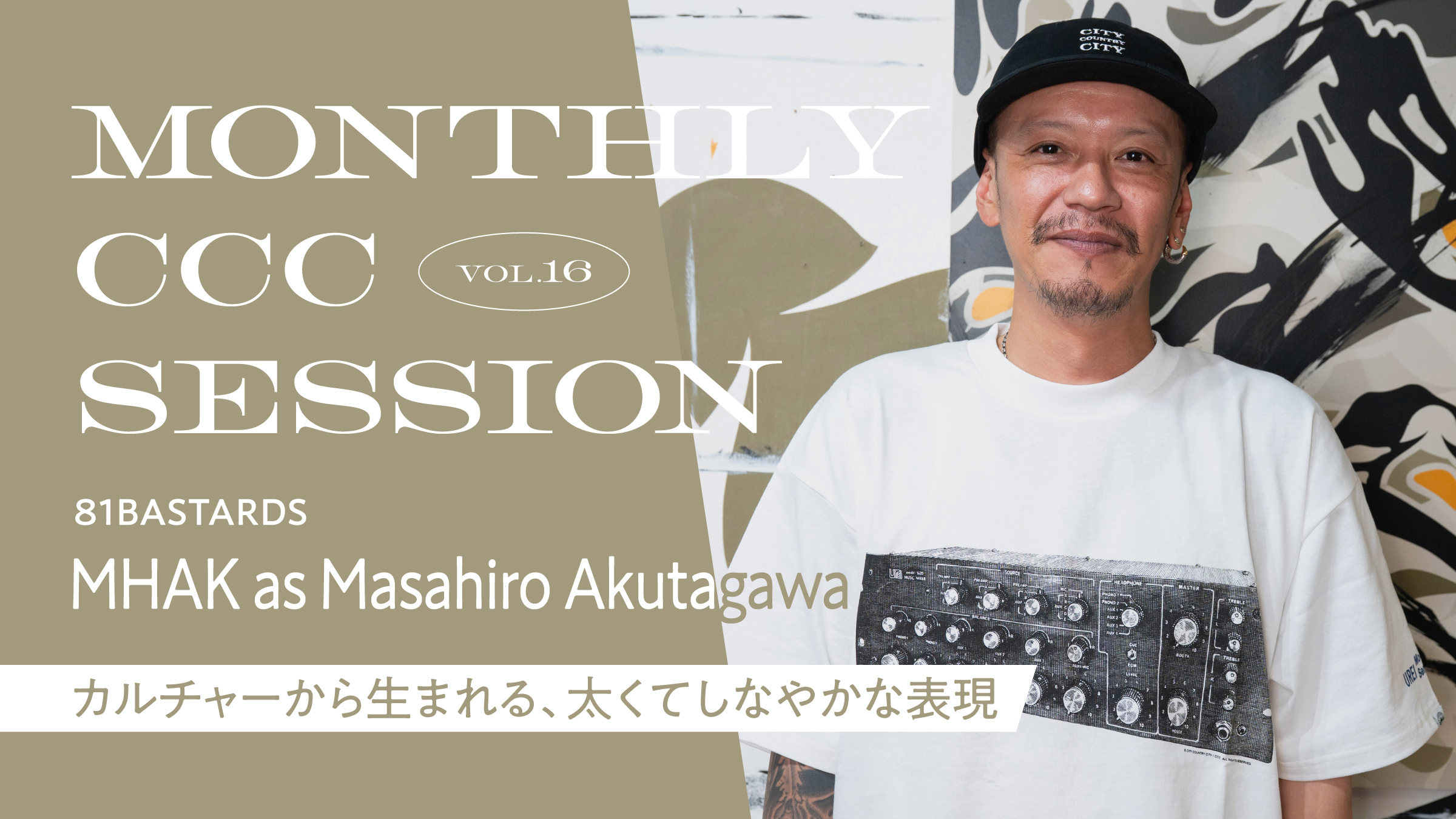
City Country City" is an anonymous brand that does not disclose its design team, but has been steadily increasing its presence. In this Series, we interview creators who have been close friends of City Country City since its establishment, in order to find out what the brand is really like. We will be looking into the contents of this mysterious brand from all angles.
This time, we’re featuring MHAK from “81BASTARDS,” who is active as an artist and painter. He’ll speak candidly about the brand’s appeal as seen through the lens of his close relationship with it.
I feel, without really knowing why, a kind of affection for this place.
—Please tell us about the relationship between MHAK and .

MHAK:There was someone on the design team who was from Aomori. They have a get-together called the “Aomori Club,” and since I’m from Aizu-Wakamatsu and we both have ties to the Tohoku region, they let me join as a special guest. That’s where we first met. It was over 10 years ago.
—What was your impression at the time?
MHAK:Since he was my senior, I was nervous the whole time (laughs). But he was really friendly toward me, and that’s how our relationship began. Even after 〈CCC〉 launched, I’ve been stopping by their exhibitions.
—I hear you often wear clothes from .
MHAK:I wear it all the time, and I often wear the cap, too. The cut is great, so I can just throw it on without thinking, and while the graphics are striking, I really like how it just feels like it fits me perfectly. I also really like the brand name, “City Country City.” Since we’re both from the Tohoku region, I can’t help but feel a sense of love for our hometown (laughs).
—Do you have similar musical backgrounds as well?
MHAK:I knew it was based on house music, but I’m actually more into punk and rockabilly, and I’m influenced by London Night.
—So it seems the connection lies more in the fashion aspect of “London Night” than in its musical background.
MHAK:That might be true. Back then, all kinds of cultures were mixed together in a good way. The members of the design team know a lot of interesting stories from that time that aren’t in the books, and we’re having a drink together while listening to them (laughs).
I view 〈CCC〉 as a kind of graphic label.
—Today, I'm visiting MHAK's studio.
MHAK:You always create your work here, don’t you? I usually work in complete silence to keep my mind clear of distractions. If I hear a nostalgic song, I tend to get carried away by the imagery it evokes.
—MHAK’s work is really abstract, isn’t it?
MHAK:I do have certain images in my head, but basically, I want to leave it up to the viewer’s imagination. That’s why I don’t want to depict them in a concrete way. Since I often paint directly on the walls of shops, I also don’t want to disrupt the space. It’s more like I paint while hoping to create a nice atmosphere in that place.
—I think it's amazing that they're able to compete while maintaining that balance.
MHAK:I wasn’t very good at first, though. But now that I’ve been drawing for over 20 years, I think that’s what’s given my work its credibility. I’ve been able to sign contracts with major brands, and I feel like that’s opened up new opportunities for me. Lately, in addition to my “MAHK” moniker, I’ve been expanding my channels and broadening my range of expression by creating work under my real name, “Masahiro Akutagawa.” This has given me even more to think about, which is really fun.
—When do you find inspiration?
MHAK:I also gain a lot from conversations with friends and seniors, and especially from interacting with the people at . As I mentioned earlier, these are people who were at the heart of Tokyo’s fashion scene in the 1990s and 2000s, so they really know the ins and outs of the industry. Isn’t it truly invaluable to hear firsthand accounts from that era? That in itself is already a form of culture. Beyond that, I also look for those elements within fashion itself—like how colors are combined in outfits.
—How do you, MHAK, perceive the graphics of 〈CCC〉?
MHAK:I see as a kind of graphic design label. They collaborate with artists and cultural figures they admire to create works, which they then express through graphics. You can see the mutual respect between them, and the quality of the finished products is incredibly high. I think that’s something you can’t really do without experience, and I personally find it a huge source of inspiration.
You can't become stronger unless you can see what you've built up.
—Earlier, you mentioned that you’re “broadening your range of expression.” Has that had any impact on you personally? For example, has your way of thinking changed, or have you noticed any changes in your daily life?
MHAK:I hadn’t really noticed it myself, but I’m sure I’ve changed. After all, I learn so much every day through my interactions with the design team and all sorts of other people. When I think about it now, I realize that those experiences have truly become a valuable asset to me. Especially since the folks at are like mentors to me (laughs).
What are your expectations for CCC in the future?
MHAK:Don’t you all at love to dig deep into things? I’d like to see you show that attitude even more—especially to the younger generation. In a way, it’s not that otaku are the strongest, but I think that’s how it should be in any culture. Digging deep creates knowledge, and that leads to persuasiveness. After all, you can’t become strong unless people can see the foundation you’ve built up over time.
—Precisely because there’s so much information out there, there’s plenty of material to dig into.
MHAK:But maybe it’s not such a good thing that we’ve reached a point where we can look things up anytime, anywhere. Everything gets handled on our smartphones, and that’s causing face-to-face communication to fade away. Of course, I don’t think that’s all bad in itself, but I do believe that in order to strengthen our own self-expression and culture, it’s important to meet people and talk with them, and to do our own research and dig deeper into things.
MHAK
Born in Aizu-Wakamatsu in 1981. Painter/artist. Influenced by designer furniture and interior design, he continues to create works centered on murals under the theme of “coexistence with living spaces.” To make his paintings function as part of a space’s atmosphere, he focuses on abstract expression and has established a unique style based on the repetition of curves. In addition to creating interior murals for private residences, restaurants, and hotels, he also provides artwork for global brands such as Levi’s®, adidas, and THE NORTH FACE. Furthermore, his activities span a wide range, including regional revitalization efforts in rural areas and his membership in the artist collective “81 BASTARDS,” which has members worldwide. To date, he has exhibited his work not only in Japan but also in various cities around the world, including the United States, Australia, Italy, and Argentina, continuing to expand his unique artistic vision both domestically and internationally.
Instagram:@mhak_

![Serials 【MONTHLY CCC SESSION] VOL.13 Yuta Kaji (Stylist) "A Hawk with a Talent Hides Its Claws](https://www.houyhnhnm.jp/wp-content/uploads/2025/02/202211864aad15f85cf8e25454659494-700x394.jpg)
![Serials 【MONTHLY CCC SESSION] VOL.12 Ronnie Jordan / WAR "Inspiration Beyond Music](https://www.houyhnhnm.jp/wp-content/uploads/2025/01/panel_monthly_ccc_session_2400_1350_b_lo-700x394.jpg)
![Serialized 【MONTHLY CCC SESSION] VOL.11 Daisuke Araki "A brand with irreplaceable experience](https://www.houyhnhnm.jp/wp-content/uploads/2024/11/panel_monthly_ccc_session_2400_1350_b-1-700x394.jpg)
![Series 【MONTHLY CCC SESSION] VOL.10 Kyohei Fujihashi (BEAUTY&YOUTH UNITED ARROWS) "A sense of exuberance that comes from having one's feet planted in fashion](https://www.houyhnhnm.jp/wp-content/uploads/2024/09/panel_monthly_ccc_session_2400_1350_a-700x394.jpg)
![Series 【MONTHLY CCC SESSION] VOL.09 Toby Feltwell, C.E. "We Only Know How to Do It That Way"](https://www.houyhnhnm.jp/wp-content/uploads/2024/07/panel_monthly_ccc_session_2400_1350_b-700x394.jpg)
![MONTHLY CCC SESSION] Extra Edition -The History of the Brand through Archived T](https://www.houyhnhnm.jp/wp-content/uploads/2024/05/panel_monthly_ccc_session_2400_1350_b-700x394.jpg)