Our editorial team visited Zurich, Switzerland, for a press tour with the bag brand *Freitag*. The other day,This articleIn our previous article, we introduced the brand’s headquarters and factories, but this time we’ll be focusing on the many tourist attractions in Zurich and the city’s culinary scene. As a permanently neutral country, Zurich is a city where diverse cultures converge, creating a unique harmony. Here, our editorial staff shares a glimpse of what they witnessed.
- Photo_Ryosuke Hoshina
- Text & Edit_Yuri Sudo
- Special Thanks: Zurich Tourism, Swiss Tourism
The entire country is a vault.
If you visit Zurich as a tourist, you’re sure to be surprised by how compact it is. The city’s attractions are scattered at just the right distances from one another, and you can easily see all the main sights in about four or five days. Plus, you can get to them by tram, bus, or on foot, so you won’t get lost—even with just your smartphone in hand.

A large cloud covered the sky just before the passing shower. The weather in Zurich is changeable and unpredictable.
As part of a press tour, our editorial staff visited two art museums in Zurich. We went in with only a superficial understanding of Swiss design, but were immediately overwhelmed. We came to appreciate the vast history and depth of art and design in Switzerland.
First, we're heading to the "Zurich Museum of Design."
From Zurich Central Station, it’s about a 15-minute ride by tram or bus to the nearest stop, “Toni Areal.” You’ll be greeted by a linear, solid-looking building—which, I’m told, was designed by the architectural firm EM2N. The Zurich University of the Arts is also located on the premises, and I can’t help but be struck by the sophisticated demeanor of the students passing by.
The "Zurich Museum of Design" was founded approximately 150 years ago and houses a collection of over 500,000 items. The collection consists primarily of four main areas: posters, graphic design, decorative arts (including textiles and ceramics), and industrial/product design.
What struck me most was that everyday items are also part of the collection. For example, everything from cigarette packs and paper bags that were likely used in department stores to home appliances and electrical outlets. The exhibition isn’t just about the beauty of their forms and designs; it also introduces the Swiss events and history behind these everyday items, allowing visitors to appreciate them from multiple perspectives.
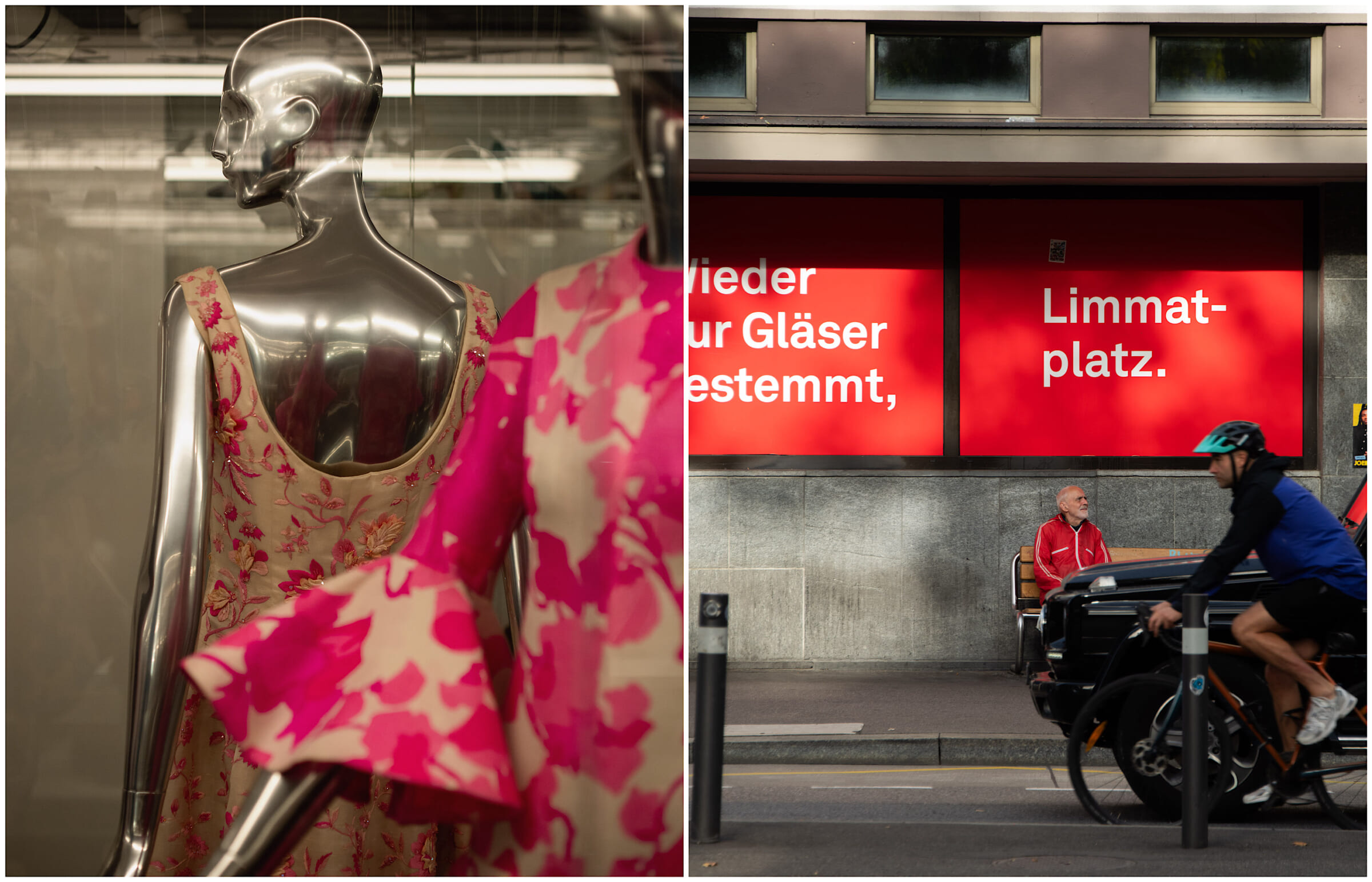
An archive of dresses.
Marionettes are also part of Switzerland's cultural heritage.
An art installation using a CRT television.
Artwork by art school students.
Perhaps because the Zurich University of the Arts is located on the same campus, we also collaborate with students from the art school. At the time, there was a project themed “healing lights,” which featured a piece where, if you shone a special light on an object for a few seconds, the illuminated area would glow in the dark.
Alongside Switzerland’s historic designs, you’ll find fresh, innovative works brimming with vitality. The coexistence of these two elements gives you a sense of the depth of craftsmanship in this region.
Next, we visited the “Zurich Art Museum.” Boasting the largest collection in Switzerland, the organization that would become the museum was founded in 1787, and the first dedicated museum building opened in 1910. Incidentally, I heard that the British architectural firm “Chipperfield” was selected to design the building after winning a competition.
There is an old wing and a new wing, and this time I focused mainly on the new wing. The exhibition features collections on long-term loan from three private collectors: Emil Georg Bührle, Werner and Gabriele Merzbacher, and Hubert Roeser.
While the breadth of this collection in terms of both era and genre is often discussed elsewhere, the collectors themselves tend to be overlooked. Learning about their backgrounds and the stories behind their collections adds a whole new dimension to the enjoyment of viewing these works.
Emil Georg Bührle was a German industrialist who built his fortune primarily through the manufacture and sale of weapons. During the interwar period, his company supplied weapons to numerous countries, including China and the Soviet Union, and during World War II, it reaped particularly large profits from large-scale arms deliveries to Nazi Germany and other Axis powers. This continued after the war, and the defense industry remained the foundation of his economic success. Beginning in 1950, with the outbreak of the Korean War and the military buildup during the Cold War, his company received a large number of new orders, particularly from the United States and Switzerland.
Given these circumstances, Bührle—who had amassed a vast fortune—reportedly assembled his collection of approximately 600 works in a relatively short period of time. He had studied art history and held a particular admiration for the Impressionist Paul Cézanne. He assembled a diverse collection of Cézanne’s works—including landscapes, portraits, genre paintings, and still lifes—which form the core of the collection. The collection also includes works by French Impressionists and Post-Impressionists such as Renoir, Monet, Van Gogh, and Gauguin.
What makes this museum so thought-provoking is that, while it houses the collection of Bührle—a wartime arms manufacturer—it also features the collection of Werner and Gabriele Merzbach, who were victims of the war.
Her husband, Merzbacher, was a Jewish collector who survived the Nazi occupation and later made his fortune as a fur trader. He and his wife, Gabriele, then devoted themselves passionately to collecting, and their collection was hailed as a “celebration of color.”
Without limiting the selection to any particular school or country, the works were gathered from France and Germany with a focus on color; representative major artists included in the collection include Henri Matisse, André Derain, Wassily Kandinsky, Ernst Ludwig Kirchner, and Paul Cézanne.
Mertzbacher was raised by a family in Zurich as a war orphan. To show his gratitude to Zurich, he donated a large number of his works to the Zurich Art Museum.
Why has such a rich and comprehensive collection been assembled? It seems there are two factors related to Switzerland’s unique characteristics: first, because Switzerland has limited habitable land, it is a country that is easily accessible to foreigners and where different languages and cultures can coexist. The other reason is that the country was largely spared from bombing during wartime, allowing the entire nation to function as a sort of vault, leading to the concentration of wealth—in this case, a collection of historical works—within its borders.
Although there are language barriers, the beauty of art is something that transcends national borders. I was reminded once again that one of the joys of travel is learning about a country’s culture through its art and design.
Healing in a foreign land.
While Switzerland is often associated with mountains, the country is also home to many large lakes, and there are plenty of boat tours available. As part of the tour, we enjoyed an elegant cruise around Lake Zurich.
Lake Zurich is a long, narrow, crescent-shaped glacial lake approximately 40 km long and 3 to 4 km wide at its widest point. As you sail southeast, you’ll notice towns stretching along both the east shore (on the left) and the west shore (on the right).
The eastern coast is called the Gold Coast, and the western coast is called the Silver Coast. The name “Gold Coast” comes from the fact that it is a golden coastline with long hours of sunshine, while the “Silver Coast” is said to be its counterpart. Both are neighborhoods where the wealthy live, and the Gold Coast is said to be home to the wealthiest of the wealthy.
As evidence of this, the east shore is lined with luxurious villas and homes with private pools, creating a tranquil atmosphere. Even though it was a weekday, we saw people enjoying aperitifs in the evening and others cruising on private boats.
I’m sure that when Japanese visitors come here, they’ll notice how gently time flows. You’ll find yourself instinctively listening to the changes in nature and its sounds. You work frantically, and before you know it, the sun has set. While busy days have their own value, the lack of breathing room can sometimes be exhausting. Zurich is the perfect healing spot—one I especially hope people like that will visit.
From here on, let’s take a look back at Zurich’s impressive scenery through photos. It wasn’t a place of obvious flashiness, but rather a wonderful place where people’s daily lives thrive and cultures intersect.
The Old Town is set on undulating terrain, with every single alleyway paved with cobblestones and lined with a variety of shops, both old and new.
Zurich's 5th District is known for its modern architecture and vibrant business scene.
I’ve also seen bicycles whizzing down the road many times. The creative ways people use them—like attaching a trailer to the back to carry babies or dogs—are something you only see in Europe.
This is another part of what makes traveling abroad so fun. Signs featuring designs unique to a particular country or region have a mysterious way of making your heart race.
Pet cats are roaming freely along the roadside.
A rich and diverse culinary culture.
Finally, here are some of the local dishes I enjoyed during the press tour. This selection is a testament to Switzerland’s unique ability to embrace cultural influences from neighboring countries with an open mind! The vegetables, fish, and meat were all fresh, and I truly felt the rich diversity of the local cuisine.
A dish I had at the staff cafeteria at the headquarters. It was part of the vegan menu—a hamburger patty made with soy-based meat. It’s hearty but not heavy.
After our boat cruise, we had pasta at the "Fischerstube" on the shores of Lake Zurich. We thoroughly enjoyed the hearty dish, which was generously loaded with seafood.
Lunch at the “Kunsthaus Bar,” a café next to the Zurich Art Museum. A dish featuring sautéed eggplant atop lightly stir-fried rice. Perhaps because the water is so good, the vegetables were crisp and delicious.
A salad with mozzarella and tomatoes. The balsamic-based dressing was so delicious that people at other tables were even snacking on it. The thin slices of fried bread added a nice touch.
A dish featuring sweet-and-salty sautéed eggplant paired with chia seeds and a sour cream sauce. It had a rich, savory flavor.
Finally, to give you a little taste of Zurich, Switzerland, we’ve prepared five sets of reader giveaways! Here’s what’s included:
① Sponsored by Freitag: Bag & Neck Wallet Set
② Sponsored by the Zurich Tourism Board: A set of souvenirs unique to Switzerland
③ Editor's Pick: A set of miscellaneous goods purchased at the "Kunsthaus Zürich"
④ Editor's Pick: A set of miscellaneous goods purchased at the art bookstores "Nieves" and "Never Stop Reading"
⑤ Editor's Pick: A box of sweets purchased at the long-established luxury grocery store "H. Schwarzenbach AG"
Please check the application guidelines in the "Information" section below.
FREITAG
Freitag Official Website
Freitag Official Instagram
Zurich Tourism Official Website
Zurich Tourism Official Instagram
Official Website of the Swiss National Tourism Board
[【 Reader Giveaway]
Application Deadline: Friday, November 6, at 11:59 p.m.
How to Enter: Please complete the short survey via the link below. Winners will be selected at random from among those who complete the survey. Winners will be notified via shipment of their prizes.
*We will strictly manage the personal information we have collected from you within our company to prevent any leakage or disclosure to outside parties. Furthermore, we will not provide this data to third parties unless we have obtained your consent.