PROFILE
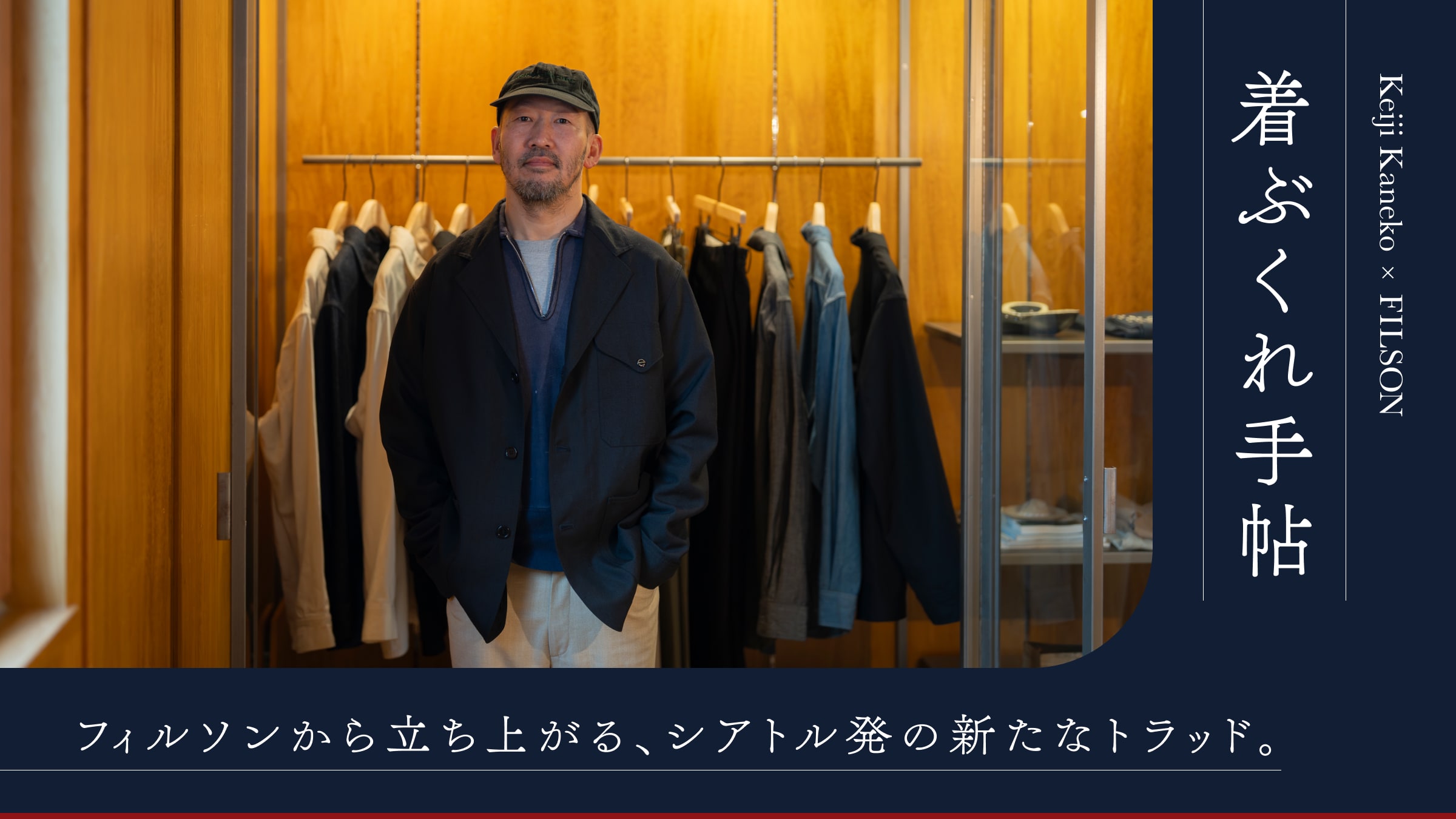
Born in Tokyo in 1973. After working as a buyer for EDIFICE and L'ECHOPPE, he currently directs his own brand, FOUNDOUR, and is the owner of BOUTIQUE. On the other hand, as a fashion director and conceptor, he is also in charge of various brands, and from this spring, he has been directing the American outdoor brand "FILSON".
Instagram:@keijikaneko
I felt confident that absolutely everyone could wear it.
When did you first pick up Filson's clothes?
Kaneko: My first foray into fashion was American casual, so naturally I knew about "Filson" when I was a teenager. At the time, I was a thin man who wore pants with a 29-inch waist, so I could not wear heavy-duty clothes at all, and when I found them at thrift stores, I would look at them with admiration.

So you didn't start wearing them until you were an adult?
Kaneko: To be honest, it was not until after I received the offer that I found some old clothes and put them on for the first time. I felt that although "Filson" is a well-known brand in Japan, there are many people like me who have grown up admiring the brand. It is hard to imagine Japanese people wearing this brand. I realized that my role in this project was to fill that gap.
Is the buffalo check jacket hanging there your vintage clothing?
Kaneko: Yes, it is. This one is from the 1930s and bears the name “Filson Clothing,” which was created through rebranding at the time. Wool from this era is thin but tightly packed, and I personally like the texture of the fabric. The patterns were drawn three-dimensionally, making them easy to wear even for slender Japanese people. In later years, the patterns became more versatile, but it became difficult for all but the strongest Westerners to wear them.
Filson has such a history, doesn't it?
Kaneko: Originally, “Filson” was making things for workers from Seattle to Alaska in the U.S. during the gold rush at the end of the 19th century. After that, the company continued to produce clothes for forest guards and forest workers, but a marketing manager suggested that the company needed to make more of an impact in order to sell more clothes, and a rebranding was carried out. In the 1930s, the name "Filchro" was created so that people could wear it as street clothes, but in the 1940s, the name reverted to its original spelling, which is a phantom name.
In the 1930s, the industry was not yet industrialized.
Kaneko: That's right. That is why the patterns were carefully drawn to fit people's bodies. I got a big hint from Filson's three-dimensional and beautiful patterns, which are built on a foundation of functional beauty as a tool. That gave me the confidence that "absolutely everyone can wear it.
Last summer, I went to a sales meeting for "Filson" in New York and wore this outfit. It was hot in the middle of summer, but I wanted to leave a lasting impression. I was also able to inspect directly-managed stores there, and I used the feeling I gained there in the creation of this piece.