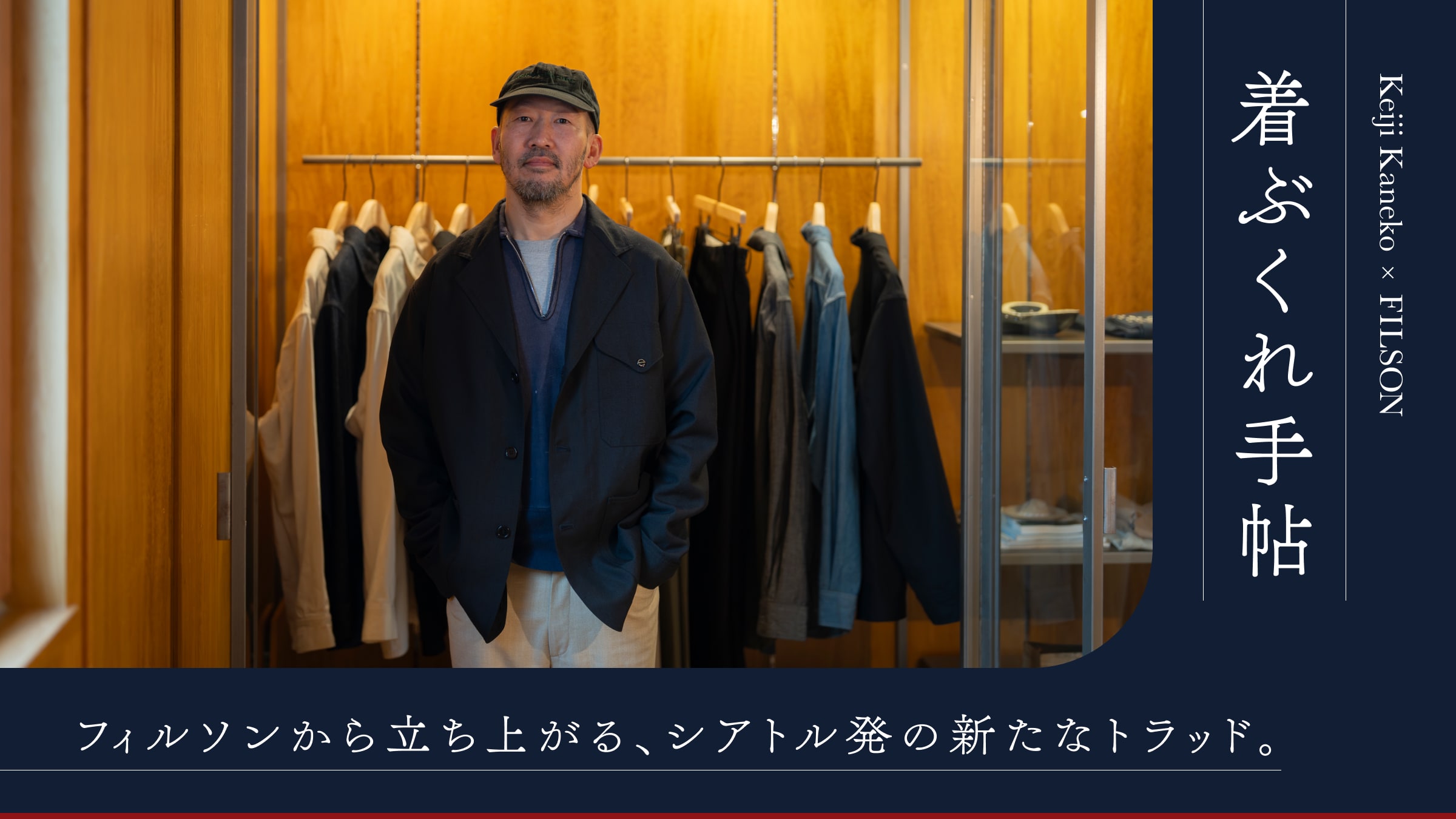
I'm really glad they were able to instill their spirit in us.
—What kind of response did you get from the American brand “Filson”?
Kaneko: This collection was completed last year and had already been approved, but when I went to Seattle this past January, I had them take another look at the actual products. I’d heard beforehand that Alex, the creative director at , was incredibly stubborn, but in the end, he was actually very pleased with it.
—What kind of person is Alex?

Kaneko: He was someone who truly embodied the values that holds dear. He steadfastly upheld the philosophy that has been passed down since the company’s founding, and I was incredibly happy to meet someone like that. He’s also the one directing the brand’s signature look, but rather than focusing on fashion, he accurately conveys the brand’s worldview.
—I saw the photos on your Instagram back home; they’re really well put together.
Kaneko: It seems they’re spending about a week shooting, but they’re really going all out. Rather than just going to a place that looks the part and having models strike poses, they’re casting real workers to capture an image of that’s deeply rooted in local life.
—Ms. Kaneko also felt a sense of empathy toward that image.
Kaneko: I got to tour the headquarters, hear Alex speak, and get a sense of the background behind how was born in Seattle, but I realized that we can’t just take something that’s been so carefully preserved and dismantle it with our own ideas.
—That said, after seeing the clothes Kaneko made, Alex acknowledged them, didn't he?
Kaneko: I could tell his expression changed the moment he touched the fabric. It was like he was thinking, “This is pretty good.” The only time I got a little nervous was when he pointed out the jacket buttons and asked, “What’s this?” Since the buttons he uses are large, he asked me, “Why did you choose these?”
—So they ask that much, do they?
Kaneko: I also value explaining my reasoning, and since I’m a guy who doesn’t back down when it comes to determination, I showed him the Filcro jacket and told him, “I used the size of these buttons as a reference.” He was convinced. In fact, he actually looked a little disappointed (lol).
—Were you able to fully understand the background behind the creation of ?
Kaneko: I was shown the materials in the archives at headquarters, and sure enough, what they’ve been doing all along hasn’t changed. I mentioned earlier that the patterns are simple, but given their body types, they still look good in them. So I was able to confirm that “that’s fine just the way it is.” However, since Japanese people can’t pull off that style, I was also able to discover the significance of what we’re doing. I realized it’s important to pay respect to the traditions they cherish while adding our own interpretation, so that people in Japan can come to appreciate the appeal of *Filson*.
—So it was a big success, then.
Kaneko: The biggest takeaway was that Alex took an interest in our approach to craftsmanship. I’m sure he loves Japanese denim, and I thought it would be great to create a collection that showcases a depth of craftsmanship they couldn’t achieve on their own. I felt like this could open up all kinds of possibilities.
—What was Seattle like?
Kaneko: There just weren’t many people on the streets (laughs). Still, there were plenty of stylish folks, so it was fun taking photos. There were cultural highlights here and there—for example, at the Seattle History Museum, Filson clothing was on display as part of the Gold Rush-era exhibits. There was also a museum dedicated to coal-mining trains, and I could really sense a deep appreciation for history.
—That’s why Seattle flourished, after all.
Kaneko: That's right. Seattle is similar to San Francisco in that it's close to the ocean, forests, and mountains, so I think it's a great place for outdoor activities. The waterfalls were amazing, too.
—I’m pretty sure *Twin Peaks* was set in Seattle, too, wasn’t it?
Kaneko: I actually went to see that waterfall. The city was promoting it as a major attraction. I also experienced firsthand how it rains constantly in Seattle, which is why a thick wool jacket comes in so handy.
—Is there a store in town?
Kaneko: That’s right. The craftsmanship really is incredible—they even have a repair workshop right in the store. They also have their own factory inside the headquarters, and I got to see the production line for Mackinaw jackets. By the way, I also got to see Alex’s studio—it had high ceilings, and one entire wall was covered with mood boards. When you visit places like that, you can really tell they’re putting serious thought into what they create. It really made me appreciate once again what an amazing brand they are.
—Whether or not you understand the creator’s intentions—including the local atmosphere—will certainly affect what is created in the future, won’t it?
Kaneko: I’m sure there are definitely some limitations that come with that, but it was really great to have them infuse us with their spirit. Sure, we sometimes get pulled in by the ways of doing things and trends in Tokyo, but what Alex is doing is the exact opposite of that. With that in mind, how can we communicate and express ourselves in our own way? It gave us a great opportunity to think deeply about that.