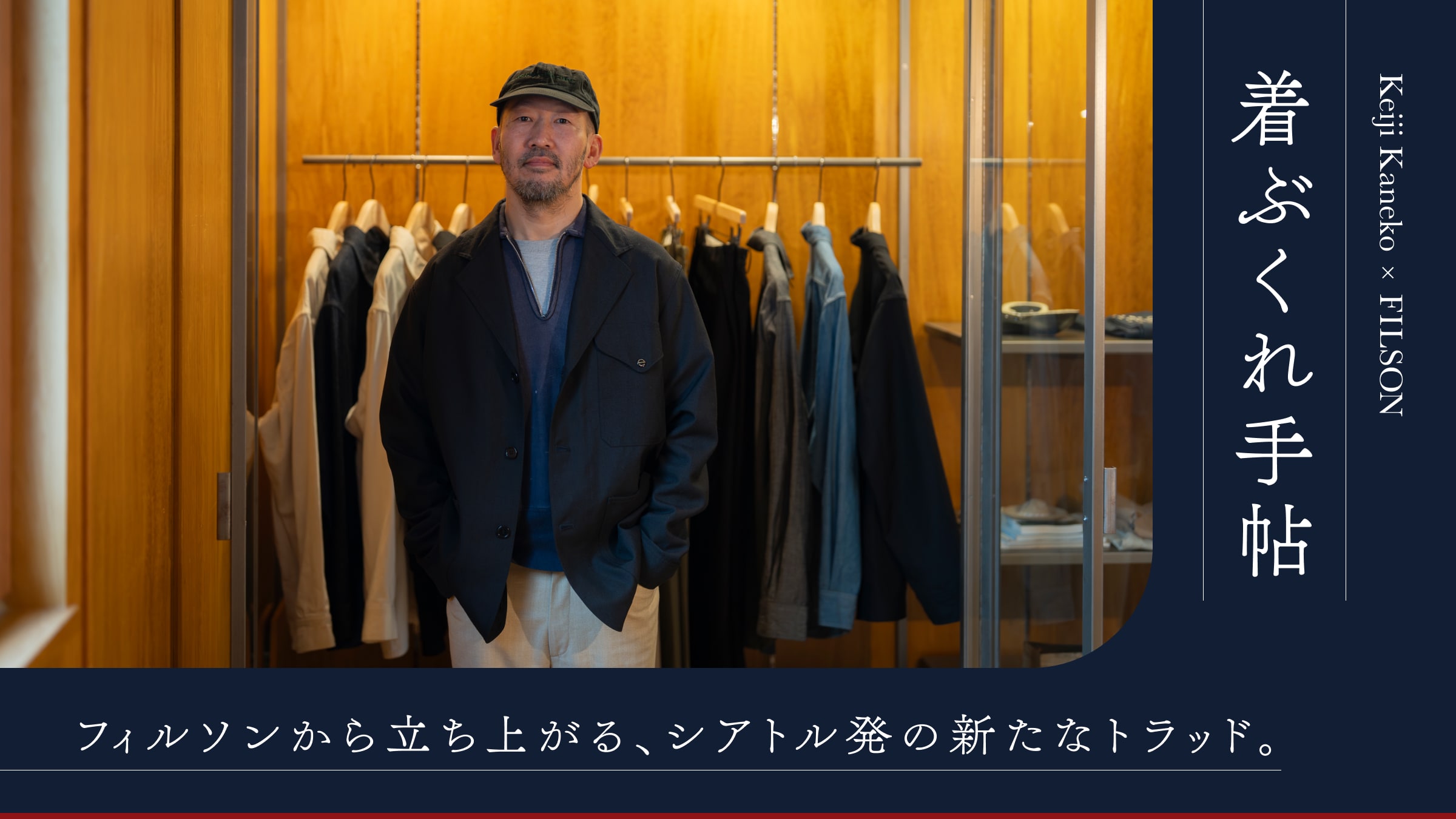
I want to create great products and enhance the brand's value.
—Mr. Kaneko, you’ve just been appointed director of the Japan-exclusive line. How did the product development process unfold?
Kaneko: 〈Filson〉 clothing is often called the “tuxedo of the forest,” and it’s designed with a strong focus on activities in the woods. However, since we wanted to create clothing for everyday urban wear this time, we decided to incorporate some traditional elements. In the U.S., “trad” is typically associated with the East Coast, while that culture isn’t as prevalent on the West Coast. So when I suggested, “How about ‘Seattle Trad’?” the Japanese team unanimously agreed, and we began developing designs based on that theme.

—“Seattle Trad.” It’s a phrase that sounds like it should exist, but it never really did, does it?
Kaneko: That might be true. We worked on this while thinking about how to incorporate ’s designs and details into the American traditional style. Our starting point was the brand’s signature item, the “McKino Cruiser Jacket,” which has four pockets on the front.
—That’s the quintessential item, isn’t it?
Kaneko: I think it’s designed to help you survive in the woods, but if you try to use it as-is for everyday urban life in Japan, it’s completely overkill. So I figured that if I pared down the four pockets to suit different situations, I could strike a better balance.
Kaneko: For example, this jacket has a chest pocket on only one side. It has a flap, and since it’s on the larger side, it’s more than enough for someone who only carries a smartphone, keys, and a pack of cigarettes. Because the design is so minimalist, we’ve chosen high-density wool gabardine woven in Bishu to lend the jacket an air of sophistication.
Kaneko: On the other hand, people who usually drive or work in an office on weekdays rarely have a chance to use their back pockets. With those people in mind, we also created a jacket with pockets on both sides of the chest. We incorporated elements of the U.S. military’s fatigue shirt while using organic cotton twill fabric for the jacket.
Kaneko: For people who ride the train regularly or are always on the go, hip pockets are essential. That’s why we’ve created jackets with only hip pockets for those kinds of people. We also drew inspiration from U.S. Navy denim work jackets. We used a cotton-linen denim fabric to capture that authentic look.
—So, you designed the functionality to suit the wearer’s lifestyle based on the placement of the pockets, right?
Kaneko: After all, is a brand that has consistently been crafting tools since its founding, so I was mindful of how to incorporate Japanese lifestyles and traditional values while preserving the brand’s unique appeal.
Kaneko: Then, when I thought about using it for work, I realized that lapels were essential after all. Since I figured that in modern times, you can still wear a jacket even if the sleeves have cuffs, I also created a version of the “Mackinaw Cruiser Jacket” updated with notched lapels. The fabric is a plain-woven wool from Bishu—it has a refined look, but its slightly rough texture also gives it a workwear feel, making it the perfect choice for this jacket.
—Is the reason every item has such a refined feel because you’re so particular about the fabrics?
Kaneko: I think so. While the “MacKino Cruiser Jacket” is iconic for its red-and-black check pattern, incorporating that into a fashion statement is quite challenging. Part of the reason I wanted to create something you could wear anywhere was that I really wanted to convey a sense of sophistication.
—And there are also shirts and pants in the lineup, right?
Kaneko: We designed this shirt to pair with a lapel jacket. While work shirts with flaps are a staple in our inline collection, we’ve refined that classic style with this design. Drawing inspiration from collar styles of the ’40s and ’50s, we designed the collar pattern with a smooth curve rather than a straight line. We also specified fine stitching and had it sewn with fine-count thread. The fabric is chambray, but we chose a lustrous version to ensure it doesn’t look too much like a work shirt.
Kaneko: As for the pants, I was particularly struck by the plump, inline flap pockets, so I made them an iconic detail. Then there are the snap buttons on the front. I analyzed my Filcro jacket as a reference and created them from scratch. I also added a waistband to the back of the waist, crafting a piece that sits somewhere between chinos and dress pants.
—Is all production done in Japan?
Kaneko: That’s right. While we plan to produce items overseas in the future, we wanted to start by showcasing the strengths of Japanese craftsmanship. We’re driven by the desire to create something even better than the American brand “Filson” and raise the profile of this brand in Japan. That’s why we use high-quality fabrics, select top-tier factories, and work with patternmakers who specialize in dresses and tailored clothing.