PROFILE
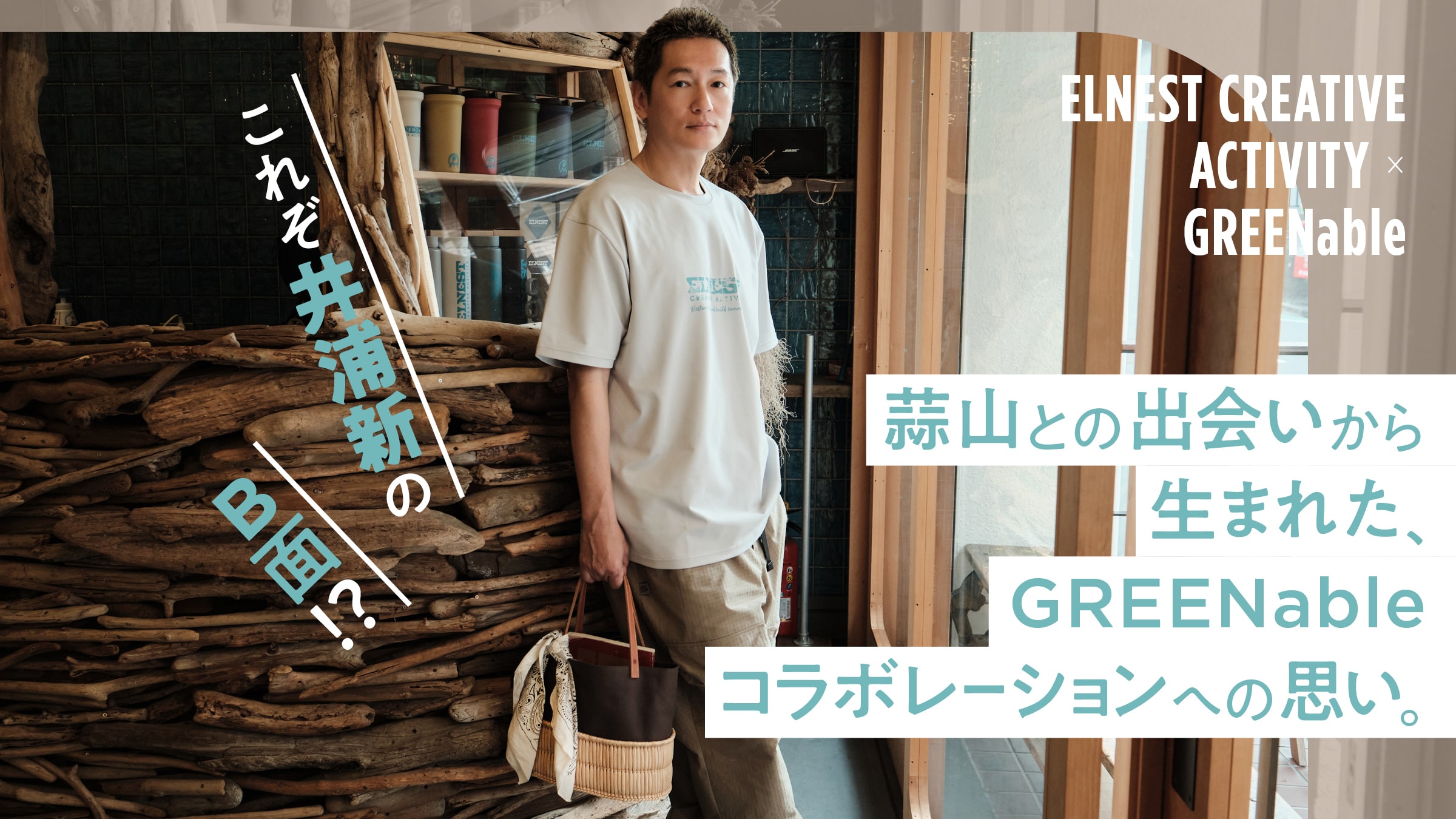
Born in 1974, she played her first starring role in a film, "Wonderful Life," directed by Hirokazu Kore-eda in 1998. Since then, she has been active in a wide range of activities, mainly in movies, but also in TV dramas and narration. He is also the director of "MINI THEATER PARK," which supports movie theaters, director of the apparel brand "ELNEST CREATIVE ACTIVITY," founder of the sustainable cosmetic brand "Kruhi," and founder of the agricultural corporation "Arsen Kitchen," which uses cyclical natural farming to grow Kruhi's own farm. He is also involved in a wide range of activities, such as nurturing Kruhi's own farm through recycling-oriented natural agriculture.
Instagram:@el_arata_nest
Collaboration begins with fieldwork.

--What did you think when you received the offer to collaborate with "Greenable"?
Iura: When we were first approached, it was a straightforward offer: "Can you do something in Maniwa City with Greenable?
We at Ernesto Creative Activities (* hereafter referred to as "Ernesto") are often asked to collaborate with various communities, but it is not an easy task. Since a lot of money is involved and a lot of people are involved, what is most important to us is whether or not we can "empathize. If you don't have empathy, you can't make a move.
When I heard about Greenable's concept, "Thinking about sustainable human activities in the midst of nature. I found the theme of symbiosis with nature and the attitude of facing local issues to be very much in line with what Ernesto and myself hold dear.
So, first of all, we thought it would be better if we could travel, do fieldwork and learn as we go along, and then something would naturally come out of it. That was the image that came to mind. I felt from the beginning that we could do a good job.
--How was your visit to Hiruzen?
Iura: I have been to various areas in Okayama Prefecture. I had visited Hiruzen, Maniwa City once for the recording of an art program, but I was not familiar with the history, climate, and nature of the area, so I wanted to visit again and learn more about it.
I like fieldwork and learning about the topography, history, culture, and people's lives of a place by experiencing it. At the beginning of my trip, I first stopped by a museum to learn the historical flow of how Maniwa City was inhabited and how the culture spread. The history of toadstool work naturally entered into this process.
In fact, I visited for three days and two nights in July 2025 and did fieldwork everywhere from the bottom of the basin to the top of the mountains. We were blessed with clear skies and everywhere we looked, the green and blue of the mountains jumped out at us. I visited with the makers of the toadwork and heard directly from them, and was reminded of how much I really don't know about them, including the problems they face.
--What kind of issues did you find in Hiruzen's toadstools?
Iura: Whenever I visit traditional Japanese handicraft sites, I am always confronted with the same two problems. A shortage of raw materials and a lack of successors. This is a common problem throughout the country.
Because gama-zaiku is also a craft that uses natural materials, it is truly a work born from a symbiotic relationship with nature. The technique was born because it is necessary for living and for livelihood. But climate change has caused temperatures to rise, raw materials no longer grow, and we are slowly being forced into a corner.
And then there is the problem of successors. From my point of view, this kind of technology is a product that is cooler and shinier than any other trend. Yet, surprisingly, Japanese people do not pay attention to them. In fact, foreign high-end brands are more interested in such Japanese technology and collaborate with them, and when that happens, Japanese people jump on the bandwagon in an easy-to-understand way (smiles).
But it is the original that has the most power. That is why we hope that this collaboration will be a kind of window, an entry point that will be easier to communicate.