
"Ghost in the Shell" The year is 2029. In this near-future Japan, where corporate networks blanket the stars and electrons and light race through the land, the country has not yet become so thoroughly digitized that nations and ethnic groups have vanished. Motoko Kusanagi, a cyborg with a fully cybernetic body, was commanding an elite unit led by Batou and others, and she hoped to establish a special task force dedicated to preventing crime before it occurs. Daisuke Aramaki of the Ministry of Internal Affairs, who had been planning to establish a similar unit, recruited Kusanagi and her team. They began their operations as Public Security Section 9, the “Ghost in the Shell.” As they confront cybercrime amid a whirlwind of international intrigue, the existence of an unidentified hacker known as “The Puppet Master” emerges during the investigation of a certain case. What fate awaits Motoko?—And what is the Puppet Master’s true purpose? A new era of cyberpunk action begins—!!
Among the summer 2026 anime lineup, one title that’s garnering a lot of attention is *Ghost in the Shell: THE GHOST IN THE SHELL*. It is the latest installment in the *Ghost in the Shell* series, which has influenced creators across various genres worldwide. It has also generated significant buzz due to the fact that it is being produced by the animation studio “Science SARU,” which has consistently released works of overwhelming quality and earned high acclaim.
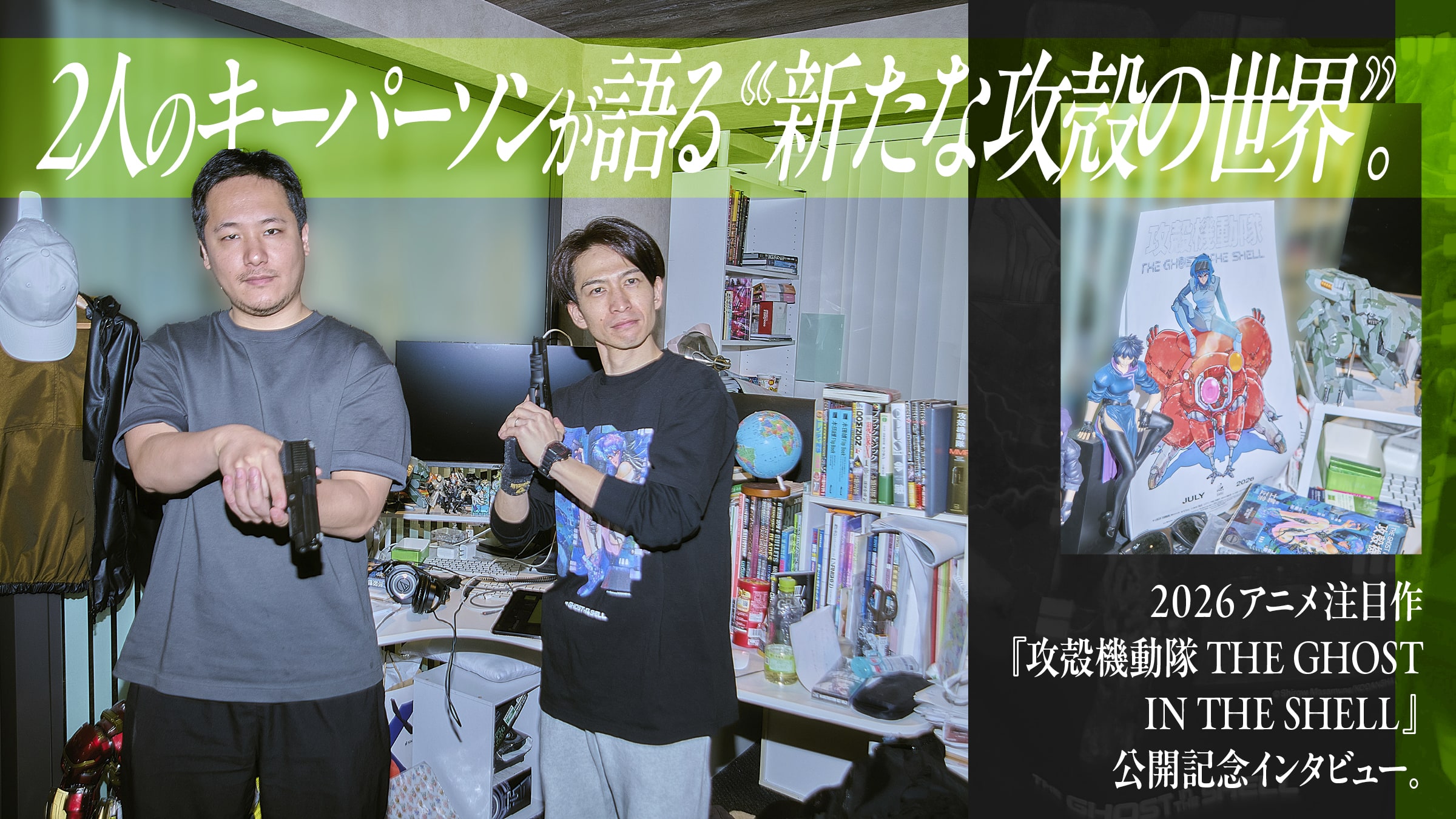
It started with a modest remark like, “Since this isn’t an anime magazine…,” but after I asked him all sorts of questions, the word count easily exceeded 10,000. It’s a bit on the long side, but believing in the phrase “Information is the true source of joy”—which also appears in the original work—please read on to the very end, just as the ghost whispers.
“I love *Ghost in the Shell*.” Driven by that passion, I immediately replied, “I’d love to do it!” And the result was…
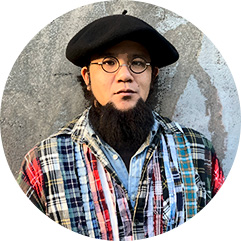
PROFILE
He is affiliated with Science SARU. Since his early days as a rookie, he has been in charge of major episodes for the studio’s popular anime series, establishing himself as Science SARU’s top animator. He has participated in films directed by Masaaki Yuasa—including *If I Could Ride the Waves with You* and *Japan Sinks 2020*—as an animator and assistant director. He served as assistant director on *Dandadan (Season 1)* and is making his directorial debut with this project. His favorite food is not pizza… but human pathos.
An attempt to portray actual events—historical facts—that took place within the fictional world from a different perspective.
—This is Moko-chan’s directorial debut. What was your first reaction when you received the offer?
Moko-chan: As for how the offer came about, I first received an offer from Science SARU, and thankfully, there were voices within the company suggesting, “How about Moko-chan?”—which led to me being offered the chance to direct my first film. As for *Ghost in the Shell*, I was introduced to both Shirow’s original manga and Oshii’s *GHOST IN THE SHELL* at roughly the same time during high school, and it’s a work I love dearly—one that actually inspired me to become an animator. So I replied, “I’d love to do it!”
—What do you mean by “emotionally”?
Moko-chan: It’s a truly great series—it’s no exaggeration to say that every single work in it is a legend—so I was torn between wondering, “Do I really have what it takes? Should I even accept this?” and the resolve that, no matter what I created, I would likely face some criticism. But… there’s no point in just thinking about it; I wouldn’t know until I tried. I decided that as long as I was mentally prepared, I should just go for it. After receiving the offer, I reread the original manga many times, and I was struck once again by how amazing it is—it made me feel that I wouldn’t mind devoting myself entirely to this manga.
—It’s likely that the pressure was quite intense.
Moko-chan: Of course, the pressure was immense… Even though I’d volunteered and said, “I want to do this!”—the moment it came down to “Let’s do it!”—I was like, “Eek!?” I was shaking like a leaf.
—Now that you’re directing a film that’s special to you personally, what was the first step you took?
Moko-chan: Just like me, there are many fans all over the world who have been influenced by *Ghost in the Shell* and hold it dear, and each of them has their own “personal vision of *Ghost in the Shell*.” There were also many such fans among the people I work with in the anime industry. So, first of all, I wanted to find out what everyone thought. I gathered a wide range of opinions subtly, for example by casually asking, “If the original Ghost in the Shell manga were to be adapted into an anime, what kind of show would you want to see?” Even after production began, I proceeded with caution to ensure I didn’t become too fixated on my own interpretation.
—It sounds like that interview alone would require quite a bit of effort.
Moko-chan: Since *Ghost in the Shell* is a franchise that has been around for so long and holds so many people’s feelings, I really felt a spiritual weight—as if I were touching a cursed object—when I first encountered it. Everyone on set has their own deep connection to it, so the passion is incredible.
—When adapting the original manga into an anime for the Reiwa era, did you establish any guidelines for the production process from the outset?
Moko-chan: First, we wanted the anime to convey to viewers the same impression as the original manga as much as possible. However, once we actually got started, we ran into a problem: since manga and anime are different media, simply copying the manga wouldn’t create the same impression. Even if the events are the same, if the anime doesn’t employ its own unique “style of expression,” it inevitably ends up feeling less impactful than the manga. So, we established a rule: we wouldn’t change the events in the story, but when it came to visual direction—such as the way scenes are depicted—we would confidently make them engaging in a way that’s unique to the anime.
To begin with, the author Masamune Shirow is by no means a writer who can be understood merely by a superficial reading—as if one could speak for him based on that alone—and I myself reread the work over 100 times during production, and while I do have a general grasp of “what’s happening and what the characters are thinking and doing” within the story, there are still parts that, no matter how deeply I dig, I just can’t fully grasp—even right up to the very end. Or rather, I think this is a work where “something that can’t be put into words” is what matters most. It was an incredibly challenging experience to receive—without the use of words—that indescribable something the author felt, and then figure out how to bring it to life through animation direction.
The original manga volumes, worn to tatters from being reread over 100 times. While they serve as reference material for interpreting the work, the more I read them, the deeper I sink into a quagmire of thought. “No matter how much I dig, there are still parts I don’t understand, right up until the very end,” says Moko-chan.
—You approached it with a different mindset than you would for a typical anime series.
Moko-chan: Sometimes, I feel like deeply compelling works of art have a will of their own. Since the original work is already so rich, I felt as though it was telling me, “Do it this way” or “It’s like this,” even without me trying to add anything. The original work is the soul, and I am the body that gives it form. Perhaps my personal concept was to listen closely and surrender my body to the soul that is the original work. I also had the mindset of “I want to approach this as a historical work.” A distinctive feature of Masamune Shirow’s works is that the episodes within the story are depicted as a series of historical events that actually occurred in that world. That’s why each chapter of the original manga includes a date. That history is also connected to Shirow’s other works, such as *Appleseed*. This time, I decided to turn that on its head and approach the project with the stance that we’d be animating the actual events—the historical facts—that took place within the story’s world. For example, even with the same event—say, “he jumped to escape”—while it’s fine to adjust how far he jumped for visual impact, the fact that “he jumped to escape” is true, so we wouldn’t change that.
—So you didn’t alter the facts; you just changed the perspective. Another reason this work is drawing attention is that Tō Enjō, an Akutagawa Prize-winning author, is participating as the series composer and screenwriter. How did that come about?
Moko-chan: Mr. Enjo had previously contributed to an *Ghost in the Shell* anthology, and since he is known to be a huge fan of the *Ghost in the Shell* series and extremely knowledgeable about it, the production committee reached out to him, and he graciously accepted our invitation, so his participation was confirmed.
The challenge of recreating the level of realism and the sense of immediacy found in the original manga in the anime.
—Mr. Abe, the producer of this work, said in an interview, “I asked on the off chance, and it actually got approved.”
Moko-chan: “I never expected you’d actually join us!” I was surprised myself (laughs). If I had to describe Mr. Enjo in one word, he’s truly a professional—intelligent, humorous, and open-minded. Actually, one word isn’t enough… On this project as well, he was very conscious of working within the context of an anime production, and he was incredibly attuned to the realities of the production floor, working closely with us—which made it a pleasure to work with him.
—I'm curious to see how Mr. Enjo's abilities and strengths are put to use in this work.
Moko-chan: During our weekly script readings (script meetings and read-throughs), we talked a lot, and he taught me so much as we worked together to bring the project to life. In addition to script development, he also gave lectures to us on the production staff about the worldview and key concepts of Masamune Shirow’s works, and for me, he was a valuable source of information who subtly instilled in me the perspective of someone who grew up with the original series.
Another thing we mustn’t forget is the careful review of the text that appears in the story. As production progressed, new elements—such as on-screen text—that weren’t in the original work began to appear one after another, but even those had to be consistent with the work’s worldview and setting. He also provided a great deal of supervision for those aspects.
—As for the character designs and color palette in this work, I think it will feel very fresh to those who haven’t read the original manga and are familiar only with Oshii’s version—*Ghost in the Shell*.
Moko-chan: Since Shirō-san’s work shows glimpses of influences from American comics and bande dessinée (the general term for comics in French-speaking countries), I thought, “He probably likes colors like this, doesn’t he?” and came up with a color scheme that’s both laid-back and vivid.
I think the Ghost in the Shell series up to this point has generally featured a relatively low color saturation and strong contrast, resulting in a subdued visual style that’s quite close to monochrome. However, in Shirow’s original manga, while that subdued quality is present, he also occasionally employs incredibly vivid and unconventional color schemes. It might be a strange analogy, but I wanted to emulate that sensibility—it’s like “butter in red bean paste.”
—It’s true that the soft, bright color palette of the original manga’s color pages is a bit different from that of Oshii’s version.
Moko-chan: That’s true. However, I think that soft, delicate look in the original work comes from watercolor-style paints, and it’s incredibly difficult to recreate that in the anime. With digital painting, the colors tend to be applied in flat, solid blocks, so it’s hard to capture those subtle nuances, and the result ends up looking “blindingly bright.” That said, in a series like *Ghost in the Shell*, the nuances on screen—and the sense of “shading”—are incredibly important. So this time, we’re trying to strike a balance by lowering the brightness considerably compared to typical anime productions and increasing the saturation instead.
There’s a movie called *Hannibal* directed by Ridley Scott. It’s a strange film—the characters are always backlit. Even when the main light source is directly in front of them, there’s always a small window or a lamp behind them, so no matter how the camera cuts, they’re always backlit. I thought I could use that effect here. I arranged small, glowing objects throughout the set so that no matter where a character stood, they’d be slightly backlit. As a result, the brightness is reduced, but I kept the saturation high, aiming for a look that’s “vivid yet shadowed.”
In terms of texture, we’ve also paid close attention to the filming process. In the era of cel animation, characters drawn on transparent film were superimposed onto background artwork to create the final image, so there’s a distinct ”sense” that the scene is built up in “layers.” While the absence of that noise is an advantage of digital animation, I wanted to preserve that sense of layering for this project, so I applied a large number of layers of processing and noise that are barely perceptible. On set, we called it “magic.”
Here’s a sneak peek at the color pages from the original manga. As mentioned in the interview, you can see the “bright, soft hues.” I wonder how they’ll bring this to life in this adaptation. I can’t wait for the premiere.
—I think the art plays a major role in supporting the world-building of the work. Art Director Masuyama commented, “We’re returning to the essence of the original work and carefully bringing out its charm,” but what specific aspects is he referring to?
Moko-chan: The world Shirō depicts gives the impression that even the plants are vibrant and brimming with vitality, so we set the climate in the anime to be slightly warmer than present-day Japan and placed many spiky silhouettes—such as cycads and ferns—on the screen. We also followed the original manga’s approach to depicting machinery, aiming for a style that conveys vitality—almost like blood vessels—and I believe these elements embody exactly what Mr. Masuyama refers to as “the breath of the original work.” Furthermore, while Director Kenji Kamiyama’s *Ghost in the Shell: STAND ALONE COMPLEX” (hereafter SAC), we deliberately included realistic, familiar residential neighborhoods; however, for this project, we returned to the level of realism found in Shirou’s original manga and made a conscious effort to handle elements that are too familiar from real life with caution.
—What do you mean by that?
Moko-chan: Take public pay phones and telephone poles, for example. We’re working hard to design each one from scratch so that they look like they belong in a futuristic world far removed from reality. One of the original work’s charms is that it makes you think, “Wow, what an amazing world!” So I made sure to include a small detail somewhere on the screen—something that would make viewers think, “That’s a weird light fixture” or “That’s a cool wall.”
—I see. Next, what aspects of the music did you pay special attention to?
Moko-chan: The artwork in the original manga is meticulous and highly detailed, but at the same time, it’s drawn with very soft, warm lines. I wondered if I could use music to enhance the contrast between that style and the cybernetic bodies and mechs. Since all anime today is finished with digital processing, while the lines have become incredibly clean, it’s also become difficult to convey a sense of warmth. Even if the design stays true to the original manga, the texture in digitally animated series tends to come across as stiff. For that reason, I thought it would be better for the overall balance if the music leaned more toward warmth and an analog feel.
—So that’s why it worked out so well.
Moko-chan: I thought that when Shirō-san was creating the original work, he might have had in mind the image of TV dramas from a certain era—like *The A-Team* and *Western Police*—where a team of several people gets up to all sorts of wild antics, so I believe I mentioned to music director Taisei Iwasaki during our meeting that I wanted to bring out that kind of nuance. We watched things together, like the “myo-myo-myoon” theme from the original *Gundam* and the trailer for Director Kinji Fukasaku’s *Prefectural Police vs. Organized Crime*, and discussed how we wanted to capture that “back-in-the-day” feel through the music.
Although *Ghost in the Shell* is a complex work, it is precisely that “mystery” that makes it so compelling.
—Although the artist hasn't been announced yet, I'm curious about the opening theme song.
Moko-chan: The theme song is… really cool! It’s a shame I can’t go into detail yet since it hasn’t been officially released, but we’ve been given a wonderful track that perfectly matches the work. Our overall creative philosophy was to avoid centralized control and instead let everyone bring their own interpretations to shape the project in a more fluid way. We asked the artists to freely expand on their own visions based on the original work, and I think the result is a wonderfully matched track that really adds depth to the series.
—The artist also said they created this work by following the whispers of their own inner voice. I’m looking forward to its release! I think a major change in this work is the personality and characterization of the main character, Motoko Kusanagi. What are your thoughts on that?
Moko-chan: That’s the most obvious, surface-level change, isn’t it? In the original version, Kusanagi is a very cheerful, emotionally expressive, human-like, warm-hearted, and charming character. At the same time, I think the themes Kusanagi grapples with have also become more human and universal.
I believe that in Mamoru Oshii’s version, the central theme was “What am I?” and in *SAC*, it was “What is society?” When I consider what question this work is asking, the one that comes to mind is “How much do humans really know about this world?”
On Moko-chan’s desk sit a stuffed animal from *Dandadan*—a series whose ending animation, which she worked on, became a hot topic—alongside an unusual number of paper cups. “The cups just seem to multiply before I know it. It’s lively and fun,” says Moko-chan.
—That’s quite a grand theme.
Moko-chan: At the beginning of the story, Kusanagi appears as a character brimming with a sense of omnipotence who believes he can make the right decisions, but as the story progresses, that assumption begins to waver, and he comes to realize that humans do not even know what life truly is. I believe this is a journey that all of us living in modern society—where technology and science have advanced and we assume that “humans perceive the world correctly”—can relate to.
So, both the original manga and this adaptation based on it might offer “one possible answer to the question: ‘How should people live, given that they acknowledge they don’t understand the world?’ …Hmm.”
— (laughs). It’s probably easier to just watch the series itself. So, if you had to name one reason why the Ghost in the Shell series continues to be so popular even now, nearly 40 years after the original manga was published, what would it be?
Moko-chan: Since it is rooted in the universal mystery I mentioned earlier, I believe it has taken on different forms throughout the ages to answer people’s “questions of the time.” And perhaps the times have finally caught up—or maybe it’s just me—but there are aspects of the original Kusanagi story that now feel deeply personal to me. Precisely because interest in “humans and the world” is growing—driven by the emergence of AI and other factors—this may be a theme that offers fresh insight once again.
—So, where do you think the core appeal of the *Ghost in the Shell* series lies?
Moko-chan: It’s a very difficult work to understand, but I think that very “unfathomability” is its greatest appeal. I believe the original manga by Shirō is not only science fiction but also has a very spiritual side to it.
In an interview, he himself said, “What I value most and want to express is a ‘sense of wonder.’” Keeping in mind that not everything in the world has been fully explained, he seeks to depict the realm beyond tangible reality through intangible concepts such as religion, the occult, and the spiritual world. If you were to sum all of that up, I suppose you could say, “It’s filled with inspiration.”
—Finally, please share a message for readers who are looking forward to this book.
Moko-chan: While this work is based on the original and returns to its roots, this does not mean a complete reset. Thirty years of the series’ history and the fans’ experiences have passed between this work and the original, and the atmosphere of the world imagined back then now feels nostalgic, yet also new and fresh. I believe it is only by standing on these layers of history that we can truly understand the significance of returning to the original work in the Reiwa era. And I feel that the spirit of that original work is something worth revisiting anew, precisely because of the times we live in today.
That said, the story isn’t connected to the previous installment, so it’s perfectly fine to start watching from here! Whether you’re new to the series or a longtime fan, I really hope you’ll check it out.
While this film may have some complex elements, it’s never stuffy—it’s packed with plenty of easy-to-understand, entertaining moments like “Bam!” and “Boom!” I’d be thrilled if you could just relax and enjoy it while munching on a late-night snack.
- 1
- 2