"There's no way I'll ever have anything to do with *Ghost in the Shell*." That's what I thought...

PROFILE
Born in 1984. Hails from Fujinomiya City, Shizuoka Prefecture. After working at GAINAX, he is currently a freelance animator affiliated with TRIGGER. In 2017, he was selected as character designer and chief animation director for the TV series *Little Witch Academia*. Since then, he has expanded his scope of work by serving as character designer on *Spriggan* and *Scott Pilgrim Takes Off,” and has been expanding his scope of work.
I was saying whatever I wanted, thinking it had nothing to do with me, but it ended up coming back to bite me in a huge way.
—To begin with, what exactly are the roles of the chief animation director and the character designer?
Handa: When people hear the term “character design,” they often assume it refers to “creating original characters from scratch,” but in the world of anime—and especially in cases like this one, where a manga is being adapted into an anime—it’s a little different. To begin with, anime production is a collaborative effort involving a huge number of people. In terms of the animation alone, a single season can require 200 to 300 key animators—and in some cases, even more animators—to bring the characters to life.
—There are that many in the TV series, too, huh?
Handa: It’s surprising, isn’t it? Well, the role of an anime character designer is to streamline and simplify the details so that others can draw the characters more easily. I’m actually better at organizing existing elements than creating something from scratch, and I quite enjoy thinking about how to make things easier for everyone else to draw, so I really enjoy doing this work.
—It feels a lot like the work of a magazine editor. You take information and make it easy to understand and convey, then pass it on to the audience.
Handa: That’s right. So, the chief animation director checks the drawings created by many animators and “tweaks the parts that stand out,” I guess. For example, with female characters, just raising the position of the mouth a little or making the outline a bit thinner can make them look much cuter all at once. The chief animation director’s role is to check those details and “polish” the drawings.
—I see. Let’s jump right into our discussion of *Ghost in the Shell: The Ghost in the Shell*. First, could you tell us how you came to be involved in this project, Mr. Handa?
Handa: This is going to be a pretty long story, but… Since I didn’t think I’d ever be involved in the project, I just said whatever came to mind when I met Moko-chan. I told her things like, “The anime so far has been great, of course, but since the girls Shirou-san draws are so cute, you should just go ahead and make the anime using the original artwork with confidence!” and I’d show her the cutscenes from the game *Ghost in the Shell* (PS, 1997) and say, “This is the best!”—just irresponsibly spouting ideas like “Do this” or “Do that” (wry smile).
Before I knew it, I received a request… and that’s how I came to participate.
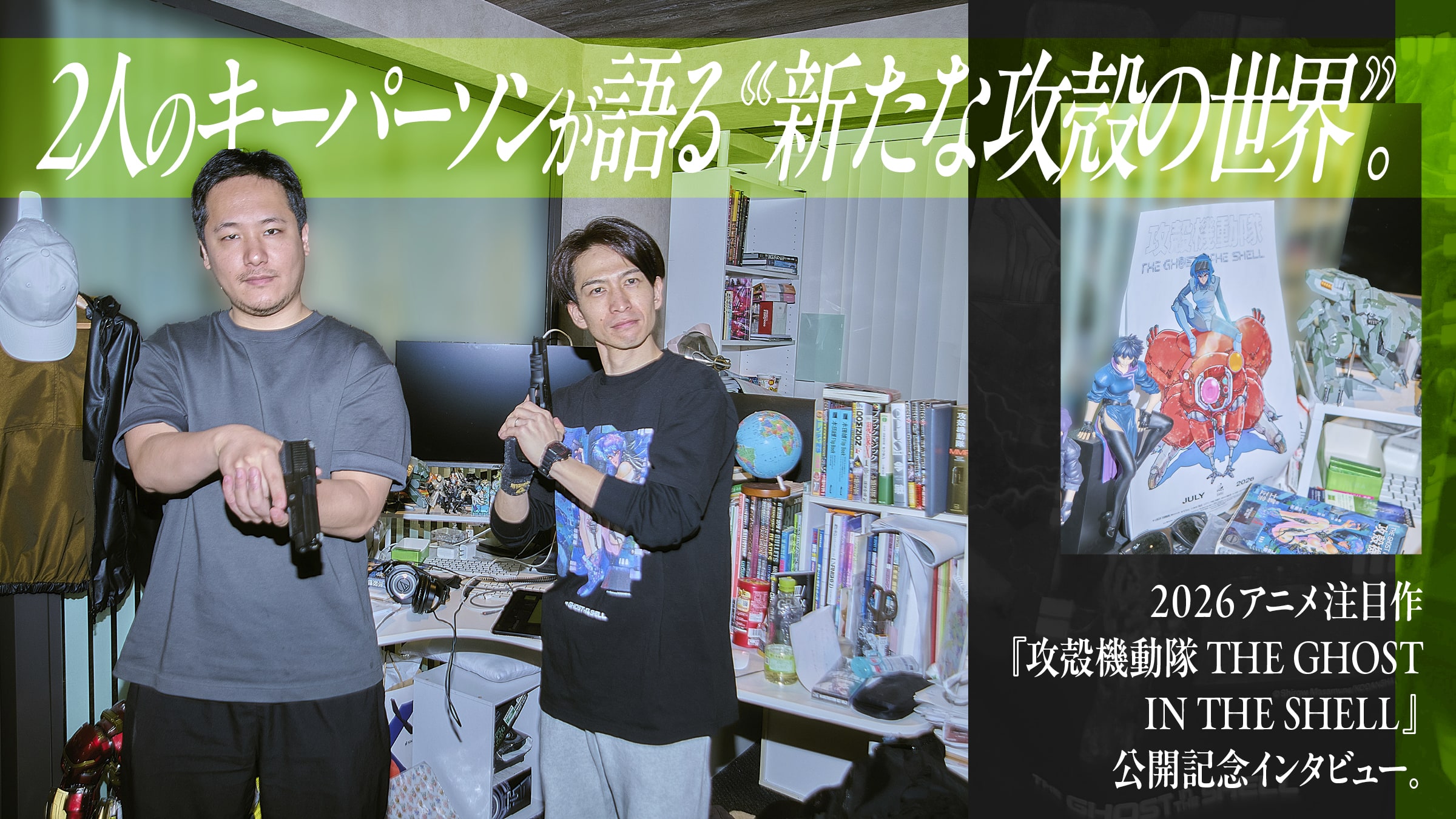
On Mr. Handa’s desk, reference materials include the *Ghost in the Shell* series, works by Masamune Shirow, and art books. Also on display are issues of *POPEYE* and *Hot-Dog PRESS* published in 1984, the year Mr. Handa was born.
—It turned out to be a massive boomerang that raised the bar way too high (lol)
Handa: After saying whatever I wanted like that, if I were to say “I won’t do it” now, people would definitely think, “What’s wrong with that guy?!” When I was agonizing over whether to take the job—after Choi Woo-young, the CEO of Science SARU at the time, told me, “Working on *Ghost in the Shell* is the unfinished business left for our generation,” and I thought, “He’s definitely right”—I spoke with a producer at TRIGGER (the animation studio where Mr. Handa works), and he gave me a strong push, saying, “*Ghost in the Shell* isn’t a project just anyone can work on. If the offer came to you, as an animator, you absolutely have to do it!”
—So that’s why you decided to participate, then.
Handa: Yes. Since I also had work at TRIGGER, the initial request was, “Please take on the character design work as much as you can manage.” But then the producer told me, “Don’t worry about TRIGGER—don’t just do the character design; stay with the project until the very end as the chief animation director!” So I thought, “Why not give it a shot!” So I moved my desk over to *Science SARU*, and that brings us to today.
—I see. What was your initial reaction when you received the request?
Handa: Of course, I was happy to be approached. Anime art can generally be divided into two categories: manga-style and realistic-style, and the *Ghost in the Shell* series—starting with director Mamoru Oshii’s *GHOST IN THE SHELL / Ghost in the Shell* (1995)—has always featured a realistic art style. Since I’m more skilled at manga-style works, I’d always thought, “In my career as an animator, I’ll probably never be involved with *Ghost in the Shell*.”
However, when I listened more closely, I learned that this project was based on Shirō’s original manga, so I thought, “If that’s the case, I think I can handle it,” and decided to take on the role. As I mentioned earlier, I never expected to be involved with *Ghost in the Shell*, so I’m incredibly happy to be working on a series I love so much.
The character designs I’d struggled with and agonized over were approved without a hitch—it was almost anticlimactic.
—The character designs in this film closely resemble the style of the original manga—they’re pop, humorous, and lighthearted. What kind of direction did you receive from the director and producer?
Handa: I wonder if anything happened…? Hmm, I don’t think anything in particular happened—it was seriously stress-free. I just drew whatever I wanted, however I wanted, and turned it in. Then they’d take it back with a “Nice!” and it was like, “Okay, what’s next…?” (laughs). Sure, I had tons of worries and inner conflicts, but isn’t that just the lonely battle every creator goes through?
—What’s it like when the original author, Shirou, reviews your work?
Handa: I hear he’s been checking on it, but Shirō hasn’t really said anything to me specifically. The only thing that’s been on my mind, though, is the art style for this project. I can’t help but wonder if he might find it embarrassing or unpleasant. The art style he used to draw is something he’s buried in the past. And here I am, happily digging it up and bringing it back. I’m a bit worried about how he feels about that.
—Lately, there’s been a trend of rebooting anime from the ’80s and ’90s with a Reiwa-era twist, hasn’t there? In cases like that, to what extent should you capture the original atmosphere?
Handa: Do you want to recreate the atmosphere of the past, or give it a modern feel? While the right answer probably varies from work to work, I think it’s absolutely essential to update our approach and take on the challenges of expression that are only possible in the Reiwa era. For example, this applies to the intricate details of hair and delicate color gradients—things that were difficult to achieve by hand-drawing on cell sheets and painting with watercolors. Digital technology makes all of that possible.
—In terms of what makes you, Mr. Handa, who you are?
Handa: I think it’s the thickness of the character lines. That’s the essence of TRIGGER’s style—it comes through naturally—and it really gives the artwork a lot of impact. Then there’s the way the lines are rendered. For this project, we asked the cinematographer to add a slightly grainy texture.
—After looking at the storyboards, I noticed there were many action and comedy scenes that made good use of the thickness of the lines. Were there any specific aspects you focused on in terms of facial expressions and the characters’ performances?
Handa: Since all the characters in the original manga have such expressive faces, I drew quite a few character charts, but I still feel like there’s room for improvement. If I were asked to draw even more variations, I could keep going forever, but I held back because I thought having too many might be confusing.
—It’s true that the characters’ human qualities are one of the defining features of this work. However, when it comes to the main character, Motoko Kusanagi, I wonder if the film wasn’t influenced too much by the atmosphere of Oshii’s version.
Handa: I made sure not to let that influence me. However, based on my experience, younger animators aren’t very used to drawing gag scenes with extreme stylization, so they often don’t know how far they can push the distortion. So, when the key animation for Episode 1 came back to me for review, Kusanagi’s expressions seemed pretty stiff to me, so I made some corrections, telling them, “For gag scenes, it’s okay to draw them this casually.”
—The comedy scenes really showcase TRIGGER’s true strengths, don’t they? Next, I’d like to ask you about the color design, including the characters. What kind of discussions did you have with Mr. Hashimoto, the color designer?
Handa: To make sure the vision came across clearly, I colored the rough character sketches I drew and submitted them, and the artist used those as a reference for the final coloring. When it came to the colors, I think Moko-chan had more specific requests than I did. Mr. Hashimoto made the necessary adjustments while incorporating requests like, “I’d like the colors to be darker.”
Introducing a “New Ghost in the Shell” for the Reiwa era—be sure to check out the characters’ fashion as well.
—Motoko Kusanagi’s blue hair in the teaser visual left a strong impression, and many people expressed their excitement, saying, “A new Ghost in the Shell is being born!”
Handa: While Kusanagi’s hair color in other works in the series ranges from dark blue to black, navy blue, and sometimes even a deep purple, my personal image of her is the color on the cover of Volume 1 of the manga. So this time, I requested a more vibrant shade of blue.
Handa: The first visual Mr. Hashimoto sent me—with the note, “I just gave it a quick try”—was truly shocking. It looked exactly like cel art from a ’90s anime.
I think this allowed us to clearly establish our stance—that “Science SARU is creating the Reiwa-era Ghost in the Shell”—as the first visual to be released to the public.
—The character designs, color palette, and composition all feel fresh yet nostalgic. It really is a “Reiwa-era version of *Ghost in the Shell*.”
Handa: That composition is based on a rough sketch for the cover of Volume 1 of the manga, which has also been included in the art book. Through this reference and the brightness of Motoko’s hair and eye colors, I intended to suggest that “this is an anime adaptation based on Masamune Shirow’s original manga” and that “the tone of this work differs from the existing Ghost in the Shell series.” I hope that message came across.
—We were actually given the original artwork as a special treat this time, but as a layperson, I’m not quite sure what the highlights are…
Handa: (Flipping through a stack of original artwork) These are the shots where Hiroki Tanaka did the original artwork. He works analog (on paper) rather than digitally, but he’s really talented and draws some incredibly cool art. Isn’t this effect just amazing?
The animation director reviews the drawings created by each animator, and the chief animation director then reviews those drawings—that’s their main job. “I check them by flipping through the pages like this,” says Handa.
As he looked at Mr. Tanaka’s original artwork, Mr. Handa couldn’t help but exclaim, “It really is cool.” Effects like explosions and the depiction of gravity are where animators really get to show off their skills.
—It really is cool! Could you tell us what you want readers to focus on most in this work, and share a message for readers who are looking forward to it?
Handa: Hmm... Well, I’ll leave it to Moko-chan to talk about the highlights of the work itself, but from a character design perspective, it all comes down to this: “Shirō-san’s art is still so cute, even by Reiwa standards!!!”
And there’s one thing I’d really like all *HOUYHNHNM* readers to pay attention to: the characters’ fashion. For example, Batou’s casual outfits always incorporate some sort of camouflage pattern—albeit in different colors—and Togusa’s jacket and pants were designed with the silhouette of the TV drama *Dangerous Cops* in mind.
While staying true to Shirō’s original manga, I think we’ve managed to capture the atmosphere of the time (1989) and the unique vibe of each character. So, I’m excited to see how the characters, dressed in these outfits, will shine. Please look forward to it!
- 1
- 2