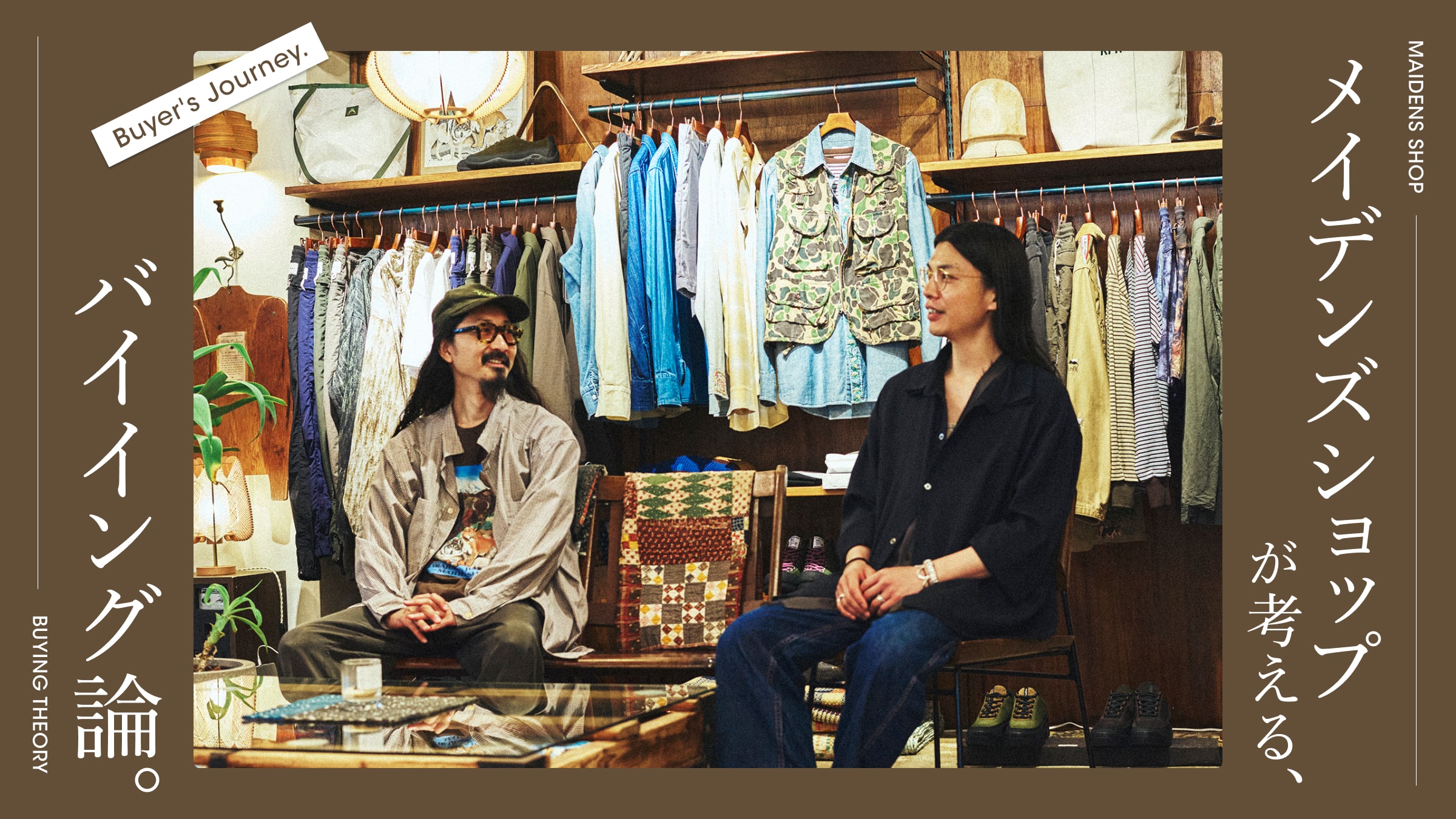
So that Maiden can remain Maiden.

—With the addition of a permanent vintage clothing section, I feel like the “Maidens Shop” lineup has gained a new “depth.”
Makino: That might be true. Japanese brands, American brands, European brands… and then there are the concepts of new and vintage clothing. “Maidens Shop” is a store that mixes all kinds of things. So what really matters there is our buyers’ ability to “spot the right pieces.”
Tanaka: What defines ”authenticity”? Guided by our key concepts—“authentic, traditional, and contemporary”—I believe we must always look beyond the surface of brands and products to the background, structure, and essence that lie beneath.
Makino: For example, the Lea Boberg shirt Tanaka is wearing right now easily costs around 150,000 yen.
Makino: Even looking at it again, I still think it’s wonderful, but at the same time, the 〈Individualized Shirts (INDIVIDUALIZED SHIRTS)) we carry are in the 30,000 yen range, and I definitely find them appealing as well. One-of-a-kind artisan pieces and mass-produced American goods… Viewing these two extremes on an equal footing is something I’m very conscious of when sourcing merchandise.
—With such a big price difference, wouldn't it be difficult to come up with a layout?
Makino: It’s not about the price, but whether it’s “the real thing” or not. In that sense, it hasn’t been difficult, and I think the key is how we present it.
Makino: Take this brand, *BODE*. The way it looks is completely different depending on whether it’s displayed next to *Maison Margiela* in a stark, all-white, sterile space, or on the same rack as on the same rack as *GABRIELA COLL GARMENTS* and *Lia Boberg*, the way it’s perceived is completely different, isn’t it?
What we want to convey is the American nostalgia that lies at the heart of *Bodi*. That’s why we’ve arranged the space with the brands I just mentioned, along with antique furniture and home goods—and just that alone completely changes the impression our customers get, doesn’t it? It’s fascinating how the same items can look completely different depending on the space they’re in and how they’re arranged—and I think that’s the very reason select shops exist. In other words, that’s what ties into “Maidens Shop’s” identity as well.
Tanaka: Our job is to showcase and convey the essence of the brand in our store. It’s not just about saying, “These are great clothes,” “The fabric is top-notch,” or “The craftsmanship is excellent”—it goes beyond that. It’s important for customers to experience the quality of these products within the context of the space itself. That’s the kind of select shop we strive to be.
So, just as Makino said, the way we present things is truly important. That carries over into our customer service and helps establish the “Maidens Shop” image in our customers’ minds. I’m usually at the Harajuku store, and I’m always mindful of that when I’m working there.
—So even though you’re a buyer, you also work on the sales floor, don’t you?
Makino: It’s not just the two of us—we make it a rule that every staff member, regardless of their role, works on the sales floor. That’s something we take very seriously at “Maidens Shop.” I believe that if we lose touch with our customers and the feel of the store itself, it would be impossible to do the kind of purchasing I mentioned earlier.
It’s important for buyers to really pay attention to customers in person. Not only can they listen to what customers have to say, but they can also communicate directly with them. I believe this is a culture at “Maidens Shop” that we should continue to cherish, even as we transition to a younger generation in the future.
—When sourcing men’s clothing, do you two ever have differing opinions?
Tanaka: Well… that happens, doesn't it? (lol)
Makino: It would be strange if everything matched perfectly. We’re from different generations, so the worlds and cultures we’ve experienced are different, too. But the fact that two people with such different backgrounds share the same passion for the shop—that the things Tanaka likes and the things I like both exist in the same space—is what makes “Maidens Shop” what it is, I think.
I think that if I just keep going based on my own personal feelings, there’s bound to be a disconnect with the rest of the world at some point. Just as Tanaka has now become a fully-fledged buyer, it’s important that the next generation shares these same values and carries on this work.
Tanaka: In that sense, the fact that I was taken abroad from a fairly young age has really shaped my values today. I’d like to make sure to pass on the experiences I’ve had to the next generation.
—Thank you for sharing your valuable insights. Finally, could you tell us about your future plans?
Makino: Delivering items we believe are great—sourced from all over the world, including Japan—to our Japanese customers. I think that’s the fundamental concept behind a select shop, but the world has become so much closer in recent years, hasn’t it? Whether it’s social media or online shops.
So, when we opened this Jimbocho store, the key change we made—one that clearly set it apart from our previous approach—was our commitment to reaching out to the world. It’s not that we want to compete there or sell like crazy; rather, as a shop that represents Japan, we hope to gain recognition among fashion enthusiasts overseas.
Makino: Over the past few years, we’ve been holding pop-up events in New York and have been making a conscious effort to expand our reach overseas. The response has been very positive.
Going forward, we’d like to expand our outreach beyond New York to various other locations, and we’re also planning to develop initiatives targeting overseas markets from both our Jimbocho and Harajuku stores.