Contents
01 What is texnh? 02 Modern Masterpieces 03 The Production Site 04 Small Leather Goods 05 Where is texnh? 06: texnh's Take on Clothing 07 What Shaped Rikiya Matsumura 08 Creating with Others 09 Why I Can't Help But Create 10 Outside Jobs at texnh01 About | What Is texnh?The concept is “existence.”

PROFILE
Born in Koto Ward, Tokyo, in 1981. After graduating from Bunka Fashion College, he moved to the United Kingdom. In 2006, he joined “Yoshida” and became a bag designer. He went independent in 2018 and founded his own company, “Canal,” the following year. He launched the “Tekne” line for the 2021 season.
Fans are unanimous in saying that the design is beautiful. Behind this lies an approach that disregards efficiency. The groundbreaking features—said to have been born from the creators’ own insights—are also indispensable when discussing *Tekne*. It is the artisans of the old downtown district who are responsible for this kind of craftsmanship.
—In a past interview, you mentioned that your design philosophy is minimalism—even to the point of omitting logos. When I actually looked at the collection, the logos were disproportionately small and hard to spot. In fact, some models feature nothing more than an inner name tag. My honest reaction was, “Here’s a designer who looks like they’ll be interesting to watch.”
Matsumura:At my previous job, I often proposed designs without name tags, so people would frequently ask me to include them (laughs). To put it bluntly, if a product has a presence that makes it instantly recognizable, it doesn’t even need a logo. Relying on a logo just feels wrong, so to speak. With that critical perspective in mind, I decided to include a logo in the concept. I think I managed to bring that concept to life, at least to some extent, with the daypack.
The brand logo is foil-stamped at the very bottom of the front pocket. “texnh” is a Greek word meaning the perfect fusion of intellect, technology, and art.
—So she’s the face of *Tekne*, isn’t she?
Matsumura:When I took a closer look at a vintage daypack, I noticed something different about its appearance. When you put it on, it sags under its own weight. That’s irresistibly cool. Wondering what made it different, I took it apart and found that the construction was actually quite simple. The main body is just two pieces sewn together.
Nowadays, the fabric is cut into small pieces for yield and efficiency. Going back to basics, I made the entire bag—from the front to the gusset, the bottom, and the back—from a single piece of fabric. However, when scaling up the size using that pattern, there were too many areas under strain, so the current design—with the back as a separate piece—proved to be the most balanced and stable solution.
We chose tricot for the lining of the main fabric. While PVC and similar materials are commonly used to add thickness, they tend to make the fabric too stiff. We experimented with various materials to find a way to give the entire piece a more supple finish, and ultimately settled on tricot.
—The texture of the fabric is also quite charming.
Matsumura:For our first collection, we developed a fabric made from recycled polyester. While we were pleased with the finish—which looked like cotton despite being a synthetic fiber—we began to question the prevailing trend of simply accepting something as “good enough” as long as it uses recycled materials. The essence of sustainability is ensuring products are used for a long time. I believed that fabrics capable of withstanding wear and tear would contribute more to the environment. That’s how I arrived at fabrics made from 66 nylon—a high-strength nylon commonly used in automotive and machinery parts.
Specifications that serve as blueprints for bag design.
—I believe the appeal of *Tekne* lies not merely in nostalgia, but in its functionality, which takes even its structure into account.
Matsumura:I think I’ve come up with an interesting design feature: the strap at the bottom of the back panel. It’s connected to the shoulder harness as a single piece. By linking these two parts, the main body is pulled backward by the weight while simultaneously hugging the waist.
By eliminating the need for a reinforcement piece at the base of the harness, we were able to add another feature: a side pocket. Unlike conventional side pockets, this one features a zipper that runs along the vertical line on the back. Not only does this enhance security, but it also makes it easier to take items in and out.
—A new model featuring the external side pockets we're familiar with has also been added to the lineup. I understand you hadn't made one like this before...
Matsumura:I was bothered by how it bulged unsightly when I put a plastic bottle inside. The design of this pocket was the solution to prevent that bulge. With this structure, it maintains a sleek appearance while minimizing outward bulging.
To be honest, it was our customers’ requests that prompted us to go ahead with commercializing this product, but I also realized we should have made it sooner. Last year, when I took my child to the World Expo, I put a plastic bottle on the left and a sun umbrella on the right, and it really came in handy for protecting my child from the blazing sun (laughs).
—They value craftsmanship and question conventional wisdom. It’s the artisans of the working-class neighborhoods who support this complex art of “techne.”
Matsumura:Yes. As a sign of respect for the artisans, we include the name of the region where the factory we commissioned is located—such as “Taito” or “Katsushika”—on the tags.
—Precisely because the brand logo on the bag is so small, the attention to detail really stands out.
Things like the quarter-note staff I've been using since I was a student.
Mr. Matsumura personally writes the serial numbers on certain products, such as belts, using a silver pen.
02 bag | A Modern MasterpieceA truly breathtaking presence.
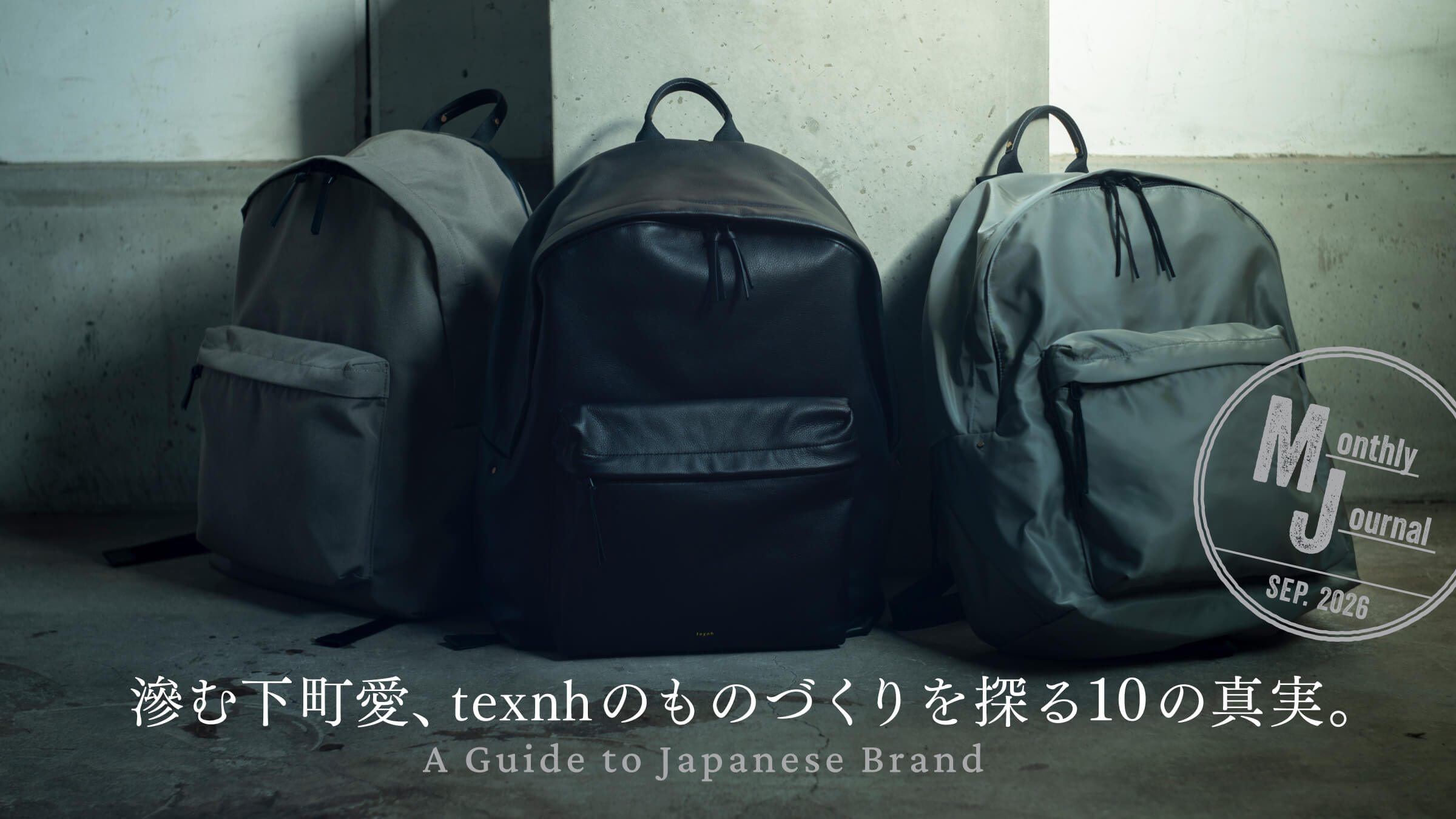
If you want to get to know *Tekne*, start with these three items. We’ve selected some of the brand’s finest models, including a fresh take on the universally acclaimed masterpiece, the “Classic Daypack.” Beyond their striking appearance, you can sense the brand’s dedication in the thoughtfully designed storage layout and the meticulous selection of materials—each chosen for its unique qualities.
LAYER DAYPCK
W350 × H450 × D180 mm
¥49,500
A derivative model of the “Classic
Daypack.” The acrylic canvas used in this bag is the same material used in awnings (for shade and rain protection). It is highly durable and offers excellent weather resistance. In addition to the side pockets mentioned in the interview, a dedicated laptop pocket has been newly added. Waterproof leather accents at key points add definition to the silhouette. “I think this is a daypack that’s perfect for work,” says Mr. Matsumura.
BLOCK
ZIP
TOTE
W630 (Top) × H320 × D180 mm
¥88,000
This tote bag is the result of a thorough exploration of what a functional bag should be, featuring a generously sized opening that makes loading and unloading items a breeze, as well as a gray lining that enhances visibility. Its specifications—including the brand’s iconic brass studs and the “YKK
EXCELLA” zipper in antique light brass—are also a standout feature. The exterior is made of kip leather, which retains a soft, supple feel while offering excellent durability.
LOOP TOTE / BELLSPRIT
W430 × H385 × D150 mm
¥25,300
When slung over the shoulder, it fits snugly as if hugging you. The meticulously designed single handle fits comfortably in your hand. The body is crafted from “Belsplit,” an ultra-high-contraction fabric. It offers excellent lightness and durability, along with superior moisture-permeable waterproofing. Its subtle sheen and drape are also appealing. The interior features “Viroblock
Ripstop.” Its packable design makes it a reliable companion on the go.
03 Factory | The Production FloorCraftsmanship that goes beyond the specifications.
Mr. Matsumura was born and raised in Koto Ward, Tokyo. He chose Morishita as the location for his office, noting, “It takes less than 10 minutes by bike to get from my home to the office.” *Tekne* works with four or five factories, most of which are located in the old downtown areas of East Tokyo. This is because each of them has the potential to match Mr. Matsumura’s enthusiasm.
One factor is location. The ability to create products face-to-face is a value that cannot be replaced by anything else. Making bags isn’t a job that can be done simply by sending over a set of specifications. The real challenge lies in how deeply we can delve into those specifications to bring them to life in three dimensions. That is what this job is all about.
Name tags that can be sewn on by hand.
"While many of our overseas production sites are large and well-equipped, and there are plenty of excellent factories, I believe the greatest advantage of *Tekne*'s manufacturing process is that, by working with nearby factories and artisans, we can quickly produce partial samples and conduct detailed inspections."
And another reason is simply that “the finished product looks great.”
"It's true that a factory equipped with state-of-the-art machinery is impressive, but at the end of the day, the products are still made on an assembly line. Even if they can be finished exactly according to the specifications, you don't really get that extra something."
When it comes to *techne*, the factories in the downtown area have the edge. They say that even when it comes to producing the right quantity at the right price, they have a clear advantage.
"I also want to preserve the craft culture of the old downtown neighborhood. As a way of showing my support, I almost never haggle over the price of my work."
The flat studs that have become the iconic symbol of 〈Tekne〉.
The factory in Katsushika Ward is the one we trust completely.
"Even when using the same leather, the overall look is different. I guess you could say the way it stands out is different. It has a certain presence right from the mock-up stage."
A major factor contributing to that look is the way the seam allowances are thinned.
"While it’s easier to sew when the seam allowance is thinned out, here we deliberately trim it while leaving some thickness. Leaving that thickness creates a unique, plump shape. There are many skilled techniques like this that are backed by experience. People might think that making a bag is just a matter of sewing it together, but it’s precisely this kind of work that truly tests a craftsman’s skill."
The process of trimming seam allowances.
You can’t overlook the 1-centimeter, 3-stitch spacing either. If the stitches are too close together, you’ll cut through the fabric. This is the optimal solution that ensures both strength and aesthetics.
Most of the dozen or so artisans are in their 40s and have 20 years of experience. They understand the key aspects of bag-making without even having to be told.
The factory is staffed by veterans with 20 years of experience.
04 Small Leather Goods | Small Leather GoodsThe charm of the good old days and the ingenuity of the design.
A multi-purpose case inspired by a work belt Mr. Matsumura found at a market in London long ago, a card case modeled after a cigar case, and a coin design—all engineered to accommodate “AirPods Pro.” The fact that we were able to bring these unique ideas to life is a testament to our close collaboration with the artisans.
ENGINEER’S BELT / BOLD
¥16,500
The design is inspired by a belt created to prevent the buckle from scratching the product during inspection. The belt itself features a two-layer construction that conceals the buckle. Another highlight is the way the lining material is bonded using a special process to create a seamless, stitch-free finish. The clean, minimalist design—comprising only belt loops and two studs—is the true essence of .
BRASS
CARD
CASE
W70 × H120 mm
29,700 yen
A brass card case inspired by a cigar case. The seamless finish is the work of a metalworks studio specializing in brass. The leather used is French lambskin, which Mr. Matsumura describes as having “the best texture.” The beauty of the leather’s seams is another highlight. It’s a testament to the ingenuity of a design that is precise down to the last millimeter.
CRATTA MULTI
CASE
W85 × H60 mm
¥24,200
The leather, which has a subdued sheen, is Italian-tanned Clatta leather. It is said to be sourced from the horse’s hindquarters, including the cordovan layer. The beige-dyed horse leather interior provides just the right accent. Thanks to its double-flap design and gusseted construction, it offers more than enough storage capacity as a coin purse. It easily holds folded bills, of course, and even fits an “AirPods
Pro” perfectly.
05 place | texnh's locationMade and sold in East Tokyo.
It has been five years since the launch of *Tekne*. To mark this milestone, Mr. Matsumura moved the company to a new office. He now occupies an entire three-story building and plans to open a shop on the first floor this December.
"I plan to make the most of the existing exposed beams and windows as much as possible. I’ll just clean them up and add a coat of paint. The structure with the concrete-reinforced column bases is also interesting, so I’ll leave it as is and lay boards across them to create built-in furniture."
On the first floor of a three-story building, a space that was once used as a warehouse has been converted into a shop. Shelves are planned to be installed on the concrete bases surrounding the steel columns, known as “root-wrapped concrete.”
I was surprised to hear that they weren't going to touch the exterior walls either.
"This area is more of a residential neighborhood than I expected. If the store were too stylish, it would stick out, so we wanted it to blend in with the neighborhood as it is. That was our top priority. Since there aren’t many other stores in the area, I think quite a few customers come here specifically to visit us."
inventory
Address: 1st Floor, 2-5-3 Shinohashi, Koto Ward
Phone: 03-6661-6190
Scheduled to open in early December
A rendering of the completed store.
Mr. Matsumura said he really wanted a place to convey the brand’s worldview. Why did he choose Morishita as his base for promoting the brand?
"I do get a little nervous in trendy areas (laughs), but we make and sell our products. It’s great that the whole process takes place in one place. Plus, we get to hear directly from our customers."
On the drive back to the office after finishing our interview at the factory, Mr. Matsumura spoke up. It was just as we were approaching Hanakawado in Asakusa, an area known for its shoe wholesalers.
"That building is the footwear wholesaler my grandfather founded. My uncle has taken over the business now. Come to think of it, I suppose I may have always been drawn to that traditional lifestyle where the shop is on the first floor and the living quarters are above it."
Email Interview
Tekne: An Interview with Architect Takuya Sakamoto—Part 1
Takuya Sakamoto of the design studio “Atelier Light” is the designer behind the store. We spoke with him about his vision for the store, ’s products, and Mr. Matsumura.
Q1. When designing the 〈Tekne〉 store, what specific requests did Mr. Matsumura have? Please tell us about the design concept you developed based on those requests.
A1. First, I heard about the concept for a store called “inventory.” The idea is to create a space that houses and supplies everything from raw materials to work-in-progress and finished goods, all under one roof.
Since we carry a wide range of products—from bags to clothing and miscellaneous goods—there is considerable variation in the size of the items and how they are displayed. To accommodate this, we used large wire mesh structures as the backbone of the space. Items can be placed directly on the wire mesh or hung from hangers and hooks. Furthermore, by adjusting the height, we made it possible to flexibly reconfigure how products are displayed and the overall impression of the space.
Q2. What aspects of 〈Techne〉 are incorporated into the shop’s design?
A2. I feel that 〈Tekne〉’s products are designed with even the user’s gestures in mind, yet their functions and structures are organized as design elements without being embellished for decorative effect.
Even in the shop, rather than concealing the structure of the wire mesh itself or the lifting mechanism visible on the ceiling, we’ve left them exposed to enhance the space’s character. At the same time, to create a contrast with these orderly structures, we’ve preserved the rough, unfinished appearance of the existing building’s structure.
06 wear | texnh's Take on ClothingDesign expertise honed through the creation of bags.
“I left ‘Yoshida Kaban’ because I just couldn’t shake the desire to make clothes.” Mr. Matsumura, who says he wants to take his time crafting the clothes he himself wants to wear, chose the “Bagless Blouson” for this project. “As the name suggests, it’s a blouson that lets you go without a bag. In a way, it’s a product that’s almost like self-denial (laughs).”
BAGLESS BLOUSON / OPTIM
JPY132,000
There are a total of six pockets on the left and right front panels, each positioned so they don’t interfere with one another, ensuring the jacket doesn’t feel bulky even when all pockets are filled. The outer fabric is “Optim™️,” made from Australian merino wool. It boasts excellent wind resistance and water resistance thanks to the latest spinning technology. The zipper is a “YKK EXCELLA,” and its polished sliders ensure smooth operation. The solid zipper pull is an original design by . This piece comes in a new shade of gray and is scheduled for release in mid-October.
07 Reference | What Shaped Rikiya MatsumuraThe Two Hasegawas and Culture.
Mr. Matsumura refers to two men named Hasegawa as his mentors. One is Susumu Hasegawa, his former boss from his “Yoshida” days. The other is creative director Futa Hasegawa. He says that thanks to these two, he has honed his eye for “quality work.”
"Camping is one of my hobbies, and it was Susumu who taught me about the design of camping gear and how to tell what’s good and what’s not. From Fumita, I learned a lot about the appeal of interactive art and various aspects of minority cultures. Both of them share a keen sense of what’s trending, and I always learn something new whenever I meet them."
Here are some of the books and music that define Matsumura-san, including those recommended by the two of them.
Something recommended by the two Hasegawas.
Tota's Recommendation: *NORMAN McLAREN: THE MASTER’S EDITION*, which has left a lasting legacy through its innovative experimental films.
Susumu's Recommendations: *LOW COST DESIGN*, which highlights ingenious ideas born from everyday life, and *COMPAGNIE DES GUIDES DE CHAMONIX: UNE BELLE HISTOIRE*, which vividly depicts the history and daily lives of mountain guides based in Chamonix, France.
I plan to play this CD at the store, too.
The compilation album *Café
Après-midi*, supervised and curated by Toru Hashimoto. “Ever since middle school, I’ve been hitting up record stores with a friend who’s still active as a DJ today. Later, during the heyday of the café music scene, I came across this compilation, and to this day, it remains something of a music textbook to me. I doubt there are many people left who own all 20 volumes. This will likely make up the bulk of the music we play in the store.”
Titled “The Parapara Book Trilogy” & a photo book that taught me about diversity.
The three books above are visually oriented, flip-through volumes. They include *A Brief History of Speed*, which traces the 40-year history of Nike’s development; a companion book to the Eameses’ film *POWERS OF
TEN*; and Hussein Chalayan’s *HUSSEIN CHALAYAN
ATTITUDE*. Below is *(un)FASHION*, a photo book by American graphic designer Tibor Kalman featuring traditional costumes and body adornments he photographed while traveling the world with his wife, Myra Kalman.
08 Collaboration | Creating with OthersIt helps broaden your horizons.
“Collaborations not only open up new avenues but also help expand a designer’s repertoire,” says Matsumura. A prime example is 〈MONOCLE〉, which specializes in travel, and 〈WILDSIDE YOHJI YAMAMOTO〉, which focuses on black, are prime examples. What does this design work—which he says is focused on bringing out the unique strengths of each brand—entail?
texnh ×
MONOCLE
TROLLEY TOTE
£300.00 (non-subscriber), £270.00 (subscriber)
Designed to be attached to a carry-on suitcase, this tote bag features a lightweight nylon body accented with water-resistant leather trim. “We incorporated the outer pocket while ensuring the strap that secures it to the carry-on blends seamlessly into the design,” the designer explained. A looped webbing strap is sewn into the top of the inner pocket to improve ease of opening and closing. This original design by *Tekne*—a feature that seems obvious yet was previously missing—is characterized by its ability to fit without interfering with a laptop. The beauty of its inverted trapezoidal silhouette also stands out.
WILDSIDE YOHJI YAMAMOTO × texnh
DAYPACK, SHOULDER / DENSE BLACK
This collaboration began with both parties’ shared desire to create a darker washed nylon fabric. “Due to the ‘salt-shrinking’ process, a whitish discoloration is unavoidable. If we dye it after the fact, the dry texture unique to washed fabric is lost.” After much deliberation, Matsumura carefully considered his selection of raw fabric and, through discussions with *Wildside Yohji Yamamoto*, perfected the ideal shade of black. “While based on *Tekne*’s signature silhouette, we’ve arrived at a product that’s similar yet distinct.” The lineup includes a daypack and a shoulder bag. Scheduled for release in Fall/Winter 2026.
HEUGN × texnh
“Leo” BAG
¥59,400
“〈Eugen〉 is my personal favorite men’s brand, so I reached out to them with a proposal.” For this third collaboration, we created a leather pouch. It was created in response to a request from Masato Koyama, the designer at “Ugen,” who wanted a bag-in-bag to hold his “Leica.” The zipper is a “YKK” Metalux. Since it’s made of resin, there’s no need to worry about scratching your camera or lenses. The compartment also features a mini pocket for an “AirTag.” Scheduled for release in early December.
09 Archive | Why I Can't Help But Create1,000 of them!?
Ms. Matsumura smiles wryly, noting that her collection of bags and accessories—including even the smallest items—might number no fewer than 1,000. These bags, which used to take up space in her home and office, are now stored through the storage service “Summary Pocket.” According to “Summary Pocket,” Ms. Matsumura holds the record for the largest number of bags stored in Japan.
"Since it captures each item individually, it also serves as a catalog. The archive is a source of inspiration, and many collections have been born from it."
The various archives I keep in “Summary Pocket.”
One such collection is a line of bags inspired by military-style storage gear. We selected helmet bags, parachute cases, and sleeping bag pouches from our archives.
This laminated drawstring bag was inspired by that sleeping bag cover. The bottom is reinforced with a detail that evokes compression straps, which also serves as a design accent. We added a handle and a pocket. When you tie the drawstring, it takes on a balloon-like shape. This silhouette is a common feature throughout the Military Trilogy.
RIGHT: VINTAGE SLEEPING BAG
LEFT: SHURAF
POUCH / AIRLY LAMI-RIP ¥28,600
10 as a Designer | texnh's Work Outside the CompanyI will remain in the background.
The company name “canall” is a coined term combining “can” and “all,” conveying the meaning “nothing is impossible.” The technical expertise and artistic sensibility that enable us to meet any request are also put to use in the creation of bags for a wide variety of brands.
"As an external designer, my job is to work behind the scenes and bring out the best in the brand," says Mr. Matsumura. His work has also expanded overseas.
A nameplate displayed at the entrance. The material, of course, is brass. The name “Canal” also echoes the word “canal.” When you think of canals, you think of Koto Ward—a subtle nod to our love for the local community.
One of them is *MAN-TLE*. It’s an Australian brand launched in 2016 by Lars Harry and Ida Kim, a married couple who were colleagues at *Dover Street Market Ginza*.
“〈Mantle〉 is known for its clothing made from stiff, textured fabrics. If you want to pair these heavy-weight pieces with a bag, the bag itself needs to make a statement as well. That’s why we proposed a messenger bag inspired by the ‘Royal Mail.’ We incorporated “Mantle’s” signature hardware, such as aluminum buckles and Tenax hooks. It has become a long-running collaboration with reorders coming in every half-year.”
MAN-TLE
R21G4 “MINI MESSENGER”
MONITOR NYLON
$650.00
A messenger bag inspired by the "Royal Mail" delivery bags. Made of washed nylon.
Another one is the Canadian boutique "HAVEN."
"The client wanted a fusion of craftsmanship, utility, and functionality. By using Cordura as the base and incorporating leather accents in key areas, we were able to preserve a sense of handcrafted artistry. The hexagonal tab—an icon of ‘Haven’—is the standout feature. We just delivered it a few months ago. I’m looking forward to seeing the reaction.”
HAVEN
HORIZON BACKPACK
¥155,000
A backpack made from “Cordura Ballistic Holophil Air,” a lightweight fabric.
Email Interview
Techne: An Interview with Architect Takuya Sakamoto—Part 2
Q3. What do you think makes 〈Tekne〉's products so appealing?
A3. As I use these products day in and day out, I occasionally find myself in situations where the features built into them really come into their own. I think one of the appeals of *Tekne* products is how my attachment to them deepens with each such experience.
I have a daypack myself. I often carry my laptop, tablet, and DSLR camera all at once, but even with all that inside, it doesn't feel heavy when I wear it—so much so that I sometimes find myself rethinking what I've packed.
Q4. I imagine you’ve worked with many different fashion designers over the years. What sets Ms. Matsumura apart from other designers?
A4. Within the “inventory” concept, I sensed Matsumura’s distinctive style in the way he positions *Tekne* products as just one tool among many. I think he defines the contours of his brand and his craft by taking a step back and viewing them objectively.