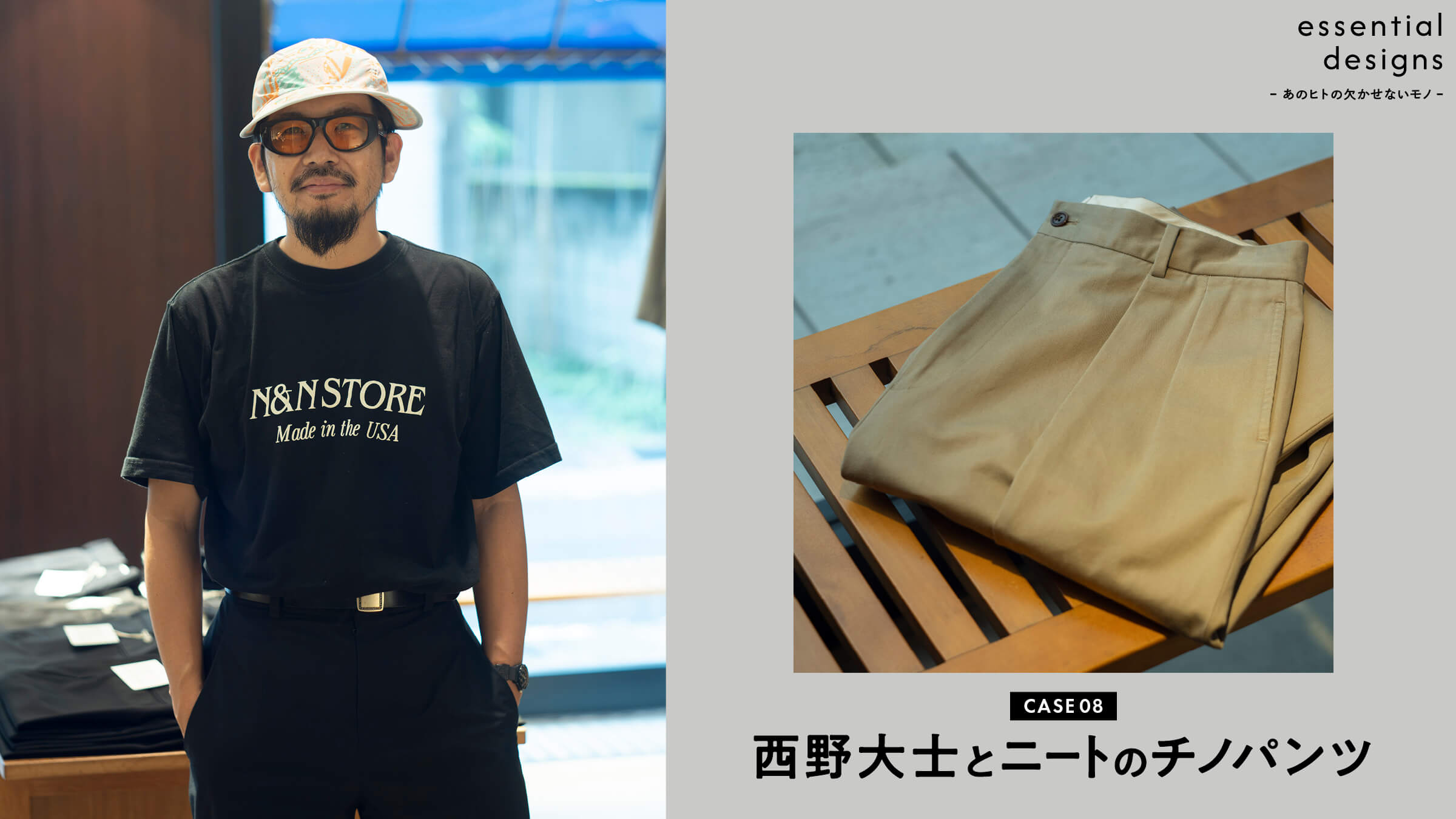
Chino Pants for Japanese People.
—This time, Mr. Nishino chose the “NEAT Chino” from NEAT as his essential item.
Westfield: Ideally, I’d prefer it not to be one of our own products, but for me, when I think of chino pants, the only ones that come to mind are 〈Neet〉’s “Neet Chinos.”

The “Neet Chino” is appealing for its silhouette—which, while roomy, is designed to suit Japanese men and can be worn in any era. Not only does it perfectly align with Nishino’s unpretentious aesthetic, but it’s actually the brand’s No. 1 best-selling item, even though the brand primarily focuses on trousers. “Lately, I’ve been pairing these with cycling shirts a lot,” says Nishino.
Why would a brand like “NEET,” which focuses primarily on trousers, decide to make chino pants?
Westfield: Since they’re based on the chino pants that *Brooks Brothers*—where I used to work—made in the 1970s, they’re actually slacks in terms of construction. While chino pants are a common item found in every brand, “there might actually be surprisingly few brands that make them to the specifications of dress pants. If that’s the case, then there’s a reason for us to do it,” so we launched the line in 2020.
—Have you tried out various pairs of chino pants yourself, Mr. Nishino?
Westfield: The thing is… I hardly ever wear chino pants; the only pair I ever wore was the “Polo Chino” from Polo Ralph Lauren. It might come as a surprise, but to me, they’re a very traditional item—and I had this impression that they’re hard to pull off, so I’d been avoiding them.
The design inspiration he showed me for “NEET Chino” was a pair of chino pants from Brooks Brothers—his former employer and a leading name in traditional menswear on the East Coast of the United States. Although the waist is quite roomy, cinching them tightly with a belt creates a casual, laid-back look reminiscent of an ordinary middle-aged American man.
—I had thought it was something that came about because of Mr. Nishino’s passion, so that came as a surprise.
Westfield: Chino and denim are fabrics with such a strong identity, aren’t they? No matter the construction or the details, as long as they’re made from those materials, they’re called chino pants or denim pants. Looking back at the Japanese fashion scene over the past few decades, I’m reminded once again just how special these two items are.
—Regarding the point mentioned earlier that “chino pants are hard to pull off,” I feel like choosing the right size is the real challenge.
Westfield: That’s right—it’s actually pretty hard for Japanese people to wear chinos that fit just right. To pull off a stylish look, one of the best solutions is to wear a slightly larger size cinched tightly with a belt for a loose fit. That’s why our “Neet Chinos” are designed with a waist that fits just right but feature a voluminous silhouette that makes them look like you’re wearing them oversized.
—One of the reasons why 〈NEET〉 trousers are so popular is that their silhouette suits Japanese people, and the same is true for these “NEET Chinos.”
Westfield: The basic silhouette of our trousers is consistent across nearly all models, with the silhouette from the waist to the thighs being the key feature. Since the skeletal structures of Westerners—who tend to have broader hips—and Japanese people differ fundamentally, we create a clean silhouette by allowing extra room around the hips and thighs and incorporating deep pleats.
—You once said, “The direction of fashion used to be outward-looking, but at some point it shifted to being inward-looking.” Is that also true when it comes to manufacturing?
Westfield: When it comes to making things, I believe there should be both an inward arrow—the desire to “make something I want for myself”—and an outward arrow—the desire to “have everyone else wear it, too.”
—Speaking of the inward-pointing arrow, Mr. Nishino mentioned that what sparked his interest in fashion was “wanting to be popular with girls in middle school.” How do you think chino pants fit into that?
Westfield: Now, I’m actually far from being popular with the ladies myself (lol), so it’s a bit awkward to say this, but what’s the deal with chino pants? Since so many brands include them as part of their standard lineup, I’d think they must be selling well. They’re our biggest hit product, too. Yet, you don’t really see many people actually wearing them, do you? That’s always puzzled me.
—It’s true that young people might not be wearing them.
Westfield: Since the vast majority of people wearing them are middle-aged guys like me, they probably aren’t very popular with the ladies (lol). Even though they should be just as valuable as jeans, for some reason they’ve been quietly overshadowed. I guess that’s the main difference between them and jeans.
—Could you tell us a little more about the items themselves? You’ve mentioned in the past that “at 〈NEET〉, we deliberately avoid using what are considered ‘high-quality’ fabrics”—is that still the case today?
Westfield: It all comes down to the question of what “good” actually means, doesn’t it? For example, Ralph Lauren’s “Polo Chino” is regarded as a timeless classic, but if you ask whether it used the “best” fabric available at the time, that wasn’t necessarily the case—I think they actually used the fabric that was most widely available on the market. When you think about it that way, whether a fabric is “good” or “bad” based on quality or price is, frankly, irrelevant to customers. I believe it’s far more important to make them feel, “I like this.”
—You’re saying that it’s more important for the fabric to match the item. So, if you had to name one thing that makes these “Neet Chinos” unique, what would it be?
Westfield: First of all, we subject the products to a pre-wash. To be honest, this is something that’s basically unheard of in a trousers factory. To achieve a worn-in look, we don’t attach accessories like buttons after sewing is complete; instead, we sew them on with basting thread and send the garments out to be washed. Afterward, we remove the basting thread and sew on the buttons. It’s an incredibly tedious process, so factories tend to resist it, but we do it at *NEET*. Another key factor is the silhouette I mentioned earlier. The “NEET Chino” is designed with a silhouette that’s wide yet timeless—perfect for Japanese men—so it pairs well with any outfit and never gets old. That’s why you’ll never want to part with them. We think of them as something like rice—a staple food that’s indispensable to the Japanese diet.
—We were just talking about how to be popular, but how should I style “NEET Chino” to be popular?
Westfield: Since this brand started with the concept that even a tattered T-shirt and flip-flops can look classy, I often pair them with vintage clothes. Lately, I’ve been wearing things like cycling shirts from the 1960s. That said, if you want to be popular with the ladies, you probably shouldn’t be wearing “NEET chinos” in the first place (laughs). Pleated chinos tend to have that “middle-aged guy” vibe, so it’s hard for women to see them as a fashion statement. But they’re a perfect fit for the unpretentious aesthetic I’m aiming for. Isn’t that really the best thing about chinos? They blend so seamlessly into your everyday look. Personally, I’ve always wanted to become the kind of adult who can pull off chinos with style.
—Isn’t it ideal when something blends seamlessly into your everyday look? They say women prefer a natural, effortless style that doesn’t try too hard.
Westfield: Oh, that's true! In that case, maybe chino pants really do make you popular (lol).
- 1
- 2