PROFILE
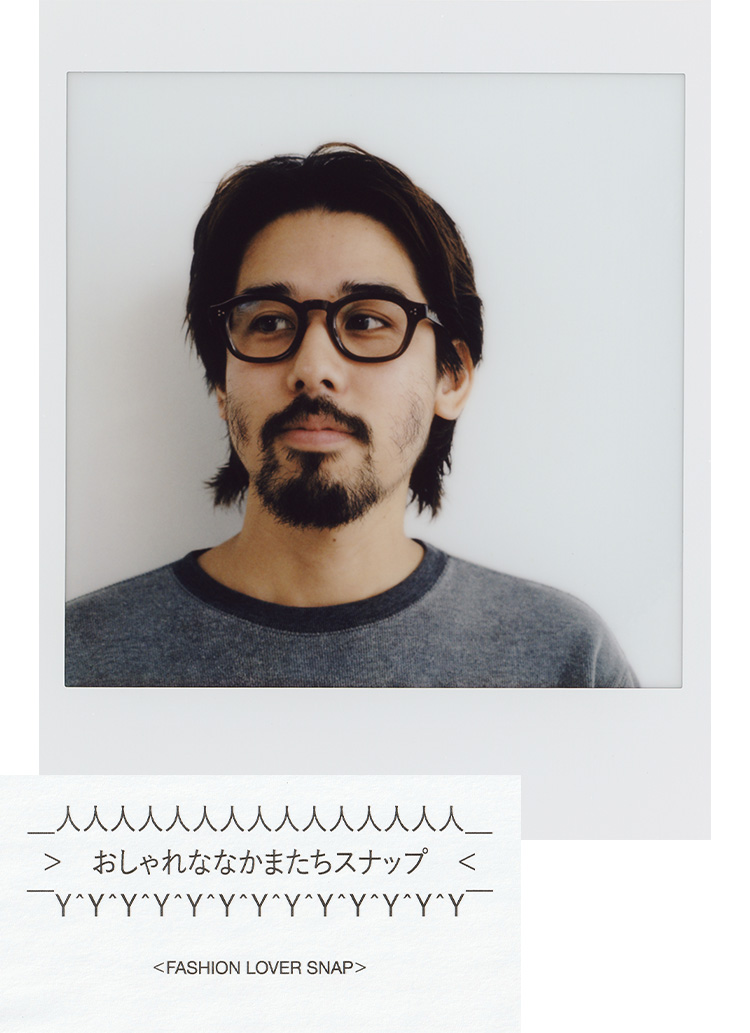
Born in 1976 in Nara Prefecture. After dropping out of Musashino Art University, he worked as a sales representative for select stores and brands before becoming a designer for "nonnative" in 2001. He reconstructs elements of work, military, and outdoor clothing in a modern way, and proposes real clothes that are both fashionable and functional.
Instagram:@takayuki_fujii_
No matter where you put them, or how many you have.
—Mr. Fujii, you have a column in another magazine that “offers guidance on how to find the things you truly need,” don’t you?
Fujii: It's been five years since the series began, hasn't it?
—You feature all kinds of things besides clothes. Do you have any specific criteria for choosing what to feature?
Fujii: First, there’s the premise that “readers can definitely buy this.” In that sense, the item I’m introducing this time might be a little different.

—Mr. Fujii, who has a keen eye for interior design, is here to introduce a stool. This may be a basic question, but what’s the difference between a stool and a chair?
Fujii: This is obvious at a glance: “whether or not it has a backrest.” A stool is one without a backrest. Because it lacks a backrest, it’s incredibly versatile—it can serve as a base for displaying vases or decorative objects, or even as an ottoman if you rest your feet on it.
—So, they’re suitable for a variety of uses. You’ve prepared a few for us—would you say these are what are commonly referred to as “designer” items?
Fujii: That’s right. However, these are products (manufactured goods), not art. Since they’re designed to be used, they aren’t one-of-a-kind pieces; in fact, hundreds of identical items are often produced. That said, since these stools were made specifically for certain facilities and their intended uses, many of them are no longer available for purchase. The number of them in circulation is quite limited.
—So that’s your favorite among them, then.
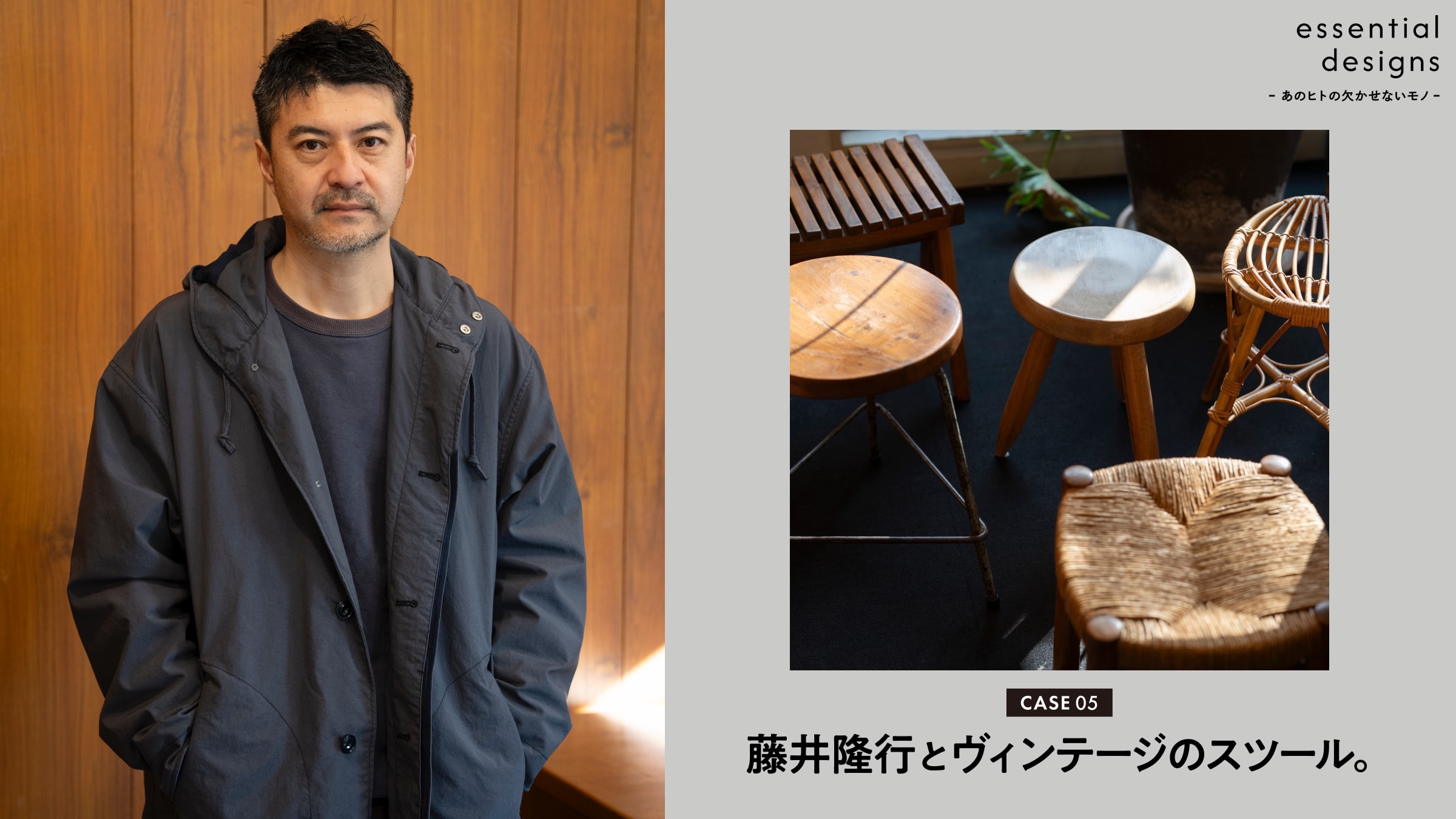
Fujii: I actually have quite a few of them, but from among them, I’ve selected stools designed by Pierre Jeanneret, Charlotte Perriand, and Louis Sonio. Jeanneret was a Swiss architect—a cousin of Le Corbusier—and also one of Le Corbusier’s key partners. Louis Sonio was an applied artist and designer, while Charlotte Perriand was an architect and designer. Both of them were French. All three were active during the same period; Jeanneret and Perriand even worked together, and at the 1935 Brussels World’s Fair, they exhibited alongside Le Corbusier, René Herbest, and others. It’s even more interesting once you know the background.
Stools designed by Pierre Jeanneret (top two), Charlotte Perriand (bottom left), and Louis Sonio (bottom right). These are all masterpieces, and their patina adds to their charm.
—I see. What got you so into these stools, Mr. Fujii?
Fujii: I suppose cars, furniture, clothes, and shoes are things most men like, but from a design perspective, the designs for all of them were pretty much finalized back in the 1950s and ’60s. That might be why I’m so drawn to stools from that era. Also, as I mentioned earlier, they’re practical, and they’re not that expensive compared to other vintage furniture. As a result, I guess you could say my collection just kept growing without me really meaning for it to.
—It’s true that the size is just right, and I can see why people can’t help but want to collect them.
Fujii: Unlike chairs, they don’t have to come as a set with a table, so you can put them anywhere you like. Plus, if they’re in a similar style or different colors, you don’t have to worry about your family noticing if the number of them increases before you know it. That’s a pretty important point (laughs).
—How do you usually go about finding them?
Fujii: Since many vintage furniture enthusiasts are also connected to the fashion world, whenever I mention, “I want this or that,” someone always seems to pop up at just the right moment to pass it on to me. I’ve also set things up so that a few interior design shops I know contact me whenever a good piece comes in.
This stool is also comfortable to use as an ottoman to rest your feet on while relaxing.
—They’re drawn to it and gather around. I’ve heard that condition is also an important factor when it comes to vintage furniture.
Fujii: Personally, I don’t really mind scratches or damage. After all, it’s normal for most vintage items from France to have some wear and tear. Shops don’t fix the scratches—they deliberately sell them just as they are—and I actually like the character that comes from that kind of aging. It’s the same with denim, isn’t it? To someone who isn’t interested, it might just look dirty, but to someone who loves it, that’s exactly what makes it great.
—You also mentioned that Mr. Fujii likes designs that tell a story, didn't you?
Fujii: What was the background behind its design, and what ideas and thought processes went into it? Also, where was it used? I love “learning the backstory”—when I gain that kind of knowledge from books or other sources, I can appreciate the object even more. For example, I’ve heard that Perian’s rattan stools incorporate traditional Japanese wickerwork techniques and have elements of the Mingei movement. That’s really fascinating, isn’t it?
- 1
- 2