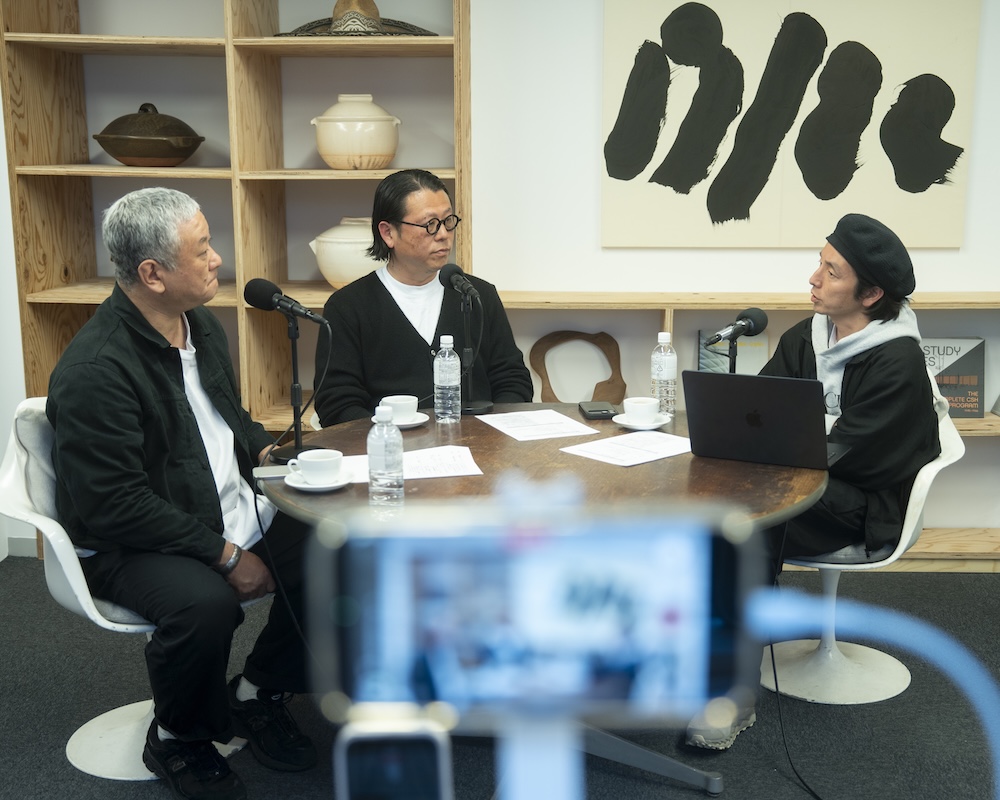
These days, the podcast industry is in the midst of a veritable “Warring States period.” The podcast “The Economics of Culture and Urban Development: Culture Scapers,” in which “Fuinam” is also participating, began airing once a week on Tuesday mornings starting in late May 2026.
The basic lineup consists of Masato Sekiguchi, CEO of “GREENING,” Shinichiro Nakahara, Representative Director of “Landscape Products,” and Ryo Komuta, Editor-in-Chief of “Fuinam”—who will serve as the three hosts, welcoming key figures leading the cultural scene as guests.
Let me take this opportunity to introduce the companies of the first two individuals.
"Greening" handles everything from planning and development to operations for restaurants, hotels, and commercial facilities, including "GARDEN HOUSE" in Kamakura, "MUSTARD HOTEL" in Shimokitazawa, and "Numazu Club"—an accommodation facility in Numazu that makes use of a designated tangible cultural property. Then there is “Landscape Products,” whose company name means “creating landscapes” and which operates across the fields of interior design, furniture, spatial design, and art. Based in Sendagaya, the company offers a diverse range of lifestyle proposals through its flagship store, “Play Mountain,” and the café “Tas Yard,” among other venues.
Although both of them have been involved in urban development for many years, they have largely worked behind the scenes, so they haven’t had many opportunities to speak publicly. However, the “firsthand insights” they can share—precisely because they have both practiced urban development at various scales, from individual projects to broader contexts—could well offer valuable hints for addressing the various challenges facing urban development in Japan.
So, what exactly is this show about? Although it wasn’t included in the podcast, since it seems to be a key point of the show’s description, I’d like to share Mr. Sekiguchi’s thoughts here.
Sekiguchi:As Japanese culture has come to be highly regarded worldwide, I sense the potential to go beyond simply viewing it as “culture = something cool” and instead connect it to future careers and business opportunities, transforming it into a growth industry that propels Japan forward. I chose this program title because I wanted to frame that perspective through the somewhat academic lens of “economics” and create a space—like a “collaborative lab”—where we can all, including our listeners, gain insights and learn together.
The term “Culture Scapers” refers to people who embody these kinds of activities. Going forward, we plan to invite guests who are at the forefront of various fields—such as food, architecture, and art—and delve deeply into their activities and work, with the aim of creating a program where we can learn together and gain new insights.

As of the time this article was published, episodes #1 through 4 have been released under the theme “How Does Culture Transform the Value of a City?” For those who haven’t listened yet, we’ve summarized the highlights of each episode. If you’re interested, please check out the full episodes on the podcast.
#1 The Fusion of Traditional Culture and Modern Business: What Are the Editorial Techniques for Future Lifestyles and Urban Planning?
The Shock of the Dashi Shop.
The conversation begins with a look back at the pop-up event held in San Francisco 10 years ago, which served as a starting point for both of them.
Sekiguchi:About 10 years ago, Mr. Nakahara and I organized a pop-up event called “DASHI KATACHI: Essence of Japan” in San Francisco to showcase Japanese dried foods and kitchen tools. Our goal was to introduce Japanese small and medium-sized enterprises to an international audience, but I was deeply impressed by the enthusiastic response from the local community. I myself had been fascinated by American culture since I was young, but through this event, I felt firsthand just how “cool” Japanese culture and the Japanese people really are. This experience sparked a desire in me to take these cool aspects of Japan and turn them into tangible projects—such as urban development and business—and pass them on to the next generation.
Nakahara:This 2015 event was a truly significant experience for me, as it brought Japan much closer to the local artisans and food producers. At the time, the term “dashi” hadn’t yet caught on overseas, but by deliberately using the word as is and presenting the tools as “katachi,” it was readily accepted by the local audience. The venue was the pottery brand 〈Heath Ceramics〉It was such a huge success that even the owner described it as the event that drew the largest crowd in history.
The Import of Culture as Seen in Matcha.
In today’s world, where the flow of information is accelerating, how is Japanese culture being interpreted in unique ways overseas and integrated into daily life? We will examine this question using specific examples.
Sekiguchi:Compared to 10 years ago, the speed at which information is exchanged has changed, giving rise to a “middle-ground” perspective where Japanese and American values blend. For example, “matcha,” which is currently hugely popular in the U.S., is a good example. While Japanese people view it as traditional matcha, in the U.S. it’s being incorporated into daily life as a health drink, a mild source of caffeine, or something similar to kale juice. At the same time, brands often emphasize its spiritual aspects. I find it fascinating how Americans are exceptionally skilled at “using their imagination to adopt positive elements and adapt them to their own lifestyles.” Rather than simply importing or exporting culture as-is, it’s important to maintain a connection while adapting it to the times and changing lifestyles.
A Perspective on Curating Culture.
What is the best approach to “preserving culture” in these changing times? We’ll delve into the potential of the combination of “Culture × City × Business,” the theme of this program.
Sekiguchi:While it may be difficult for busy modern people to make dashi from scratch every morning, this cultural tradition lives on through innovations like dashi packets. My current focus is on “how to curate” this culture. I’m thinking about how to convey Japan’s positive cultural traditions in a way that fits the lifestyles of modern Japanese people and people overseas, and how to turn that into a viable business.
Komuta:Since my job title is “editor,” I’m particularly sensitive to the word “editing,” but I believe that people in any field are, in fact, engaging in a form of editing the moment they begin combining different elements. I find it a very interesting approach that this program incorporates not only “culture” and “the city” but also the aspect of “business.” In the creative world, business theory tends to be somewhat shunned, but depending on how it’s approached, it can become a very authentic theme. Through this combination of the three elements, I’d like to delve deeply into discussions about the future of business and cultural studies.
#2 A City’s Energy Comes from “Food”: What Is the Common Initial Impulse Behind Areas Where Creatives Gather?
An interesting story about a town.
The two of them, who have visited various cities both in Japan and abroad, discuss the areas they currently find interesting and the rapid pace of change in cities as time goes on.
Komuta:I imagine you two have traveled to many places, both in Japan and abroad. What makes a city interesting?
Sekiguchi:Sendagaya was interesting about 20 years ago when places like “Play Mountain” and “Tas Yard” opened and the character of the neighborhood began to change, but the way the Mission District in San Francisco and Brooklyn in New York transformed back in the day was also fascinating. Back then, instead of major chains, artisanal coffee roasteries that roasted their own beans emerged, and—fueled by the IT boom—art studios and people began to gather in the surrounding area. While Ura-Harajuku in Japan was transformed by fashion, it was striking to see that over there, it was “food” players—such as coffee shops, bakeries, and cocktail bars—that were driving the buzz.
Nakahara:Lately, I’ve had more opportunities to visit Asia than California, and I’m truly amazed by the pace of change in South Korea and Taiwan. Young people suddenly open shops in places where there used to be nothing, and the moment investment comes in, the look of the town changes in a way that’s truly astonishing. Changes that took 10 years to unfold in California are happening in a much shorter span of time in Asia. I’m very curious to see what will remain after this frenetic pace.
Komuta:There’s no doubt that young people today are interested in Asia—specifically in things like fashion, culture, and music from places like South Korea.
The strength to enjoy the journey.
The conversation moves from the “passion” driving Asia’s breakneck pace to the mindset toward manufacturing that Mr. Nakahara says he learned from the people of California.
Sekiguchi:A South Korean startup founder once said, “We enjoy our work so much that all of our employees are working 24 hours a day.” Attitudes toward work have changed in Japan today, which is fine in its own way, but there’s no denying that behind that sense of urgency lies an overwhelming passion. There are times when I feel we simply can’t match that level of passion.
Nakahara:One of the biggest things I learned while studying in the U.S.—in places like San Francisco—is that people involved in crafting things and the food industry all really enjoy the process. Take ramen, for example. In Japan, there’s an established original recipe, and everything is produced very efficiently. But over there, since they don’t know the original, there are people who start out by feeling their way through the process on their own, aiming to create something independently. Watching that process taught me that this is where the fun lies—that’s where something original lies dormant.
Komuta:I used to have this rather rigid view that there are a lot of people in the U.S. who approach things in a very rational way, but I’m surprised to learn that people in California place such importance on the process when it comes to creating things.
Nakahara:Sometimes I wonder if the emphasis on preserving tradition is too strong in Japan. During President Obama’s term, the souvenir given at the G20 summit was honey harvested from a farm created using turf removed from the White House lawn. In Japan, they’d definitely have given something from a company that’s been around for hundreds of years, wouldn’t they? I thought, “Giving honey harvested from your own garden—that’s so cool.”
From a point to a plane. A city that begins organically.
A Journey into the Memories of Sendagaya. We look back on the process by which a single shop—a “point”—served as the catalyst, leading to the organic connection between people and places that gave birth to this neighborhood.
Sekiguchi:Back when I was a salaryman, my office was in Sendagaya, so I had a front-row seat to watch the neighborhood undergo a process of “editing” and transformation, centered around Mr. Nakahara’s “Play Mountain.” I felt that Mr. Nakahara was different from a designer—he was truly someone who was editing the neighborhood itself.
Nakahara:I never set out to build a town from the start; it all began with chance encounters between people and properties. As for the location of our second store, it was a space where food and drink weren’t allowed, but I jokingly said, “I’ll rent it if you’ll let me run a café there,” and the owner suddenly gave me the go-ahead (laughs). It just so happened that a senior coffee master had recently moved to Tokyo from Kagoshima, so I decided to entrust the shop to him.
Komuta:Restaurants and cafes often serve as the starting point for getting people to linger in the city, and from there, clothing stores and other businesses tend to spring up, don’t they?
Nakahara:Even in regional cities, just one store opening in an empty lot can suddenly draw a crowd and bring about change. I find this kind of organic urban expansion, which happens all over the country, to be truly fascinating.
#3 The Future of Organizations and Trust-Based Management: An Environment Where Creators Thrive
From fashion to food, clothing, and shelter.
The discussion will focus on the new direction of “Fuinam” as a media outlet, which is expanding its scope to encompass lifestyles and culture in general in response to changing times.
Komuta:It’s been over 20 years since “FuiNam” started out as a fashion magazine, and our readers have grown older just like I have. It’s only natural for interests that began with clothing to shift toward furniture, architecture, and food. Furthermore, I sense that your interests are now turning toward domestic travel and tourism, so I want to delve deeply into Japan. Just as creators eventually find themselves wanting to run their own lodging facilities, I’d like to incorporate content into “Fuinam” that compactly encapsulates the essentials of life: clothing, food, and shelter.
Sekiguchi:It seems like this initiative is expanding beyond just fashion to encompass culture, urban development, tourism, and food as well.
Chasing two rabbits: business and beauty.
The discussion moves from the universal theme of balancing creativity and business to the cutting-edge organizational structures implemented by long-established American brands.
Komuta:I believe that creativity and business are not mutually exclusive—they are two wheels that must turn together. While some say designers should serve as CEOs, I think it’s entirely possible to pursue beauty while running a business, and I’d like to share some business insights that will be useful going forward.
Nakahara:I currently work as the CDO (Chief Design Officer) at “Conran Shop,” and I think having the CEO and CDO on equal footing is great for the company’s balance. Also, I heard that Heath Ceramics in San Francisco has restructured itself into a trust-like entity where all employees work together to achieve the company’s goals. Under this model, every employee is granted stock ownership, and the two representatives serve as chairs for financial and creative matters, respectively—not as company representatives. It really showed me a new vision for the future; the U.S. is truly ahead of the curve in this regard.
From Mass Production to Artisan Shochu.
Set in Kagoshima—a place Mr. Nakahara has been involved with for over 20 years—this piece delves into the maturation of craft culture and the changes taking place in the city as a result of the resonance between people and the local community.
Komuta:How have things been lately in Kagoshima, where Mr. Nakahara has been involved for so long?
Nakahara:I’ve been returning frequently to my hometown of Kagoshima since around 2000, and I’ve seen the number of creators making interesting things grow steadily. By taking them to various places, I’ve witnessed the gradual improvement in the quality of their work. As they begin to come together, a culture and movement of craftsmanship emerges, and the city begins to change. The design and craft fair I started 20 years ago requires absolutely no government funding and has grown into a major annual event that attracts many participants, with an increasingly younger crowd each year.
Sekiguchi:With Mr. Nakahara in the picture, the balance between Kagoshima, Sendagaya, and the U.S.—this triangle—is incredibly fascinating. The unpredictable chemistry that arises from this cultural exchange is really interesting, isn’t it?
Komuta:From a media perspective, we believe that the term “craft”—which has now become widely accepted—likely spread through the activities of those around Mr. Nakahara.
Nakahara:When it comes to craft products in Kagoshima, among the third- and fourth-generation owners of shochu distilleries—who inherited businesses that were mass-produced by their parents’ generation—there are many young people who are returning to their roots, starting from scratch with sweet potatoes, and shifting to a production method focused on bringing out the full potential of shochu. Shops that used to carry natural wine have suddenly started stocking these shochus as well. Such changes are taking place in the alcoholic beverage industry, too.
#4 Cities, Rural Areas, or Something Else: Reflecting on Japan’s Future “Town Planning” in Light of the Real Estate Bubble and Tourism
The Value of Kamakura and Regional Cities.
Taking Kamakura—home to the “Garden House” designed by Mr. Sekiguchi—as a starting point, the discussion turns to the future of Japanese towns, focusing on how economy and culture can thrive in places that aren’t major cities.
Sekiguchi:Land in Shichirigahama, Kamakura, cost 1 million yen per tsubo 15 years ago, but now it’s 4 to 5 million yen. Niseko has seen the sharpest rise in land prices in Japan, followed by Hakuba, but this isn’t just about real estate prices—it signifies a turning point in the value of these towns. It’s not just about the beautiful ocean and mountains; there’s a culture and way of life centered around surfing and snowboarding, complemented by culinary and tourism elements. I believe that the Shonan area—where value, lifestyle, and culture are thriving as a viable economy outside of Tokyo—is paving the way for the future of regional cities in Japan.
Komuta:Foreign visitors seem to have a better understanding of Japan these days, and you even see them at restaurants where you might think, “They know about this place, too?” On the other hand, I think issues such as overtourism and transportation infrastructure are also starting to emerge.
Sekiguchi:Since this also involves infrastructure, it’s becoming difficult to run a business that simply focuses on increasing the number of tourists; however, as daily life and culture have matured, I believe there’s a growing demand among people who want to “spend time doing nothing in Kamakura.”
Japan's Content Strength.
The discussion will focus on the depth of Japanese content—which is virtually inexhaustible—and the new trends in the interior design industry driven by the momentum of Asian creativity.
Sekiguchi:Running a hotel, I feel that inbound tourism will continue to grow. Rather than seeing a lot of first-time visitors, it feels like people who used to come twice a year are now coming three or four times. For example, in Japan, even if you just want to eat ramen, the choices are endless. I think foreigners see Japan as a country where, no matter how much you explore, there’s always more to discover.
Nakahara:The pace of creativity in Asia is also fast. For example, at “Conran Shop,” given the current global situation, importing from Europe presents significant hurdles and many challenges. That’s why I think it’s important to manufacture products in Asia and establish contacts in each country by creating points of contact with people of the same generation who speak a common language.
Komuta:When I focus on the momentum of Asian manufacturing and branding through my work in visual production, I’m always amazed by the high level of detail in their references. We’ll definitely need to keep an eye on Asia going forward.
Guests Who Bridge Cultures.
To overcome the crises facing traditional regional cultures, we look ahead to the future of the program and place high hopes on “guests who will shape the future.”
Nakahara:Right now, partly due to the weak yen, my friends from overseas are visiting Japan out of interest in its manufacturing landscape. Even in the apparel industry, there’s a belief that “making things in Japan is best,” leading some to buy homes in places like Gifu and set up production bases there. While the U.S. lacks scattered “production hubs” like pottery towns and hasn’t developed a major industry around them, Japan still manages to hold on to its traditional production centers—like Bishu for wool and Wakayama for socks.
Sekiguchi:Wholesalers aren’t just the traditional kind anymore—they’re taking on a new form, like the ones that set up booths at craft fairs to showcase their products. It’s interesting how that really helps connect value, isn’t it? I’d love to hear what those people have to say.
Komuta:As direct transactions become more common, I believe wholesalers can generate new demand by adopting a mindset focused on “curation” and connecting people with products. Given the current challenges, I’d like to invite guests who can engage in positive, enjoyable discussions about how we can move forward.
At first glance, terms like “economics” and “urban development” might seem like abstract, academic concepts. However, the conversations among those who have been driving change on the front lines are all grounded in reality and brimming with excitement that directly connects to our daily lives and future careers. How can we transform Japan’s future culture into business opportunities and connect them to the future of our cities? The doors to this “Collaborative Lab” are already open.
Why not tune in to their lively and in-depth conversations every Tuesday morning while commuting to work or school? Feel free to start by checking out an episode on a topic that interests you.
- Photo_Masayuki Nakaya
- Text_Shinri Kobayashi


![[Series 【 Culture Scapers] What Does New Regional Urban Planning Look Like in the Face of Population Decline? Our guest is Ryo Ishida of New Local.](https://www.houyhnhnm.jp/wp-content/uploads/2026/08/DSC00815-700x468.jpg)
![[Series 【 Culture Scapers] Our first distinguished guest is Chef Shinichiro Harakawa!](https://www.houyhnhnm.jp/wp-content/uploads/2026/07/A7V9159-700x560.jpg)