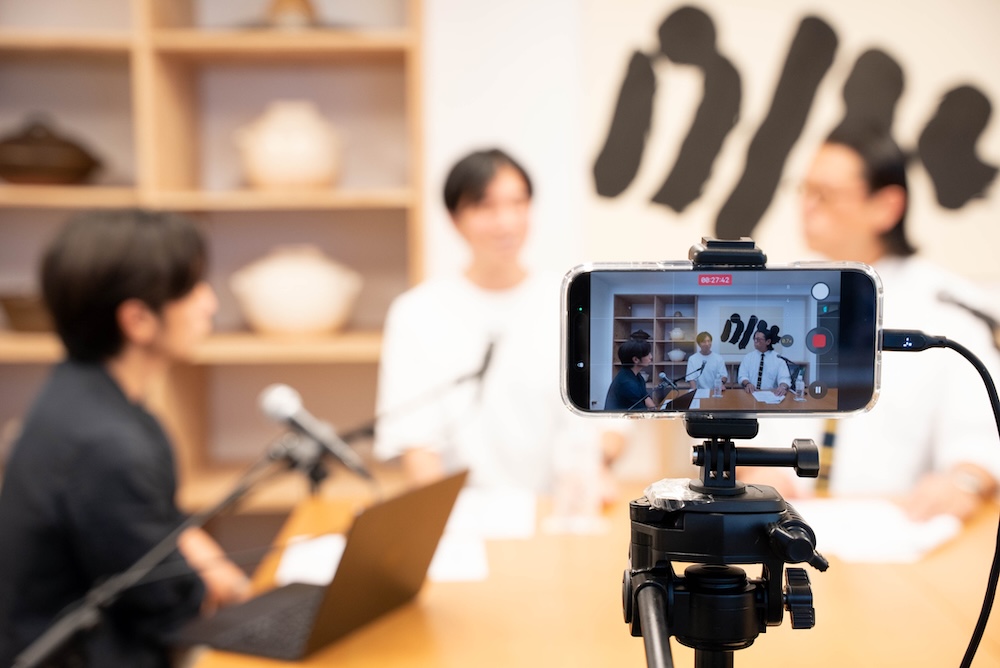
The podcast series “The Economics of Culture and Urban Development: Culture Scapers,” in which Fuinam is also involved in the production.
The second guest, “NEW LOCAL"The episode featuring Ryo Ishida, the company's representative, was released over the course of four weeks."
For those who haven't listened yet, here's a quick rundown of the highlights—or should I say, the must-hear moments?—from the four episodes. If you're interested, please check out the full episodes on the podcast.

Mr. Ishida studied architecture at the University of Tokyo and, after working in Kengo Kuma’s research lab, pursued an unconventional career path by joining McKinsey rather than becoming an architect.
How did you come to be involved in community development in rural areas through “New Local”?
#9: From Architecture as a Starting Point to Becoming Someone Who Drives the City and the Business Itself
Mr. Ishida spent his childhood in San Francisco and New York. During high school, he began traveling abroad on his own, and he says that the things he saw on his trips were churches, art museums, architecture, and cityscapes.
He then majored in architecture and urban design at the University of Tokyo and joined Kengo Kuma’s research laboratory. Mr. Kuma’s philosophy—which he described as “Architecture + α”—reflected his approach of not limiting himself to the field of architecture alone, and this mindset would later influence Mr. Ishida’s own career.
Mr. Ishida, who had come to question whether architects alone could transform a city, discovered the field of consulting and, sensing its similarities to architecture, made the switch to McKinsey. Drawing on the fundamental business skills he acquired during his five years there, he gradually came to realize a path toward creating value through the intersection of architecture and business.
#10: Why I Started My Business Under the Banner of “Regional Revitalization 2.0”
After gaining experience on various projects at McKinsey for about five years, Mr. Ishida moved to an IoT company specializing in smart cities and smart buildings. Having gained experience spanning architecture, business, and technology there, why did he decide to return to the field of “regional development”?
The COVID-19 pandemic marked a turning point. Mr. Ishida, who had previously focused his work on Tokyo and overseas, began reaching out to people engaged in interesting initiatives across Japan and visiting those areas in person. There, he met people who were opening shops, attracting visitors, and transforming towns in regions facing population decline. The realization that “they were clearly doing more to improve their communities than I was in my day-to-day work” became a major catalyst for him to start his own business.
That’s how the concept of “New Local” was born. It refers to “new locals”—people who are newly engaged with a community and create value there. For Ishida, who was born and raised in Tokyo and had no rural hometown to return to, the term “New Local” also carries the meaning of creating a new hometown for himself.
#11: What Are the Initiatives of "New Local" Groups Working on Regional Revitalization?
After traveling throughout Japan and meeting people who were taking on new challenges in their communities, I came to realize that the work I should be doing lies in regional areas, and so I founded “New Local” in 2022.
“New Local” promotes the concept of "new locals." We build companies in partnership with local leaders and, while developing businesses such as hotels and restaurants that utilize real estate, we bring talent, capital, and expertise to the community.
Behind this lies our critical perspective on conventional regional revitalization efforts. Rather than relying on government-led initiatives or efforts tied to a single region, we aim to partner with leaders who are truly committed to the region’s future, generate solid profits as a business, and expand rapidly into multiple regions. We are striving for this “Regional Revitalization 2.0.”
#12 Community Development and Japan's Potential
In this fourth episode, we delve deeper into Mr. Ishida’s views on community development and Japan’s potential by answering questions submitted by viewers. He explains that his background in architecture is not only useful for practical work such as design and renovation, but also serves as a way of thinking that helps him envision hypotheses about “what the future might look like” and present them in an engaging way—a mindset that he says informs his current business ventures.
When it comes to regional brands, he says it is more important to “discover and reinterpret” the history and culture that lie dormant in a region than to build them from scratch. He explains that the unique character of a region emerges from the interplay between cultures introduced from outside and local traditions.
Going forward, there are plans to expand activities from the current 10 regions to 100 through initiatives such as business succession in local communities, partnerships with companies, and the development of local leaders. The “Next 10 Years” envisioned by Mr. Ishida is finally getting underway.
This series offers valuable insights not only for those interested in regional revitalization but also for anyone involved in urban development and business.


![[Series 【 Culture Scapers] What Urban Landscapes Have Emerged from a Life Split Between Japan and Sweden? We welcomed Akihiro Matsui, CEO of Media Surf, as our guest.](https://www.houyhnhnm.jp/wp-content/uploads/2026/09/DSF2229-700x467.jpg)
![[Series 【 Culture Scapers] Our first distinguished guest is Chef Shinichiro Harakawa!](https://www.houyhnhnm.jp/wp-content/uploads/2026/07/A7V9159-700x560.jpg)
![[Series: 【 Culture Scapers] Culture and urban development in 20-minute episodes. A podcast released every Tuesday—we hope you’ll tune in.](https://www.houyhnhnm.jp/wp-content/uploads/2026/06/culs_05-700x560.jpg)