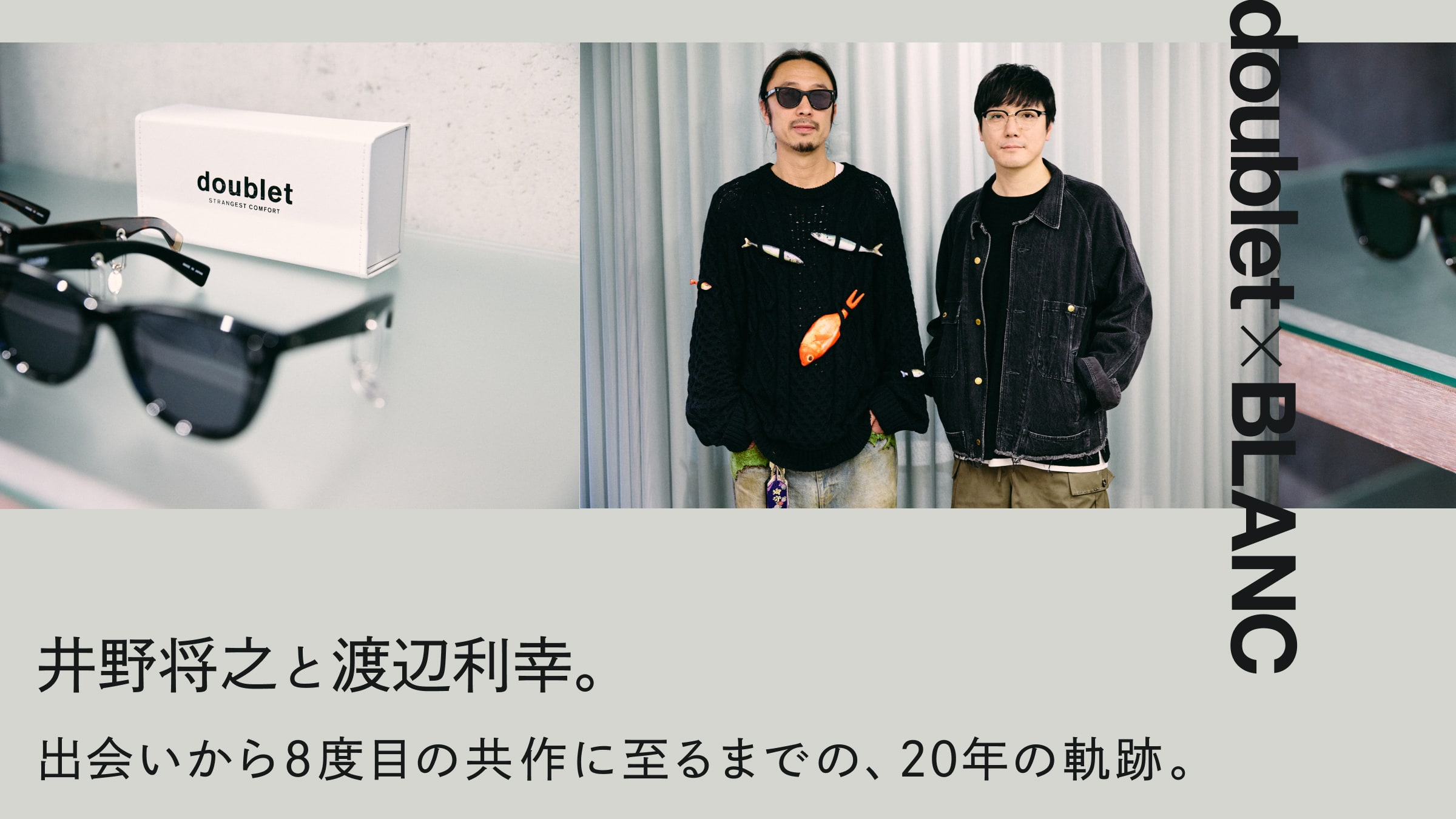
PROFILE
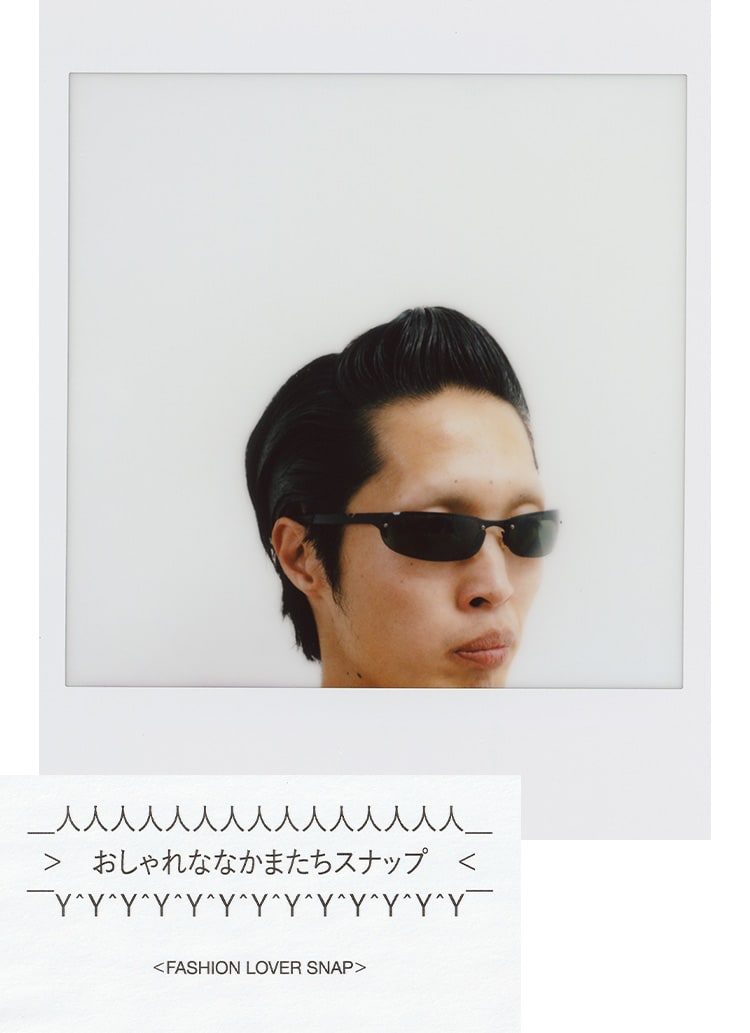
Born in 1979. Maison Won the Grand Prix at the LVMH Prize in June 2018. He has been presenting his collections in Japan and abroad, focusing on designs that bring humor and surprise to everyday life.
PROFILE
Born in 1976. After joining "Maison Established "Blanc" in 2012. He regards eyewear as something to be enjoyed on a daily basis, like bags or shoes, and values "a sense of atmosphere as a fashion item.
The end of repeated challenges.
Could you start by telling us about your relationship?
Ino: Relationships... (looking toward the door) Oh, they don't paint the color there only. It's the same as Nabe's eyewear. (*All eyewear by Blanc has only the left temple end in a different color, which has become an icon of the brand.)
Watanabe: It's just been removed (laughs).
Ino: Oh, I see. I thought they were matching products to meeting rooms.
All: (Laughter)

I could feel the goodness of our relationship just from this conversation. You worked together at your previous job, right?
Ino: Yes, we worked at Maison Mihara Yasuhiro at the same time. Mr. Nabe treated me very well. I was allowed to go with him to Paris, and he took me to various places there. He was my senior.
Watanabe: I guess I was a senior. It's in the past tense (laughs).
Ino: No, no, no, even now! What are you talking about?
Watanabe: I was the store manager. At the time, I was buying and managing a boutique store that was a separate business of Mr. Mihara's company. When I went to Paris to buy clothes after the "Maison YASUHIRO Mihara" show, the company policy was to take a few people from the planning side with me to the exhibitions. It was a good learning experience.
Ino: Yes, at that time, Mr. Nabe invited me to join him.
So you have known each other for a long time.
Ino: We have known each other for 20 years.
That's quite a long time. I believe it was around the same time that you launched your brand, wasn't it?
Ino: No, I think Nave was a bit ahead of you...?
Watanabe: I left Mr. Mihara's company in 2012, finished the samples that year, and actually started selling them in 2013. Well, it was about the same time.
Ino: I remember well that I was allowed to use a pair of "Blanc" sunglasses for my first collection. I have been using them ever since. I have always worn eyewear from Mr. Nabé's collection.
Watanabe: Really, thanks to you. I'm letting you get on with it (laughs).
Ino: No, no (laughs). (Laughs.) And while I was using it, we started talking about working together to make it.
Watanabe: This is the 8th one. I've done a lot!
26ss88ew14 - eyewear
¥52,800
Compared to the previous products, the eighth collaboration eyewear has a relatively basic look, doesn't it?
Ino: The concept of our previous products was to create sunglasses that could be found anywhere, but could not be found anywhere else. We exchanged opinions on what Mr. Nabé thought of eyewear and what I wanted to challenge, and Mr. Nabé helped me to put it all together and give it shape. He would say, "Let's put temples on the lenses," and so on.
Watanabe: When I talk with Mr. Ino, he comes up with a lot of crazy ideas (laughs).
Ino: We did something like holograms!
Watanabe: I did. At first, Ino-kun was talking about "The Matrix. He said, "I like the way the green letters are all lined up on the black screen. I remember gathering all the green plastic parts in the world and sending them to Mr. Ino.
Past collaboration eyewear.
Ino: In the end, that fell through.
Watanabe: Yes, yes (laughs). I also remember Mr. Ino's request: "Can you make a hologram print on the lens so that when you look to the right, you see Hawaii, and when you look to the left, you see outer space? (Laughs).
All: (Laughter)
Watanabe: Then I decided to go to DNP to learn hologram printing in order to meet Mr. Ino's request. Well, I had to give up that idea because of the lot size problem. I also felt that it would be bad if the person wearing the glasses was involved in an accident, since the field of vision would be limited.
Ino: Thank you so much for everything.
This work is the result of that kind of thing. To be honest, it doesn't really tie in with what we've been talking about so far...
Ino: We have taken on many challenges in the past seven times. After those challenges, we talked about going to a different phase from the next time before we started production. Until now, we had been trying to make the lens with temples an icon. Ideally, everyone would be able to recognize the eyewear as "Doublet" and "Blanc" eyewear.
Watanabe: Yes, it is. Because that one is distinctive.
Ino: But after our seventh collaboration, we decided to go back to the basics of what we wanted, what we would want to hang 365 days a year. Of course, I wanted to make the previous products as well, right? But the days when you can wear them are limited. The eighth product started with the idea of making eyewear for daily use.
So the tension has changed drastically from the past. Was there some kind of motif?
Ino: I had just seen "The Man with No Name" with Timothée Chalamet, and I thought Bob Dylan was really cool. I asked Mr. Nabe if he would like to make something with that kind of atmosphere, something that would remain cool over time.
Watanabe: It was a new conversation...a really new conversation for us.
Ino: It is truly authentic. Sunglasses in the shape that anyone would draw if asked to draw a picture of sunglasses. From there, Mr. Nabé worked out details such as cutting them at a sharp angle. He made them a little cat's eye, and so on.
Watanabe: Just a little bit, really.
Ino: Microcats! It's like that, isn't it? And then there are the flat lenses. The finish is authentic, yet completely different from what Bob Dylan was wearing at the time, and incorporates a lot of technology and quality that is still possible today. The lenses are thick, too, aren't they? Nabe-san made the lenses look three-dimensional, even though they are flat.
So this is one that was born from Mr. Watanabe's repeated millimeter-by-millimeter adjustments.
Watanabe: It sounds great when you say it like that, but glasses are mostly about millimeters. 1 millimeter is really just a little bit, but 1 millimeter for glasses is a lot bigger.
Ino: It's the face, isn't it?
Watanabe: Yes, it is the face itself. So we did a lot of fine-tuning.
Ino: The carabiner on the temples started with the idea of being able to attach a glasses chain. Of course, you can also attach a key chain or a stuffed animal of your choice to this carabiner, and I think this eyewear can be enjoyed in various ways.
Watanabe: It's a very simple part, but in case you're wondering, everything is custom-made for this eyewear.
—How do you achieve this sense of depth?
Watanabe: To get a little technical, we’re using a technique called “television cut” around the edges of the lens. You know how old CRT televisions had a slightly slanted screen? Basically, we treat the lens as if it were a monitor and apply the cut that way.
Ino: Maybe it’s because of that attention to detail, but Nabe-san’s eyewear looks good on absolutely everyone. That’s why we always run out of pairs at the shows. They look so good that I end up letting everyone try them on (laughs).
- 1
- 2