The Future of Manufacturing.
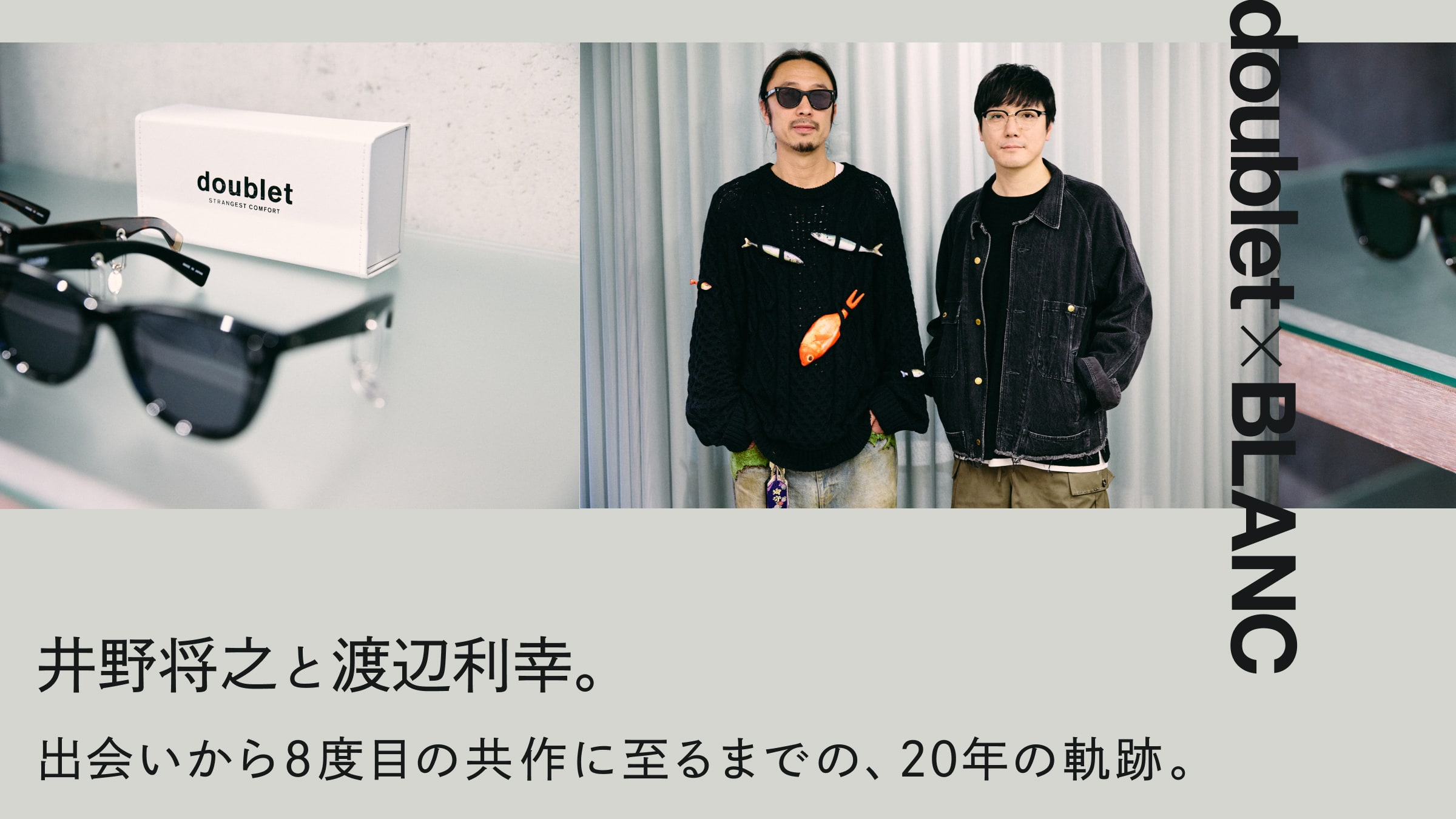
This is the eighth time that "Doublet" and "blanc" have collaborated on eyewear, and it has taken on a new dimension. When you heard about this change in direction, did you feel that there was something missing from your perspective?
Watanabe: I had both feelings. On the one hand, I enjoyed the time I spent working hard to fulfill Mr. Ino's outlandish ideas, and I still want to do more, but on the other hand, I agree with his goal of creating something that will appeal to many people who want to use it ”365 days a year. I have no choice but to do it.
Ino: It was a new frontier for me. But it also made me realize many things. It was like pushing simplicity to the limit, or rather, honing it. It is not a design that adds and adds, but a design that subtracts. I was able to feel anew that design is really interesting.

Watanabe: Until now, the basic premise has been to attach temples directly to the lenses. With this eyewear, there may be people who use it with prescription lenses.
Ino: Yes! That's the point.
When the temples are directly attached to the lenses, it is not easy to change them, is it?
Watanabe: It's not impossible to change them, but it would take a tremendous amount of effort and time. We had to make custom-made lenses that would not crack even if the temples were directly attached. But with this new model, we can easily change the lenses without changing the frame.
Ino: I have heard such stories in the past. They wanted to wear the glasses, but they couldn't because of their poor eyesight. Then I realized that I had been turning a blind eye to such customers without realizing it. I asked myself if I could really be proud to say that I was a designer.
Watanabe: If I met someone wearing this as a pair of glasses, I would be impressed, I'm sure.
Ino: You'll want to shake hands with them, for sure. "Wow, it's a degree! You've got a degree! I'm sure they'll come up to you and say, "Wow, you've got degrees!
I guess we will be passing each other on the street more often. This is your eighth film together, and it has been 20 years since you met.
Watanabe: Ino-kun says things that are several hundred meters beyond what I can imagine, so I have to listen to what he has to say. I go into our meetings prepared for what he might say, but he easily exceeds my imagination.
Ino: I tried to make a party item with a nose on it, or I bought a Dragon Ball scouter and brought it to Nabe-san and said, "Can you make this? I would buy a "Dragon Ball" scouter and bring it to Nabe-san and ask, "Can you make this?
Watanabe: So the meeting becomes less of a meeting (laughs). (Laughs) I couldn't tell if I was supposed to laugh or not. But Ino-kun, you keep a straight face when you do that.
Ino: By the way, I mean everything I say. That's what makes him so bad (laughs).
Watanabe: I always feel that this is the source of the power to create such an impressive runway.
Is your approach to craftsmanship like that, not only in this collaboration, but throughout your career?
Ino: I always want to think positively about how far I can take what I have in mind. I don't want to give up when it is only in the imaginative stage. As I explore the possibilities, I see what is possible and what is not, and maybe a new idea will emerge that would be better. In this way, we are getting closer and closer to a landing point.
I see that you and Mr. Watanabe are working together as a tag team as well.
Ino: When working with Mr. Nabé, no matter how much I messed up, he would always present me with a “destination here” in words. He navigates me through the process as if he is consolidating my rambling ideas.
It's a really good relationship.
Ino: Mr. Nabe led me to a place I could not have reached by myself. This pair of eyewear is filled with a lot of feelings, including the story behind it. It is a piece of eyewear that I really love and want to wear every day.
Watanabe: After the first meeting, I always went home with my head in my hands (laughs).
So you have continued to confront them.
Watanabe: It's easy to say it can't be done, but I'm also the type of person who thinks that nothing will come of it unless I try.
Ino: I thought that design is something that is extremely restricted and limited. But for this collaborative eyewear project, I was free to say whatever I wanted because Mr. Nabé was there. I felt that he was able to handle it well when we talked.
Watanabe: I want to respond to Mr. Ino's feelings. Otherwise, it is not a collaboration. While respecting Mr. Ino's opinion, we had to present a goal that would take shape as such, and we had to present a benchmark. That is why we proceeded with a series of discussions. I am happy that you continue to work with me among the many eyewear brands that have offered to collaborate with you.
I think it is because you are Mr. Watanabe.
Ino: Yes, I like you, Nabe-san. As I mentioned earlier, I don't think I have ever heard him say, "It can't be done. I think he tries to give me some kind of shape.
Watanabe: I think I've said it a hundred times in a roundabout way just because I haven't used the word "can't." (Laughter.)
Ino: Eh, I've never felt that way. I really think that they keep exploring small possibilities, nabe.
Watanabe: I'll say yes - I'll tell you that (laughs).
What is the source of your creative activities?
Ino: Thankfully, we received an award from LVMH, and various things have taken a turn in the right direction, and people are gradually becoming aware of our work. I also want to make use of this experience in some way. I am standing on the stage in Paris while searching for something like that.
Ino: In our collections, we are actively seeking out interesting but unknown materials that have not yet been introduced to the world, or that have begun to appear but have not yet been focused on, but I think that is a hurdle that large companies have a hard time overcoming. But we have the lightness of footwork to do it in an instant, and I think that is our strength.
A future with such materials is something I take for granted, and one of the reasons I am making things now is to make it possible for that “normal” to arrive as soon as possible. To achieve this, I am taking on challenge after challenge.
I was very impressed by the phrase "Paris Collection may be a place where you can bring someone's dream" that Mr. Ino wrote in Huynem's blog.
Ino: Such people/companies are not thinking about themselves, but are challenging themselves with new materials with an eye toward the future. In a sense, they are running against their own backs, or are prepared to take on new challenges. I think that is really cool. We are making products with the hope that we can support them in any way we can.
Watanabe: I always watch "Doublet" runways and exhibitions, and there is always a message that they want to convey, and I can feel it very clearly. I think that is something that is not easy to do. I think that is something that is not easy to do.
Ino: On the day of the show, Mr. Nabé comes to Paris and carefully polishes each piece of eyewear he uses. From my point of view, that makes me very happy.
Watanabe: That's all I can do.
Do you change your approach to manufacturing when you are collaborating and when you are not?
Watanabe: I started as a sales person and worked my way up to a buyer. Basically, I think about the feelings of the buyer, set a goal first, and then work backward from there to start manufacturing. In a sense, I sometimes go on the defensive. It is natural to pay attention to details when thinking about the person who will hang the product.
There is a line that should not be crossed, isn't there?
Watanabe: Yes, we are making eyewear within the constraints of eyewear. However, when it comes to collaboration, the designer, or in this case, Mr. Ino, brings in design spice. I think it is my role to faithfully reproduce the design, but also to keep the line that must not be crossed and ensure the quality of the product.
Ino: It was really good. Thank you very much. I hope many people will wear it.
Watanabe: I want to pass by you on the street and shake your hand.
Ino: That is the goal!
- 1
- 2