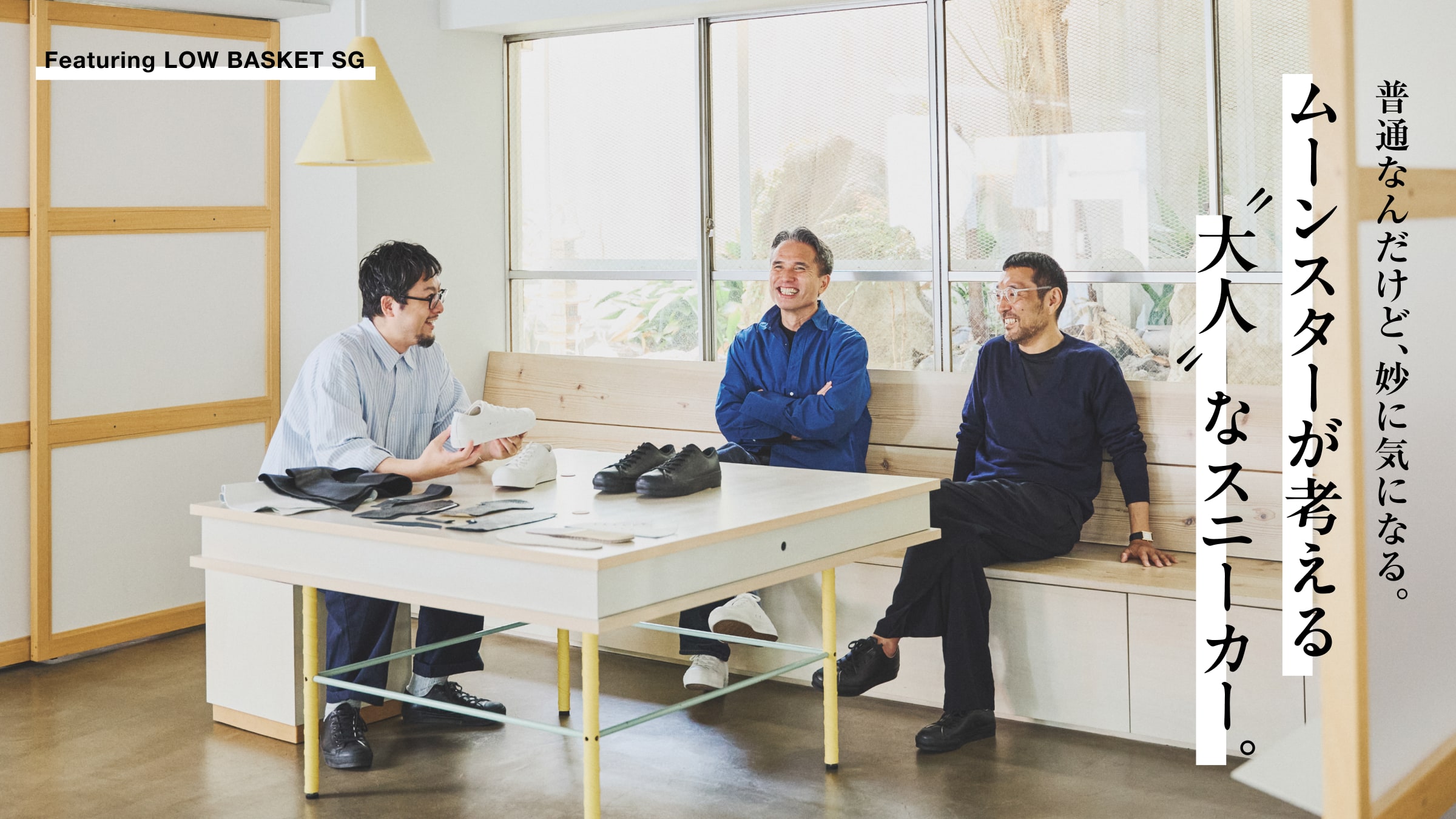
I want to prioritize the wearer’s feelings over efficiency.
—What are your impressions of *Moonstar*?

Ebe: It really is Kurume, isn’t it? I had the chance to cover a story there when I was working at my previous editorial department. They put such incredible care into their craftsmanship, and I remember thinking it felt very Japanese.
Kaji: I guess it’s “Tsukiboshi Intersection,” after all. Back when I was in my teens and twenties, I used to meet people there without even knowing what it meant.
Ebe: That's Gaien Nishi-dori, right?
—I wonder why it came to be called “Tsukiboshi Intersection”?
Yamada: Originally, *Moonstar* had its own building there, and there was a sign on the roof. It had become something of a landmark.
Kaji: Wow! I didn't know that.
—Originally, made tabi, didn't they?
Yamada: The company was founded in Kurume City, Fukuoka Prefecture, in 1873 (Meiji 6), starting with the manufacture of zashiki tabi. In 1920, after learning about canvas shoes from the United States, we began researching and developing Japan’s first “jigatabi”—tabis with rubber soles attached. This marked the beginning of Moonstar’s vulcanization process. From there, our Kurume factory was established, and we began producing sneakers using the vulcanization process as well. Kurume is known as the “City of Rubber,” and rubber development is thriving there. That’s why even today, other shoe manufacturers have set up factories there, and tires are also produced.
—Development is really booming here, isn't it?
Yamada: Around the same time as *Moonstar*, other shoe manufacturers in Kurume also began producing jikatabi, and through healthy competition, they helped boost the rubber industry. In addition to zashiki-tabi, jikatabi were particularly useful in agriculture and coal mining, and demand for them reportedly grew nationwide, starting from Kurume.
In the modern era, various companies began producing sneakers using the vulcanization process, but quality control proved difficult, and currently, only about three or four domestic factories—including Moonstar—are still in operation.
—What makes Japanese-made sneakers so great?
Yamada: The vulcanization process involves applying a mixture of sulfur, natural rubber, and synthetic rubber—known as raw rubber—to the upper using rubber adhesive, placing it in a special oven, and inducing a chemical reaction through the application of heat and pressure to transform it into elastic rubber.
When it comes specifically to Moonstar’s vulcanization process, we have nearly 100 years of history, so we’ve accumulated a wealth of expertise. For example, the part in the heel known as the “counter” is typically made of a hard material, such as plastic, but that often leads to it cracking. However, we’ve developed a soft rubber that enhances its resilience.
Then there’s the cushioning. We use foamed rubber here as well, so it doesn’t lose its shape even after wearing them for days, and it’s resistant to hydrolysis.
Ebe: It's just a small thing, but it makes a huge difference, doesn't it?
Natural rubber, which is the raw material for rubber. It is processed and used in various parts of shoes.
Yamada: That's right. conducts research and development on rubber compounds from the user's perspective. I think that's where the difference lies. For example, by using highly abrasion-resistant rubber for the outsole, they've made their shoes designed to last a long time.
—So you adjust the ingredient ratios and use different blends depending on the specific application, right? Are there any particular characteristics shared by the artisans at the factory who handle these products?
What Mr. Yamada is holding is raw rubber foxing tape. He applies this to the side of the shoe by hand. Because it’s unstable, it requires a delicate touch.
Yamada: At Moonstar, we refer to this process—in which craftsmen apply sheets of raw rubber to the upper one by one before vulcanization—as the “hand-layering method.” Raw rubber is a very unstable and delicate material; much like chewing gum, once it stretches, it loses its shape. Hidden stains and scratches appear irregularly, often imperceptible at first glance. Therefore, the artisan’s skill and experience are crucial for applying the rubber with just the right amount of pressure while carefully checking key areas. In fact, even if I were to perform the same task myself, I wouldn’t be able to spot every scratch or achieve a finish where the left and right sides look exactly the same.
Kaji: So that difficult task is being handled by the craftsmen, isn't it?
Yamada: That’s right. It’s not just the application process—we also take the time to carefully cut out each part one by one in the preliminary stages. It requires a variety of delicate tasks, all of which are performed at our factory. I think that kind of manual work is what ensures our quality.
Ebe: In the standard vulcanization process, don't they go that far?
Yamada: Many processes are mechanized these days. For example, when it comes to attaching the upper to the last, machines are likely the norm for products manufactured overseas. But at *Moonstar*, we stick to traditional methods and do the work by hand. This makes it easier to control the fit. That said, many factories are turning to mechanization in pursuit of cost efficiency and speed.
The cut-out pieces are carefully sewn together. Craftsmanship is essential to creating three-dimensional shoes that fit the human foot. The assembled parts are then mounted on a last, and the sole and foxing tape are attached.
—There are certainly things that get lost in the process of mechanization, aren't there?
Yamada: That's right. But we want to prioritize the wearer's comfort over efficiency.
Ebe: That sincerity—or perhaps naivety—really resonates with the values that are considered virtues in Japan.
Yamada: Of course, not everything is done by hand; for the parts where using machines improves quality, we rely on them. Even today, the slogan “Let’s make products with the wearer in mind” is displayed in the factory, and that spirit continues to be passed down through the generations.