Italy is more open-minded when it comes to fashion.
For many years, I never managed to visit Italy because the timing just never worked out. But when I was appointed as the Japanese concept developer for *Felisi* last year, I ended up visiting for the first time in about 25 years. And that was the spark that set me on a path to getting deeper and deeper into the world of Italian fashion.

—How was your trip to Italy after so long?
Kaneko:First, I visited Ferrara—the city where *Ferragamo* was founded—last October. I’ve been using this brand’s products since my twenties, and since it was founded in 1973—the same year I was born—I feel like there’s something fateful about it, which really boosted my motivation. As a result, I gained a deeper understanding of the brand, and it sparked new ideas for product design.
—So this time you’re visiting as a concept developer rather than a buyer, right? I imagine that makes a difference in how you feel about it.
Kaneko:It was nice to be able to take our time exploring the town. But I guess I still have a bit of a buyer’s instinct left in me—I kept looking for things to buy, but I couldn’t find anything at all (laughs). The only thing I found was a really old-established lingerie shop, where I bought some underwear and pajamas.
—And this January, you’ll be participating in “Pitti” as a member of , right?
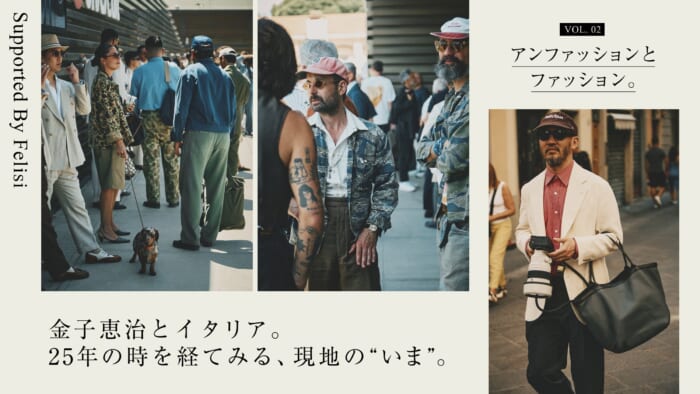
Kaneko:Once it was decided that I’d be participating in “Pitti,” I found myself getting really fired up for some reason. I just really wanted to take photos of people at the venue, and since I was going to be there myself, I knew I had to pay close attention to my own fashion as well. So I thought through all kinds of scenarios and made sure to prepare thoroughly.
—But you mentioned earlier that it’s “the polar opposite” of the glamorous atmosphere at “Pitti.” How did you bridge that gap?
Kaneko:First of all, my visit to Ferrara served as a great foundation, and the fact that I started taking my own photos was a major factor. “Pitti” is where lots of stylish people gather, right? I was really motivated to capture those people in my own way.
—As a buyer, your job is to find products, but in this case, you’re not only the concept developer for *Ferragamo* in Japan but also bringing your perspective as a fashion director to the table, right?
Kaneko:I really felt like I was free from the pressure of buying clothes. Since that pressure was gone, I just thought, “I’m going to take as many photos as I can of styles I think look cool.” I didn’t want to miss any photo opportunities, so I even practiced my shooting techniques on location beforehand (laughs).
I also felt like enjoying fashion again for the first time in a while. “Pitti” has its own unique dress code, and I really enjoyed the process of adjusting my look to fit the occasion. I decided to change my outfit every day and brought along a variety of bags. I was still mulling over the details right up until the moment I left.
—The more I simulated it, the more fired up I got (laughs).
25/44/LD+A ¥165,000
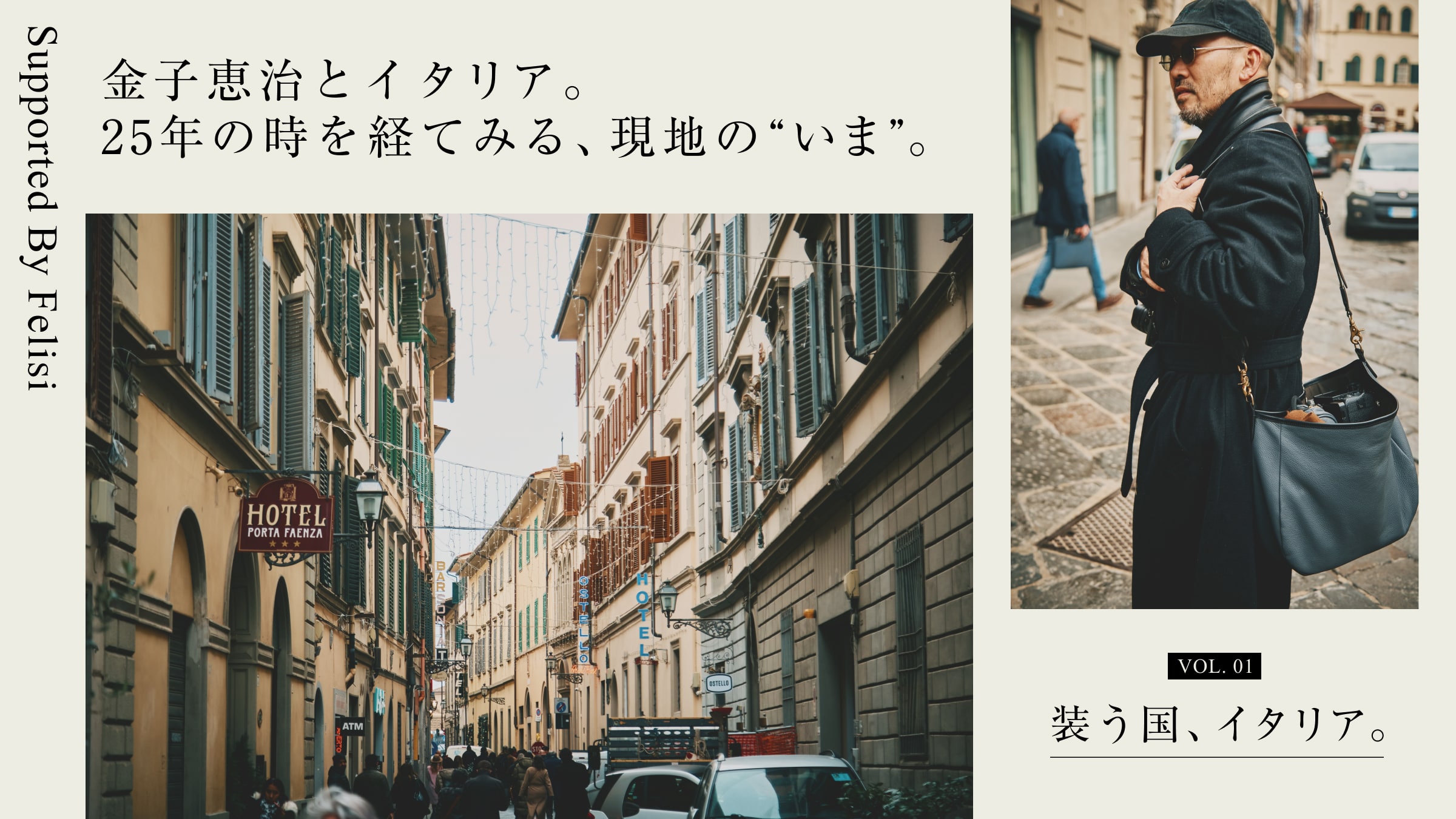
Kaneko:During the shoot, I really relied on a bag from Ferragamo’s special “Ferrarage” series. It had just the right depth and was perfect for storing the camera and lenses I use. Since it doesn’t have a flap, I could quickly pull out my camera and lenses. That made taking photos a smooth process—it was completely stress-free.
—The design is lovely, too.
Kaneko:That’s right. I’m probably the only one using it as a camera bag, but it doesn’t look out of place at the “Pitti” venue, and I think it’s a product suitable for adults. You can wear it over one shoulder or carry it crossbody. As long as you keep your arms close to your body, the opening closes naturally, so pickpockets can’t reach inside.
10/30/2/LD+DS ¥188,100
Kaneko:When I had a little more to carry, the Ferragamo 2-way shoulder bag also came in handy. It’s a soft, embossed leather bag, but since it has a generous gusset, it was easy to store my camera and lenses in it as well.
—I feel that using a product designed for fashion as a camera bag is very typical of Kaneko.
Kaneko:The leather quality at is excellent, and since it’s textured leather, even if it gets scratched, the marks aren’t noticeable, so I don’t worry about it. Another great thing is that it gives me peace of mind, even when I’m carrying heavy items like a camera and lenses. All the brass hardware is made in Italy, so the craftsmanship is top-notch. It’s perfect for use here while traveling, of course, but it’s also incredibly well-suited for when I’m in Tokyo.
—It sounds like you must have discovered a lot of things while taking all those photos.
Kaneko:That’s right. Italy seems to have a more open attitude toward fashion. It’s not like you have to be shy about dressing up—looking stylish is just the norm there. I actually went to “Pitti” in June, so I plan to talk more about that in future installments of this series.