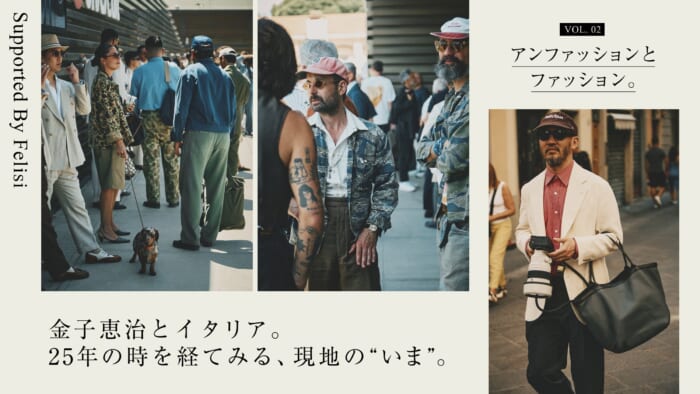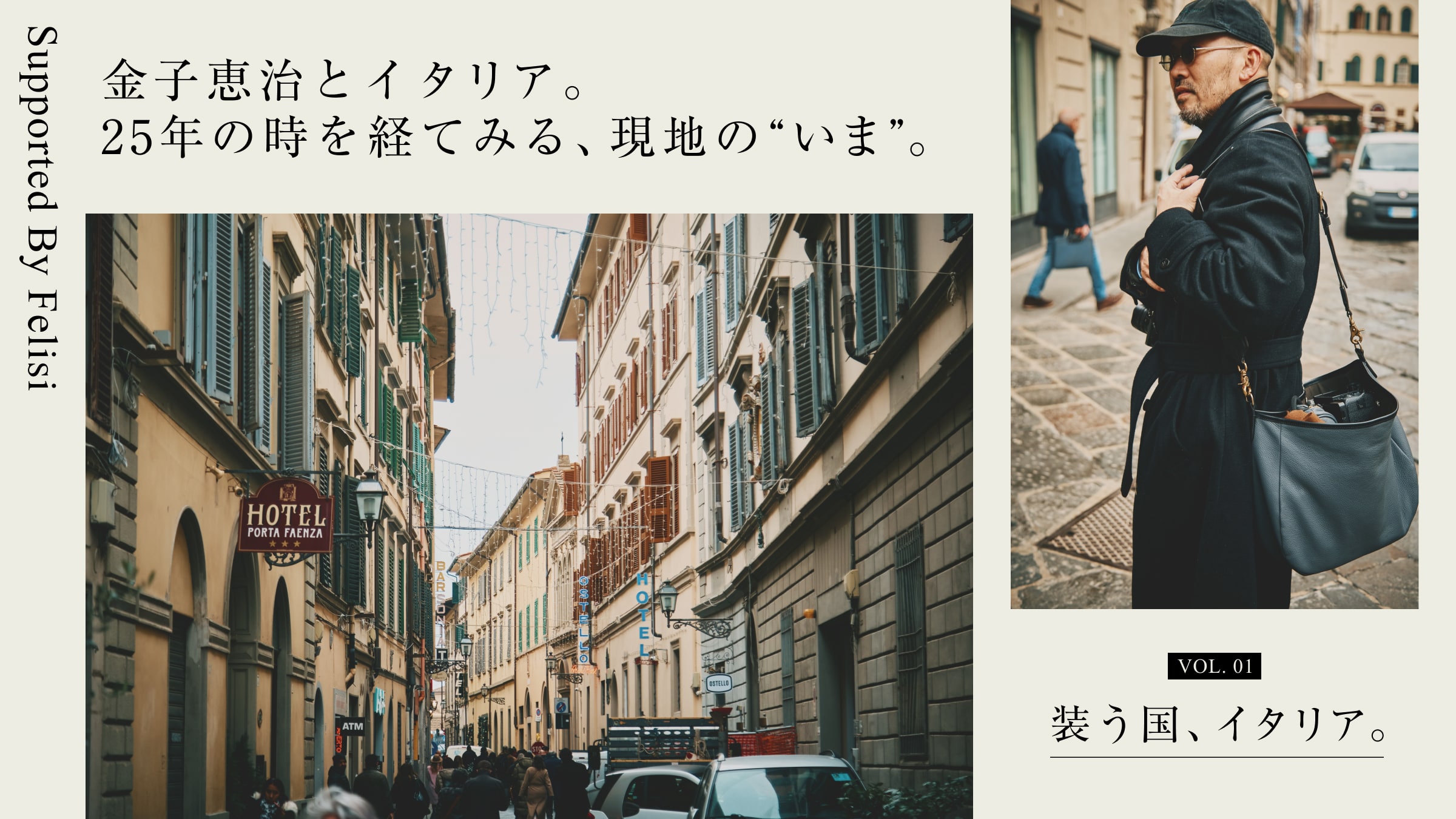
A deep-rooted commitment to and culture of personal style has been passed down through the generations.
Kaneko said she experienced firsthand the differences between Japanese and Italian culture. She added that this was true not only at the “Pitti” venue but “even on the streets of Florence.” She noted that the way people dressed and the food culture—things she had always taken for granted—were “completely different.”

—How was the authentic Italian cuisine?
Kaneko:I realized just how much the Italian food served in Japan is a carefully crafted flavor. I don’t mean that in a negative way at all; I think it simply means that Japanese Italian chefs have been striving to create flavors that suit Japanese palates. Authentic Italian cuisine is much more unadorned—or rather, incredibly simple.
—I’ve heard that while Japan focuses on making dashi and using a wide variety of ingredients to create complex flavors, Italian cuisine is very simple and uses cooking methods that bring out the natural umami of the ingredients. In a sense, it’s like taking things away—or rather, I’ve heard that this approach reflects a strong commitment to the quality of the ingredients.
Kaneko:That really is how it is. The steak is seasoned very simply—it’s almost like eating it with just salt. I guess it’s just a different way of enjoying it. At first, I didn’t know that, so it felt a little lacking.
—Are the dishes mostly the kinds of things we’d expect, like pizza and pasta?
Kaneko:That’s right. There isn’t really anything special about it—but when I think back on it, I suppose it’s really just the sensation of eating the food itself. I got the impression that the locals drink alcohol to enhance the flavor of their meals. That’s why they have no qualms about drinking even at lunch.
—What's the atmosphere like at the restaurant?
Kaneko:It was really casual. There wasn't a stuffy atmosphere at all, and everyone seemed to be enjoying their meal. Everyone was dressed just like they normally would. Still, they all really knew how to put an outfit together.
—It’s easy enough to picture the atmosphere of cities like London and Paris, but what’s the vibe like in Florence—especially when it comes to the style of people on the street?
Kaneko:I didn't really feel the influence of fast fashion there. I think that's because it's a country that knows how to make clothes. Just as the French don't drink coffee at chain cafes, I get the impression that Italians wear well-made clothes.
—It’s more like the foundation for dressing is solid, so to speak.
Kaneko:Their standards for fashion really are high, aren’t they? Whether it’s how they choose their clothes or how they wear them. Looking back, I don’t recall seeing a single person dressed oddly. I think that’s proof that a culture—or rather, a deep commitment—to personal style has been passed down through the generations.
Kaneko:The lingerie shop I found in Ferrara is also a family-run business that’s been around for 150 years. I think the fact that places like that still exist shows that people really care about what they wear.
—Are there still a lot of small businesses like that?
Kaneko:I wonder. There were lots of small shops in Florence, too, but I couldn’t figure out how many of them managed to stay in business. I suppose they must have customers who’ve been buying from them for generations.