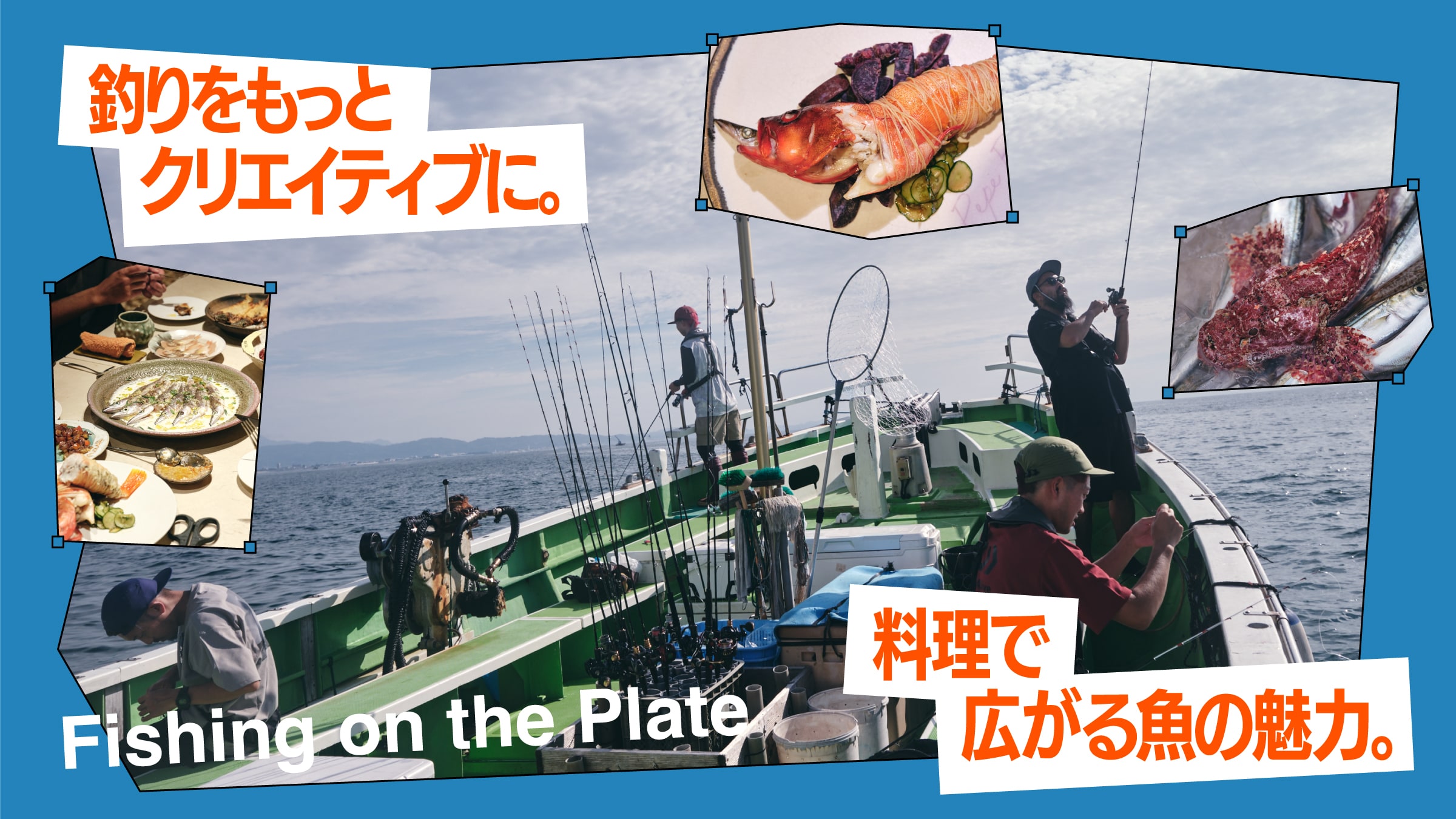
Depicting fishing on a single plate.
And at “Pepelosso,” they prepared three dishes featuring mackerel, a fish I wasn’t very familiar with.

The first dish is “Marinade.” The skin is seared over charcoal and topped with a sauce made from milk blended with grated Parmigiano and raw almonds. Inspired by the school of sardines I saw today, the chef also uses sardine fish sauce in this dish. To finish, it’s garnished with mint and tarragon, with a touch of horseradish for an extra kick.
Imai:The combination of fish, milk, and cheese is a classic dish from northern Italy. I thought that since barracuda might feed on small sardines, I decided to use fish sauce. Today, I caught seven barracuda using a seven-hook sabiki rig, so I’ve arranged all seven on a single plate.
These are fried in a special batter made from fermented bread and lightly seared over a charcoal fire. We’ve added a rich sweetness and depth of flavor using mosto cotto, an Italian seasoning made by reducing the juice from wine grapes.
Imai:"Fritto" originated in Italy. After frying, the food is seared over charcoal to remove excess oil and infuse it with the aroma of the charcoal fire.
The third dish features salt-grilled barracuda stuffed into the belly of a red seabass, then baked in the oven. Seasoned with nothing but salt, it allows you to savor the umami of both fish. It’s an innovative dish created with a very free-spirited approach. The salt-grilled barracuda was prepared using our original “sandwich-grilling” technique, in which the fish is seared from both sides over charcoal. Incidentally, the charcoal we use is Kishu Bincho-tan, which is extremely rare.
Imai:We’ve been working on something called “fishing technique recreation” lately. It involves recreating on a plate exactly how a particular fish was caught. Today, I caught a red grouper using the “otoshikomi” method with a live barracuda as bait, so I recreated that catch in a dish. I could have stuffed it with vegetables, but for now, I’m keeping it simple and just using the barracuda.
It wasn’t just the fish used as ingredients—the entire day’s catch was turned into a meal. “Pepe Rosso’s” dishes are the result of a combination of solid culinary skills and this kind of playful creativity.
Imai:Japan’s rich marine resources are something we can be proud of on the world stage, and we have a long history of enjoying fish dishes. Cooking fish that you’ve caught yourself allows you to experience that culture on a deeper level. Personally, I enjoy coming up with new cooking methods that blend Japanese and Western styles, as well as incorporating techniques that no one else has tried before. I think one of the charms of cooking is the freedom to bring out the natural flavors of ingredients.
Mihara:Even if you think a fish tastes a certain way, the one you actually catch might have a different flavor, so it’s fun to try cooking it in various ways. I read online that raw barracuda is high in moisture and has a mild flavor, but when I tried it, it was different from what I expected—it had a sweet flavor and was delicious.
Akutsu:If I had to pick just one dish from this meal, my favorite would be the “fritter” made with barracuda. Even though it was deep-fried, it had a distinct charcoal-grilled aroma, and I could really taste the rich umami of the barracuda. I’d always thought of barracuda as something served salt-grilled or dried, so this was my first time eating it fresh—and it was even more delicious than I imagined, completely changing my perception of the fish.
Hongo:The "marinated" barracuda, served with a milk-based sauce and Western-style horseradish, had a flavor I’d never tasted before. Barracuda is often associated with Japanese cuisine, but I was glad to discover that it also pairs well with Italian dishes.