In the 1990s, the term "vintage" was used to describe vintage clothing that did not meet the definition of "antique," but still had value, as opposed to "antique" clothing that was 100 years old. Nowadays, there is a movement to find new value in "new vintage," even in old clothes from the 1980s onward, which used to be called "regular" vintage clothes. In this project, four vintage clothing stores with different styles propose new ways to enjoy vintage clothing. Each of them will talk about the charm of vintage clothing with their own sense of style.
The 16th season has arrived with all the stores newly replaced! For our 123rd edition, we are joined by YUTA of FiLo__Store, a sister store of the popular "Mr. Chubby" in the fierce battleground of vintage clothing in Koenji. What new vintage items will he introduce this time?
Text_Tommy
Edit_Yosuke Ishii
YUTA / Owner, FiLo__Store
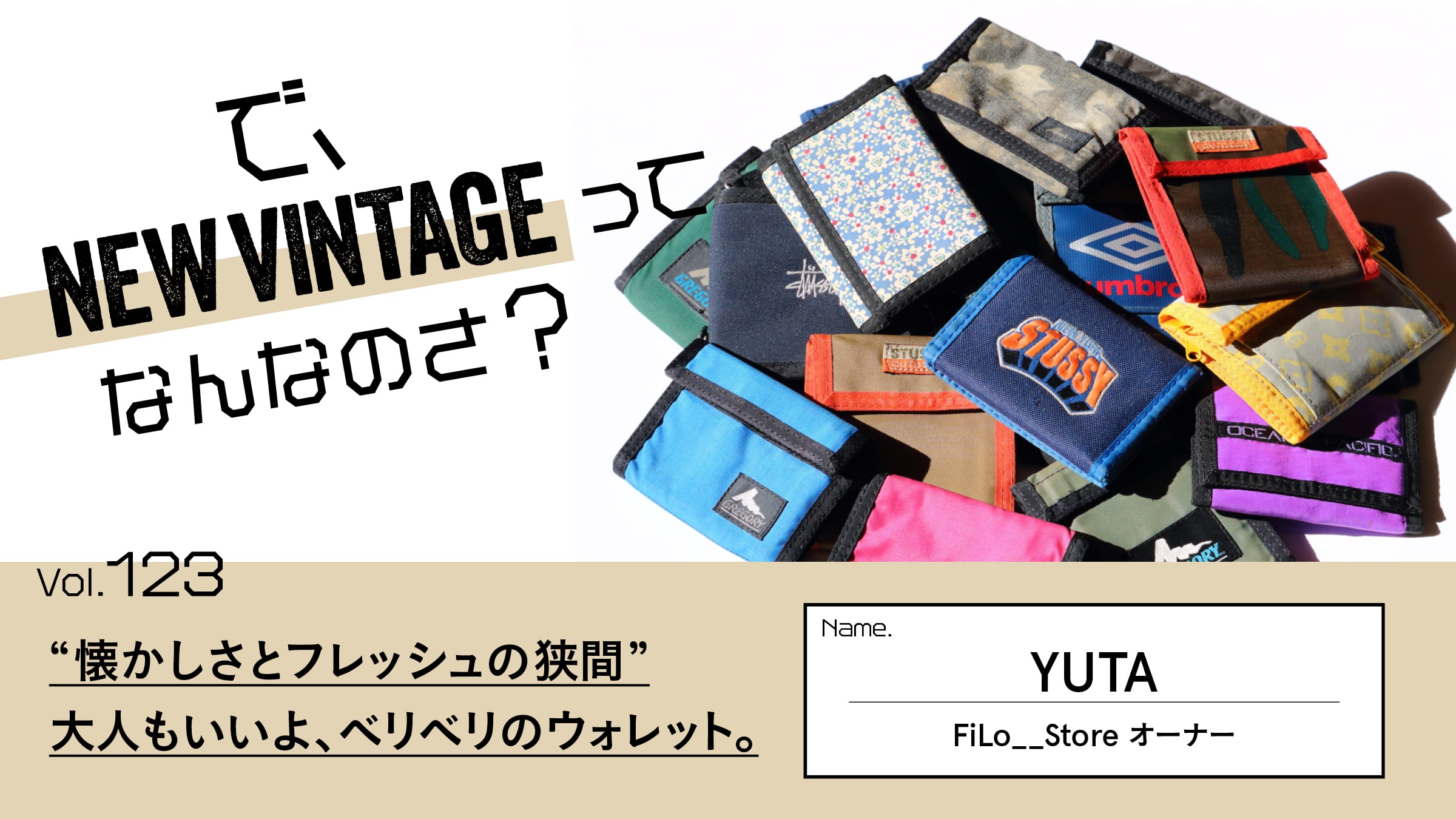
Vol.123_Various Wallets
When you appeared as "Mr. Chubby" in Season 13, I asked you "What is New Vintage? Is the basic concept the same at "filo Store"?
Yes, we do. At that time, I told them that I would sell items that are likely to skyrocket in price via social networking sites at a reasonable price before that happens, and that the value would increase after the item is in the hands of the customer. I told you that I think items that can do this can be considered new vintage, and this attitude is no different at this store.
Mr. Chubby" and "Philostore" have different concepts, don't they?
The atmosphere here is more relaxed, so that customers can talk with each other and select items at their leisure, but the basic selection of items is almost the same. The items introduced here are also in the same vein as those sold at "Mr. Chubby's.
So, we have prepared a variety of wallets of different brands.
(Laughs). I collected a variety of different brands with a lot of variety. In general, I thought it was interesting. In the store, we put them all together in one place, but customers also pick them up with a "What's this? and they pick them up and say, "What's this? I thought it was an item that would allow me to experience the "I've never seen this before, but it looks interesting" feeling that only secondhand clothing can provide.
I think it's an encounter with an item that stimulates interest or intellectual curiosity, isn't it?
That's it. It's also a communication tool with customers. Let's take a look at the items in order. First, let's start with "STUSSY," which has a strong following among all ages and genders, from the younger generation to the backwoods generation, as the royal road to street fashion.

Top row: Stussy's wallet ¥8,800, middle row: Stussy's wallet ¥8,800, bottom row: Stussy's wallet ¥11,000 (all)philostore)
There is a great variety of items, many of which have never been seen before, which is unique to Coco. Considering that a hat made from the same fabric was also released, the monogram pattern here is probably a "I might have some leftover fabric, so I might as well make it" kind of thing. Compared to clothing, small items are much harder to find, so it is fun to dig for them.
The camouflage pattern is from the "STUSSY OUTDOOR" line that gained popularity in the 90s. The combination of this woodland camouflage and orange is a perfect match for the atmosphere of the time. This navy color with embroidered logo has a gusset and round zipper, just like an 8cm CD case back then. Putting aside the ease of use, the appearance that reminds us of the times may be nostalgic for people in their thirties and older, and fresh for the younger generation.
From the 90's to the 00's, every brand released wallets, right?
Yes, there are. In addition to the products that brands used to sell inline, there may be products that were produced under license, and it is thought that a truly enormous number of products are still lying dormant in the market. Next are some interesting items. The first one that catches the eye is "blind," a skate brand founded by Mark Gonzalez. It is a so-called "biker wallet" with a wallet chain attached, but the material is nylon. The logo designed by Gonz is a real eye-catcher. If you are looking for something unexpected, Umbro is also a good choice. The surface is coated with a waterproof material, making it tough to use, and in recent years, Umbro has been collaborating with skate brands, so you may want to try this one in connection with skate!
Upper left: Elle Bean wallet ¥6,600, upper right: Blind wallet ¥5,500, lower left: Wild Wallets ¥8,800, lower right: Umbro wallet ¥5,500 (all)philostore)
Next is L.L.BEEN. It has many card slots and is designed to be large enough to hold tickets and other items, so it is more of a travel wallet. The "FREE STYLE" on the inside tag seems to be that of the manufacturer's OEM company.
An interesting example is the floral-patterned "WILD WALLETS," which can only be found in secondhand clothing. This brand is still made in China, but this is from the "Made in USA" period. These are made from scraps of fabric used for Vans shoes.
I miss this! I remember seeing them in front of the cash registers of sneaker stores and American casual select stores in the 90's.
Overland Equipment, introduced in the previous "Mr. Chubby" installment, also made many wallets and pouches, but the king of outdoor bags, Gregory, took the world by storm in the 1990s and became a major staple in the outdoor bag market. GREGORY, the king of outdoor bags, took the world by storm in the 1990s and has become a major standard for outdoor bags.
Upper left: Gregory's wallet ¥8,800, upper right: Gregory's wallet ¥11,000, lower right: Gregory's wallet ¥8,800 (all)philostore)
Like the "Wild Wollets" mentioned earlier, these bags are also made of the same fabric as the bags, so I think it would be fun to have them as a set. Or rather, since there are so many colors to choose from, it is fun to find a color or pattern you have never seen before.
It is also important to note that it is easy to tell when these items were made by the tags that have changed. The green tag is commonly known as the "blue letter tag" and dates back to 1993-1996. By the way, the camouflage pattern is a silver tag and dates from 1997 to 2015. The other tag is not so common, but I think it might be from the mid 90's.
A long time ago, wallets with hook-and-loop fasteners, or "Velcro," were considered a no-no, but times have changed, haven't they?
That's right. After the Corona Disaster, compact wallets became popular as cashless transactions progressed, didn't they? I feel the tide has turned since then. Some people seem to be using mini wallets from 100 yen stores.
The point is that the compactness and design of the product is more like an accessory than functionality in terms of storage capacity, and it can be used to express one's individuality. Each one has its own differences, and the price is not that different from buying a new one. So, it's a good idea.
No matter how expensive they are, they cost around 10,000 yen. Personally, I like outdoor brand things, so I buy them as I find them, but skate brands are also interesting. I like skate brands, but skate brands are interesting, too. Stussy established a line of accessories like this in the 90s and 00s, but you don't see many of Supreme's early stuff, and there are very few types, so it might be a good idea to dig around in those brands.
It's a standard item for street brands, but Supreme doesn't have much of an image, and it makes a bit of a difference.
It's not this sophisticated, but a little more cheaply made like a skate brand's accessories, or a coin wallet like a pouch. As with the items introduced here, I think you can find a lot of them if you ask your seniors or siblings or look around. They are easy to collect, and even if you collect a lot of them, they don't get in the way, and they make a nice interior decoration just by being left on the shelf. Above all, you can have as many wallets as you want.
YUTA / Owner, FiLo__Store
While running "Mr. Chubby" with his partner Kazuma in Koenji, known as a fierce battleground for vintage clothing, they opened a sister store, FiLo__Store, in April 2025. The items purchased mainly from the U.S. and Europe are vintage and regular "used clothes" as well as domestic and maison brands, both new and old, and are all good items that their antennae have caught.
Instagram:@filo__store