In the 1990s, the term "vintage" was used to describe vintage clothing that did not meet the definition of "antique," but still had value, as opposed to "antique" clothing that was 100 years old. Nowadays, there is a movement to find new value in "new vintage," even in old clothes from the 1980s onward, which used to be called "regular" vintage clothes. In this project, four vintage clothing stores with different styles propose new ways to enjoy vintage clothing. Each of them will talk about the charm of vintage clothing with their own sense of style.
Before we knew it, this series has reached its 18th season! For the 137th installment—the first in a series featuring an entirely new lineup of shops—we’re visiting “197,” a hidden gem located between Sangenjaya Station and Komazawa-Daigaku Station on the Den-en-toshi Line. What kind of new vintage finds will the owner, Mr. Mochizuki, introduce to us!?
Text_Tommy
Edit_Yosuke Ishii
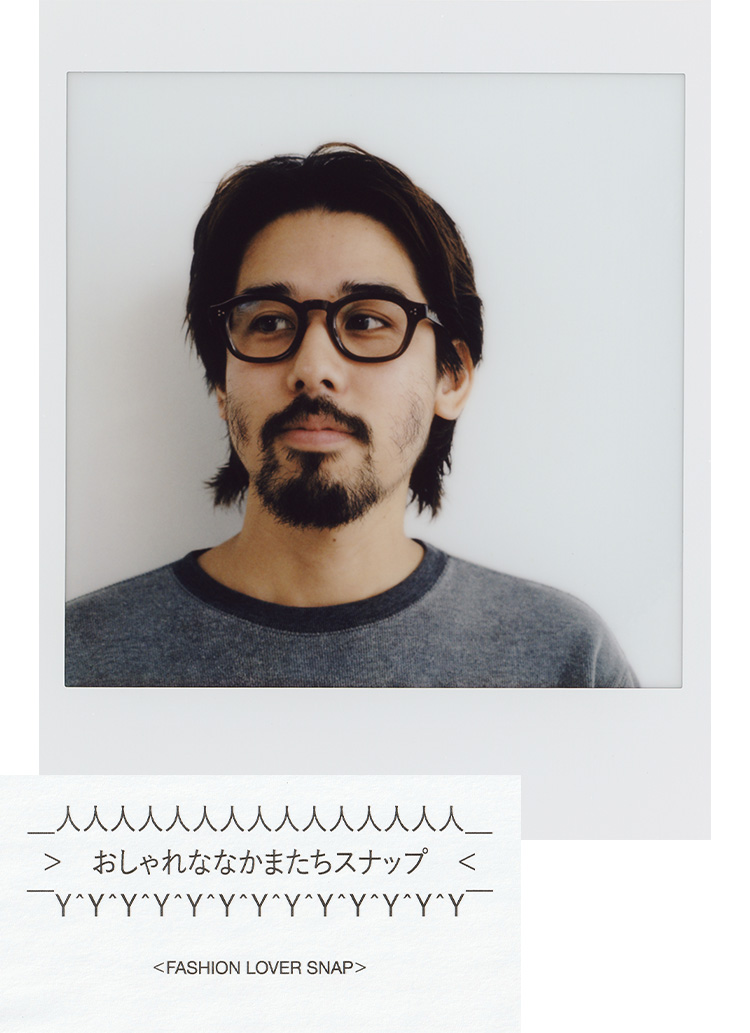
Kota Mochizuki / 197 Owner
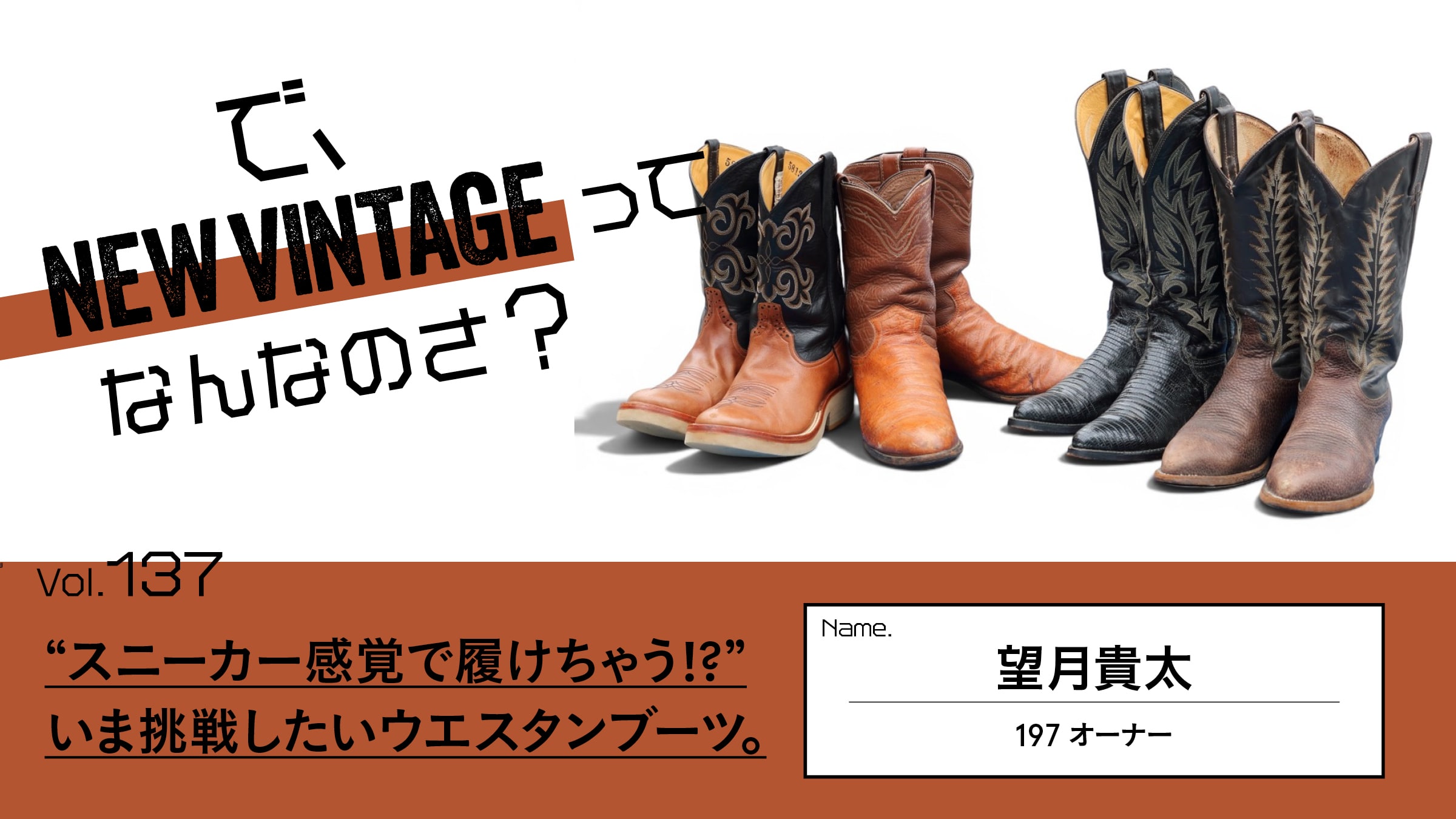
Vol. 137: Modern Western Boots
—The theme of this series is “finding good staples now that will stand the test of time, just like true vintage pieces.” So, what kind of shop is “197” anyway?
The store I used to work at, “Fridge,” also sold vintage clothing, but when I decided to strike out on my own and open my own vintage shop, I wanted to focus on items centered around the hippie culture and Western styles of the 1960s and ’70s—which I’d always loved—so I launched “197.”
—At New Vintage, one of our basic definitions is “items from the 1980s onward.” In that regard, would this fit the genre?
In Japan, “Western” and “70’s” tend to be seen as trendy keywords that come and go, but in the U.S., Western-style items have a dedicated and loyal following among a certain demographic, making them a true classic that never goes out of style. As a result, items from recent years are, of course, also available on the vintage market. With that in mind, I’d like to focus this time on “Western boots as ”new vintage.’”

—I’d love to jump right in! But before we do, what is Mr. Mochizuki’s definition of “New Vintage”?
To put it in a cool way, I suppose they’re “things that remain timeless classics while constantly evolving with the times.” Take Western boots, the theme of this article: while some remain true to their authentic, American-made roots, others have evolved in design to suit the times. In both cases, the functionality originally intended for horseback riding has been embraced as a fashion statement, and the way they’re incorporated into style has changed with the times. I think it’s items like these that will endure as “New Vintage.”
—I see. Speaking of Western boots, back in the ’90s and ’00s, you’d often see hardcore American casual style enthusiasts wearing *Tony Lama* around Shibuya. Which brands are well-known in that category?
In addition to *Tony Lama*, which was just mentioned, *Justin* is also a classic choice. It’s well-known in Japan, too. If you’re looking for high quality, you can’t go wrong with *RIOS of MERCEDES* or *Lucchese*. There are also numerous other long-established brands and lesser-known manufacturers favored by cowboys. So, to start, please take a look at “Tony Lama” and “Justin.”
Tony Lama Western Boots ¥ 27,500(197)
Justin Western Boots ¥25,300(197)
—This area really has that “Western boots” vibe, doesn’t it?
Speaking of details, a toe that tapers toward the tip is more classic. The purpose of this is to allow the rider to quickly slip their toes into the stirrups when the horse is moving, and the slanted cut at the back of the heel is also designed to make it easier to hook the foot into the stirrup. It is this functional beauty that truly defines the appeal of Western boots.
—It seems the shaft height varies depending on the model, though.
Since they’re designed to protect against rocks, plant thorns, snakes, and the like—as well as prevent bruises and chafing on the legs and ankles—the higher the shaft rises toward the knee, the sturdier the boot becomes. That’s why the basic rule is to let the pant legs cover the top of the boots rather than tucking them inside. The top of the shaft is designed to be slightly loose so that you can quickly remove the boots if you get caught in a trap. Additionally, the stitching on the toe and shaft serves both as decoration and reinforcement for the upper.
—This stitching really brings out the Western vibe.
It really has that "Western" feel, doesn't it? While there are many similar designs for the toe stitching, the designs on the shaft vary widely. Classic motifs include leaf patterns, butterfly designs, and those modeled after the Thunderbird from Native American legends, which are also very popular.
—Are there different kinds of materials?
Western boots are broadly categorized into “work” and “dress” styles. The former typically uses sturdy calfskin or horsehide as the base material. The boots mentioned earlier fall into this category. The other pair, , is a dress-style boot. These often feature so-called “exotic leathers,” such as snake, crocodile, lizard, stingray, and elephant. By the way, just because they’re dress-style doesn’t mean they aren’t durable—with proper care, they’ll last a long time, so which one you choose really comes down to personal preference.
—What about this one?
Justin's Western Boots ¥24,200(197)
The brand is “Justin,” and while it leans more toward workwear, the use of ostrich leather on the upper gives it a slightly dressier feel. This leather is incredibly light and soft; not only is it said to be several times more durable than cowhide, but it also develops a natural luster and depth the more you wear it.
—When choosing Western boots as a “new vintage” style, what should I look for?
This is purely my personal opinion, but if you want to enjoy the authentic look of Western boots, I recommend dress-style boots made with exotic leather and featuring bold designs. However, if you’re looking to enjoy them as “new vintage” styles today, the “versatility as a fashion item” of work-style boots is also important. Many of our customers start by buying work-style boots in classic colors like black or brown, and then try dress-style boots for their second or third pair.
—When it comes to ease of wearing, heel height also seems to be a key factor.
That’s true. If you’re concerned about heel height, I think it’s better to choose a “Peco” style—which is derived from Western boots—rather than a classic Western boot. Among these, roper boots with flat crepe soles are especially recommended for those new to Western boots. The shaft is slightly shorter, and the rounded toe is similar in shape to a plain-toe boot. Designed for cowboys who dismount to work on the ground, this style prioritizes mobility and ease of walking.
Rios of Mercedes Roper Boots ¥88,000(197)
—So these count as Western boots, too, huh?
That’s right. What’s more, this pair features decorative stitching on the upper, which not only makes them easy to style but also gives them a distinct Western vibe—that’s a key point. If we’re looking at it from the hippie-inspired counterculture perspective—another key theme of the “197” collection—I’d suggest wearing them freely, perhaps even with sweatpants, rather than pairing them with boot-cut jeans like Levi’s “517.”
—That’s true. If you can incorporate it as freely as those West Coast gals did back in the Y2K era, it really opens up the range of ways to enjoy it.
Exactly. I really want people to wear them as casually as they would sneakers. They’re the kind of shoes people tend to dismiss without even trying them on—maybe because of the narrow toe box or the high heel—but they’re great for adding a casual touch to slacks or sweatpants, and I think they’re just as versatile as Converse “All-Stars.”
—By the way, what's the price…?
For men’s sizes, in this price range, they generally cost between 20,000 and 30,000 yen. Even the most expensive ones are just over 40,000 yen. Another key point is that most Western boots aren’t mass-produced, so even though they come in a wide variety of materials, silhouettes, and designs, you’re unlikely to see someone else wearing the exact same pair. In short, there’s plenty of room for choice, and you can have fun figuring out how to incorporate them into your style. In that sense, I think Western boots have become a truly “new vintage” item in recent years.
Kota Mochizuki / 197 Owner
After branching out from the popular Setagaya select shop “fridge,” the business began operating as a vintage clothing store in 2023. On April 5, 2025, it opened a brick-and-mortar store under the name “197.” The shop is located along Route 246, roughly halfway between Sangenjaya and Komazawa. It’s on the fourth floor of a mixed-use building with a hard-to-spot entrance. You’ll be greeted by a 5-and-a-half-tatami-mat space packed to the brim with items centered around hippie and Western styles. The shop is open only on weekends; weekdays are by appointment only. Check their official Instagram for opening dates!
Instagram:@197_tokyo


![[Series: 【—What Exactly Is “NEW VINTAGE”?] Vol. 142 “It’s Just So Awesome” Chico’s Design. That all-over embroidered denim jacket is just so cool, isn’t it?](https://www.houyhnhnm.jp/wp-content/uploads/2026/09/nv_142b-700x394.jpg)
![[Series 【: What Exactly Is “NEW VINTAGE”?] Vol. 141 “What’s Next After Rasler!?” What Is “Texas Stretch” from the 2000s?](https://www.houyhnhnm.jp/wp-content/uploads/2026/09/nv_141b-1-700x394.jpg)
![[Series 【: What Exactly Is “NEW VINTAGE”?] Vol. 140: Lowering the Bar by “Expanding the Subject.” Sound Clips You Can Choose Based on Mood and Graphics.](https://www.houyhnhnm.jp/wp-content/uploads/2026/08/nv_140a-700x394.jpg)
![[Series: 【—What Exactly Is “NEW VINTAGE”?] Vol. 139: Is “Instagrammability” Also a Requirement for New Vintage? Keep That in Mind for Week Closing.](https://www.houyhnhnm.jp/wp-content/uploads/2026/08/nv_139a-700x394.jpg)
![[Series 【: What the Heck Is “NEW VINTAGE”?] Vol. 138: I Don’t Think It Needs to Be Popular. Cloudvale, Which “Seems Like It Might Take Off.”](https://www.houyhnhnm.jp/wp-content/uploads/2026/07/nv_138a-1-700x394.jpg)
![[Series 【: What Exactly Is “NEW VINTAGE”?] Vol. 136: Daydreaming About Landscapes Yet to Be Seen. Get in the Travel Mood with Local-Themed T-Shirts.](https://www.houyhnhnm.jp/wp-content/uploads/2026/06/nv_136b-700x394.jpg)