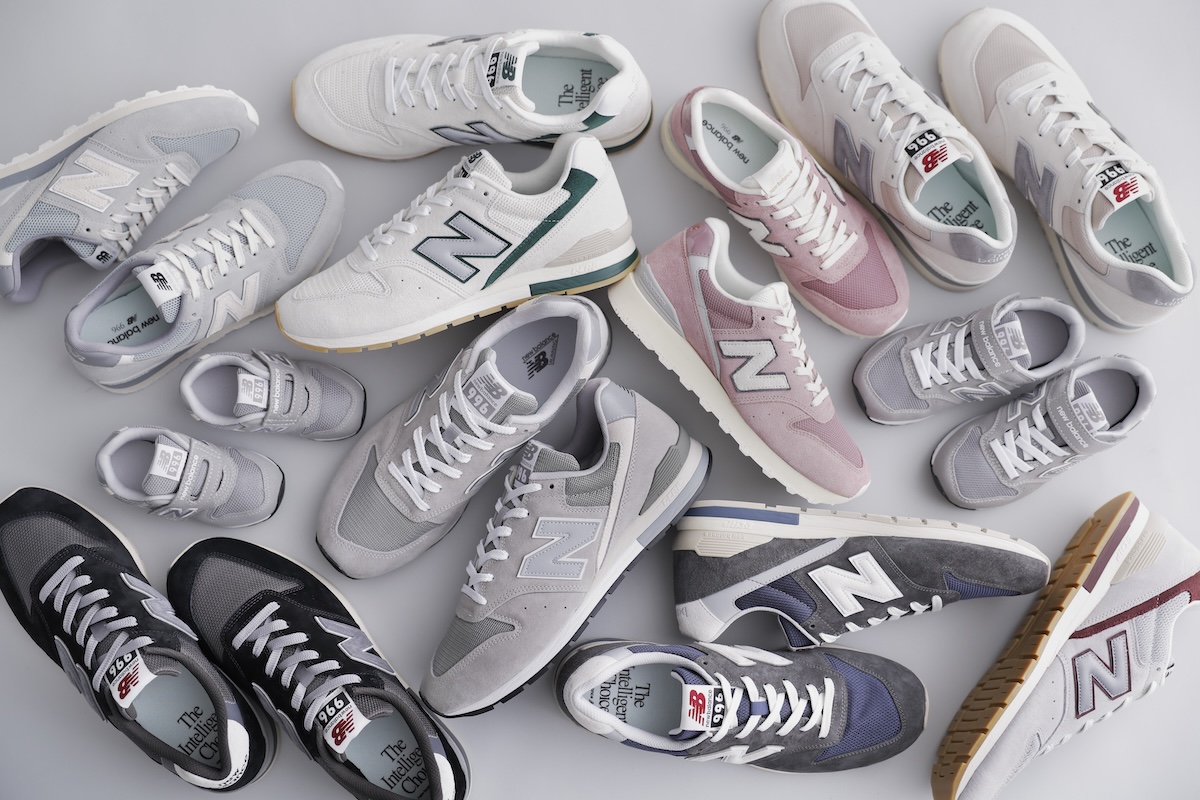
New Balance’s 900 series sneakers have garnered a large following. Among them, the “996” is a classic model that’s popular with people of all ages and genders. However, there are many different versions of the “996,” and it can be hard to tell them apart—not to mention that it might feel a bit awkward to ask about them at this point. That’s why we’ve invited Ayaka Ueda, who oversees New Balance’s lifestyle footwear planning, to give us a thorough breakdown of the “996,” from its origins to the models currently available.
- Photo_Erina Takahashi
- Text_Shogo Komatsu
- Edit_Kazuki Sakaguchi
Japan's best-selling model.
—First, I’d like to ask about the 900 series. What kind of series is it?
Ueda:This series began with the “M990,” which was introduced in 1982. It debuted as the pinnacle of on-road running shoes designed for paved surfaces and is characterized by its excellent cushioning and stability.

Ayaka Ueda, Lifestyle Footwear Planning Manager at “New Balance Japan”
—Following the “M990,” the “M995” was released in 1986. So the model after the “M990” isn’t the “M991,” is it?
Ueda:That’s right. While the series continued with the “M995,” followed by the “M996,” “M997,” and “M998,” the “M991” was released in 2001, the “M992” in 2006, and the “MR993” in 2008. The reason for this isn’t entirely clear.
—The “M996” was introduced in 1988. What kind of model is the “M996”?
Ueda:At the time, it was marketed as “Made in the U.S.A.” After numerous updates, it has now gained a following among people of all ages and genders, and has become one of the top-selling models in Japan. It is truly an indispensable part of the New Balance brand.
—How is it different from the “M995”?
Ueda:This is the outsole. From the “M990V1” through the “M995,” we used outsole materials manufactured by Vibram, but as the variety of rubber compounds increased, we stopped using them starting with the “M996.”
—By the way, what does the “M” at the beginning of the product number stand for?
Ueda:An “M” was added to indicate “Made in the U.S.A.” Currently, the “996” is manufactured in Asia and is sold under the model names “CM996V2” and “U996V2.” “CM” stands for Classic Men’s, and “U” stands for Unisex. These two models are identical in every way except for their names. Starting this year, they’ll be standardized under the “U996V2” name. By the way, women’s models have a “W” at the beginning of their names.
New Balance.CM996 GR2 ¥16,940(ABC-MART)
New Balance.U996 3LE ¥16,940(ABC-MART)
New Balance.W996T 8ZS ¥ 12,980(ABC-MART)
—By the way, what does “V2” mean?
Ueda:This is Version 2. It was updated in 2019 and became V2.
A Commitment to Comfort.
—Could you tell us again what the key features of the “996” are?
Ueda:Compared to other models in the 900 series, its slender silhouette is the standout feature. It uses the SL1 last (shoe last), which creates a sharp shape that minimizes excess material around the instep of the forefoot.
From top to bottom:U996 2YG, ,U996 3LE, ,U996 76Y, ,U996 5WP, ,U996 8U8 ¥16,940 each (all from ABC-MART)
—When you compare them, it does look sleeker. The “996” and “574” look similar—is there some connection between them?
Ueda:The “574” was originally developed as an off-road running shoe, and the “996” was created as an on-road model, carrying on that legacy. Since they’re designed for different surfaces, the shapes of their outsoles differ. The “574” has a more rugged, textured design.
—I see. They look so similar that it's hard to tell them apart at first glance.
Ueda:Also, while the “996” uses the SL1 last, the “574” uses the SL2 last, so the “574” offers a roomier fit than the “996.”
—You also brought along the original “M996” released in 1988. It really hasn’t changed much in appearance, has it?
Ueda:There are some minor differences—like the lack of a registration mark on the heel logo or the different number of bars on the “Flying NB”—that make it feel like a spot-the-difference game, but the overall design remains virtually unchanged. Also, in terms of functionality, the original uses “ENCAP,” while the current version features “C-CAP.”
—What are the functions of each one?
Ueda:One thing they have in common is that both feature technology designed to enhance stability. “ENCAP” is a sole construction in which EVA material is encased in polyurethane, offering a soft feel and excellent shock absorption. “C-CAP” is a material made from compressed EVA. It provides a firm feel underfoot and is characterized by its light weight and high durability. If you hold a “996” in your hand, you’ll see that it’s lighter than other New Balance lifestyle shoes.
—Even though the appearance hasn't changed from back then to now, the midsole has been updated.
Ueda:When the model was updated from V1 to the current “U996V2,” a two-layer structure featuring “C-CAP” and a modified midsole hardness was adopted to further enhance cushioning. The women’s version does not use “C-CAP.”
—Are there any other differences?
Ueda:Since the Women’s “996” was updated to Version 2, it has been redesigned to maintain the B width (foot circumference) while providing more room around the instep, resulting in an improved fit. The Women’s version is characterized by a slim exterior and a roomy interior. We also offer the “WL996T,” a Women’s model with a slightly thicker sole.
Why it's popular with such a wide range of people.
—In addition to men’s and women’s sizes, the “996” line also includes kids’ sizes.
Ueda:It's been very well received. I think one of the great things about the “996” is that the whole family can wear them.
Starting from the top left:W996 2SB ¥ 12,980, ,CM996 GR2 ¥16,940, ,YV996 GR3 ¥7,590, ,IZ996 GR3 ¥6,930(All from ABC-MART)
—Are the kids' shoes different in terms of comfort and functionality?
Ueda:Children's feet are very delicate, so we pay close attention to comfort. We've even heard from people who wore the "996" when they were little and started wearing them again as adults.
—It really is popular with people of all ages, isn’t it? What other aspects do you think make the “996” so appealing?
Ueda:The biggest advantage is definitely how easy they are to coordinate with any outfit. I think the authentic design goes well with just about any look. Even among the 900 series, these have a slim silhouette, so they don’t stand out too much in an outfit—whether you make the shoes the focal point or the clothes, they should blend in seamlessly. There’s also a wide range of colors to choose from, so being able to find your favorite shade is another part of the “996’s” appeal.
—How many color options do you offer?
Ueda:Combining our men's and women's lines, we release 18 to 20 new colors every six months. When you include our classic colors like gray and black, as well as GORE-TEX styles, we actually offer a wide variety of options.
—That wide range of options is another reason why the “996” is so popular.
Ueda:That’s right. If you’re thinking about trying New Balance but aren’t sure which pair to start with, I’d recommend the “996.” Models labeled “Made in the U.S.A.” or “Made in the UK” are also great, but they might feel like a bit of a stretch for your first pair. That’s why the “996” is the perfect way to get started with New Balance, and I think it’s a pair you’ll be able to wear for a very long time. It has the appeal of a timeless design that isn’t swayed by trends, and above all, it’s incredibly comfortable. That’s exactly why I think it has continued to be loved by so many people for so many years.
ABC-MART
Phone: 0120-936-610, 10:00 a.m.–5:00 p.m. (Monday–Thursday)
ABC-MART Special Feature Page “My Buddy 996”
My Buddy 996 for HOUYHNHNM
Special Site


![[【My Buddy 996] The New Balance 996: A Trusted Companion for Every Day. Soya Kaya (Comedian) from Kagaya](https://www.houyhnhnm.jp/wp-content/uploads/2026/08/26-2-700x524.jpg)
![[【My Buddy 996] The New Balance 996: A Constant Companion in Everyday Life. Yataro Matsuura (Essayist)](https://www.houyhnhnm.jp/wp-content/uploads/2026/08/26-1-700x524.jpg)